
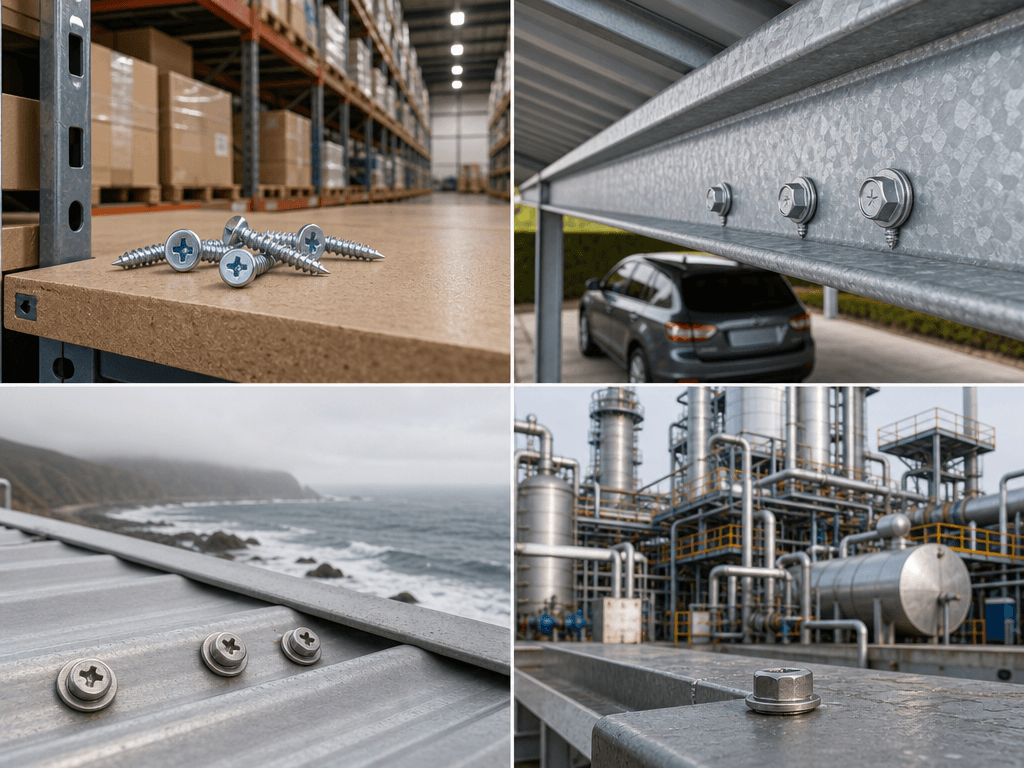
كيفية اختيار مادة التثبيت المناسبة لبيئات العمل المختلفة؟

Han Congming
الكاتبلدينا خبرة في تصنيع وبيع البراغي والمثبتات، وندير منشأة إنتاج خاصة بنا بقدرة إنتاجية مستقرة على نطاق واسع. نحن متخصصون في براغي الحفر الذاتي، وبراغي الجدران الجافة، وبراغي ألواح الخشب، والبراغي الميكانيكية، والمسامير، والمثبتات المخصصة لتطبيقات البناء والصناعة.
Fastener material selection often starts with a grade name: 304, 316, 410, HDG, or a coating brand. That is the wrong starting point.
The right question is not “Which material is best?” It is “Which material system is appropriate for this working environment, this joint, and this expected service life?”
A stainless steel screw can fail in a warm, chloride-rich crevice. A coated carbon steel screw can be a practical, long-lasting choice in a dry indoor assembly. A galvanized screw can be suitable for one outdoor project and unsuitable for another. The material name alone does not settle the decision.
This guide gives buyers, distributors, and project teams an environment-first framework for specifying self-drilling screws, self-tapping screws, and related fasteners. It covers the main material families, the environments that change the choice, galvanic corrosion, coating and washer systems, and the information to put in an RFQ.
Start with the working environment, not the material grade
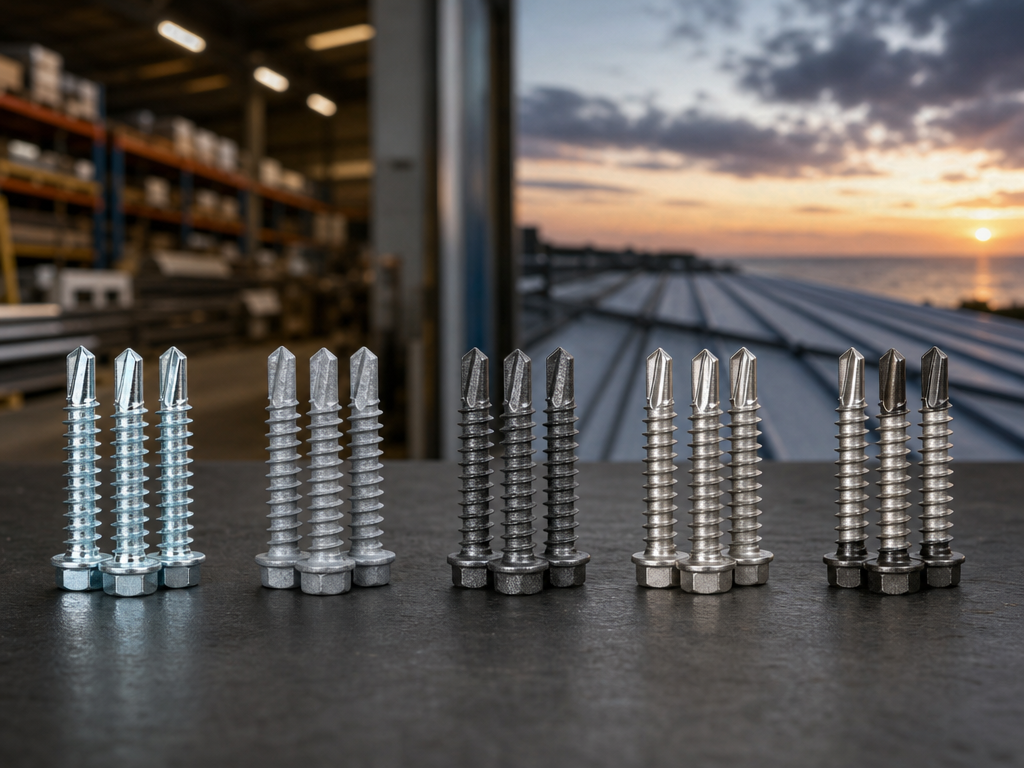
“Outdoor” is not a complete environment description. A dry inland warehouse, a sheltered carport, a coastal roof, a chemical plant, and an agricultural building can all be described as outdoor or semi-outdoor, but they expose a fastener to very different conditions.
Define the operating envelope before comparing materials:
- Location and exposure. Is the fastener indoors, sheltered, directly exposed to weather, splashed, washed down, or permanently wet?
- Moisture and chlorides. Is the moisture fresh water, sea air, salt spray, pool water, or a cleaning chemical? Does water remain around the washer, lap, or connection?
- Airborne pollutants. Is the site near the coast, heavy industry, traffic, agriculture, or a chemical process?
- Temperature and cycling. Will the fastener see high heat, freezing, repeated wet-dry cycles, or thermal movement?
- Substrate and contact metals. What is the screw drilling into, and what other metals will touch it?
- Expected service life and maintenance. Is the connection inspectable and cleanable, or is it sealed behind a finished façade?
The micro-environment matters as much as the climate. Water trapped under a washer, between lapped sheets, inside an open profile, or in a poorly drained connection can create a more aggressive condition than the general atmosphere suggests. A material with good atmospheric corrosion resistance can still suffer crevice corrosion when chlorides and moisture remain in contact with the surface.
For that reason, material selection should begin with a short project description, not a catalog page. Write down the location, the substrate, the exposure, the expected life, and the other materials in the joint. Those five items will eliminate many unsuitable options before price is discussed.
Compare the material families buyers actually use
Most B2B fastener decisions fall into a small number of material families. Each has a different balance of corrosion resistance, strength, drilling performance, appearance, and cost.
Carbon steel with zinc plating
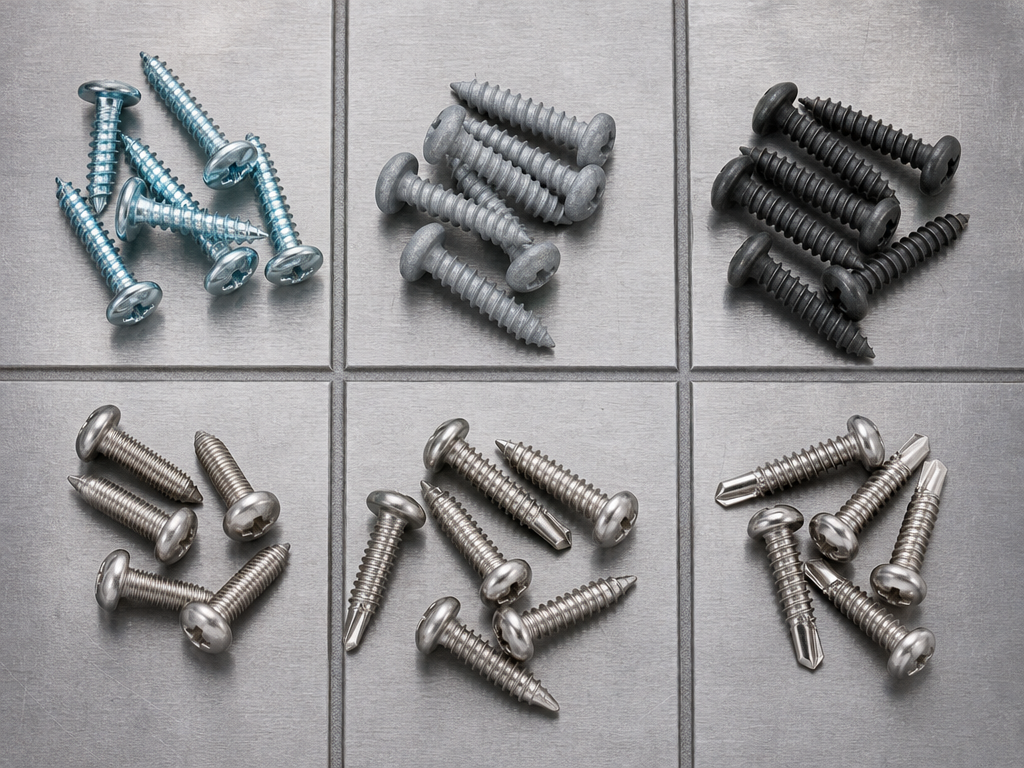
Zinc-plated carbon steel is a common economical choice for dry indoor assemblies, protected equipment, and mild indoor environments. The zinc layer provides sacrificial protection, but electroplated zinc is relatively thin compared with hot-dip galvanizing.
It is not the default choice for long-term exterior exposure, coastal sites, or wet connections. If the coating is scratched, damaged at the thread, or exposed at a cut edge, the underlying steel can begin to corrode. The specific coating thickness, process, and test requirement still need to be confirmed.
Carbon steel with hot-dip galvanizing (HDG)
Hot-dip galvanizing usually produces a much thicker zinc coating than electroplating. It is widely used for outdoor and industrial steel connections where a robust, economical corrosion-protection system is required.
HDG is not simply “better zinc plating.” The coating can affect thread fit, appearance, and the way the fastener assembles. Coating uniformity, drainage, and damage during installation also matter. For a self-drilling screw, confirm that the proposed product and point configuration are actually available with the required coating; not every screw design is offered in every finish.
Carbon steel with zinc-aluminum flake or ceramic topcoat systems
Zinc-aluminum flake coatings and ceramic topcoat systems are used where a more uniform, engineered coating is needed. Products sold under names such as Ruspert or Dacromet belong in this broad category, but the brand name is not a specification.
The performance depends on the base metal, pretreatment, coating thickness, coverage, adhesion, curing, and damage tolerance. Two fasteners with the same coating name can have different coating systems and different test results. Ask for the exact product, coating specification, test method, and report scope.
304 stainless steel
Grade 304 is an austenitic stainless steel, often described as 18/8 stainless because of its chromium and nickel content. It offers good corrosion resistance in many atmospheric, humid, and general outdoor environments, and it is widely used for visible architectural and sheet-metal connections.
Grade 304 is not a universal coastal or chemical-service answer. It can suffer pitting and crevice corrosion in warm, chloride-rich conditions. It is also not automatically the best drilling option: the finished drill point, thread, and installation method still have to suit the substrate.
316 stainless steel
Grade 316 contains molybdenum, which generally improves resistance to chlorides compared with 304. It is often considered for coastal, marine, and some chemical or industrial environments.
“316” is still not a guarantee. Warm chloride conditions, crevices, deposits, and inadequate cleaning can affect even higher-alloy stainless steels. Confirm the grade, surface condition, passivation, washer material, and expected maintenance with the project technical reviewer.
410 stainless steel
Grade 410 is a martensitic stainless steel that can be hardened and tempered. It is used where hardness and drilling or wear resistance matter, but its corrosion resistance is generally lower than that of 304, especially in aggressive or chloride-rich environments.
Grade 410 should not be treated as an outdoor equivalent simply because it is called stainless. It may be appropriate in a controlled environment, under a suitable coating system, or where the application specifically requires its hardness. The exposure and finished-product evidence still decide.
Bi-metal self-drilling screws
A bi-metal self-drilling screw combines a corrosion-resistant stainless steel body and head with a hardened carbon steel drill point and lead thread. The two materials are joined, often by welding, and the point is hardened for drilling.
This construction is useful when a stainless exterior is wanted but the drill point must penetrate steel. It is often discussed for metal roofing, wall cladding, steel framing, and other exterior metal connections.
The word “bi-metal” does not make the screw rust-proof. Ask which stainless grade is used for the body, which material is used for the point, how the weld or transition is controlled, what coating protects the point and joint, and what total steel thickness the drill point is designed for.
Aluminum and specialty alloys
Aluminum and specialty alloys are application-specific. They can be useful where weight, conductivity, or a particular chemical environment matters, but they are not a drop-in substitute for steel screws in every structural or drilling application. Aluminum also introduces galvanic-corrosion questions when it is coupled with steel or stainless steel in a wet environment.
Match the environment to a starting material
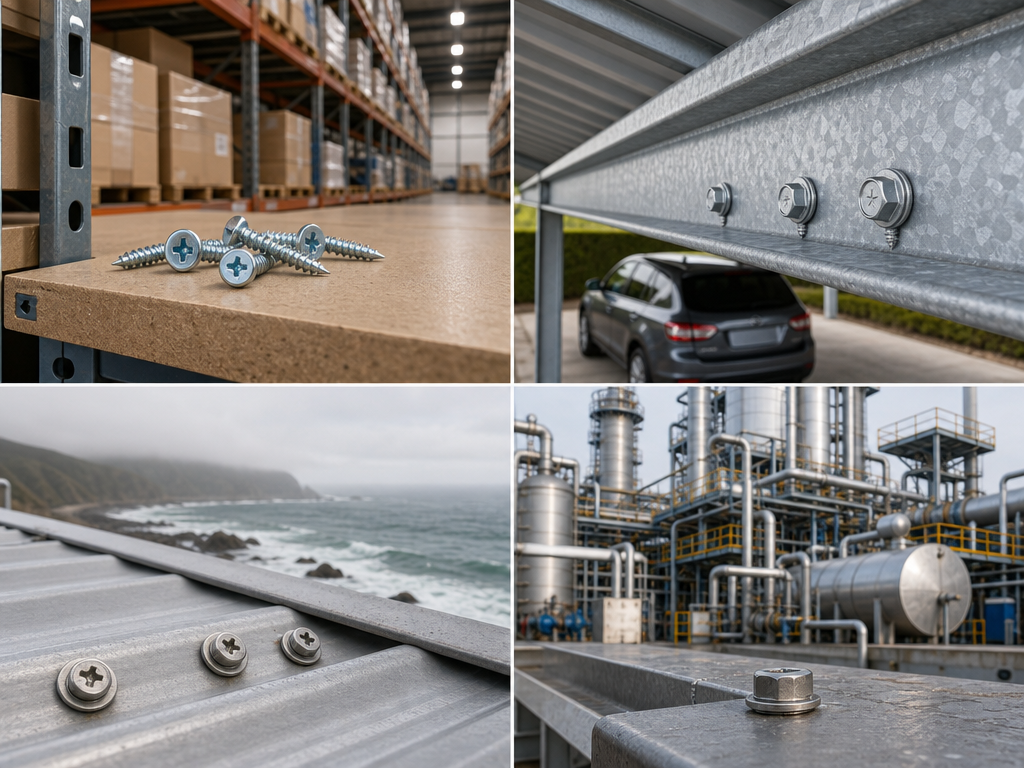
The table below is a starting point for shortlisting, not a final specification. The project drawing, substrate, washer, coating, installation method, and technical approval still control the choice.
| Working environment | What drives the decision | Practical starting point | Must confirm |
|---|---|---|---|
| Dry indoor, controlled | Cost, strength, appearance | Zinc-plated carbon steel | Coating thickness, indoor moisture, cleaning chemicals |
| Sheltered outdoor, general atmosphere | Humidity, intermittent rain, appearance | HDG, zinc-aluminum flake system, or 304 | Actual chloride level, drainage, coating damage |
| Direct weather, roofing and cladding | Rain, UV, thermal movement, washer sealing | HDG or engineered coating; 304 or bi-metal where stainless is required | Panel system, substrate, washer, installation, coastal exposure |
| Coastal, marine, or chloride-rich | Salt spray, sea air, washdown, crevices | 316 or a 316-body bi-metal system | Chloride concentration, temperature, cleaning, crevice design |
| Industrial or chemical | Pollutants, acids, process chemicals | 316 or a higher-alloy option; coated carbon only if compatible | Chemical list, concentration, temperature, cleaning agents |
| Agricultural or animal housing | Moisture, ammonia, manure, cleaning | HDG or 316, depending on exposure | Ammonia level, washdown, bedding, manure contact |
| Treated wood | Preservative chemistry and moisture | HDG or stainless compatible with the preservative | Wood treatment type, moisture, code or manufacturer requirement |
| High temperature | Strength retention, oxidation, coating stability | Carbon or alloy steel; stainless where appropriate | Temperature range, cycling, coating limits, approval |
| Aluminum or dissimilar-metal assembly | Galvanic corrosion, drainage, contact area | Material pair selected for the joint; isolation may be required | Area ratio, electrolyte, washer, coating, maintenance |
| Hygiene-driven or cleanable areas | Cleanability, moisture, cleaning chemicals | 304 or 316 as a starting point | Cleaning protocol, chemical compatibility, surface finish |
Two important cautions apply to this table:
- A higher grade is not automatically the right grade. Grade 316 may offer better chloride resistance than 304, but it may not solve a poor detail, a trapped-water condition, or an incompatible washer.
- A coating name is not a coating specification. “HDG,” “Ruspert,” “Dacromet,” and “zinc plated” can describe different processes, thicknesses, and test scopes. Compare the exact product and evidence.
Check galvanic corrosion and dissimilar-metal contact
Galvanic corrosion occurs when two different metals are in contact in the presence of an electrolyte, such as moisture or salt solution. The less noble metal can corrode faster than it would on its own.
Common examples in fastener assemblies include:
- Stainless steel fasteners in aluminum panels or aluminum components.
- Zinc-coated steel fasteners in contact with copper, brass, or other noble metals.
- Carbon steel components coupled with stainless steel in a wet or poorly drained joint.
- Mixed-metal roof, façade, or equipment assemblies where water runs from one material onto another.
The severity depends on the metal pair, the electrolyte, the relative surface areas, the duration of wetness, and the design. A small stainless fastener in a large aluminum sheet creates a different area ratio from a large stainless component with a small aluminum contact; the small-anode case is generally more severe.
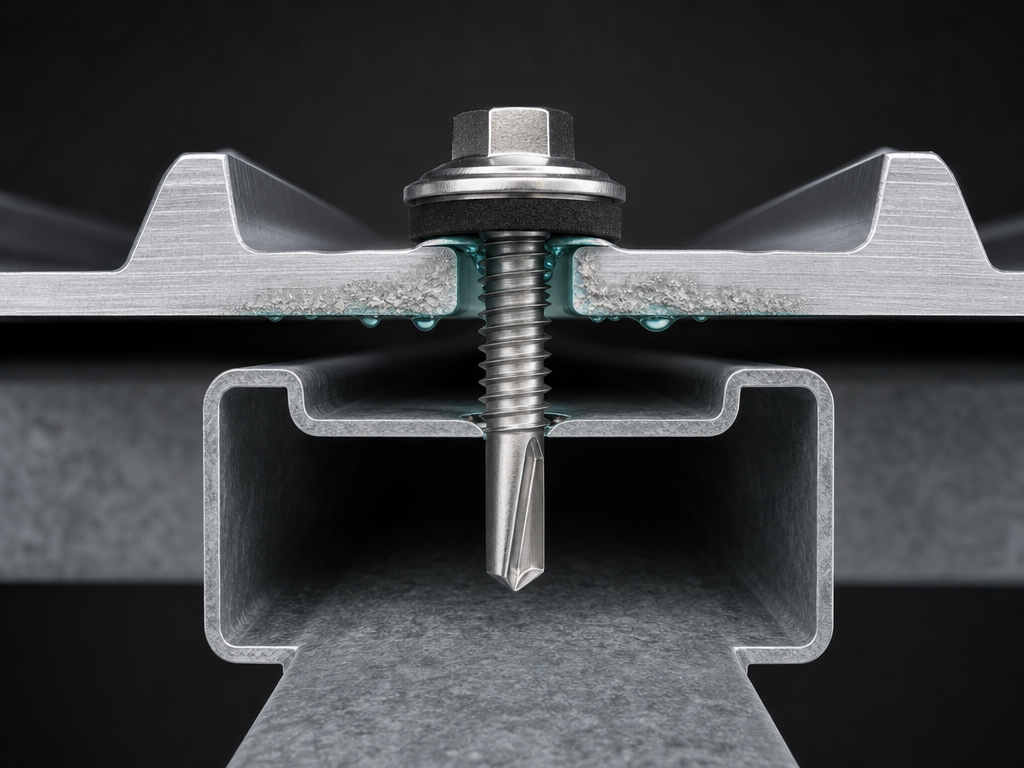
A sealing washer is not automatically an isolation washer. EPDM or another sealing material may keep water out of the hole, but it does not necessarily separate the metals or prevent a galvanic couple at the thread, head, or adjacent surfaces. If dissimilar metals are unavoidable, ask the project engineer about isolation washers, coatings, drainage, and a different material combination.
Do not solve a galvanic-corrosion problem by changing only the screw grade. The joint design, washer, coating, and contact area are part of the same decision.
Treat coating, washer, and installation as one system
Fastener material selection does not end with the base metal. The coating, washer, and installation method can determine whether the material performs as intended.
Coating performance
Ask what the coating is expected to do, not only what it is called:
- Is it intended for indoor, outdoor, coastal, industrial, or chemical exposure?
- What is the coating thickness and coverage on the head, shank, thread, point, and cut edges?
- How is the coating applied, cured, and inspected?
- How resistant is it to scratches, abrasion, and installation damage?
- Does it affect thread fit, torque, or galling?
- What test method, duration, specimen, and failure criterion were used?
A salt-spray result is a controlled comparison tool, not a direct prediction of service life. ASTM B117 and similar methods can be useful, but the result depends on the exact product, surface preparation, test duration, and failure endpoint. A longer number is not automatically better if the test conditions and product are different.
Washer performance
For roofing, cladding, and exterior assemblies, the washer is part of the corrosion and sealing system. Ask about:
- The EPDM compound or sealing material.
- The metal backing material and coating.
- Bonded or unbonded construction.
- Washer dimensions and compression behavior.
- Compatibility with the panel coating and the fastener material.
- Whether the washer is also expected to isolate dissimilar metals.
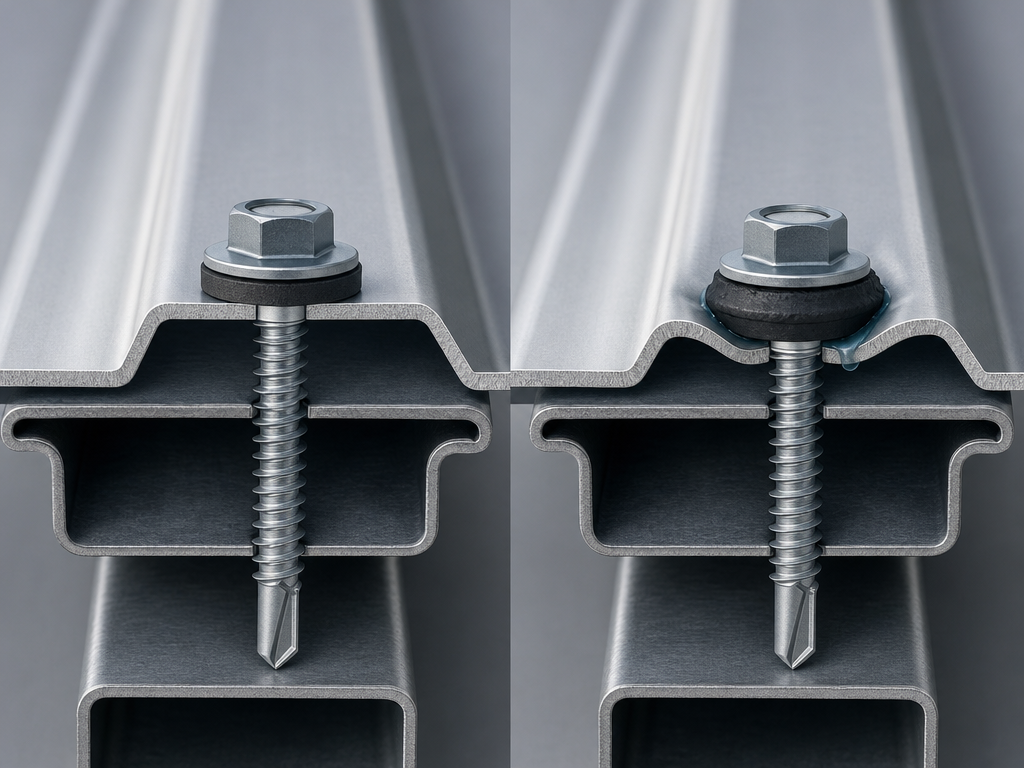
An under-compressed washer may leave a water path. An over-compressed washer may be damaged or permanently deformed. The correct seating condition should follow the panel manufacturer, fastener manufacturer, and project specification.
Installation damage
Scratches, overdriving, thread stripping, a damaged washer, or a worn driver can create corrosion initiation points. Stainless steel can also gall during installation if the fastener, tool, and driving condition are not controlled.
The material choice and the installation method should be approved together. A screw that performs well in a sample bag but is damaged during installation may not perform in service.
Use a practical selection sequence
A repeatable selection process is more useful than a material ranking:
Environment and service life → substrate and total thickness → material family → galvanic and coating compatibility → washer and installation → sample and evidence → total installed cost.
In practice:
- Describe the location, moisture, chlorides, pollutants, temperature, and maintenance.
- Record every layer the screw passes through and the supporting material.
- Shortlist one or two material families, not ten grades.
- Check contact with other metals and the need for isolation.
- Select the coating and washer as part of the same assembly.
- Confirm the drill point, thread, length, and installation method for the actual joint.
- Request product-specific evidence and run a trial on the real assembly.
- Compare total installed cost, including rework, callbacks, and maintenance.
If two options both pass the functional trial, compare the evidence and the total installed cost. A lower purchase price is not a saving if the screw needs extra pilot operations, fails during installation, or creates a corrosion callback.
Put the right information in the RFQ
A useful fastener RFQ lets the supplier quote a defined system rather than a generic screw. Include the following:
| RFQ field | What to provide |
|---|---|
| Environment | Indoor, sheltered, direct weather, coastal, industrial, agricultural, chemical, or other |
| Service life | Expected years, maintenance plan, and whether the connection can be inspected |
| Substrate | Material, grade, strength, and thickness of each layer |
| Other metals | Panel, purlin, bracket, washer, and any dissimilar-metal contact |
| Fastener type | Self-drilling, self-tapping, or an existing model or drawing |
| Material and grade | Required base material and grade, if already specified |
| Coating | Coating system, color, thickness or class, and test requirement |
| Washer | EPDM or other sealing material, backing, dimensions, and compression requirement |
| Drill point | Required point type and target steel thickness or substrate |
| Installation | Tool, speed, torque control, access, and trial-assembly requirement |
| Evidence | Material certificate, coating report, test scope, batch traceability, and sample |
| Packaging and quantity | Unit pack, labels, mixed-SKU rules, destination, and order quantity |
If a field is unknown, write “unknown” and ask what the supplier needs. Do not fill the gap with a generic value from another project. A short technical conversation is usually better than an RFQ full of assumptions.
Common material-selection mistakes
“Stainless is always better.” Stainless is a family of grades with different corrosion resistance, hardness, and drilling behavior. The grade and finished product still have to match the environment.
“The same grade means the same product.” Two 304 screws can have different points, threads, coatings, washers, heat treatment, and test scope. Compare the complete specification.
“A higher salt-spray number means a longer service life.” Test method, specimen, coating, and failure criterion must match before the numbers can be compared. Salt spray is not a service-life guarantee.
“The coating name is the specification.” HDG, zinc plating, Ruspert, and Dacromet can describe different systems. Ask for thickness, coverage, adhesion, and product-specific evidence.
“The washer is only for sealing.” The washer can affect sealing, bearing pressure, galvanic isolation, and installation. It is part of the assembly.
“One material can cover every SKU.” A distributor may need different materials for dry indoor stock, exterior roofing, coastal projects, and treated-wood applications. A single “best” material can create unnecessary cost or unnecessary risk.
Frequently asked questions
Is stainless steel always the best fastener material?
No. Stainless steel is useful in many humid and outdoor environments, but it is not automatically the best choice for every application. Grade, chloride exposure, crevices, strength, drilling performance, washer compatibility, and cost all matter.
Which is better for coastal environments, 304 or 316?
Grade 316 is generally more resistant to chlorides than 304 because it contains molybdenum. That does not make every 316 fastener suitable for every coastal detail. Confirm the actual chloride exposure, temperature, cleaning regime, crevice design, and washer material.
Can I use stainless steel screws with aluminum?
Stainless steel and aluminum can form a galvanic couple when moisture is present. The joint may need isolation, a different washer, a coating, drainage, or a different material combination. Ask the project engineer to review the complete assembly.
Is HDG always better than zinc plating?
Hot-dip galvanizing usually provides a thicker zinc coating and is often more suitable for outdoor or industrial exposure. It can also affect thread fit and appearance, and not every fastener design is available in every coating. Confirm the coating class and the actual product.
What is a bi-metal self-drilling screw?
It is a screw with a corrosion-resistant stainless steel body and a hardened carbon steel drill point and lead thread. The construction is intended to combine stainless protection on the exposed body with reliable drilling into steel. The body grade, point material, weld, coating, and drill capacity still need to be specified.
Does a longer salt-spray test mean a better screw?
Not necessarily. A salt-spray result depends on the test method, specimen, surface preparation, coating system, duration, and failure criterion. Use it to compare like with like, and treat it as one piece of evidence rather than a direct service-life prediction.
Choose the material for the environment, then prove it
The right fastener material is the one that fits the actual working environment, the substrate, the expected service life, and the installation method—and can be supported by product-specific evidence.
Start with the environment. Define the joint. Check dissimilar metals. Select the coating and washer as part of the same system. Confirm the drill point and installation. Then ask for a sample and the documents that apply to the exact product being quoted.
This guide is a selection framework, not a substitute for project engineering, building codes, panel manufacturer instructions, or a qualified corrosion assessment. The final material and coating should be approved for the actual project conditions.
If you are sourcing self-drilling screws, self-tapping screws, or a related fastener for a project, send ScrewTrade the application details: location and exposure, substrate and thickness, expected service life, existing drawing or sample, coating and washer requirements, quantity, and required documents. The requirement can then be reviewed against the available product options before a sample or quotation is approved.
Related News
Other news you might be interested in

خريطة الطلب على أدوات التثبيت لعام 2027: مراكز البيانات والطاقة والمشاريع الصناعية
توقعات أدوات التثبيت لعام 2027 ليست انتعاشًا واسعًا. إنها خريطة لقطاعات مشاريع محددة—وأقوى القطاعات هي مراكز البيانات والطاقة وأعمال صناعية مختارة. الاتجاه واضح بالفعل في نتائج الشركات في أواخر عام 2026. أعلنت شركة هيلتي عن نمو مبيعاتها بالعملة المحلية بنسبة 5.9% في الأشهر الثمانية الأولى من عام 2026، مع نمو مزدوج الرقم في الأمريكتين وآسيا والمحيط الهادئ، بينما وصفت البناء التقليدي بأنه ضعيف. ارتفعت مبيعات LISI في قطاع الطيران بنسبة 14.3% في الأشهر التسعة الأولى، لكن مبيعاتها في قطاع السيارات انخفضت بنسبة 5.2%. نمت مبيعات بوسارد في الربع الثالث بنسبة 12%، بفضل الطلب على مراكز البيانات في الأمريكتين وتوسع أشباه الموصلات والإلكترونيات في آسيا.

ما هو المسمار ثنائي المعدن ولماذا يحتاج السقف المصنوع من الألمنيوم إليه؟
المسمار ثنائي المعدن هو قفل واحد مصنوع من معدنين بمهام مختلفة. في التسقيف، البناء الشائع هو رأس وجسم من الفولاذ المقاوم للصدأ مع نقطة حفر وجزء ملولب من الفولاذ الكربوني المقوى. الجزء المصنوع من الفولاذ المقاوم للصدأ يقاوم التآكل على السقف المكشوف؛ النقطة المقواة تحفر في العارضة الفولاذية أو الركيزة أو الإطار. غالبًا ما يتطلب التسقيف بالألمنيوم هذا المزيج عندما يتم تثبيت لوح ألمنيوم مباشرة على هيكل فولاذي سفلي، لأن اللوح ناعم ومقاوم للتآكل، لكن المسمار لا يزال يتعين عليه حفر الفولاذ وتحمل الطقس. المسمار ثنائي المعدن ليس ضمانًا: يجب تحديد درجة الفولاذ المقاوم للصدأ، وقدرة النقطة، والطلاء، والحلقة، وتفاصيل الألمنيوم إلى الفولاذ.
Want to know more?
Get in touch with us for more information about our services and products.