
Keluhan Sekrup Atap Logam: Daftar Periksa Spesifikasi Washer, Lapisan, dan Pemasangan untuk Distributor

Han Congming
PenulisKami berpengalaman dalam produksi dan penjualan sekrup serta pengencang, dengan fasilitas produksi sendiri dan kapasitas produksi skala besar yang stabil. Kami adalah spesialis sekrup bor mandiri, sekrup drywall, sekrup papan partikel, sekrup mesin, baut, dan pengencang khusus untuk aplikasi konstruksi dan industri.
Follow ups rarely start with 'screw size error'. More commonly, it starts with details that never appear in the quotation: gasket structure, coating system, total steel thickness, installation tools, or the actual environment faced by the roof.
That's why metal roof screws should not be purchased as standalone hardware. Fasteners are only a part of the connection system, which includes panels, brackets, sealing gaskets, drive tools, and the people who use them. When the rest of the system is not specified, screws can be installed in holes, but they can still leak, loosen, corrode, or damage the panel. The same issue applies to self drilling roof screws with EPDM washers: washers and installation conditions are part of product performance, not optional accessories.
For distributors, importers, and project buyers, the actual goal is not to write the longest specification. It is a document that can be referenced, sampled, checked, duplicated, and tracked. This list covers gaskets, coatings, and installation details, which typically determine whether a metal roof screw order is executed or returned as a follow-up.
The buyer's question answered in this article is simple:
How can I write a metal roof screw specification that reduces callbacks without specifying products that I have not tested excessively?
A useful answer starts with five checks:
- Will screws and washers seal the penetrations after thermal motion, wind, rain, and normal installation changes?
- Is the coating suitable for actual exposure, not just the surface names listed in the catalog?
- Can installation personnel replicate the approved results on site?
- Can two quotations and two batches of goods be compared on the same basis?
- If there is a problem, can it be traced back to the correct product and installation conditions?
If you are still comparing connection types, please start with our complete guide for metal roof self drilling screws. This article assumes that a product series has been selected and focuses on introducing the following specifications.
Start with the connection, not the screw
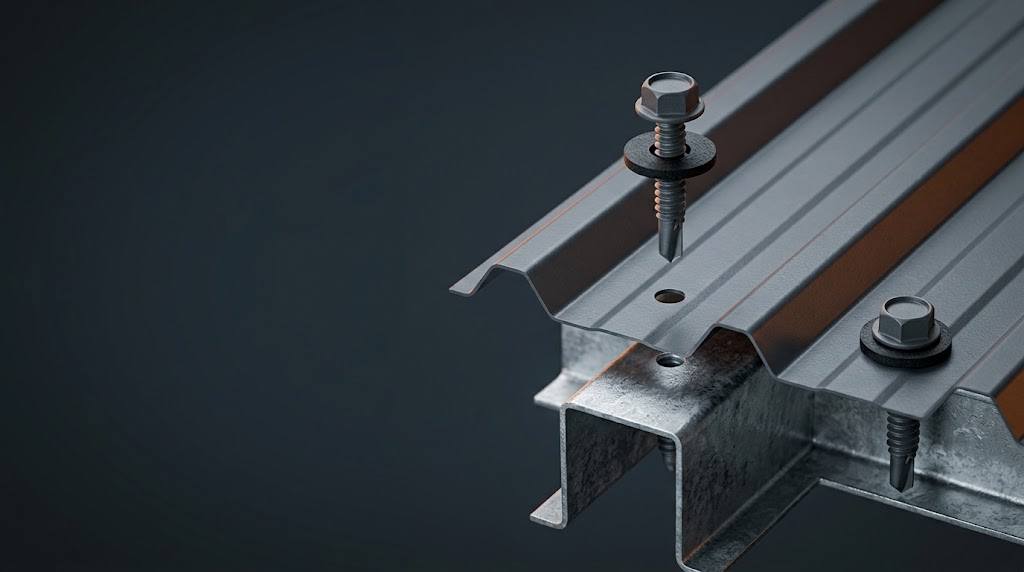
The first specification error is selecting a screw from the catalog before describing the connection that the screw must make. Metal roof screws can pass through thin roof panels, but still require drilling into thicker steel purlins. It can be fixed on wood instead of steel. It may also pass through insulators, gaskets, brackets, or clips before reaching the supporting components.
Before selecting a point, line, or length, record the complete stack:
| Specification Input | What to Record | Why It Matters |
|---|---|---|
| Panel | Material, profile, thickness, coating, and color | Affects bearing, sealing, and appearance |
| Support | Steel purlin, wood framing, or other substrate; grade and thickness | Determines drill-point capacity and thread engagement |
| Intermediate layers | Insulation, spacer, clip, bracket, or existing panel | Changes the total thickness and clamping condition |
| Connection type | Metal-to-metal, metal-to-wood, or sandwich panel | Determines point, thread, and length logic |
| Exposure | Indoor, coastal, industrial, agricultural, humid, or high-UV | Drives material, coating, and washer requirements |
| Installation | Tool type, access, angle, control method, and crew experience | Affects washer seating and panel damage |
| Commercial scope | Order quantity, packaging, labels, and destination market | Prevents later disagreement about the deliverable |
| Evidence | Drawing, sample, test report, or approved reference | Creates a basis for comparison and repeat orders |
Drilling points must be selected for the entire material stack, not just for the panels. The screw length must provide the required support joint after passing through each layer. The head and driver must be suitable for installation tools and available channels.
The TEK number itself is not a complete specification, as the performance of the drill bit also depends on its geometry, steel type, hardness, installation speed, and actual joint.
For metal to metal roof screws, the support is usually steel purlins or frame components. Used for metal to wood screws, wood density, moisture, texture direction, and risk of splitting. The sandwich panel connection adds a different set of issues: total panel thickness, insulation type, gasket support, and whether screws can clamp the panel without deforming it.
If the project is still in the product selection stage, before comparing brands, use connection diagrams to compare metal to metal roof screws, metal to wood roof screws, and sandwich panel fasteners. The product name cannot determine whether two fasteners have the same point, thread, or usable length.
Gasket specification: The sealing joint has more than one rubber ring
EPDM gaskets are typically described as sealing accessories. In practice, it is a performance component. The gasket forms a sealed interface around the penetration, adapting to small surface irregularities and helping to distribute the load of the screw head throughout the entire panel.
Most roof gaskets combine EPDM sealing layer with metal backing gasket ring. Some are provided as adhesive components; Others may use separate gasket devices. Structure is important because the gasket must remain in place during driving, in contact with the panel, and recover after compression.
When specifying gaskets, do not stop at the word "EPDM". Ask for the following information:
- EPDM compound or grade, if defined by the supplier
- Metal backing material and surface treatment
- Adhesive or non adhesive structures
- Outer diameter and tolerance of gasket
- EPDM layer thickness and total gasket thickness
- Recommended compression conditions or valve seat requirements
- Available evidence of aging, UV, ozone, or compression recovery
- Compatibility with panel coating and expected usage environment
- Physical samples of complete screw and washer components
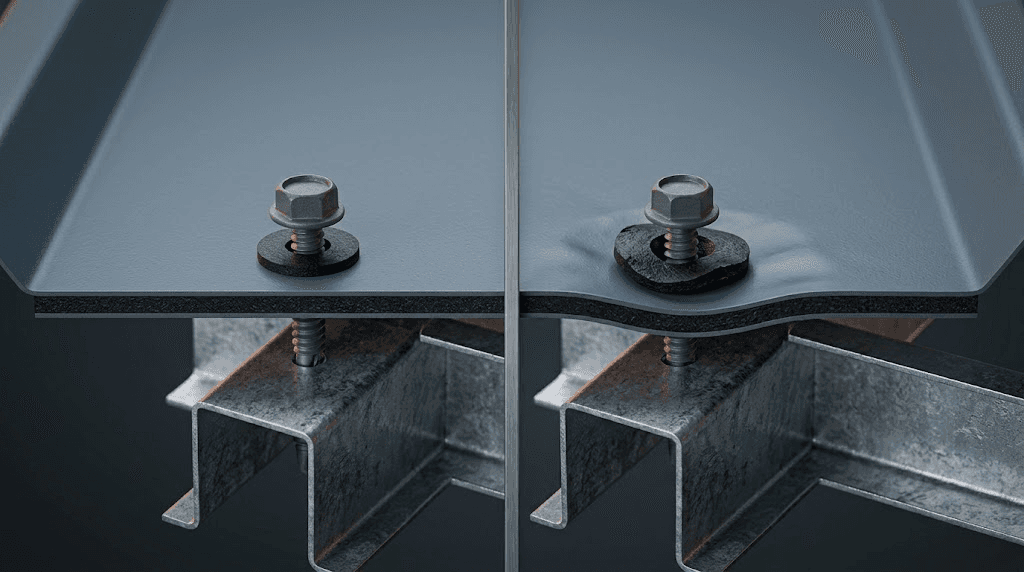
You must also specify the installation itself. Insufficient compression of the gasket may leave water around the fastener. Overcompressed gaskets may become flattened, cracked, compressed, or permanently deformed. Oblique screws can compress one side of the washer while loosening the other side. Worn or undersized sockets can damage the head and make stable installation difficult.
The goal is not the tightest screw. It is a uniformly compressed gasket that can maintain continuous contact with the panel without causing significant damage. The published installation guidelines typically require the use of controlled screw guns, clutches, or depth control settings, and visual inspection of the washers, but the exact tool settings and installation conditions should follow the panel manufacturer, fastener manufacturer, and project specifications.
For more detailed information on gasket functionality and installation, please refer to our guide on EPDM gaskets in roof screws and prevention of over drive and sealing failures.
Coating specifications: match the environment, not just the surface name
The discussion of coatings often turns into a comparison of names: galvanized, Rupert, Dacromet, or stainless steel. These names are useful starting points, but they do not answer the buyer's real question:
Is this type of fastener still suitable for the environment and the expected service life of the project?
Starting from the basic materials:
- Carbon steel with protective coating is commonly used for general metal roofing and building applications, where the coating system is suitable for exposure.
- Stainless steel can be used in humid, outdoor, or corrosion sensitive environments, but the grade and application still need to be confirmed.
- Bimetallic self drilling screws combine hardened drill bits with corrosion-resistant body or head configurations, typically used for demanding roof and metal connection applications.
Then define exposure. Roofs near the coast, agricultural buildings with moisture and ammonia, industrial areas with pollutants, and dry inland warehouses do not pose the same corrosion risk. Consideration should be given to the contact area of screw heads, washers, drill tips, cutting edges, and any contact with different metals.
The coating evidence should be specific. If the supplier provides salt spray results, please inquire:
- Which specific SKU, material, and coating system were tested?
- Is the testing conducted on finished screws or coated panels?
- What testing methods and duration were used?
- What is the endpoint of the fault: white corrosion, red rust, blistering, or other conditions?
- How were the results evaluated and how many samples were tested?
- Has the report identified the production batch or approved specifications?
- Is this result applicable to the referenced product?
Salt spray test is a controlled comparative tool and cannot directly predict the service life. If the testing conditions, products, and evaluation criteria are different, the longer the number, the better. ASTM B117 and similar methods have documented limitations when used as independent evidence of real-world performance. Use reports for similar comparisons and confirm the applicability of the project with the responsible technical reviewer.
For a more comprehensive comparison of common finishes, please refer to the Ruspert, Dacromet, and Galvanized versions of self drilling screws.
Installation specification: Define "correct" before inserting the first screw
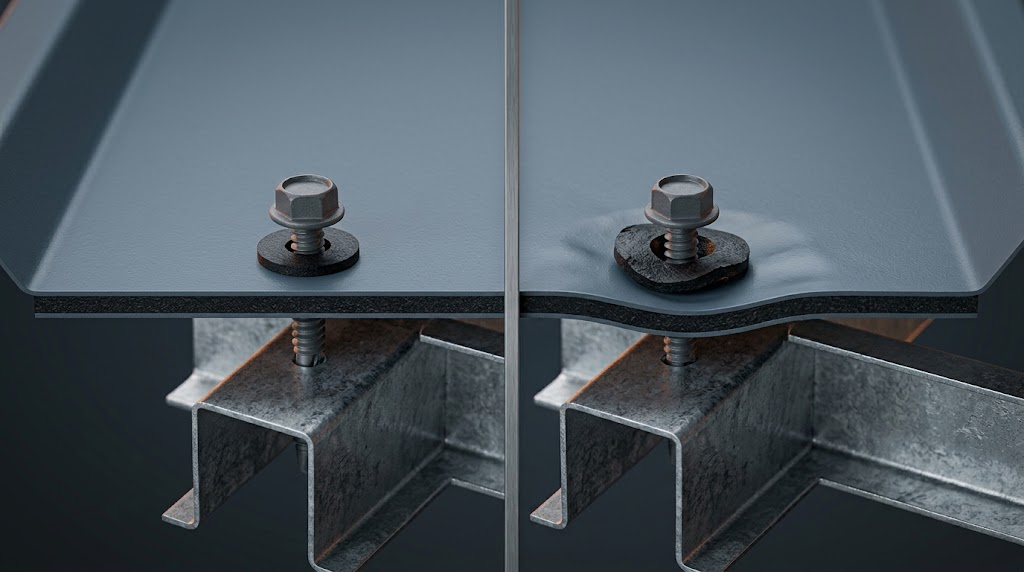
Installation is not a separate topic from procurement. This is part of the standard. If the quotation, cardboard box, or installation card does not explain how the fasteners should be installed, the distributor may receive a callback starting from the roof.
The actual installation specifications should determine:
- Approved panel areas and fastening methods
- Required screw angle and activation method
- Manufacturer's recommended tool types, speed ranges, and control methods
- Is the impact driver suitable for specific fastener and panel systems
- Required washer base conditions
- What should I do if the screw rotates, falls off, damages the panel, or cannot be in place
- Who checks the first installation and how to record the results
Panel manufacturers have issued different patterns and connection requirements for different contours, wind zones, edges, corners, and support conditions. Therefore, a universal spacing diagram should not be considered a universal rule. Approved panel instructions and project documents take priority.
Trial assembly is the cheapest way to reduce uncertainty before placing bulk orders. Use representative panels, actual support materials, recommended screws and washers, and expected tools. Record tool settings, installation speed, gasket condition, and any panel deformations. If production materials cannot be used for testing, please record the differences and consider the results as temporary.
Distributors can also convert the trial results into a one page installation card or a brief on-site guide. This includes product references, approved gaskets, target seat conditions, and a simple 'stop and report' checklist for overspeed, underspeed, thread peeling, gasket damage, or panel deformation.
Dealer single page specification checklist
Before requesting a quotation, please fill in the following fields. The purpose is not to make the order complicated; This is to make the hypothesis visible.

| Checklist Item | Required Detail |
|---|---|
| 1. Project and exposure | Location, indoor or outdoor, coastal or industrial exposure, expected service conditions |
| 2. Panel and support | Materials, profiles, thicknesses, coatings, and condition |
| 3. Connection type | Metal-to-metal, metal-to-wood, sandwich panel, or mixed assembly |
| 4. Screw designation | Product name, standard or drawing reference, and approved sample reference |
| 5. Drill point, thread, diameter, length | Complete dimensional and performance requirements |
| 6. Head and drive | Head style, bearing area, drive type, and installation access |
| 7. Washer assembly | EPDM specification, backing washer, dimensions, bonding, and seating requirement |
| 8. Coating system | Material, coating type, color, test or report requirement, and exposure basis |
| 9. Installation method | Tool, control setting, fastening pattern, trial assembly, and inspection condition |
| 10. Packaging and labels | Unit pack, carton, label data, mixed-SKU rules, and destination requirements |
| 11. Sample and approval | Sample quantity, approval record, and change-control procedure |
| 12. Inspection and traceability | Batch identification, documents, and incoming inspection requirements |
If the distributor is unable to answer one of the fields, it should be discussed before the order, not after the first batch of goods.
Feed and return control
The specification is only effective when the delivered product can be compared with the approved reference. When the goods arrive, check the complete components, not just the number of screws:
- Product references, carton labels, and batch identification
- Screw diameter, length, head, transmission device, and point
- The existence, type, size, and adhesion of gaskets
- Consistency of coating appearance and color
- Packaging conditions and unit packaging quantity
- Any inspection documents or certificates agreed upon in the order
Put the approved samples and shipping records together. If problems arise in the future, the first step is not to replace the screws. This is to preserve evidence: photos of the affected area, location and orientation of fasteners, installation time, exposure conditions, tools and settings used, relevant carton labels, and undamaged samples from the same batch as much as possible.
The leakage near the screw does not prove that it was caused by the screw. Water can flow out from lap joints, waterproof boards, penetrations, damaged panels, or higher fasteners. Corrosion can start from the head, gasket interface, drill tip, cutting edge, or contact with different metals. Installing replacement screws without determining the root cause may transfer the problem to the next connection.
Classify the issues before proposing corrections:
- Product or batch conditions
- Gasket or sealing condition
- Installation or tool condition
- Panel, bracket or system condition
- The combination of multiple factors
This classification determines whether the next action belongs to the quality process of suppliers, installers, panel manufacturers, project designers, or distributors.
How to Compare Two Roof Screw Quotes
The lowest unit price only makes sense when both quotations describe the same complete component. When comparing quotes, please confirm:
- Is the washing machine included and is the structure the same?
- Is the coating system and color the same?
- Are the points, threads, diameter, and length the same?
- Are the packaging, labels, and unit counts the same?
- Does it include inspection documents, samples, and change control?
- Can the quoted product be traced back to the batch or approved reference?
- Does it include installation instructions and technical support?
- Which assumptions have not been explained?
If a quote appears cheaper, determine which requirement is omitted before considering the difference as a price advantage. In roof fasteners, the difference between two quotes is usually due to gaskets, coatings, documentation, or installation assumptions, rather than just lower factory costs. This is particularly important for wholesale or bulk orders, as there are small specification differences repeated between thousands of fasteners.
What should I send for the quotation of metal roof screws
To receive a useful quotation, please send to the supplier:
- Panel type, contour, material, and thickness
- Supporting materials, grades, and thicknesses
- Connected drawings, photos, or cross-sections
- Required points, threads, diameters, lengths, and head styles
- Gasket requirements, including EPDM and backing structure
- Coating, color, and exposure environment
- Installation method and any trial assembly requirements
- Packaging, labeling, and target market requirements
- Quantity listed by SKU and expected replenishment mode
- Required inspection documents and sample approval process
This information allows suppliers to confirm whether the proposed fasteners match the application and whether any specification items need to be clarified before sampling. It also provides distributors with written basis for comparing quotes, approving samples, and inspecting subsequent shipments.
ScrewTrade offers self drilling and self tapping screws, including hexagonal washer head self drilling screws assembled with EPDM washers, for batch B2B and project requirements. To discuss specific roof applications, please send your connection details, required specifications, and packaging plan through the contact page.
Frequently Asked Questions
Are all EPDM gaskets the same?
no EPDM identifies the rubber series, not the complete gasket specifications. Compounds, metal backing, adhesion, size, compression behavior, and aging performance may vary. Specify the complete gasket component for the application.
Is a higher salt spray index better?
No. The salt spray results must be compared on the same product, coating system, testing method, duration, and failure endpoint. The results support comparison and quality control; It cannot directly predict the service life in each environment.
Can I use an impact screwdriver on metal roof screws?
Use fasteners and tools and control methods specified by the panel manufacturer. If the product or application is not approved for the use of impact drivers, please use the recommended screw gun or controlled clutch settings. Consistent seating is more important than maximum driving speed.
Who should set the installation torque?
The panel system, fastener manufacturer, project specifications, and applicable approvals should specify the installation conditions. Without confirmation, it is not allowed to transfer a single torque value from another roof or another screw design.
What is the most common reason for roof screw retraction?
There is no single reason. Common risks include missing or incompatible gaskets, incorrect points or lengths, mismatched coatings and exposures, excessive or insufficient driving, incorrect fastening positions, damaged panel coatings, and connections that have never been tested as complete components.
How to prevent confusion of washing machines or SKUs in duplicate orders?
Define the product and washing machine as one SKU, approve physical samples, include the washing machine structure in the purchase order, and require carton labels to identify the entire component. Before distributing the balance to the site, check the first delivery according to the approved reference.
The true specification is a complete connection
Metal roof screw pullbacks are expensive because they rarely involve only one screw. They involve panels, brackets, washers, coatings, tools, installation conditions, and the expectations of distributor customers. Clear specifications make these assumptions visible before placing an order.
Starting from the connection. Define the gasket as a performance component. Match the coating with the exposure. Write installation and acceptance conditions into the order. Approve samples according to the same standards. Then compare the prices of the entire component, not just the unit price.
This list will not replace the instructions of specific project engineering or panel manufacturers, but it will provide distributors with a more solid foundation to reduce avoidable recalls, protect the brand, and make repeat orders more predictable.
Related News
Other news you might be interested in
Kepala Datar vs. Kepala Truss pada Sekrup Self-Drilling: Memilih Kepala yang Tepat untuk Rakitan Lembaran Logam
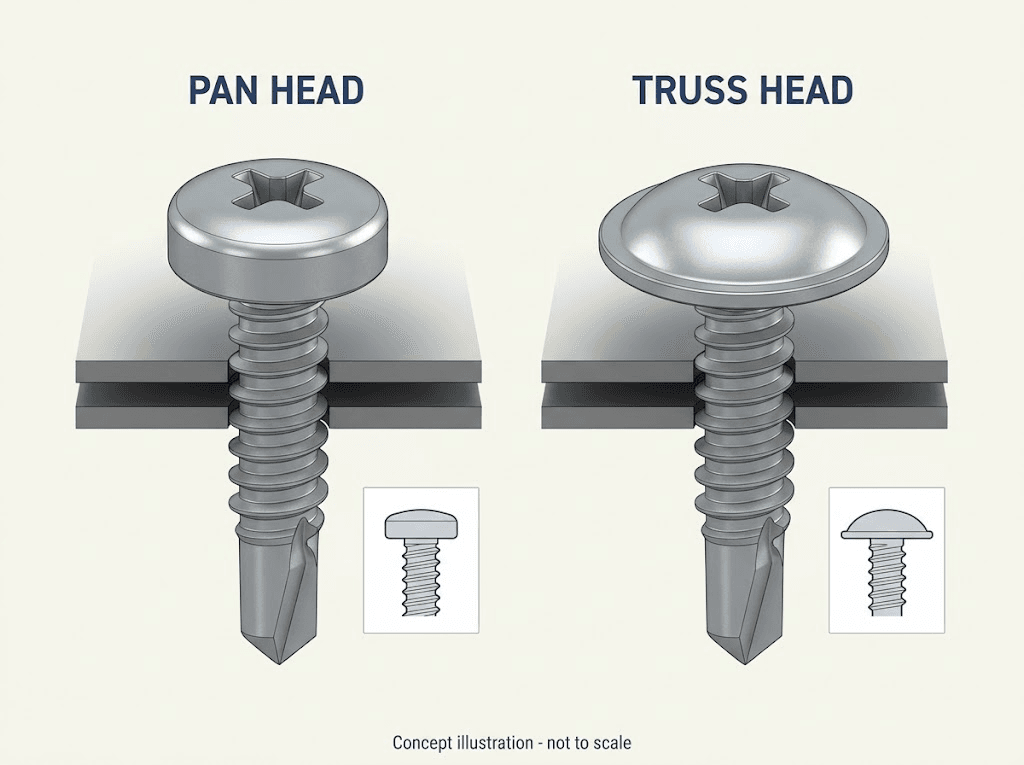
Dua sekrup self-drilling dapat memiliki diameter nominal dan panjang yang sama, tetapi cocok dengan rakitan lembaran logam secara berbeda. Satu kepala mungkin duduk dengan nyaman di samping tepi yang dilipat, sementara yang lain tumpang tindih dengannya. Sekrup yang membersihkan panel mungkin masih mengganggu penutup yang dipasang di atasnya. Bagi pembeli yang membandingkan sekrup self-drilling kepala datar dan kepala truss, pertanyaan yang berguna adalah: kepala mana yang cocok dengan sambungan, menekan pada permukaan yang dimaksud, dan memberikan ruang untuk perakitan dan perawatan? Jawab pertanyaan itu sebelum menyetujui pengganti atau melakukan pesanan dalam jumlah besar.
Sekrup Self-Drilling Bersayap untuk Kayu ke Baja: Kapan Anda Membutuhkannya?
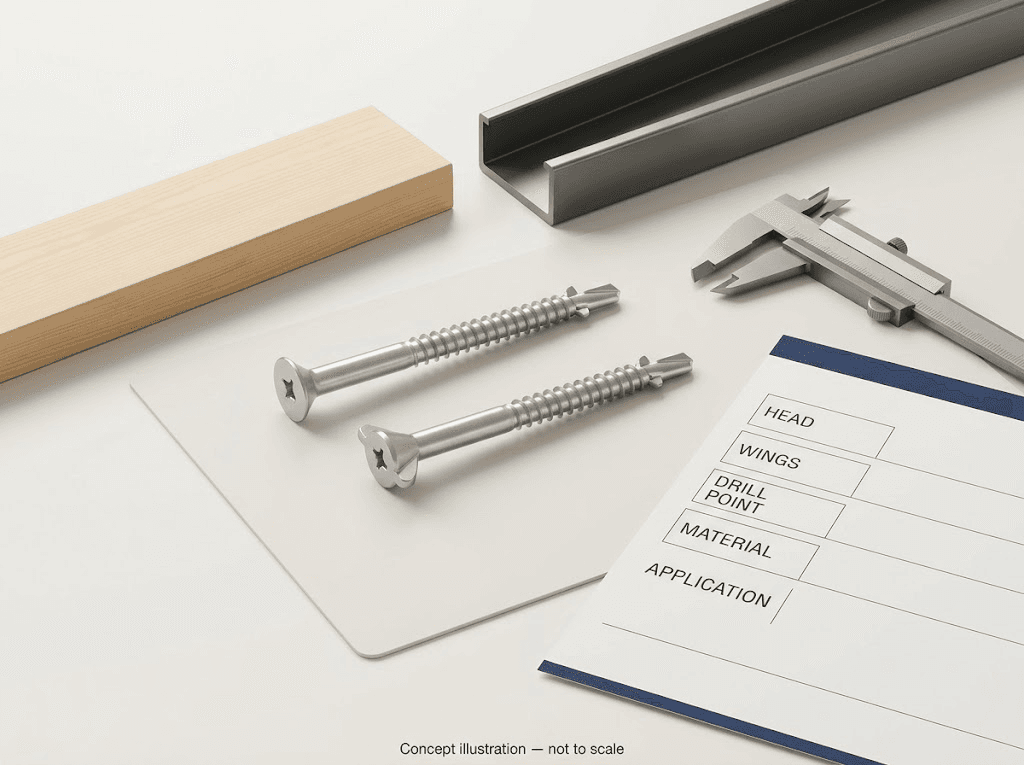
Sekrup dapat menembus papan kayu dan mengebor baja tanpa menghasilkan sambungan yang Anda inginkan. Jika ulir menyentuh kayu sebelum baja dibor dan diulir, papan mungkin tidak tertarik rapat ke rangka. Memilih sekrup lain dengan diameter yang sama dan badan yang lebih panjang tidak serta merta mengatasi masalah tersebut. Sekrup self-drilling bersayap adalah salah satu opsi untuk sambungan kayu ke baja yang sesuai. Sayapnya menciptakan ruang kosong melalui kayu sebelum sekrup menyentuh baja. Keputusan pembelian adalah apakah ruang kosong tersebut sesuai untuk perakitan Anda—dan apakah pengikat tertentu dirancang untuk bahan dan ketebalan yang terlibat.
Want to know more?
Get in touch with us for more information about our services and products.