
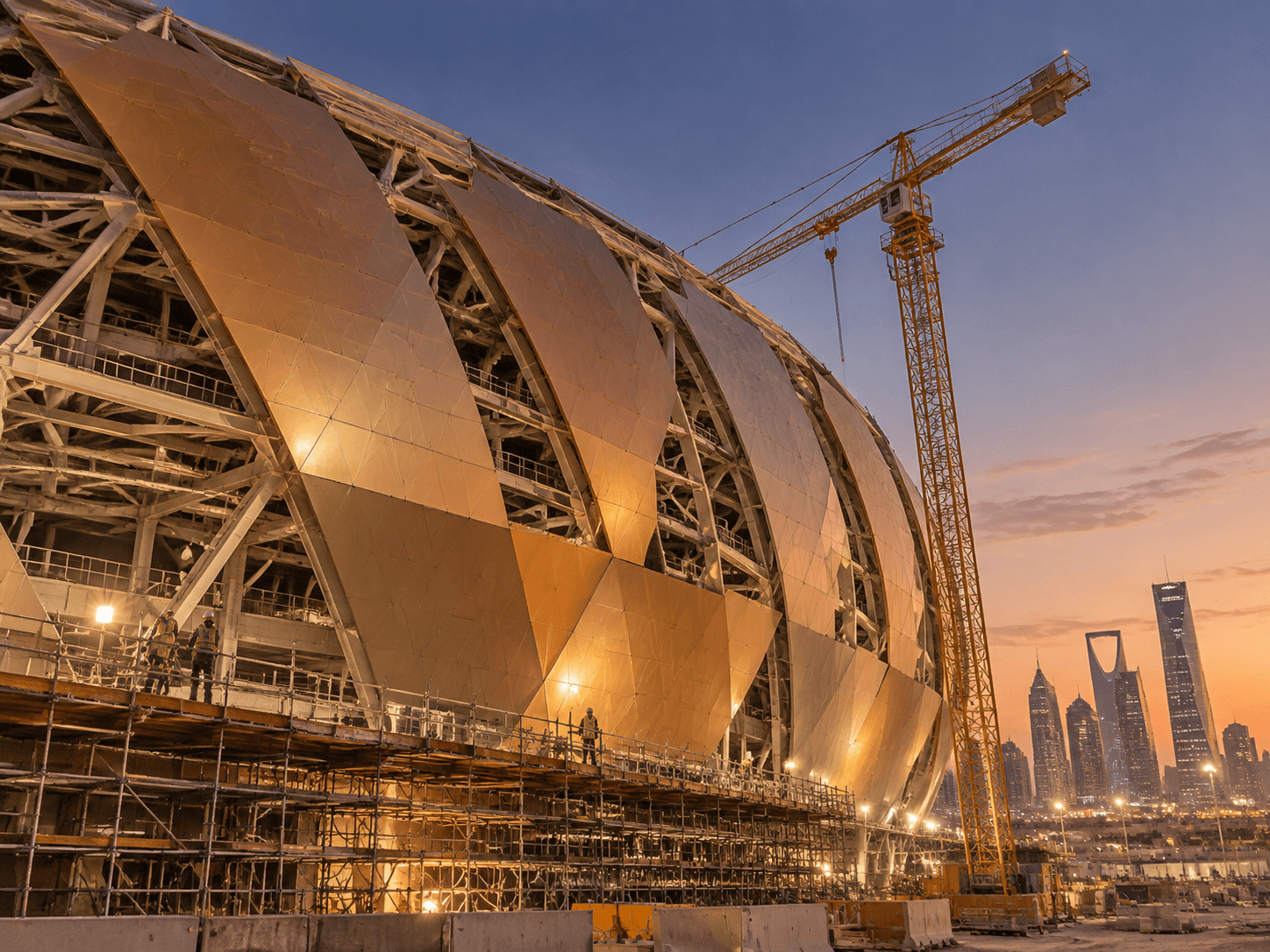
Proyek-Proyek Mega Arab Saudi dan Permintaan Pengikat yang Mereka Dorong: Pasar Timur Tengah pada 2026

Han Congming
PenulisKami berpengalaman dalam produksi dan penjualan sekrup serta pengencang, dengan fasilitas produksi sendiri dan kapasitas produksi skala besar yang stabil. Kami adalah spesialis sekrup bor mandiri, sekrup drywall, sekrup papan partikel, sekrup mesin, baut, dan pengencang khusus untuk aplikasi konstruksi dan industri.
Saudi Arabia still has the Gulf's largest construction pipeline. It also has a very different procurement market from the one described in the first wave of giga-project announcements.
Kamco Invest data cited by MEED Projects put Saudi contract awards at USD 24.4 billion in the third quarter of 2026 and USD 73.4 billion in the first nine months, down from USD 79.5 billion a year earlier. The Kingdom still accounts for 49.7% of the GCC's USD 2.05 trillion planned and unawarded pipeline—about USD 1.02 trillion. At the same time, worldsteel expects GCC steel demand to fall by about 11% in 2026, before a conditional 11.3% rebound in 2027.
Those numbers describe the same market. The pipeline is enormous, but the cash curve is slower. Projects are being phased, rescoped and repriced. New awards are more selective. Construction input costs are rising. For a fastener supplier, the useful question is no longer "Is Saudi Arabia building?" It is "Which package is moving, who buys the fasteners, and what evidence does that buyer need?"
This guide answers that question for self-drilling screws, self-tapping screws and related construction fasteners in 2026. It covers the demand pockets that matter, the procurement chain, the standards and documentation checks, and the RFQ inputs that separate a credible Saudi quotation from a catalogue price.
Key takeaways
- Saudi Arabia remains the Gulf's largest projects market, but 2026 is a year of deferral, descoping and repricing—not a blanket boom.
- Fastener demand enters through tier-2 and tier-3 packages: building envelope, PEB, MEP, data centers, solar and fit-out. The project owner rarely buys screws directly.
- The strongest near-term windows sit around Expo 2030 Riyadh, Diriyah and Qiddiya hospitality, Red Sea and AMAALA openings, data-center construction and 2034 World Cup enabling works.
- Coastal, inland and interior environments require different material and coating systems. One "Saudi specification" is not enough.
- SABER/SASO applicability, local-content requirements and project submittals must be checked by HS code and by tender—not assumed from a product name.
- Suppliers that can document the connection, the washer, the batch and the packaging will outperform suppliers that compete on unit price alone.
The 2026 picture: a bigger pipeline, a slower cash curve
Saudi Arabia's project market is not short of announcements. It is short of certainty about timing.
The 2026 state budget projects SAR 1.313 trillion in spending and a SAR 165 billion deficit, about 3.3% of GDP. Capital expenditure is still substantial, but the infrastructure and transport allocation is SAR 35 billion, down 14.9% year on year. The government describes 2026 as the start of Vision 2030's third phase: less emphasis on launching programmes, more emphasis on delivery and fiscal discipline.
That policy shift is visible in the project data. The pipeline is still huge, but the award curve has flattened. The mix has also changed. In the third quarter, construction contracts led the Saudi market at USD 9.2 billion, up 7.6% year on year, while oil and power awards fell. Input-cost inflation reached its fastest level since the Al Rajhi Capital survey began in January 2026; about 45% of surveyed firms reported higher input prices in September.
| Signal | 2026 reading | What it means for fasteners |
|---|---|---|
| Contract awards | USD 73.4 billion in 9M 2026, down from USD 79.5 billion a year earlier | The market is still large, but new awards are slower and more selective |
| Planned and unawarded pipeline | About USD 1.02 trillion in Saudi Arabia, 49.7% of the GCC total | A multi-year opportunity, not 2026 revenue |
| GCC steel demand | About -11% in 2026; +11.3% in 2027 under an optimistic scenario | Project deferral, not the disappearance of demand |
| 2026 budget | SAR 1.313 trillion spending; SAR 165 billion deficit; infrastructure and transport SAR 35 billion, -14.9% | Fiscal discipline is shaping the sequence of packages |
| Construction costs | Fastest input-cost inflation since January 2026 | Quote validity, escalation and freight assumptions matter more |
| Saudi imports of HS 731814 | USD 37.4 million and 17,817 tonnes in 2024; China supplied about 37.5% of value | An established import base, not a blank market |
Two cautions belong beside that table.
First, contract awards are not fastener orders. A USD 1 billion award may mobilize in 2026, erect steel in 2027 and install the envelope or MEP systems in 2028. The fastener order usually follows the package subcontractor's procurement schedule, not the owner's announcement.
Second, steel demand is not fastener demand. worldsteel's GCC figure covers all steel products. It is a useful directional signal because structural steel, cladding and light-gauge framing are major fastener substrates, but it cannot be converted into screw volume. The HS 731814 import figure is closer to the product category, but it includes self-tapping screws and does not isolate self-drilling screws or project-grade assemblies.
The practical conclusion is not to wait for a perfect market forecast. It is to track the packages that are actually being awarded and to build a quotation around the connection, the environment and the approval path.
Where fastener demand actually enters a mega-project
A giga-project is not a single buyer. It is a hierarchy of packages, each with its own specification, procurement team and approval chain.
The typical path looks like this:
Owner or developer → PMC/consultant → main contractor → package subcontractor → distributor or fabricator → fastener supplier
The owner sets the programme and the design intent. The consultant writes or approves the specification. The main contractor awards the package. The steel fabricator, roofing and cladding subcontractor, MEP contractor, solar EPC or fit-out contractor buys the fasteners—often through a distributor, sometimes directly from the manufacturer.
That is why a supplier can know the project name and still lose the order. The buyer is usually one tier below the name in the headline.
| Project package | Typical fastener use | Who usually buys | What must be proved |
|---|---|---|---|
| Building envelope | Panel-to-purlin, lap, flashing, louver, gutter and penetration | Roofing/cladding subcontractor, panel fabricator, distributor | Substrate and thickness, drill point, thread, length, washer, coating, pull-over |
| PEB and light steel | Cladding and sandwich panels to purlins and girts; secondary framing; temporary buildings | PEB fabricator, main contractor, distributor | Steel grade and thickness, point type, length, batch consistency |
| MEP and HVAC | Duct flanges, hangers, supports, access panels, plant-room framing, cable tray | MEP contractor, duct fabricator, electrical contractor | Sheet thickness, vibration, corrosion, head access, sealant compatibility |
| Data centers | Cable tray, busbar support, switchgear enclosure, cooling and modular wall assemblies | MEP/electrical contractor, OEM integrator, fit-out contractor | Load, vibration, grounding/bonding, fire performance, finish |
| Solar | Rail-to-purlin, roof penetration, hanger bolt, mounting assemblies | Solar EPC, roofing contractor, distributor | Wind uplift, waterproofing, dissimilar metals, coating, service life |
| Fit-out and retrofit | Partitions, ceilings, façade, fixtures, signage, temporary works | Fit-out contractor, joiner, distributor | Substrate, head finish, fire/acoustic requirement, dust and heat |
The table also explains why "Saudi project" is too broad a brief. A stadium envelope, a data-center cable tray and a hotel fit-out may use the same product family name, but they do not use the same screw, washer, coating or approval package.
Six demand pockets worth tracking
Building envelope: roofing, cladding and sandwich panels
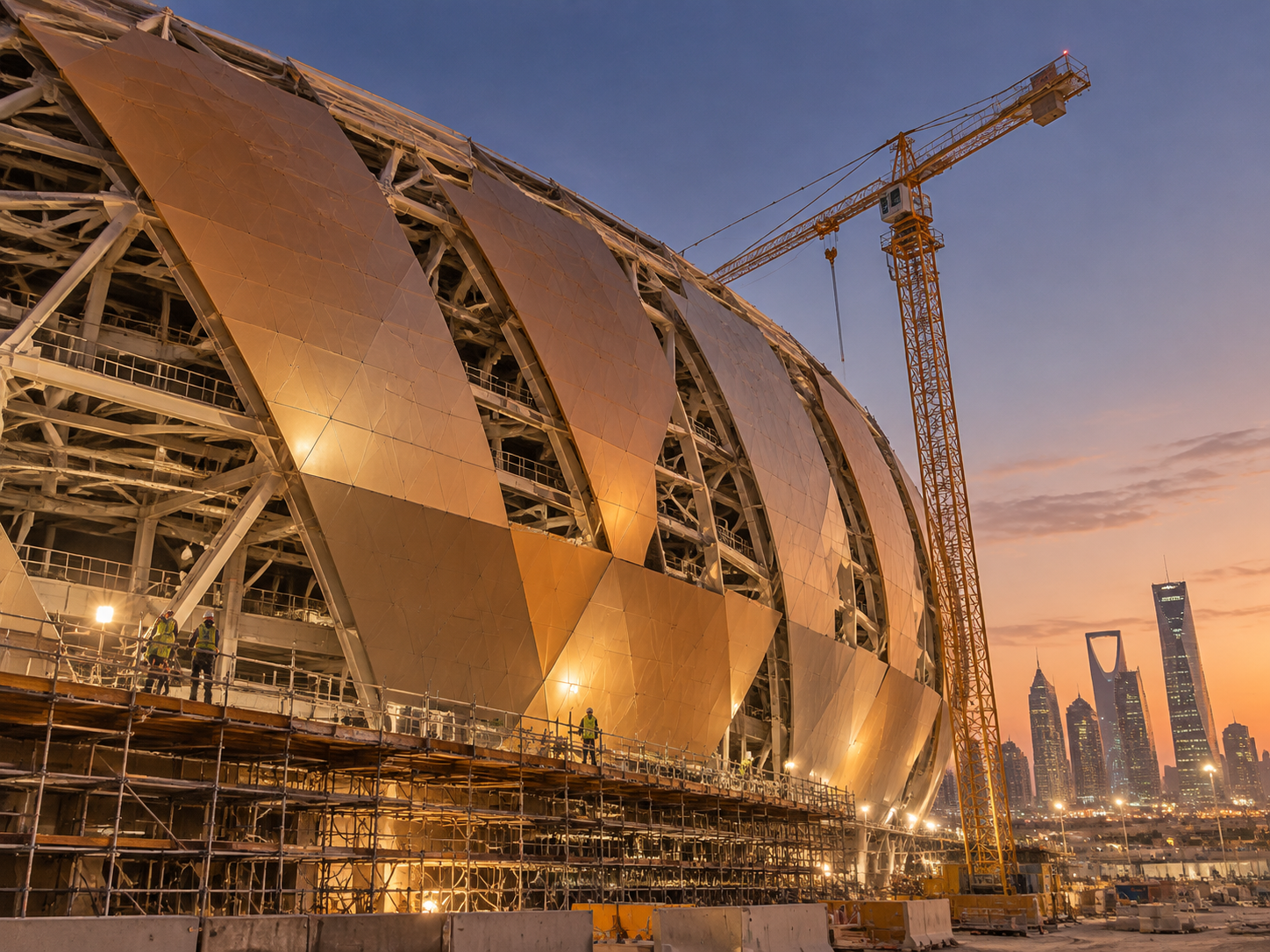
The building envelope is the most direct fastener market in the Saudi project pipeline. Stadiums, arenas, transit facilities, warehouses, data-center shells, industrial buildings, labor accommodation and retail assets all need metal roofing, wall cladding, sandwich panels, flashings, gutters, louvers and penetrations.
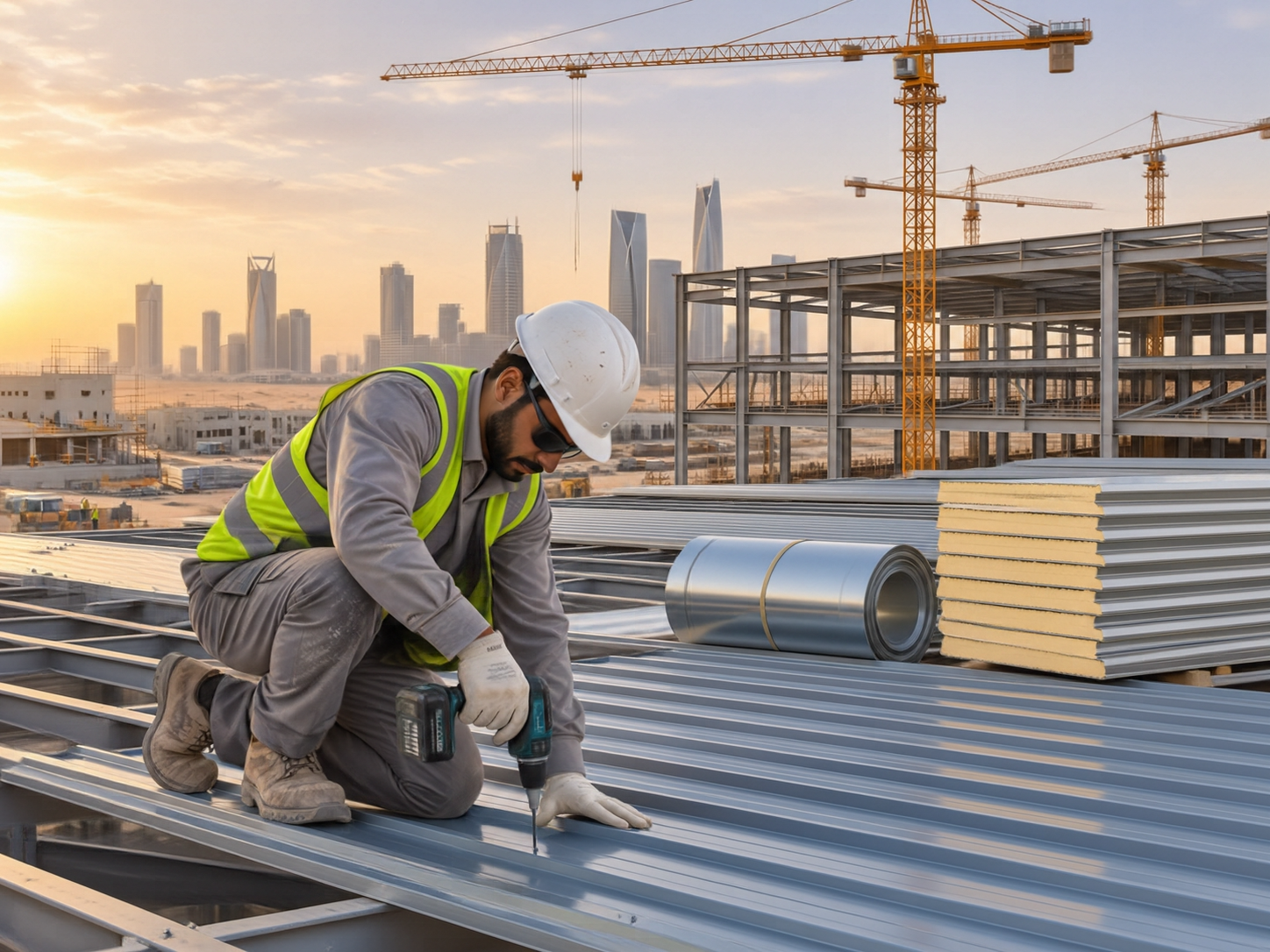
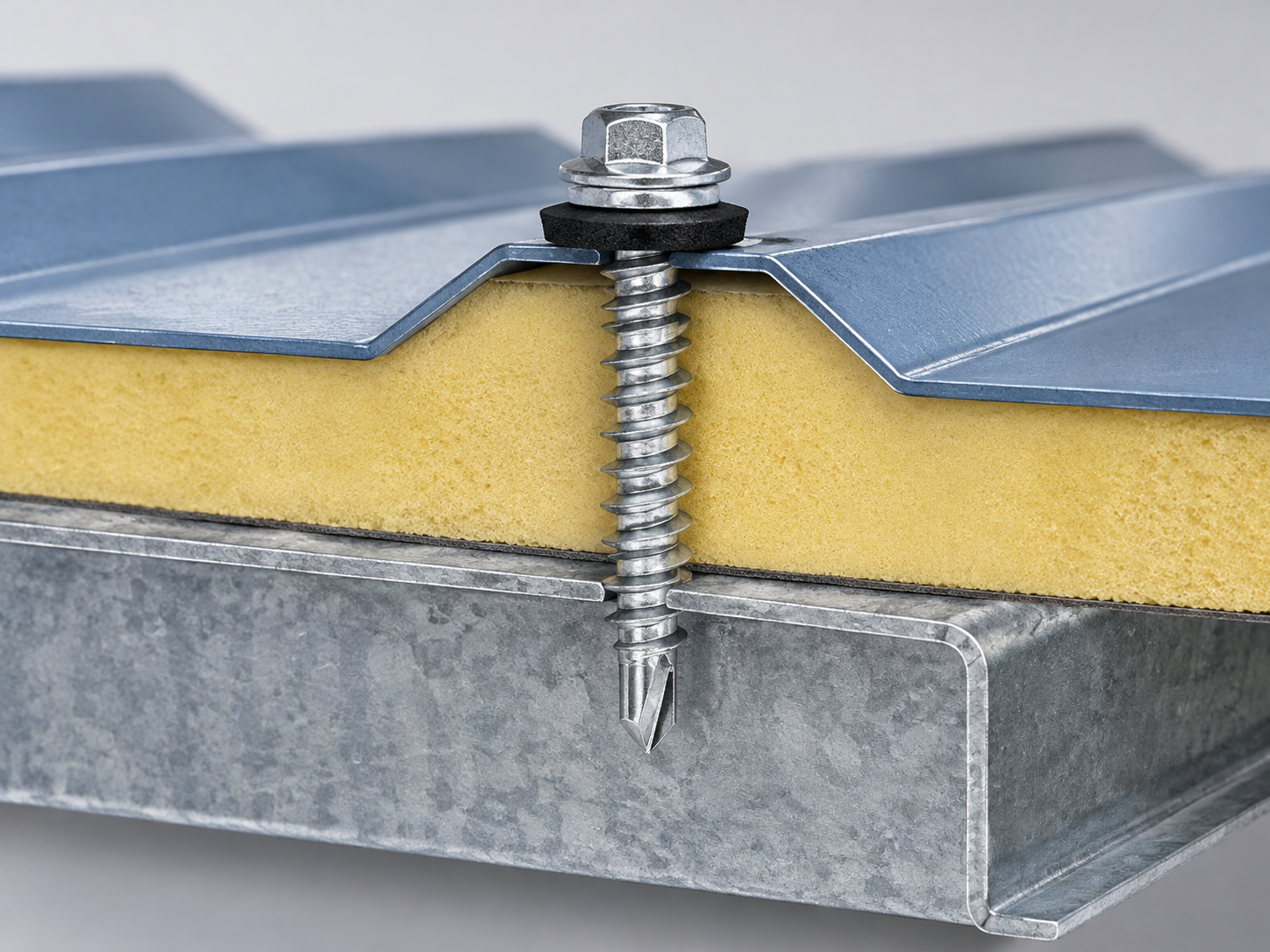
Exposed-fastener metal roofing relies on self-drilling screws with sealing washers. Standing seam roofing uses concealed clips, so it does not generate the same screw count per square meter. That distinction matters when a supplier tries to convert roofing area into fastener demand: a large standing-seam roof can be a smaller screw opportunity than a smaller exposed-fastener roof.
The variables that decide the fastener are familiar, but they are often missing from an RFQ:
- the panel profile, rib height, material and thickness;
- the purlin or girt material, grade and thickness;
- the insulation, underlayment or acoustic layer in the compressed stack;
- the wind-uplift and thermal-movement requirements;
- the exposure: coastal salt, inland dust, high UV or conditioned interior;
- the washer compound, metal backing and head geometry;
- the installation tool, torque control and access.
"TEK 5" is a useful starting description, not a complete specification. Two screws with the same point number can differ in point geometry, thread form, case hardness, coating, washer and usable length. A supplier that quotes only the point number is asking the buyer to fill in the rest of the connection.
For coastal projects on the Red Sea or the Gulf, the material system deserves separate attention. A coated carbon steel screw, a 410 stainless screw and a bi-metal screw with a hardened drill point are not interchangeable across all exposures. The right choice depends on what must be drilled, how thick and hard the substrate is, what remains exposed, and what evidence the supplier can provide for the exact item.
PEB, light steel and construction-support buildings
Pre-engineered buildings, warehouses, factories, logistics facilities, labor camps, site offices and modular buildings create demand before the permanent envelope is complete.
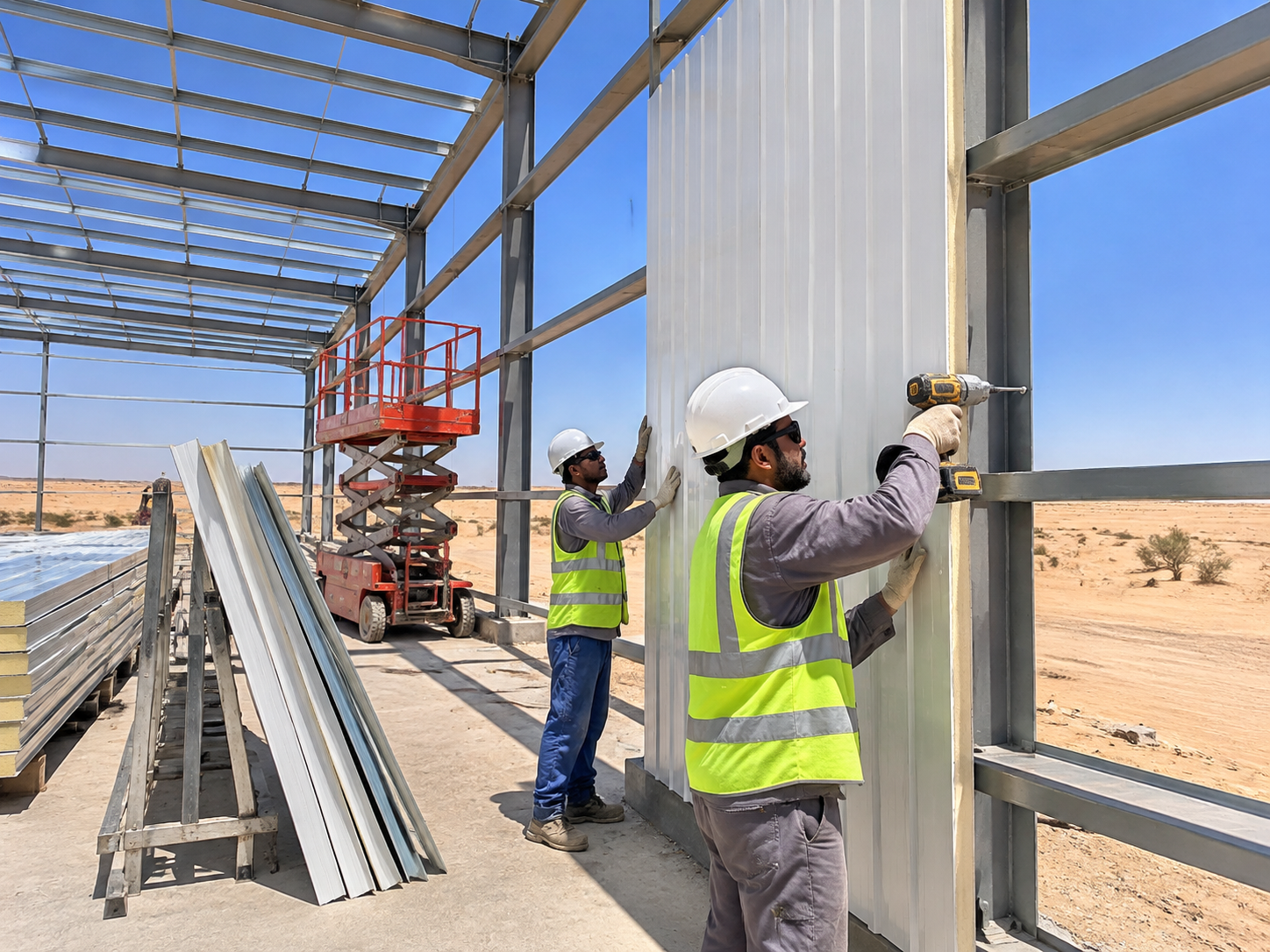
This is an important timing point. Construction camps and temporary facilities are often procured early, while the main package is still in design or mobilization. A supplier that only tracks the headline project may miss the first order. A supplier that tracks the enabling works, site establishment and early packages may find a more accessible buyer.
The fastener scope in a PEB package is usually secondary framing and envelope, not the primary structural connections. Primary steel connections are normally bolted to the engineer's specification. Self-drilling screws are used for cladding, sandwich panels, light-gauge framing, flashings and similar assemblies. That distinction should be explicit in the quotation; a supplier that implies its screws replace structural bolts is creating a technical and liability problem.
Length selection is the most common failure point. The required length is not the panel thickness. It is the compressed stack plus drill-point allowance, substrate engagement, washer compression and installation tolerance. A longer screw is not automatically safer: it can bottom out, expose a point on the underside, damage a finished surface or change the clamp condition.
MEP, HVAC and district cooling
MEP packages are less visible than the building envelope, but they are a steady fastener market. Ductwork, hangers, supports, access panels, plant-room framing, pipe bridges, cable tray and district-cooling equipment all use self-drilling and self-tapping screws in sheet-metal assemblies.
The technical questions are different from roofing:
- Is the screw supporting a static load or a vibrating assembly?
- Will the fastener be exposed to condensate, cleaning chemicals or outdoor air?
- Is there enough clearance for the head and tool?
- Does the duct sealant or insulation system require a specific fastener or washer?
- Is the connection part of a fire-rated or pressure-critical assembly?
Expo 2030 Riyadh is a useful example of where these packages appear. The official programme reports that more than 70% of the main utility corridors are complete, the Saudi Arabia Pavilion main-contractor tender was issued ahead of an anticipated award in the fourth quarter of 2026, and major packages are progressing for the Iconic Landmark, the Souq buildings and the district-cooling plants.
District cooling is particularly relevant. It combines large plant rooms, insulated pipework, sheet-metal enclosures, supports and electrical infrastructure. The fastener value is not in one dramatic application; it is in the hundreds of small connections that must survive heat, vibration and service access.
Data centers and electrical infrastructure
Data centers have become one of the strongest adjacent demand stories in the Gulf. MEED tracks more than 174 active and planned data-center projects across the GCC with a combined value above USD 93 billion, including DataVolt's USD 5 billion, 1.5 GW campus at Oxagon in NEOM and AWS's USD 5.3 billion investment in a Saudi infrastructure region.
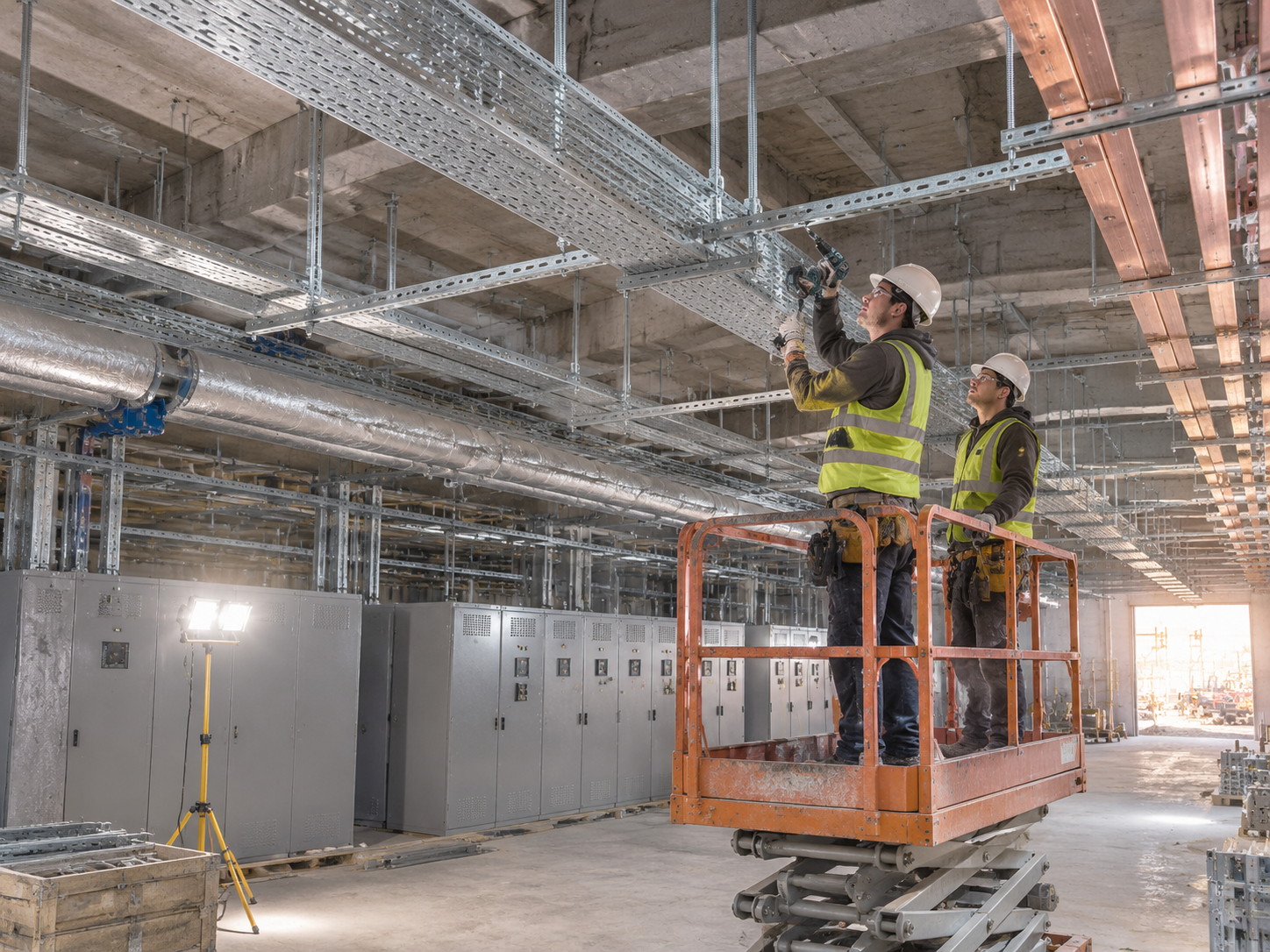
For a fastener supplier, "data center" is not a product category. It is a set of assemblies:
- cable tray and busbar supports;
- switchgear and control-panel enclosures;
- cooling units, ducts and raised-floor supports;
- modular walls, ceilings and clean-room partitions;
- equipment skids, access platforms and security enclosures.
The approval criteria are likely to include load, vibration, grounding and bonding, fire performance, finish and cleanliness. A standard roofing screw may be technically adequate for a simple cable-tray support, but it is not automatically approved for a bonded or fire-rated assembly. The supplier should ask which assembly the fastener enters, not simply which building type the project is.
Data-center construction also has a longer lead time than the headline suggests. A campus announced in 2026 may place structural and MEP orders in 2027 and 2028. That makes it a good target for prequalification and sample approval, not for a 2026 volume forecast.
Solar and renewable-energy mounting
Saudi Arabia's renewable-energy programme adds another fastener pocket: utility-scale solar, rooftop solar, green-hydrogen projects and hybrid installations.

The fastener questions are similar to roofing but more demanding on waterproofing and dissimilar-metal contact:
- How is the rail or bracket fixed to the purlin, and what is the purlin thickness?
- Is the roof membrane or panel penetrated, and how is the penetration sealed?
- What wind uplift and thermal movement must the assembly resist?
- Are stainless, galvanized and aluminum components in contact?
- What coating or material is required for the coastal or desert exposure?
Solar mounting often uses hanger bolts, bi-metal screws, stainless screws and sealing washers in combinations that are not interchangeable with a standard roofing screw. The supplier should ask for the mounting drawing and the bill of materials, not just the screw size.
Fit-out, retrofit and event venues
The final demand pocket is the one that arrives last: fit-out, retrofit and event-related works.
Hotels, museums, retail, stadium hospitality, Expo pavilions, temporary structures and existing-building upgrades need partitions, ceilings, façade elements, fixtures, signage and services. These assemblies use different screws from the envelope: drywall screws, self-tapping screws, light-gauge framing screws, countersunk heads and decorative finishes.
Retrofit work is also significant in Saudi Arabia's industrial cities and older commercial buildings. A retrofit roof may add insulation, a new panel or a sub-purlin; an HVAC upgrade may add supports and access platforms. The fastener scope is small per square meter but highly variable, and the cost of a callback is high.
Event deadlines compress the approval cycle. A supplier that can provide a sample, a trial assembly and a batch-consistent production slot before the package is awarded has a real advantage over one that quotes a catalogue price and waits for a purchase order.
What Saudi projects demand from a fastener supplier
The connection, not the product name
A credible quotation starts with a section drawing, not a product name.
The supplier should be able to mark every layer from the exposed face to the far side of the substrate: panel, underlayment, insulation, batten, existing roof, purlin or girt, washer and head. Then it should confirm:
- the substrate type, grade and thickness;
- the drill point and thread form;
- the nominal and usable length;
- the required engagement;
- the washer and head geometry;
- the installation tool and torque control;
- the trial-assembly method.
If the buyer cannot provide a drawing, the supplier should provide a template and ask for the missing dimensions. A quotation that assumes the connection is not a quotation; it is a guess with a price attached.
Corrosion and climate evidence
Saudi Arabia is not one environment.
The Red Sea coast, Jeddah, Yanbu, Jubail and the Eastern Province combine humidity, salt and industrial emissions. Riyadh and the interior combine high UV, heat, dust and large day-night temperature swings. Conditioned interiors, shaded car parks and process areas have different exposure again.
Salt-spray hours are useful for comparing coatings under a defined test, but they are not a service-life prediction. The test cycle, salt concentration, scribe condition, coating thickness, adhesion and the actual exposure all affect the result. A supplier that says "1,000 hours salt spray, therefore 20 years" is making a claim the test does not support.
The material system should be selected for the environment, not for a grade name. 304, 410, 316, bi-metal, hot-dip galvanized, zinc-aluminum and organic coatings each have a place. The supplier should state what it can prove for the exact item, and the project team should confirm the acceptance criteria.
Washers, heads and panel profiles
The EPDM washer is often treated as a low-cost accessory. In service, it may be the component that decides whether the joint stays sealed.
The washer compound, metal backing, bond between rubber and metal, diameter, thickness and compression set all matter. So does the head: a hex washer head, pan head, truss head or countersunk head changes the bearing area, the tool access and the way the fastener sits against the panel.
A washer that is too small may not cover the hole or distribute the load. A washer that is too large may not seat correctly on a narrow rib. Over-driving crushes the washer and can split the panel; under-driving leaves the seal incomplete. The installation method is part of the fastener specification.
Batch, traceability and packaging
Saudi project buyers increasingly ask for evidence that the product shipped is the product approved.
A practical submittal package includes:
- the product data sheet and drawing;
- the material and coating specification;
- the relevant test reports and their scope;
- the origin and HS code;
- the batch or lot identification;
- the packaging and label format;
- the sample retention and pre-shipment inspection plan.
Packaging is not a back-office detail. A carton that survives a humid port, a hot site container and a dusty laydown area protects the coating and the washer. Mixed-SKU containers, pallet configuration, carton marking and moisture protection should be agreed before the order, not after the first shipment.
SABER, SASO and the importer's role
Saudi Arabia's SABER platform, operated under the SASO conformity framework, links product conformity to customs clearance. The Saudi importer registers the product, classifies it by the current Saudi customs code, works with an approved conformity assessment body and obtains the applicable product and shipment certificates for regulated products.
Two mistakes are common.
The first is to assume that all fasteners require the same SABER treatment. The second is to assume that no fasteners do. The correct answer depends on the product, its HS classification and the technical regulation that applies. The supplier should provide accurate product data and test evidence; the importer and its conformity body should confirm the current requirement for the specific shipment.
SABER requirements and customs codes can change. The importer should confirm the current classification and declaration requirements for each shipment. A quotation that ignores these steps may look cheaper until the container reaches the port.
Local content and project prequalification
Local-content requirements vary by contract. Some giga-project packages require a local-content plan, a minimum percentage or evidence of in-Kingdom value add; others apply project-specific criteria. LCGPA and IKTVA are the reference frameworks, but there is no single percentage that applies to every tender.
For a fastener supplier, the practical questions are:
- Is the product on a mandatory local-content list for this tender?
- Does the contractor need a Saudi-registered supplier or a local manufacturing partner?
- What evidence is required for the local-content score?
- Does the project require vendor prequalification, a sample approval, a factory audit or a specific test report?
Local content is not a substitute for technical compliance. A Saudi-made product that cannot meet the connection, coating or test requirement is not a solution. The strongest position is technical compliance plus a credible local-content path.
The 2026–2028 procurement calendar
The useful way to read the Saudi pipeline is by package stage, not by project announcement date.
| Programme | 2026 status | Fastener-relevant window | Caution |
|---|---|---|---|
| Expo 2030 Riyadh | Site works and utilities advancing; Saudi Pavilion tender Q4 2026; Souq, Iconic Landmark and district-cooling packages progressing | 2026–2028 envelope, MEP, fit-out | Package awards and subcontractor selection lag the programme announcement |
| Diriyah | USD 727.9 million of Diriyah Square hotel and residence contracts awarded; hotel packages in delivery | 2026–2028 façade, MEP, fit-out (indicative) | Luxury finishes and sample approval slow the substitution path |
| Qiddiya | Six Flags opened 31 December 2025; Aquarabia opened April 2026; more assets through 2029 | 2026–2029 venue, MEP, façade, fit-out | Operating assets are not the same as future construction packages |
| Red Sea and AMAALA | Resorts opening through 2026, including Four Seasons and Raffles on Shura Island | 2026–2028 fit-out, façade, exterior and marine works | Remote logistics and coastal corrosion |
| NEOM | The Line construction suspended in September 2025 after 2.4 km; Oxagon and data-center components prioritized | 2027–2028 data-center and MEP packages | Rescoping is active; confirm the package, not the brand |
| 2034 FIFA World Cup | 15 stadiums in the bid, including 11 new builds; construction expected to accelerate later in the decade | 2027–2032 | Design and procurement now; not a 2026 order |
| Data centers | 174+ GCC projects; Oxagon, AWS and HUMAIN-linked capacity | 2027–2028 | OEM and contractor-led approval; long lead times |
The calendar sends a clear message: 2026 is a year for qualification, sampling and package tracking, not for assuming that every announced project is buying screws now.
A Saudi project RFQ checklist
A good RFQ does not ask for "the best price for self-drilling screws." It gives the supplier enough information to quote a system.
| # | Input | Why it matters |
|---|---|---|
| 1 | Project location and exposure | Coastal, inland, industrial or interior changes the material and coating |
| 2 | Connection drawing or section | Defines the compressed stack and the usable length |
| 3 | Substrate type, grade and thickness | Determines drill point, thread and engagement |
| 4 | Panel, profile and insulation | Controls head seating, washer compression and length |
| 5 | Screw type, point, thread, diameter and length | Prevents catalogue substitution |
| 6 | Washer and head specification | Sealing, bearing and tool access |
| 7 | Material and coating system | Corrosion and UV performance |
| 8 | Standard and test-report requirement | Makes the acceptance criterion explicit |
| 9 | Sample and trial-assembly requirement | Catches installation problems before the bulk order |
| 10 | Packaging, labeling and batch traceability | Protects the product and supports project records |
| 11 | Quantity, SKU mix and container plan | Avoids partial shipments and excess stock |
| 12 | Delivery, Incoterms and quote validity | Makes freight and cost escalation visible |
| 13 | HS code, SABER and local-content requirements | Prevents a customs or tender surprise |
| 14 | Warranty, spare parts and after-sales path | Defines what happens after installation |
If the project is still at tender stage, the supplier can quote a budgetary system with clearly stated assumptions. If the project is at award stage, the supplier should quote a frozen specification and a trial-assembly plan. Mixing the two is how optimistic budgets become expensive variations.
Mistakes that make a Saudi quote look amateur
- Quoting the headline project value as demand. A USD 1 billion project does not buy USD 1 billion of fasteners, and the owner is rarely the buyer.
- Using one "Saudi specification" for the whole country. Coastal salt, inland heat and conditioned interiors are different environments.
- Selling on "TEK 5" alone. The point number is a starting description, not the full connection.
- Ignoring the washer and panel interaction. The seal and the clamp are part of the system.
- Treating salt-spray hours as service life. The test is a comparison tool, not a warranty.
- Assuming every screw needs SABER—or that none does. Check the HS code and the current technical regulation.
- Leaving local content and prequalification until after the price is agreed. They can change the supplier, the documentation and the delivery path.
- Quoting a fixed price with no freight, coating or raw-material assumption. Saudi projects are long-cycle; cost inflation and shipping routes can move.
- Offering "project grade" without evidence. A project buyer will ask for the data sheet, the test report and the batch record.
- Forgetting the mixed-SKU reality. A project needs several lengths, heads and washers; a single-SKU quote creates replenishment problems.
How ScrewTrade fits
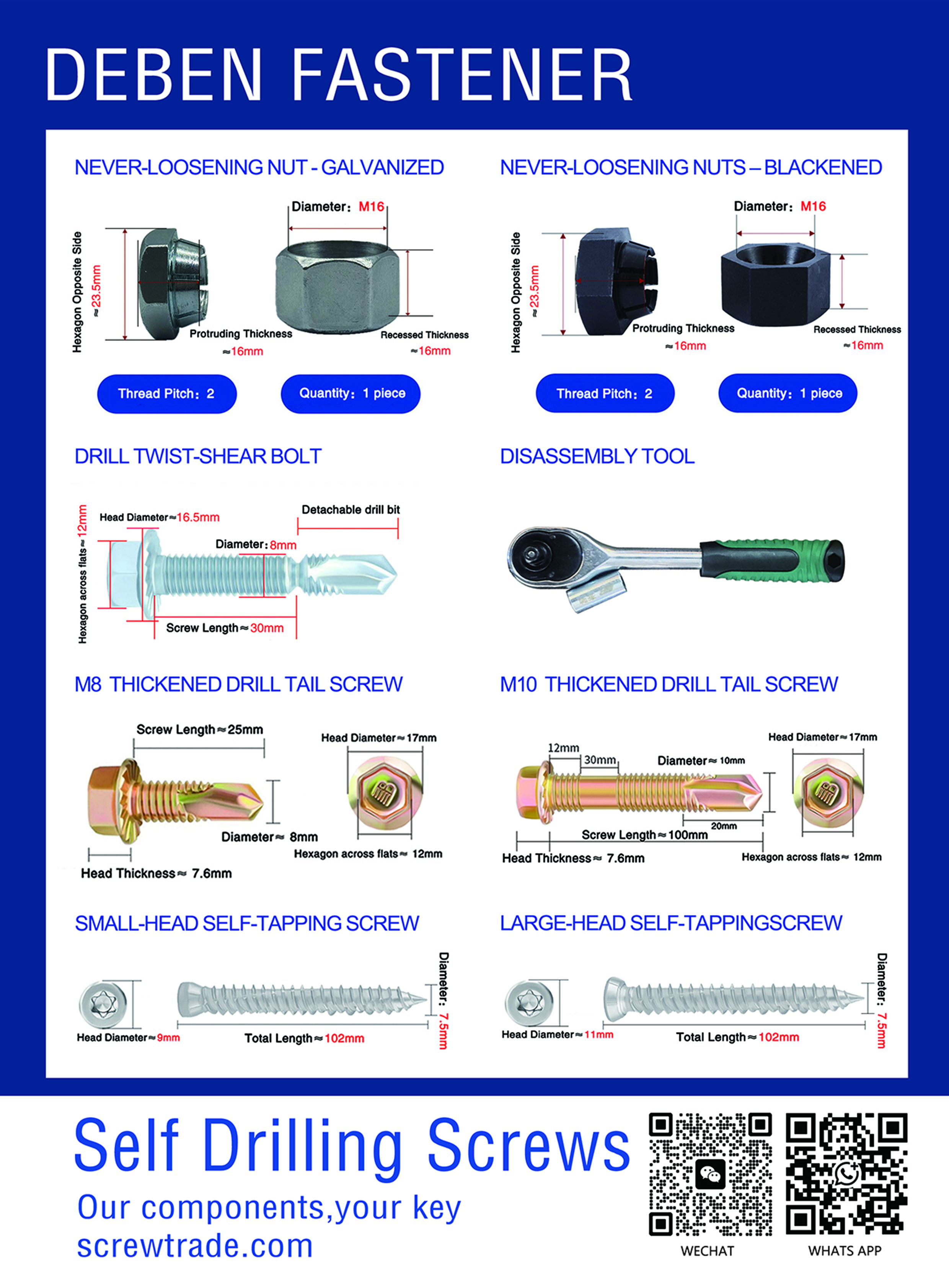
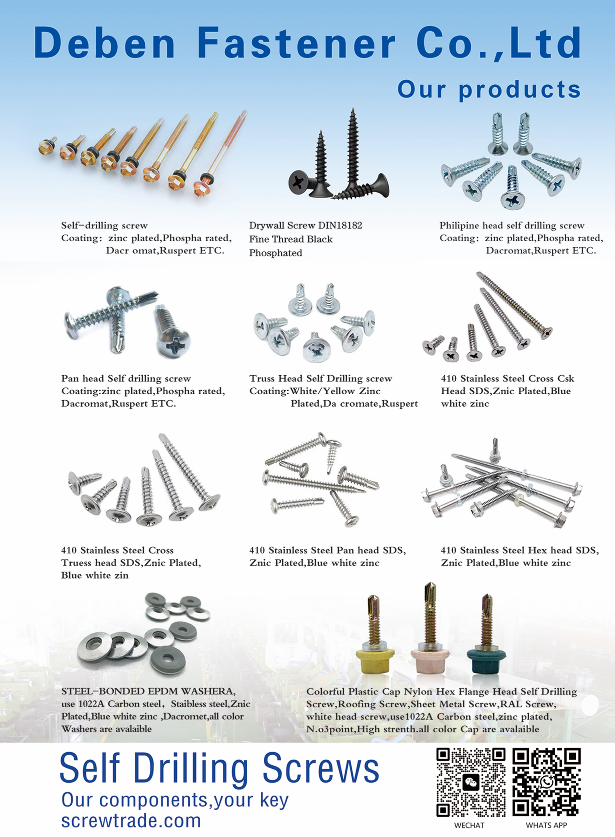
ScrewTrade supplies self-drilling and self-tapping fastener families used in metal roofing, wall cladding, sandwich panels, PEB, HVAC, electrical support and solar mounting. The public product range includes:
- Farmer screws for metal roof and wall applications;
- Hex head self-drilling screws assembled with EPDM washers;
- Sandwich panel screws;
- Weather-resistant coated TEK 5 hex washer head self-drilling screws;
- Bi-metal self-drilling screws;
- Solar mounting system wood-thread hanger bolts.
The public product pages state carbon steel or stainless steel options, zinc-plated or customized finishes, a 4.0–12.0 mm diameter range, a 16–150 mm length range, OEM/ODM support, bulk carton or pallet packaging, sampling and batch-traceability support. These are product-family descriptions, not a project approval or a guarantee for a specific connection.
For a Saudi project, the useful starting point is a short technical brief:
- the connection drawing and substrate;
- the panel, insulation and washer;
- the exposure and required coating;
- the target quantity and SKU mix;
- the destination port and required delivery date;
- the HS code, SABER and local-content requirements;
- the sample and test-report requirements.
ScrewTrade can then coordinate specification matching, sampling, packaging, batch records and mixed-container planning. It does not replace the project's technical reviewer, the importer's conformity body or the contractor's approval process. Those approvals remain part of the project.
If you are preparing a Saudi or GCC project package, send the drawing, the application and the delivery plan to ScrewTrade's contact page. A useful quotation starts with the connection, not the catalogue.
FAQ
Are Saudi mega projects still worth targeting in 2026?
Yes, but target packages rather than headlines. The pipeline is large, while awards and steel demand show deferral and rescoping. The suppliers that track package awards, subcontractor selection and sample approval will see the demand earlier than those waiting for a project-level purchase order.
Which fasteners are used most on Saudi projects?
It depends on the package. Exposed metal roofing and cladding use self-drilling screws with EPDM washers. PEB and light steel use self-drilling screws for cladding and secondary framing. Sandwich panels use panel screws with sealing washers. MEP and electrical works use self-drilling and self-tapping screws in sheet-metal assemblies. Coastal and high-corrosion exposures may require stainless or bi-metal options.
Is one coating enough for every Saudi project?
No. Coastal salt, inland UV and dust, industrial emissions and conditioned interiors produce different corrosion profiles. The coating system should be selected for the exposure and supported by test evidence for the exact product.
Do all fasteners need SABER?
No. SABER applies to regulated products under the relevant technical regulation. The importer should confirm the current requirement for the specific HS code and shipment. The supplier's job is to provide accurate product data, test evidence and labeling.
What causes the most callbacks?
The most common causes are the wrong length, the wrong washer or head for the panel, over-driving or under-driving, and a material or coating that does not match the exposure. The screw itself may be correctly manufactured and still fail the assembly.
How early should a supplier quote?
At tender or subcontractor-selection stage, often 6–18 months before site installation. Early quoting allows sample approval, trial assembly and production scheduling. A quote requested after the package is awarded leaves little room for technical review.
Conclusion
Saudi Arabia's mega projects will continue to create fastener demand through 2030 and beyond. The pipeline is too large, and the construction programme too central to Vision 2030, for the market to disappear. But the 2026 market is not a repeat of the announcement years. It is a market of phased awards, rescoped packages, rising costs and stricter documentation.
For fastener suppliers, that is actually an opportunity. When the market was driven by headlines, anyone with a catalogue could claim to be a project supplier. When the market is driven by packages, the advantage moves to suppliers that can read the connection, prove the coating, control the batch, package for the site and deliver the right mix on time.
The headline is the pipeline. The order is in the detail.
Related News
Other news you might be interested in

Peta Permintaan Pengencang 2027: Pusat Data, Energi, dan Proyek Industri
Prospek pengencang 2027 bukanlah pemulihan yang luas. Ini adalah peta kantong-kantong proyek—dan kantong terkuat adalah pusat data, energi, dan pekerjaan industri tertentu. Arahnya sudah terlihat dari hasil perusahaan pada akhir tahun 2026. Hilti melaporkan pertumbuhan penjualan mata uang lokal sebesar 5,9% dalam delapan bulan pertama tahun 2026, dengan pertumbuhan dua digit di Amerika dan Asia Pasifik, sementara menggambarkan konstruksi tradisional sebagai lemah. Penjualan kedirgantaraan LISI naik 14,3% dalam sembilan bulan pertama, tetapi penjualan otomotifnya turun 5,2%. Penjualan kuartal ketiga Bossard tumbuh 12%, didukung oleh permintaan pusat data di Amerika dan ekspansi semikonduktor serta elektronik di Asia.

Apa itu Sekrup Bi-Logam dan Mengapa Atap Aluminium Membutuhkannya?
Sekrup bi-logam adalah satu pengikat yang terbuat dari dua logam dengan fungsi berbeda. Dalam atap, konstruksi umumnya adalah kepala dan badan baja tahan karat dengan titik bor baja karbon keras dan ulir pemimpin. Bagian baja tahan karat menahan korosi pada atap yang terbuka; titik yang dikeraskan mengebor purlin baja, girt, atau rangka. Atap aluminium sering membutuhkan kombinasi ini ketika panel aluminium dipasang langsung ke substruktur baja, karena panelnya lembut dan tahan korosi, tetapi sekrupnya tetap harus mengebor baja dan bertahan dari cuaca. Bi-logam bukan jaminan: kelas baja tahan karat, kapasitas titik, lapisan, ring, dan detail aluminium-ke-baja masih harus ditentukan.
Want to know more?
Get in touch with us for more information about our services and products.