
Panduan Lapangan untuk Distributor: Memilih Panjang Sekrup Self-Drilling pada Retrofit Bangunan Logam dan Atap

Han Congming
PenulisKami berpengalaman dalam produksi dan penjualan sekrup serta pengencang, dengan fasilitas produksi sendiri dan kapasitas produksi skala besar yang stabil. Kami adalah spesialis sekrup bor mandiri, sekrup drywall, sekrup papan partikel, sekrup mesin, baut, dan pengencang khusus untuk aplikasi konstruksi dan industri.
Metal roofing remains a growth category in the United States. The Metal Construction Association’s 2026 market study forecasts about 4.775 billion square feet of U.S. metal roofing shipments in 2026, rising to 4.876 billion square feet in 2027 and more than 5.4 billion square feet by 2030. The same public summary indicates that roughly 96% of residential metal roofing activity is replacement or renovation, while standing seam accounts for more than 60% of metal roofing area—most of it a concealed-fastener system.
For distributors, that mix creates a practical counter question. The growth is real, but a large share of the work is retrofit. Retrofit roofs rarely arrive as a clean, single-layer drawing. They arrive as an existing panel, an old underlayment, a layer of insulation, a purlin that may not be straight, and a contractor asking for “the right length.”
At the same time, U.S. distributors are planning annual inventory against a split demand picture. Fastenal’s Q3 2026 release showed direct fastener and hardware daily sales up 16.8%, while AIA’s September Architecture Billings Index was 44.7, below the 50 mark that signals expansion. The lesson for a fastener distributor is not to stock every length in the catalogue. It is to stock a smaller number of clearly defined assemblies that match the jobs your customers actually run.
That is what this field checklist is for.
Key takeaways
- Screw length is a connection decision, not a catalogue lookup.
- The panel is only one layer. Existing roof, underlayment, insulation, battens, purlins and washers all change the required length.
- Nominal length and usable length are not always the same. Confirm how the supplier measures length.
- Steel purlins, wood purlins and mixed substrates need different point and thread logic.
- A trial assembly is cheaper than a callback.
- Distributors should build a “length matrix” by assembly, not a wall of every possible length.
Why retrofit projects expose length errors
A new-build roof can still go wrong, but a retrofit gives the buyer more places to hide an assumption.
The existing roof may have:
- an old exposed-fastener panel with laps that do not match the new panel;
- a recover system with an additional layer of panel or underlayment;
- insulation that has compressed unevenly;
- purlins that are out of line, corroded, or partially deteriorated;
- old fasteners left in place;
- a wall-to-roof transition, flashing or penetration that changes the local stack.
The three most common length mistakes are:
- Measuring only the new panel. The screw may pass through the panel but not develop the required engagement in the purlin.
- Copying the old fastener. The old screw may have been wrong for the original assembly, or the new panel and insulation may be different.
- Choosing “longer is safer.” A longer screw can bottom out, expose a point on the underside, damage a finished ceiling, buckle the panel, or change the clamp condition.
Length selection starts with a section drawing, not a catalogue page.
Draw the complete connection section
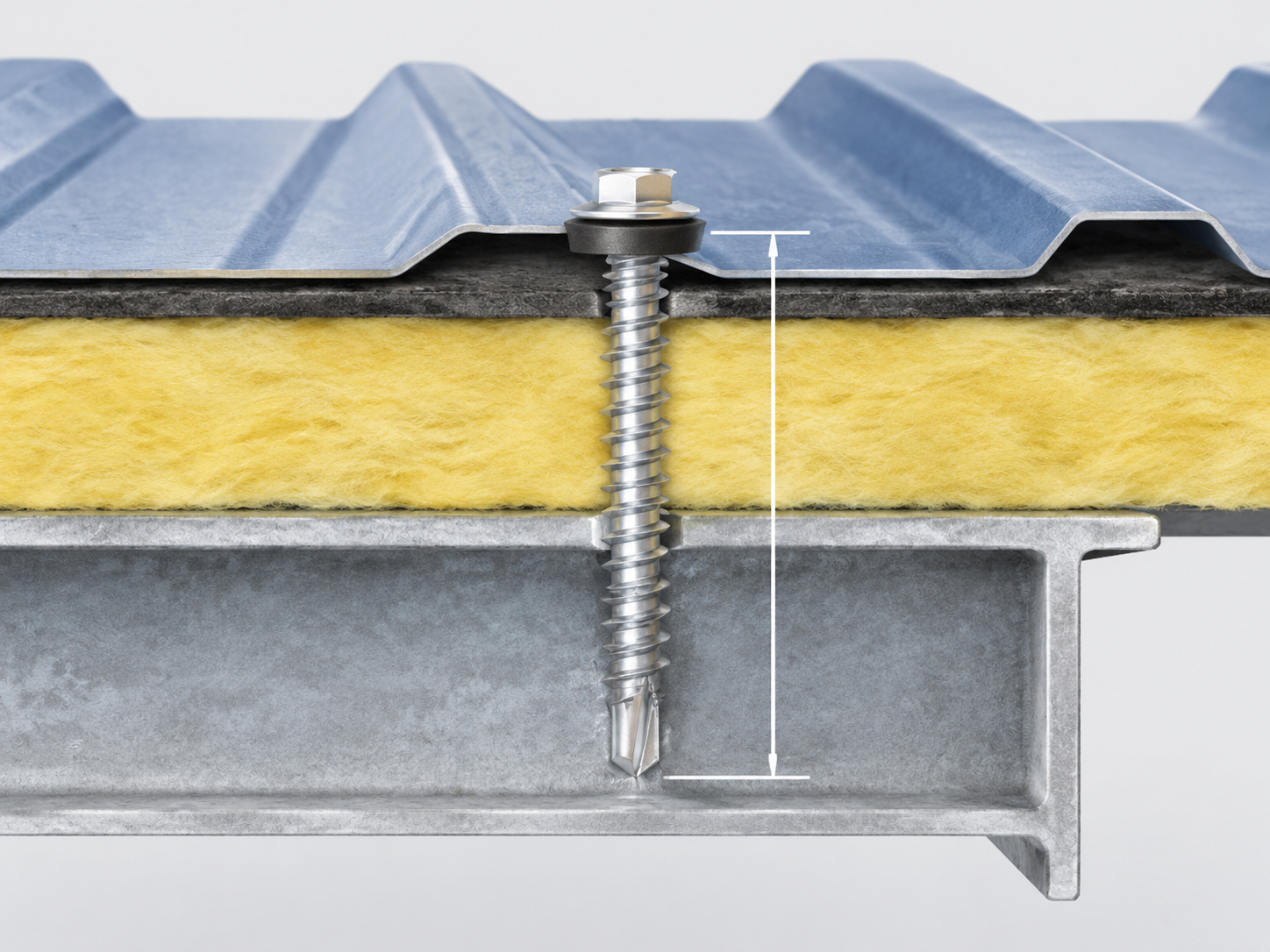
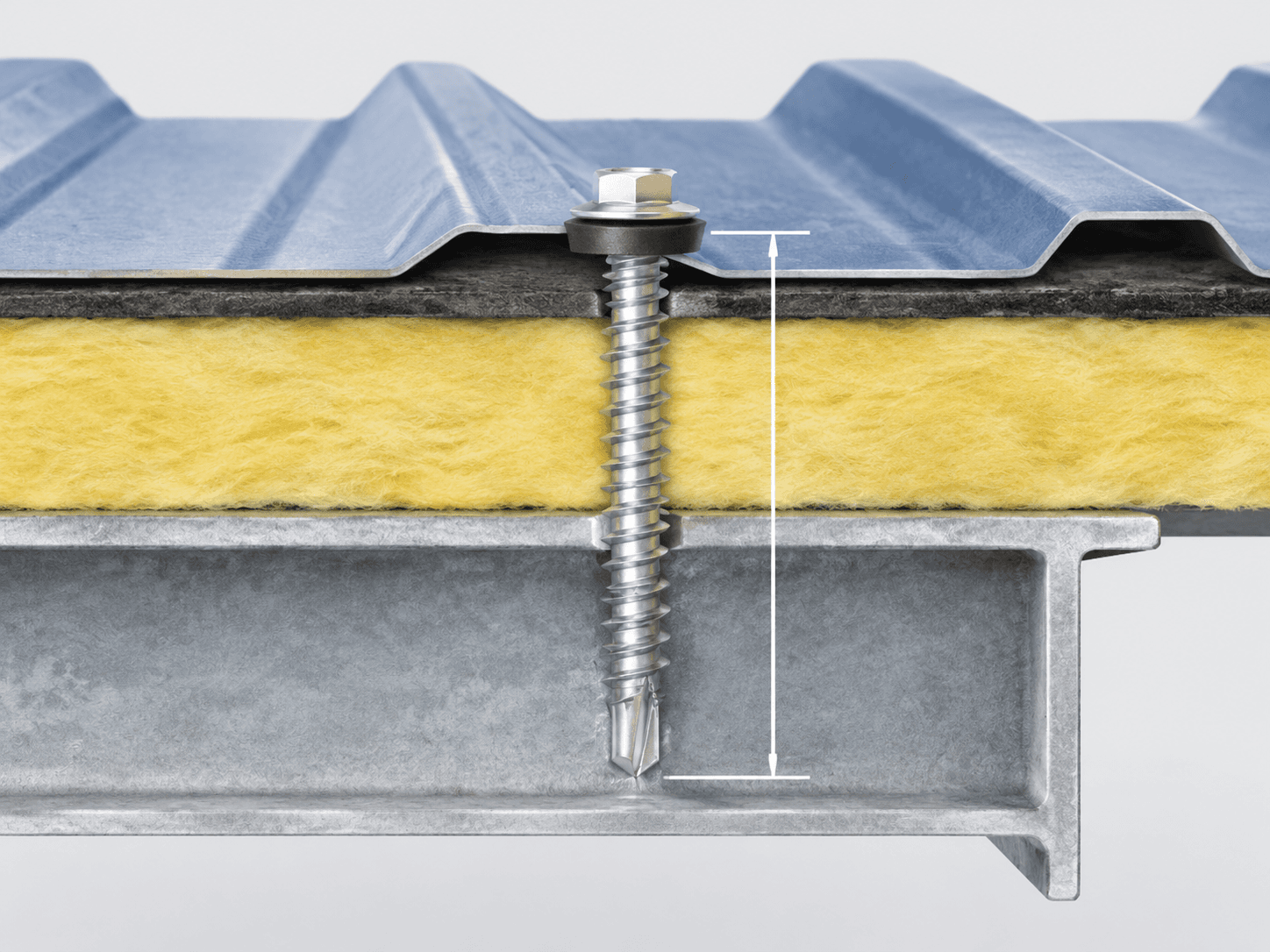
Before selecting a screw, draw the connection at the actual support. Mark every layer from the exposed face to the far side of the substrate. A useful section includes:
| Layer | What to record | Why it changes the length decision |
|---|---|---|
| Panel | Profile, material, thickness, rib height, lap condition | Determines bearing, sealing and how the head sits |
| Underlayment / membrane | Material and thickness | Adds stack height and may compress |
| Insulation | Type, thickness, density, facer | Changes compressed stack and washer support |
| Battens / spacers | Depth, material, spacing | Adds an explicit layer that cannot be ignored |
| Existing roof | Panel, membrane, old fasteners, condition | Adds unknown thickness and possible obstruction |
| Purlin / girt / substrate | Steel or wood, grade, thickness, condition | Determines drill point, thread and engagement |
| Washer / head | EPDM washer, metal backing, head style | Affects sealing, bearing and usable length |
| Installation | Tool, angle, access, control method | Affects seating and compression |
For a roof, measure at several points along the purlin line—not only at the eave. For a wall, measure at the girt and at any insulation or spacer condition. For a sandwich panel, measure the full panel thickness, including the core and both facings, and confirm how the washer will bear on the panel surface.
If the project is a retrofit over an existing roof, record whether the new screw will reach the original purlin or a new sub-purlin. A longer screw cannot correct a structural support problem. If the existing purlin is deteriorated, out of line, or not adequate for the new panel, stop and refer the condition to the project’s structural or technical reviewer.
Calculate usable length, not just nominal length
A self-drilling screw has to do several jobs with one length:
- pass through the panel and any intermediate layers;
- allow the drill point to start and cut;
- develop the required thread engagement in the support;
- leave enough thread for the washer and head to clamp the assembly;
- tolerate normal installation variation without bottoming out or leaving the joint loose.
A practical starting expression is:
Required length ≈ compressed stack thickness + drill-point allowance + required substrate engagement + washer compression allowance + installation tolerance
That is a planning expression, not a universal formula. Each term has to come from the panel system, the fastener supplier, the project specification, or a trial assembly.
Two details are easy to miss:
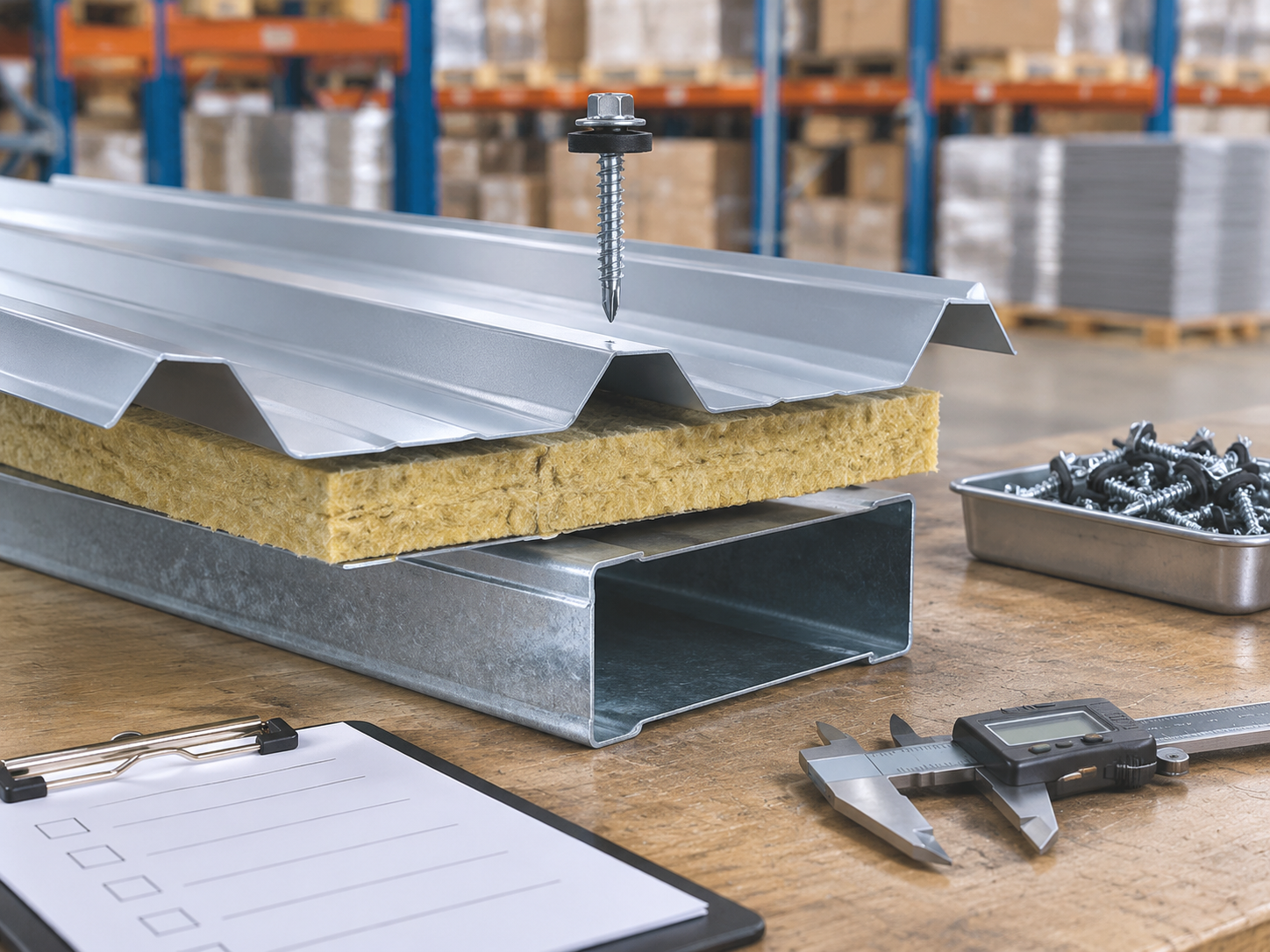
Nominal length versus usable length. Confirm whether the supplier measures length from under the head to the tip, or overall. This matters especially for countersunk heads and for screws with a drill point that occupies part of the nominal length. Two screws with the same nominal length may not have the same usable thread length.
Compression and tolerance. Insulation, underlayment and EPDM washers compress. A screw that looks correct on a loose stack may be too long or too short when the assembly is clamped. The trial should use the actual or representative materials, not a bundle of offcuts with different compression.
Do not use a single “one inch into the support” rule for every project. Required engagement depends on the substrate, the panel system, the screw design, the wind and structural requirements, and the applicable approval. The number belongs in the project documentation, not in a generic catalogue note.
Match the point and thread to the substrate
The drill point and thread are not interchangeable between steel, wood and mixed assemblies.

Steel purlins and girts
For a steel purlin or girt, the screw must drill through the panel and then drill and tap into the steel support. The point must suit the steel thickness, grade and hardness, and the thread must develop the required engagement.
A “TEK 5” or similar point designation is a starting description, not a complete specification. Two screws with the same point number can differ in point geometry, thread form, case hardness, coating and usable length. For a steel-to-steel roof or wall connection, confirm:
- the steel thickness range the point is intended to drill;
- the thread form and the intended support material;
- the panel thickness range;
- the required engagement beyond the support;
- the installation tool and control method.
Wood purlins
For a wood purlin, the fastener generally needs a wood-appropriate point and thread. A sharp wood point, often described as a Type 17 point, and a coarse thread are common in metal-to-wood roofing screws. But “Type 17” is not a complete approval. Confirm the wood species, moisture condition, treatment, purlin size and the required embedment.
Pressure-treated lumber adds another variable. The treatment chemistry, retention level and service condition can affect the corrosion risk to the entire metal assembly—not only the screw shank. The treatment label, washer, coating and any project hardware recommendation should be reviewed together.
Mixed and retrofit stacks
If the roof mixes timber and steel supports, do not assume one screw can serve both. Record each support condition separately and confirm a separate approved item where required. The same rule applies when a retrofit adds a new sub-purlin or a spacer: the screw that works at the new support may not be the screw that works at the original purlin.
Check the washer, head and panel profile together
Length is only useful if the head and washer can seat correctly on the panel.
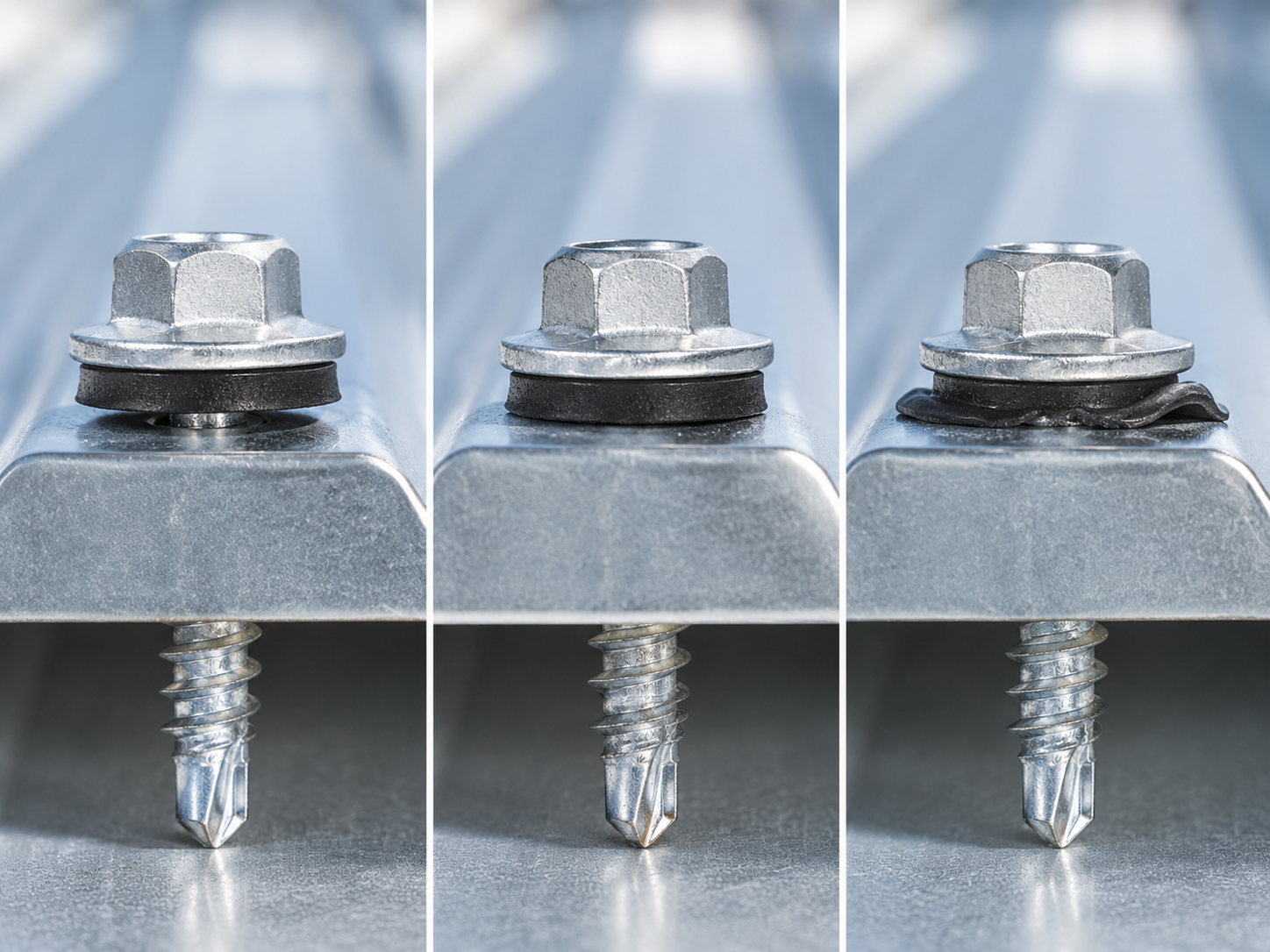
For exposed-fastener metal roofing, an EPDM washer is a performance component, not a free accessory. The washer creates the sealing interface around the penetration, accommodates small surface irregularities, and distributes load from the head. Its outside diameter, EPDM thickness, metal backing, bonding method and compression behaviour all matter.
A length that is correct for the screw may still be wrong for the assembly if:
- the washer is too large or too small for the panel rib;
- the head is too small for the panel bearing area;
- the washer is over-compressed and extruded;
- the washer is under-compressed and not sealing;
- the screw is angled, so one side of the washer lifts;
- the panel profile prevents the head from seating flat.
For wall panels and sandwich panels, the same logic applies with different risks. A wall panel may need a washer that seals against a vertical surface without deforming the panel. A sandwich panel may need a fastener that clamps the facings without crushing the core. The panel manufacturer’s approved fastener and installation details take priority over a generic length chart.
Run a trial assembly before the bulk order

A trial is the cheapest way to catch a length problem. Use the actual or representative panel, insulation, underlayment, purlin and washer. If production materials are not available, record the differences and treat the result as provisional.
Field trial checklist
- Identify the panel profile, material and thickness.
- Record the underlayment, insulation and any batten or spacer.
- Record the purlin or girt material, grade, thickness and condition.
- Confirm the screw reference, point, thread, diameter and nominal length.
- Confirm the washer type, dimensions and bonding.
- Use the intended tool, bit and control setting.
- Drive the screw at the specified angle and location.
- Observe drill start, hole formation, thread engagement and washer compression.
- Check for panel deformation, stripped threads, split timber, exposed point or insufficient engagement.
- Record the result, tool setting, photos and sample reference.
Stop and review if:
- the screw spins without developing engagement;
- the point does not start or walks on the panel;
- the washer is crushed, split or not sealing;
- the panel deforms around the head;
- the screw tip protrudes on the underside;
- the timber splits or the screw strips;
- the installed length does not match the drawing.
A successful trial proves only that the tested combination worked in the recorded conditions. It does not replace the panel approval, structural design or project-specific testing.
Build a distributor “length matrix,” not a wall of lengths
Distributors often stock by length because length is the easiest field to sort. The better unit is the assembly: a defined panel, substrate, insulation condition, screw, washer and installation method.
A simple matrix can look like this:

| Assembly ID | Panel / profile | Substrate | Insulation / existing roof | Screw point / thread | Nominal length | Washer | Coating | Approved reference |
|---|---|---|---|---|---|---|---|---|
| R-01 | Exposed R-panel, 0.5 mm steel | Steel purlin, 1.5 mm | None | Self-drilling steel point | To be confirmed | Bonded EPDM | Zinc / project finish | Sample and drawing |
| R-02 | Exposed R-panel, 0.5 mm steel | Steel purlin, 2.0 mm | 50 mm insulation | Self-drilling steel point | To be confirmed | Bonded EPDM | Zinc / project finish | Sample and drawing |
| W-01 | Wall panel, 0.5 mm steel | Steel girt, 1.5 mm | None | Self-drilling steel point | To be confirmed | Bonded EPDM | Zinc / project finish | Sample and drawing |
| S-01 | Sandwich panel, 50 mm | Steel purlin | Integral core | Sandwich panel screw | To be confirmed | Sealing washer | Project finish | Panel approval |
| T-01 | Retrofit over existing panel | Original purlin | Existing roof + new panel | Self-drilling steel point | To be confirmed | Bonded EPDM | Project finish | Site measurement |
The matrix does three things:
- It forces the sales team to ask for the section, not just the length.
- It gives the warehouse a way to label cartons by application, not only by size.
- It makes repeat orders comparable, because the same assembly can be quoted and inspected the same way.
For Q1 stocking, review the matrix against actual sales history and open projects. Keep depth in the assemblies that repeat. Keep flexibility in the long-tail lengths that only appear on occasional retrofits. A large length assortment can look like service, but it can also hide slow-moving stock, mixed washers and picking errors.
ScrewTrade’s published product pages list self-drilling screw diameter ranges of 4.0 mm to 12.0 mm and length ranges of 16 mm to 150 mm, with customizable dimensions, finishes and packaging. Those ranges are a starting point for a discussion, not a specification for a particular roof. The exact item still has to be matched to the panel, substrate, washer and project approval.
What to send with an RFQ
A useful RFQ gives the supplier enough information to confirm the assembly instead of guessing the length.
| RFQ field | What to provide |
|---|---|
| Project type | New build, retrofit, recover, repair or wall application |
| Panel | Profile, material, thickness, coating and manufacturer |
| Substrate | Steel purlin/girt or wood purlin; grade, thickness and condition |
| Existing roof | Layers, old panel, insulation, fasteners and condition |
| Complete stack | Panel, underlayment, insulation, battens, spacer and substrate |
| Screw | Product reference, point, thread, diameter, nominal length and head |
| Washer | EPDM specification, metal backing, dimensions and bonding |
| Exposure | Indoor, outdoor, coastal, industrial, humid or high-UV |
| Installation | Tool, bit, speed or clutch setting and access |
| Trial | Whether a sample or trial assembly is required |
| Packaging | Bulk carton, pallet, labels and mixed-SKU rules |
| Quantity | Quantity by assembly and expected replenishment |
If one field is unknown, leave it visibly open. Do not fill it with a value copied from another panel, another purlin or another supplier’s brochure. A good supplier will mark the unknown as a question, not hide it under a generic recommendation.
ScrewTrade supplies self-drilling and self-tapping screws for metal roof, wall and sandwich panel applications, including Farmer screws for metal roof and wall applications, hex washer head self-drilling screws assembled with EPDM washers, weather-resistant coated TEK 5 hex washer head self-drilling screws, and sandwich panel screws. For a specific retrofit, send the section drawing, panel profile, purlin or girt details, exposure condition and target quantity through the contact page.
Frequently asked questions
Can I use a longer screw if the purlin is deeper?
Not automatically. A longer screw may be necessary to reach the support, but it can also bottom out, expose a point, reduce thread engagement or change the clamp condition. Confirm the complete stack and the required engagement before changing length.
Is one inch of thread engagement in wood always enough?
No. Required embedment depends on the wood species, moisture, treatment, purlin size, screw design and project requirements. Use the panel approval, structural design or project specification rather than a generic rule.
Can the same screw be used for steel and wood purlins?
Usually not. Steel purlins and wood purlins need different point and thread logic. A screw designed for one substrate is not automatically suitable for the other.
How do I know the EPDM washer is compressed correctly?
The washer should be evenly seated against the panel without visible crushing, splitting or extrusion. The exact seating condition should follow the fastener and panel manufacturer’s instructions. A controlled screw gun and consistent technique matter more than maximum torque.
What if the existing roof has multiple layers?
Draw the section and measure the compressed stack at several points. Confirm that the new screw reaches the intended support and that the existing structure is adequate. If the support condition is uncertain, stop and refer it to the project’s technical reviewer.
Can a distributor stock by length alone?
Length alone does not define an assembly. Two screws with the same length can differ in point, thread, washer, coating and usable thread length. Stock and quote by the complete assembly wherever repeat business justifies it.
The length is part of the connection
In a retrofit, the screw length is not a number copied from a catalogue. It is the result of a section drawing, a substrate check, a washer decision and a trial assembly.
For distributors, the commercial benefit is straightforward: fewer wrong-length callbacks, fewer mixed-washer complaints, more comparable quotations and a stock list that reflects real jobs rather than every possible size. Start with the connection, write the assembly down, and let the length follow the evidence.
Related News
Other news you might be interested in

Peta Permintaan Pengencang 2027: Pusat Data, Energi, dan Proyek Industri
Prospek pengencang 2027 bukanlah pemulihan yang luas. Ini adalah peta kantong-kantong proyek—dan kantong terkuat adalah pusat data, energi, dan pekerjaan industri tertentu. Arahnya sudah terlihat dari hasil perusahaan pada akhir tahun 2026. Hilti melaporkan pertumbuhan penjualan mata uang lokal sebesar 5,9% dalam delapan bulan pertama tahun 2026, dengan pertumbuhan dua digit di Amerika dan Asia Pasifik, sementara menggambarkan konstruksi tradisional sebagai lemah. Penjualan kedirgantaraan LISI naik 14,3% dalam sembilan bulan pertama, tetapi penjualan otomotifnya turun 5,2%. Penjualan kuartal ketiga Bossard tumbuh 12%, didukung oleh permintaan pusat data di Amerika dan ekspansi semikonduktor serta elektronik di Asia.
Apa itu Sekrup Bi-Logam dan Mengapa Atap Aluminium Membutuhkannya?
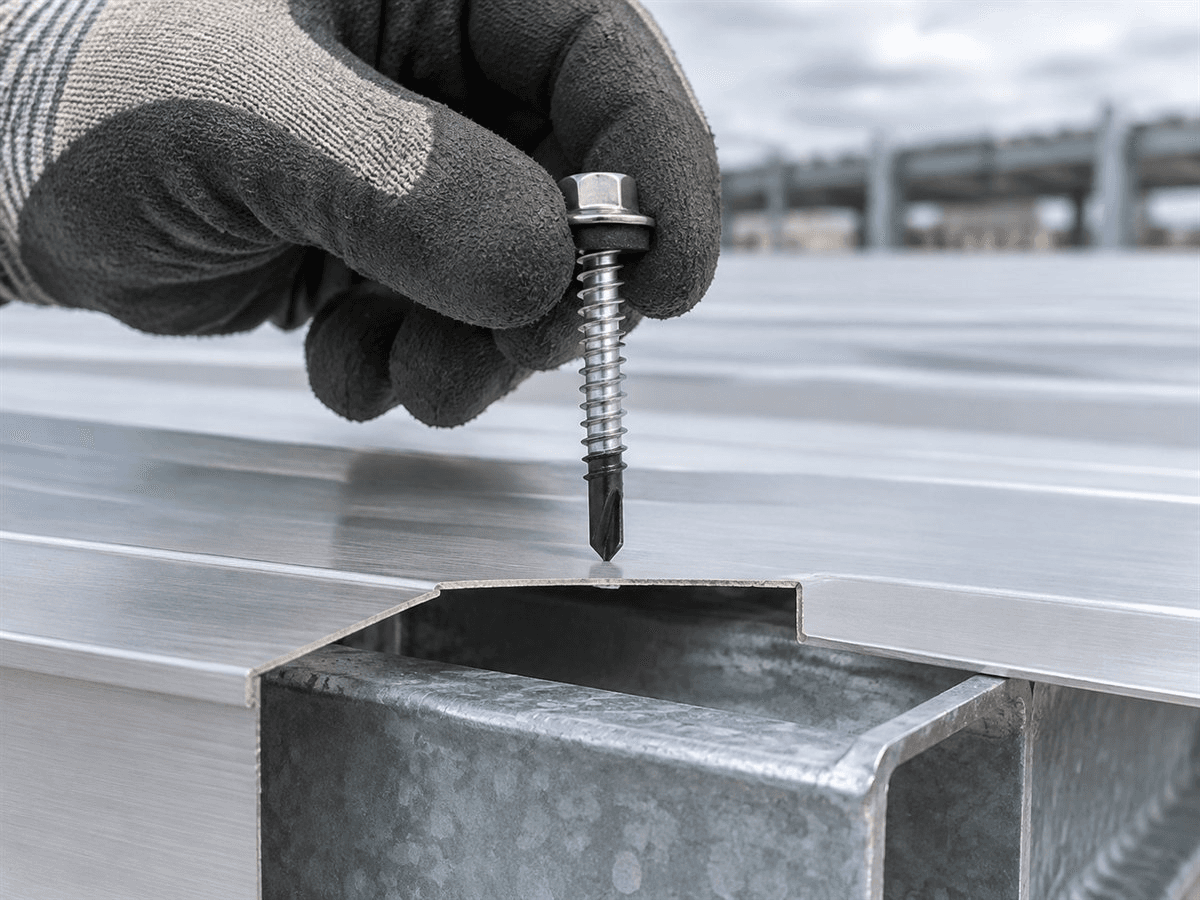
Sekrup bi-logam adalah satu pengikat yang terbuat dari dua logam dengan fungsi berbeda. Dalam atap, konstruksi umumnya adalah kepala dan badan baja tahan karat dengan titik bor baja karbon keras dan ulir pemimpin. Bagian baja tahan karat menahan korosi pada atap yang terbuka; titik yang dikeraskan mengebor purlin baja, girt, atau rangka. Atap aluminium sering membutuhkan kombinasi ini ketika panel aluminium dipasang langsung ke substruktur baja, karena panelnya lembut dan tahan korosi, tetapi sekrupnya tetap harus mengebor baja dan bertahan dari cuaca. Bi-logam bukan jaminan: kelas baja tahan karat, kapasitas titik, lapisan, ring, dan detail aluminium-ke-baja masih harus ditentukan.
Want to know more?
Get in touch with us for more information about our services and products.