
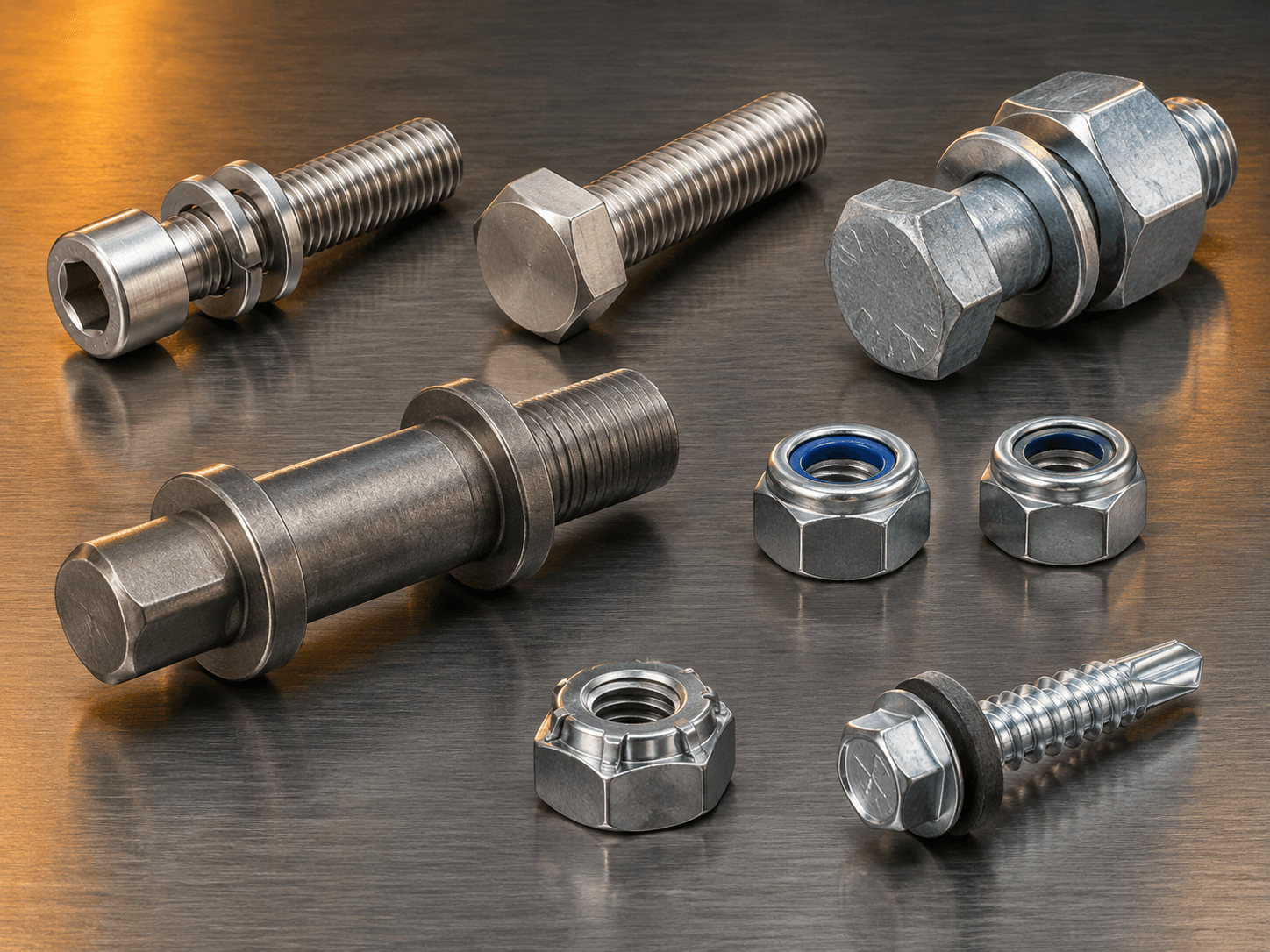
Mengapa Baut Anda Masih Longgar? Panduan Menggunakan Ring Pegas & Ring Pengunci

Han Congming
PenulisKami berpengalaman dalam produksi dan penjualan sekrup serta pengencang, dengan fasilitas produksi sendiri dan kapasitas produksi skala besar yang stabil. Kami adalah spesialis sekrup bor mandiri, sekrup drywall, sekrup papan partikel, sekrup mesin, baut, dan pengencang khusus untuk aplikasi konstruksi dan industri.
A bolt can leave the assembly line tight and be loose a week later without anyone touching it. The nut may still be in place. The washer may still be under the head. The joint has simply lost clamp load.
That distinction matters because spring washers and lock washers are often added at the end of the design process, as a small part expected to solve a large problem. Sometimes they help. Sometimes they hide the real cause. And for the common split spring washer, the test evidence is much weaker than the catalog description suggests.
This guide separates the failure mechanisms from the hardware names. It explains what each washer can and cannot do, how to choose by failure mode, and what to put in an RFQ before approving a bulk order.
Short answer: restore clamp load first, then choose the locking method
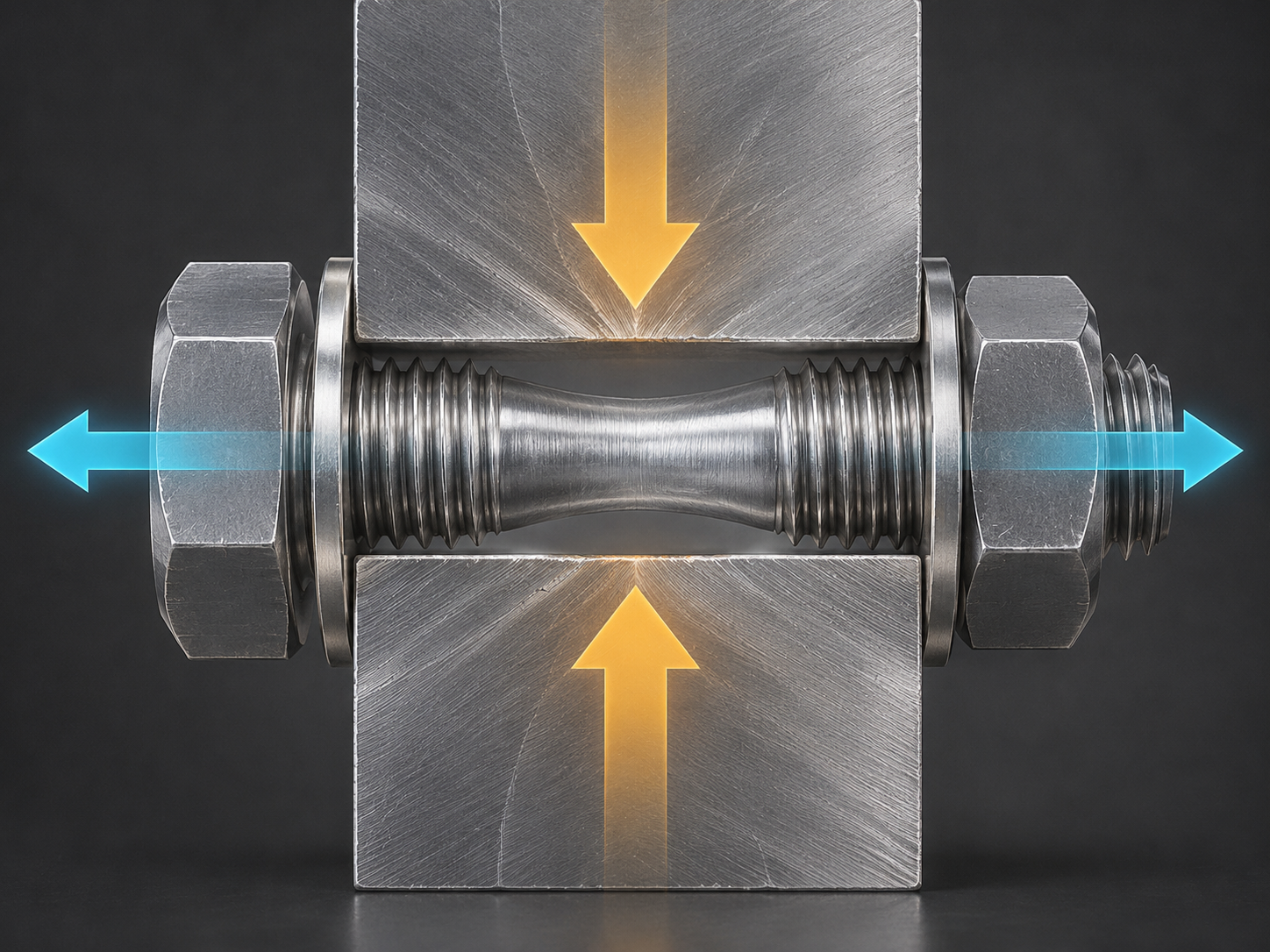
- A bolted joint holds because the bolt is stretched and the clamped parts are compressed. That tension is the clamp load.
- A bolt can lose clamp load by rotating (self-loosening) or without rotating (embedding, creep, thermal movement, insufficient preload).
- A spring washer adds a small spring force and, in some designs, a biting edge. A lock washer adds friction, biting, a wedge, or a positive tab. Neither can create preload that was never applied or fix a joint that is too soft.
- Split helical spring washers are not a reliable vibration lock. NASA RP-1228 called this type “useless for locking,” and Junker tests show they can fail to prevent self-loosening or even accelerate it.
- Match the hardware to the failure mode: wedge-lock washer or proven lock nut for transverse vibration; conical spring washer or disc spring for settlement and thermal movement; tooth washer for electrical bonding; hardened flat washer for bearing area; EPDM washer for sealing.
“Loose” is a loss of clamp load, not a loose nut
When a bolt is tightened, it stretches like a spring. The clamped parts compress. The resulting tension is the preload, and the compression is the clamp load. The joint stays tight only while the clamp load remains above the load that tries to separate or slide the parts.
Torque is an indirect way to create preload:
F ≈ T / (K × d)
where F is clamp load, T is applied torque, K is the nut factor, and d is the nominal diameter. The nut factor changes with thread friction, under-head friction, lubrication, plating, and surface finish. Two bolts tightened to the same torque can therefore end up with different clamp loads. A torque wrench controls torque, not tension.
A joint can lose clamp load in two ways:
- Rotation-induced loosening: the nut or bolt turns in the loosening direction.
- Non-rotational loosening: the nut does not turn, but the clamp load falls because the joint settles, creeps, relaxes, or changes temperature.
A lock washer is aimed at the first. It does nothing for the second. That is why a bolt can still be “loose” with a lock washer in place.
The six ways a bolt loses clamp load
| Mechanism | What happens | What you may see | First move |
|---|---|---|---|
| Transverse vibration | Mating threads and bearing surfaces slip; the fastener rotates progressively | Nut backs off; witness mark moves; preload decays in a Junker test | Reduce slip, increase clamp load/stiffness, use a proven locking method |
| Embedding and settlement | Roughness, coatings, paint, gaskets, or soft sheet collapse locally | Joint is tight at assembly, loose after hours or days; nut has not moved | Hardened washers, compression limiters, re-torque, smoother surfaces |
| Creep and stress relaxation | Gasket, polymer, or soft metal continues to deform under load | Preload decays over weeks or months | Joint redesign, compression limiter, disc spring, re-torque |
| Thermal cycling | Parts expand at different rates; preload changes with temperature | Loosening or leakage after heating/cooling cycles | Material match, disc spring stack, preload set at operating temperature |
| Insufficient or excessive preload | Bolt never reaches required tension, or yields during tightening | Low breakaway torque, bolt stretch, thread damage | Torque-tension test, lubrication control, calibrated tool, correct bolt grade |
| External rotation, wear, corrosion | Fastener is turned, reused, worn, or seized | Damaged threads, rust, galling, missing locking feature | Replace, protect, use the correct locking method |
Transverse vibration is the classic self-loosening mechanism
Junker’s work in 1969 showed that preloaded fasteners self-loosen when relative movement occurs between the mating threads and the bearing surface under transverse joint loading. The joint does not need a large axial load; small transverse slip is enough.
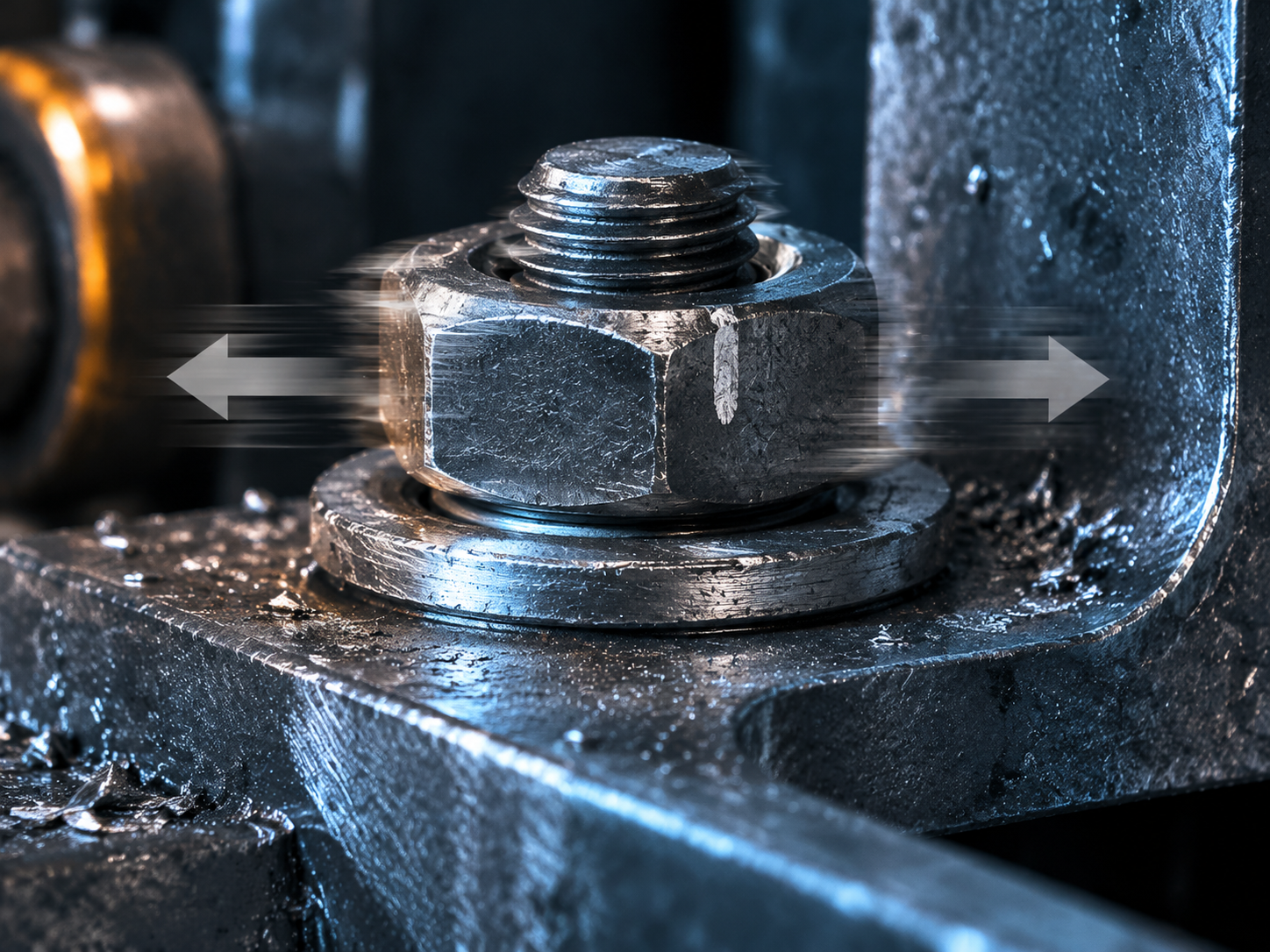
This is why a lock washer that only adds a small axial spring force may not solve the problem. The nut is not being pushed off the bolt; it is being walked loose by relative movement. A locking method has to resist that movement or keep the joint from slipping.
Embedding and relaxation look like “loosening” but are not
A nut that has not rotated can still lose preload. Paint, plating, scale, soft gaskets, and thin sheet all have surface irregularities that flatten under load. The bolt does not turn, but the joint becomes thinner, so the bolt tension drops.
A spring washer cannot fill that gap. In fact, every additional washer interface adds another contact surface that can embed. If the joint is settling, the better answers are hardened washers, compression limiters, a stiffer joint, or a re-torque step.
Thermal movement is a design issue, not a washer issue
A joint that is tight at 20°C may lose preload at 120°C or become over-stressed at -40°C. The amount depends on the materials, the grip length, and the temperature difference. A disc spring stack or a conical spring washer can maintain load over a designed deflection range, but it must be selected from the load-deflection curve, not from the name on the box.
Spring washer vs lock washer: the names are not specifications
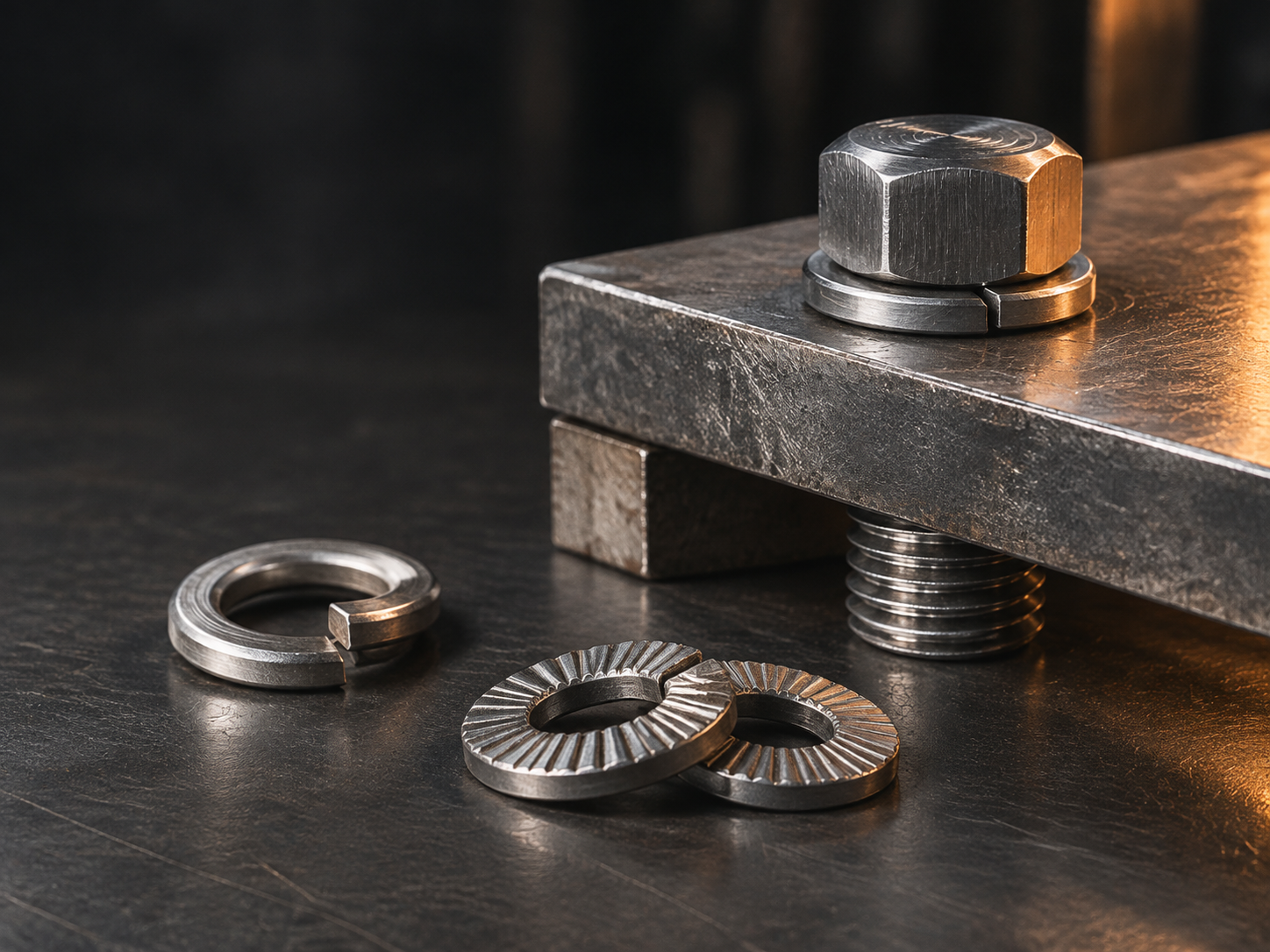
Catalog language is loose. In North America, “lock washer” often means the split helical ring. In Europe, “spring washer” may mean a helical spring washer, a wave washer, or a conical spring washer. Tooth washers, wedge washers, and tab washers are also sold as lock washers. They do not work the same way.
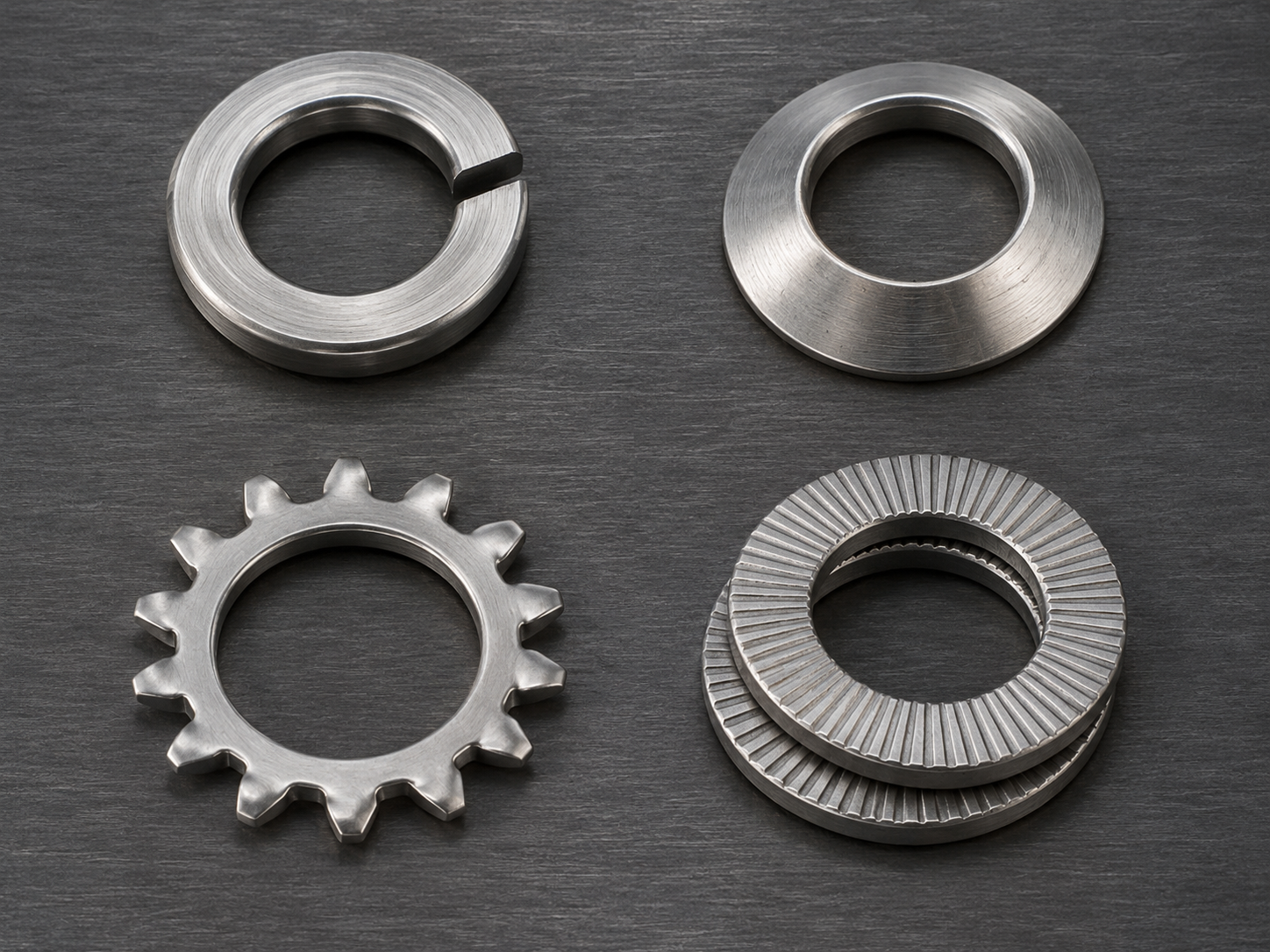
In this article, spring washer means the helical split ring unless stated otherwise. Lock washer is used as the catalog umbrella term.
| Part | What it is | Primary job | Main limits |
|---|---|---|---|
| Helical spring washer / split lock washer | A ring cut at one point and formed into a helix | Small spring force; edge bite; light-duty anti-rattle | Flattens at low preload; unreliable under Junker vibration; can damage surfaces; directional; not for hardened surfaces or left-hand threads |
| Conical spring washer / Belleville washer | A conical disc spring, often to DIN 6796 [6] | Maintains clamp load under settlement or thermal movement | Must be designed by load-deflection; not a friction lock; can flatten if over-compressed |
| Tooth lock washer | Internal, external, or combination teeth | Bites the surface; resists rotation; electrical bonding | Damages finish; not for hardened surfaces; limited vibration performance; not a preload fix |
| Wedge-locking washer | Two hardened washers with radial cams | Prevents self-loosening under high vibration | Needs hardened surfaces, correct orientation, and adequate preload; cost and reuse limits |
| Tab washer | A tab that is bent against a nut or component | Positive locking | Single-use; tab must engage correctly; inspection required |
| Flat washer | A plain ring, usually hardened for high-strength joints | Distributes load; protects surface; covers a slot | Not a lock washer |
| Sealing washer | Metal-backed EPDM or other elastomer | Seals the penetration | Not a lock washer; compression and panel profile matter |
The practical lesson is simple: ask for the standard, drawing, material, hardness, and test evidence. “Spring washer” or “lock washer” is not a complete specification.
What a helical spring washer can and cannot do
The common split spring washer is a ring with one cut, formed into a helix. It is covered by standards such as ASME B18.21.1 and DIN 127 B. When compressed, it acts as a spring, and its raised edge can bite into the mating surface. That is the theory. In a tightened joint, the reality is different.
It flattens at a small fraction of the target preload
At normal operating preload, a helical spring washer is usually flat. NASA RP-1228 states: “In summary, a lockwasher of this type is useless for locking.” [1] Bolt Science’s tests show that these washers flatten at roughly 10% to 20% of the target preload for fasteners of property class 8.8 and above. Once flat, the washer is effectively a flat washer with a split.
It does not stop Junker-type self-loosening
Junker tests show that helical spring washers fail to prevent self-loosening. In some tests they can increase the rate of preload loss compared with a plain nut. Bolt Science also reports that some washers split or dig into the nut or bolt during tightening.
This is not a new debate. Bolt Science reports that DIN withdrew a range of standards for so-called lock washers, including helical spring washers, because they were shown to be ineffective in resisting self-loosening or in changing joint stiffness in a useful way. The standards history is a signal: a part can be widely sold and still be a poor locking device.
They are not always useless, but the use must be justified
A spring washer can maintain some contact force after slight loosening, which is why it survives in low-criticality applications. It can be useful for:
- low-preload brackets, covers, and non-structural enclosures;
- assemblies where a small spring force or slight edge bite is useful;
- applications where the OEM has validated the exact stack by test;
- light-duty electrical or mechanical assemblies where the washer is not the primary locking method.
It is not a good default for:
- structural bolting or preload-critical joints;
- high-vibration machinery, conveyors, pumps, or vehicle systems;
- safety-related connections;
- soft joints where embedding is the real problem;
- hardened surfaces where the edge cannot bite;
- left-hand threads;
- high-temperature joints where the spring properties change.
Stacking rules matter
- If the design depends on the split edge biting the bearing surface, do not isolate it with a flat washer underneath.
- Do not stack a split spring washer under a bonded EPDM sealing washer unless the assembly has been tested. The split edge can damage the sealing face and change compression.
- Replace flattened, cracked, or corroded spring washers. A used spring washer may not have the same free height or edge condition.
- Check the grip length. Adding or removing a washer changes the stack height and the thread engagement.
What a lock washer can and cannot do
“Lock washer” is a family, not a guarantee. The mechanism matters more than the label.
Tooth lock washers
A tooth lock washer has internal or external teeth that bite into the bearing surface. It can resist rotation better than a plain washer on some soft substrates, and it is useful for electrical bonding because the teeth cut through paint, oxide, or plating to create a conductive path.
Limits:
- It damages the finish and can create a corrosion site.
- It is not effective on hardened surfaces.
- The teeth can flatten or wear, especially after reuse.
- It is not a substitute for preload or a soft-joint fix.
- For electrical bonding, place the washer between the surfaces to be bonded, not under the screw head, unless the design specifically calls for that arrangement.
Wedge-locking washers
A wedge-locking washer is a pair of hardened washers with radial cams. The cam angle is steeper than the thread helix angle, so the pair locks under tension rather than relying on friction. This is the principle used by Nord-Lock and similar products.
Wedge-locking washers are a strong choice for high-vibration joints, but they are not universal:
- They need hardened bearing surfaces and the correct washer pair.
- They need adequate preload; a wedge cannot compensate for a loose bolt.
- They add stack height and cost.
- Reuse depends on the manufacturer’s rule and the condition of the cams.
- They do not fix embedding, creep, or a soft joint.
Tab washers and positive locking
A tab washer is bent against a nut or component to prevent rotation. It is a positive lock, not a friction device. It is common in aerospace, machine tools, and applications where a tab can be engaged reliably. It is single-use in many designs; a bent tab that has been straightened should not be reused without approval.
What no lock washer can do
No lock washer can:
- create preload that was never applied;
- stop embedding or creep in a soft joint;
- compensate for a bolt that is too small, too short, or yielding;
- replace a structural bolting standard;
- seal a joint;
- correct a joint that is poorly designed or assembled.
Why your bolts still loosen with a lock washer
If a lock washer is installed and the joint still loosens, the washer is not necessarily defective. One of these conditions is more likely.
The preload was never there
A torque value is not a preload value. Friction, lubrication, plating, thread condition, and tool calibration all change the torque-tension relationship. If the bolt never reached the required tension, the lock washer has nothing to hold.
Fix: run a torque-tension test on the actual joint, control lubrication, calibrate the tool, and verify thread condition.
The joint is embedding
Paint, plating, gaskets, soft sheet, and rough surfaces flatten under load. The nut does not rotate, but the clamp load drops. A lock washer cannot fill the gap.
Fix: use hardened washers, compression limiters, smoother surfaces, and a re-torque step after run-in.
The joint is moving transversely
If the joint slips sideways under vibration, the fastener can self-loosen even with a spring washer. The Junker test is designed to reproduce this condition.
Fix: increase joint stiffness and clamp load, reduce slip, and use a locking method with demonstrated Junker performance, such as a wedge-locking washer or a proven lock nut.
The joint is thermally cycling
Different materials expand at different rates. A joint that is tight at assembly may lose preload when hot or become over-stressed when cold.
Fix: match materials, set preload at the operating temperature, and use a disc spring stack or conical spring washer designed for the movement.
The washer stack is wrong
Common stack errors include:
- a flat washer under a split spring washer when the design depends on the edge biting;
- too many washers, adding interfaces that can embed;
- a spring washer under a bonded EPDM washer, damaging the seal;
- the wrong washer diameter or hardness;
- a tooth washer on a hardened surface;
- a wedge washer installed with the cams facing the wrong way.
Fix: define the stack in the drawing, including washer type, orientation, hardness, and thickness. Do not let the shop “add a washer” without engineering approval.
Thread engagement is insufficient
If the bolt is too short, the nut is too thin, or the threads are damaged, the joint cannot develop full preload. A lock washer may hide the problem for a short time.
Fix: check thread engagement, bolt length, nut height, and thread condition. Use the specified grip length.
The locking element is reused or worn
Nylon inserts lose prevailing torque after repeated use. Tooth washers flatten. Wedge cams wear. Tab washers are single-use in many designs. A reused locking element may not perform like a new one.
Fix: follow the manufacturer’s reuse rule; replace locking elements at service intervals; inspect before reassembly.
The environment attacks the fastener
Corrosion, galling, chemicals, and high temperature can change friction, seize threads, or degrade the locking element. Stainless steel is particularly prone to galling without the right lubrication and assembly practice.
Fix: select the material and coating for the environment, use an appropriate lubricant, and avoid mixing incompatible materials.
The bolt is yielding or fatiguing
If the bolt is over-tightened, under-sized, or subjected to cyclic loading, it may yield or crack. The joint may feel loose because the bolt has lost tension permanently. A washer cannot fix a bolt that is being loaded beyond its capacity.
Fix: check bolt grade, preload, joint stiffness, and fatigue detail. Redesign the joint if necessary.
A selection guide by failure mode
Use the symptom to identify the mechanism before choosing the hardware.
| What you see | Likely mechanism | First move | Washer’s role |
|---|---|---|---|
| Nut backs off under vibration | Transverse self-loosening | Reduce slip, increase clamp load/stiffness, use a wedge-lock washer or proven lock nut | Spring washer alone is not enough |
| Joint loose after a few days; nut has not moved | Embedding or relaxation | Hardened washers, compression limiters, re-torque | Conical spring washer may help if designed; split washer does not |
| Leak at a gasket | Gasket creep or loss of compression | Compression limiter, re-torque, disc spring | Sealing washer is for sealing, not locking |
| Loosens after thermal cycles | Differential expansion | Material match, disc spring stack, operating-temperature preload | Conical spring washer can maintain load if designed |
| Bolt breaks instead of loosening | Fatigue or overload | Joint design, preload, radius, thread, material | No washer fixes this |
| Pull-through in thin sheet | Insufficient bearing area | Hardened flat washer, flange head, larger bearing surface | Flat washer, not spring washer |
| Electrical bonding fails | Paint or oxide insulation | Tooth washer between the bonded surfaces | Tooth washer, not a structural lock |
| Rust, seizure, or galling | Corrosion or friction | Material/coating, lubricant, isolation | Washers do not fix the environment |
What this means for ScrewTrade product selection
ScrewTrade’s range covers several product families that are often bought together. They are not interchangeable, and the washer is only one part of the assembly.
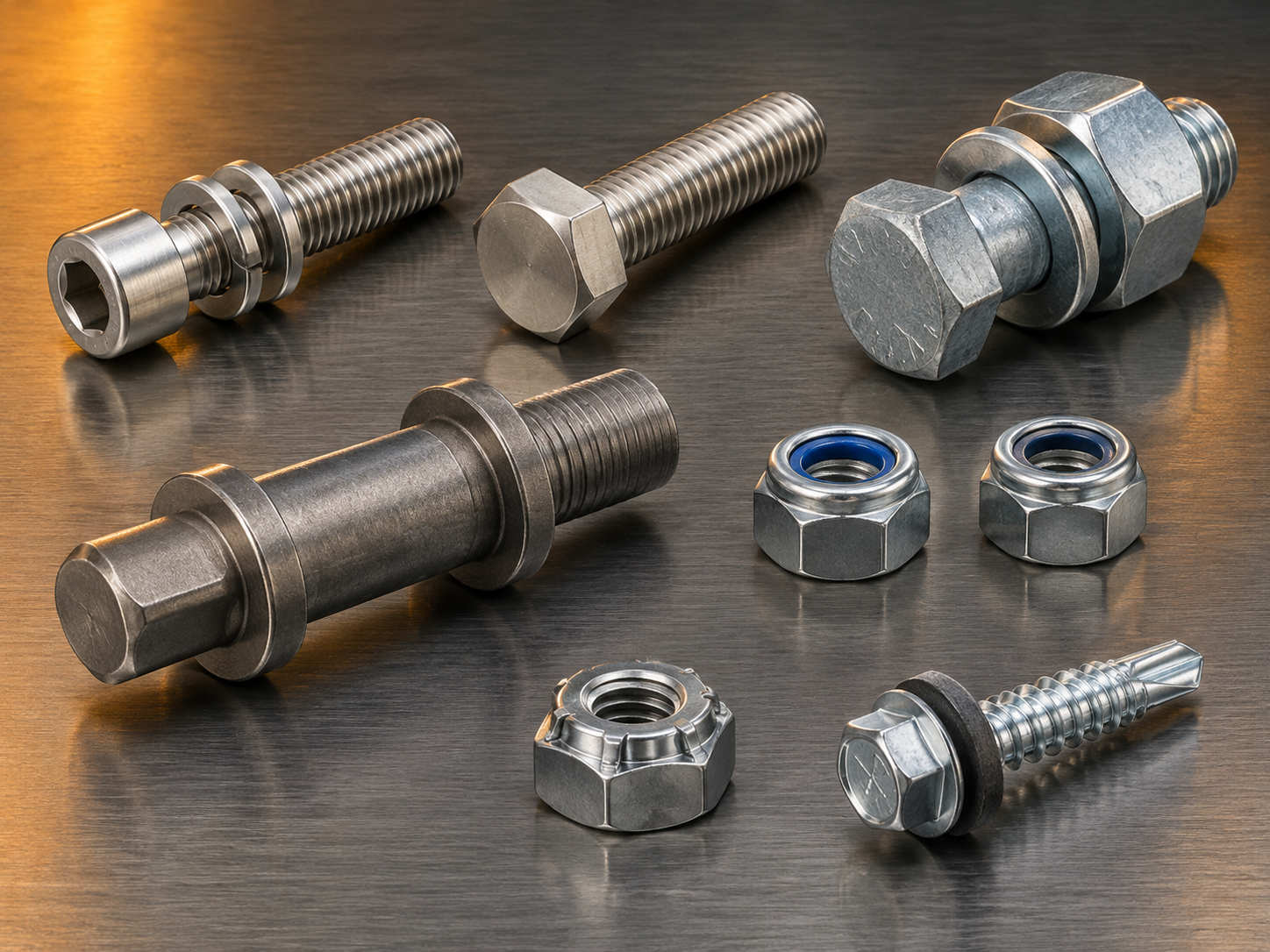
| Product family | Primary job | Where it fits | What to confirm |
|---|---|---|---|
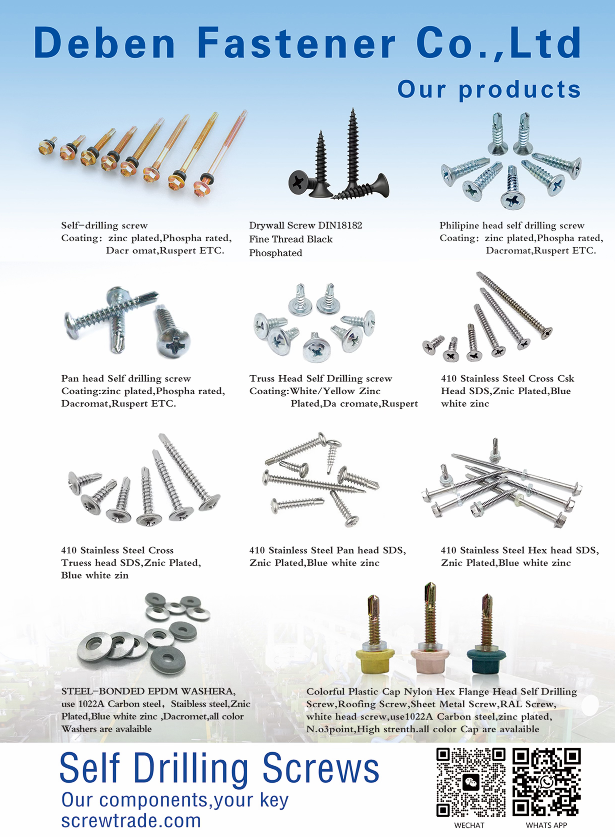
| Self-drilling screws with EPDM washers | Drill, fasten, and seal in one pass | Metal roof and wall panels, sandwich panels, exposed fastening | The EPDM washer is a seal, not a lock; do not add a split spring washer |
| DIN 912 socket head cap screw with flat and spring washers | General machinery assembly with a convenient washer stack | Brackets, covers, non-critical equipment | The spring washer is not a vibration lock; check grip length and consider a lock nut or threadlocker for vibration |
| DIN 933 stainless steel hexagon head bolt / DIN 931 stainless steel half-thread bolt | General bolted joints | Machinery, frames, outdoor and corrosive environments | Grade, galling, lubrication, nut and washer match |
| High-strength bolt with nut and washer / torque-shear type high-strength bolt | Structural or project bolting | Steel structures, heavy equipment, project assemblies | Follow the project standard; do not add a spring washer unless the engineer approves it |
| DIN 982 / DIN 985 nylon-insert lock nuts | Prevailing-torque locking | Machinery, vibration, moderate temperature | Nylon insert limit is roughly 120°C (250°F) ; follow reuse rules |
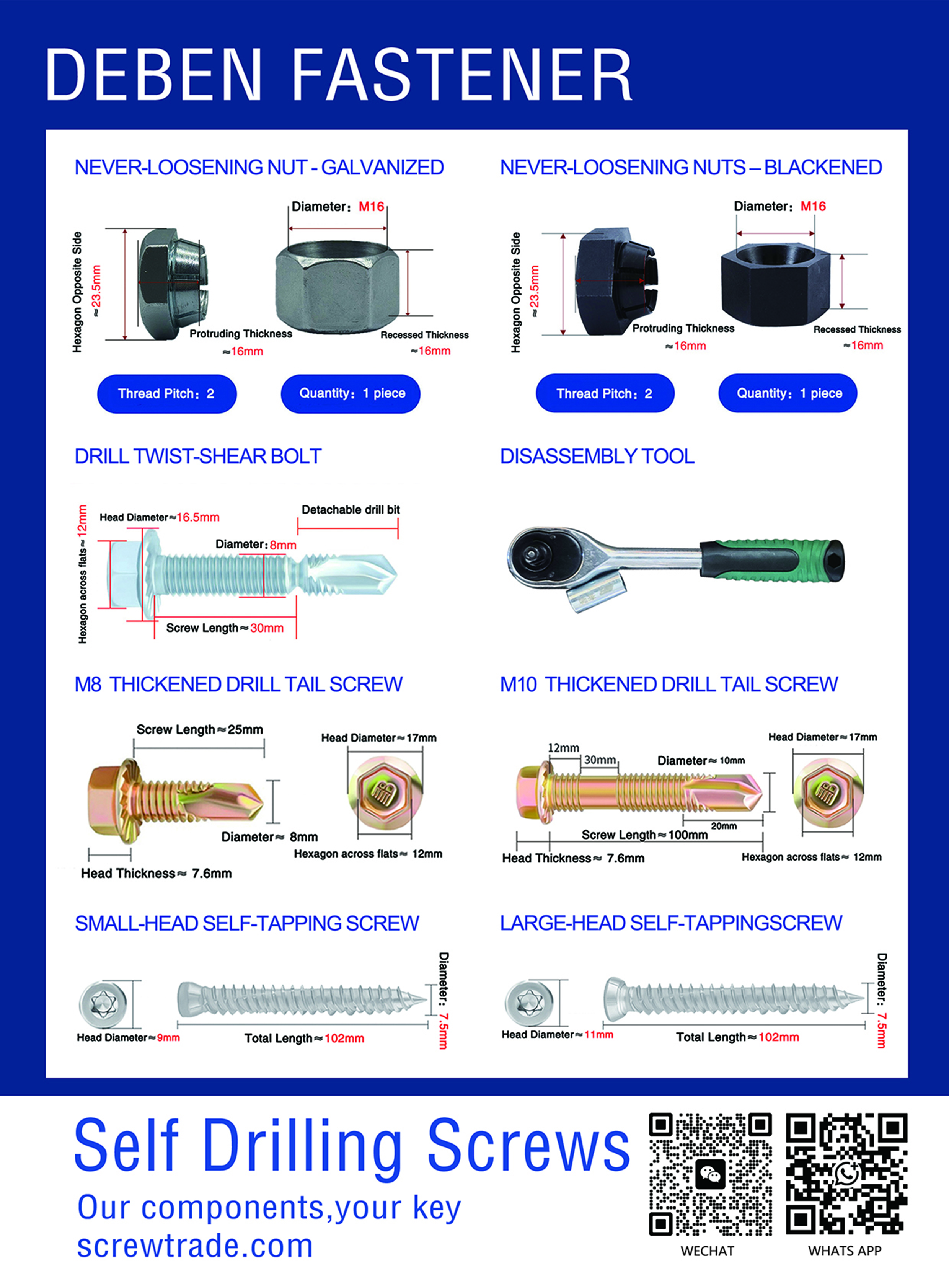
| BENCHI M16 anti-loosening lock nut | Mechanical anti-loosening | High-vibration, safety-related equipment | Supplier-stated vibration testing; request the report, torque procedure, and material certificate |
| EPDM sealing washers | Weather sealing | Roofing, HVAC, enclosures, outdoor equipment | Not a lock washer; compression, panel profile, and material compatibility matter |
Two product-level cautions
Do not add a spring washer to a high-strength structural bolt assembly. A high-strength bolt, nut, and washer are a matched system. Adding an extra compressible element changes the stack height and the torque-tension relationship. If the project specifies a particular assembly, follow it.
Do not stack a split spring washer under a bonded EPDM washer. The split edge can damage the sealing face and change the compression. If the joint needs both sealing and locking, solve the two jobs separately: use the sealing washer for the seal and a lock nut, threadlocker, or wedge-locking washer for the lock, with a tested stack.
A DIN 912 screw with flat and spring washers is a convenience assembly. It is not a locking specification. If the application is vibration-critical, specify a tested locking method and confirm the stack height.
Installation checklist
Before assembly
- Define the required preload, not only the torque.
- Confirm the torque-tension relationship on the actual joint.
- Check thread condition, lubrication, and plating.
- Confirm the washer type, orientation, hardness, and stack.
- Confirm grip length and thread engagement.
- Confirm the locking element is compatible with the service temperature and chemicals.
During assembly
- Use a calibrated torque tool.
- Seat the washer or flange without overdriving.
- For wedge-locking washers, confirm the pair and orientation.
- For tooth washers, confirm the teeth contact the intended surface.
- For nylon-insert nuts, confirm the insert engages the thread and is not damaged.
- Do not add a washer to fix a fit problem without engineering approval.
After assembly
- Use a witness mark to detect rotation, but do not rely on it alone; a joint can lose preload without rotation.
- Re-torque gasketed or soft joints after run-in if the specification allows.
- Inspect for embedding, cracked washers, damaged coatings, and loose hardware.
- Replace locking elements according to the manufacturer’s reuse rule.
RFQ checklist
What to send with the inquiry
- Joint drawing or clear photo.
- Material and thickness of each layer.
- Bolt grade, size, thread, and length.
- Required preload or torque, and the torque-tension method.
- Vibration amplitude/frequency, thermal cycle, and corrosion exposure.
- Applicable standard and test evidence required.
- Sample quantity and trial method.
- Packaging, labeling, annual volume, and destination.
What to ask the supplier
- What is the locking mechanism, and how does it work?
- What test standard and conditions support the claim?
- What preload, amplitude, frequency, cycles, and failure criterion were used?
- What is the temperature limit and reuse rule?
- What surface hardness and finish are required?
- What is the exact washer stack and grip length?
- Can you provide a sample and a first-article report?
- How is the lot traced from raw material to finished part?
“Spring washer” or “lock washer” is not a complete specification. A quotation should state the standard, dimensions, material, finish, hardness, and locking mechanism.
Conclusion: fix the joint, then choose the washer
Bolts still loosen because the joint loses clamp load. A spring washer or lock washer can be part of the solution, but it cannot be the whole solution. Start with the joint: preload, stiffness, embedment, thermal movement, and vibration. Then choose the locking method that matches the mechanism.
Split helical spring washers are inexpensive and familiar, but they are not a reliable vibration lock. Conical spring washers, wedge-locking washers, tooth washers, lock nuts, and threadlockers each solve a different problem. Use them where their mechanism matches the failure mode, and verify the claim with a test that represents your joint.
Send ScrewTrade the joint drawing or photo, the bolt grade and size, the required preload, the vibration/temperature/corrosion conditions, and the annual quantity. We can help match the product family and identify what needs to be tested before you approve a bulk order.
Related News
Other news you might be interested in

Peta Permintaan Pengencang 2027: Pusat Data, Energi, dan Proyek Industri
Prospek pengencang 2027 bukanlah pemulihan yang luas. Ini adalah peta kantong-kantong proyek—dan kantong terkuat adalah pusat data, energi, dan pekerjaan industri tertentu. Arahnya sudah terlihat dari hasil perusahaan pada akhir tahun 2026. Hilti melaporkan pertumbuhan penjualan mata uang lokal sebesar 5,9% dalam delapan bulan pertama tahun 2026, dengan pertumbuhan dua digit di Amerika dan Asia Pasifik, sementara menggambarkan konstruksi tradisional sebagai lemah. Penjualan kedirgantaraan LISI naik 14,3% dalam sembilan bulan pertama, tetapi penjualan otomotifnya turun 5,2%. Penjualan kuartal ketiga Bossard tumbuh 12%, didukung oleh permintaan pusat data di Amerika dan ekspansi semikonduktor serta elektronik di Asia.

Apa itu Sekrup Bi-Logam dan Mengapa Atap Aluminium Membutuhkannya?
Sekrup bi-logam adalah satu pengikat yang terbuat dari dua logam dengan fungsi berbeda. Dalam atap, konstruksi umumnya adalah kepala dan badan baja tahan karat dengan titik bor baja karbon keras dan ulir pemimpin. Bagian baja tahan karat menahan korosi pada atap yang terbuka; titik yang dikeraskan mengebor purlin baja, girt, atau rangka. Atap aluminium sering membutuhkan kombinasi ini ketika panel aluminium dipasang langsung ke substruktur baja, karena panelnya lembut dan tahan korosi, tetapi sekrupnya tetap harus mengebor baja dan bertahan dari cuaca. Bi-logam bukan jaminan: kelas baja tahan karat, kapasitas titik, lapisan, ring, dan detail aluminium-ke-baja masih harus ditentukan.
Want to know more?
Get in touch with us for more information about our services and products.