
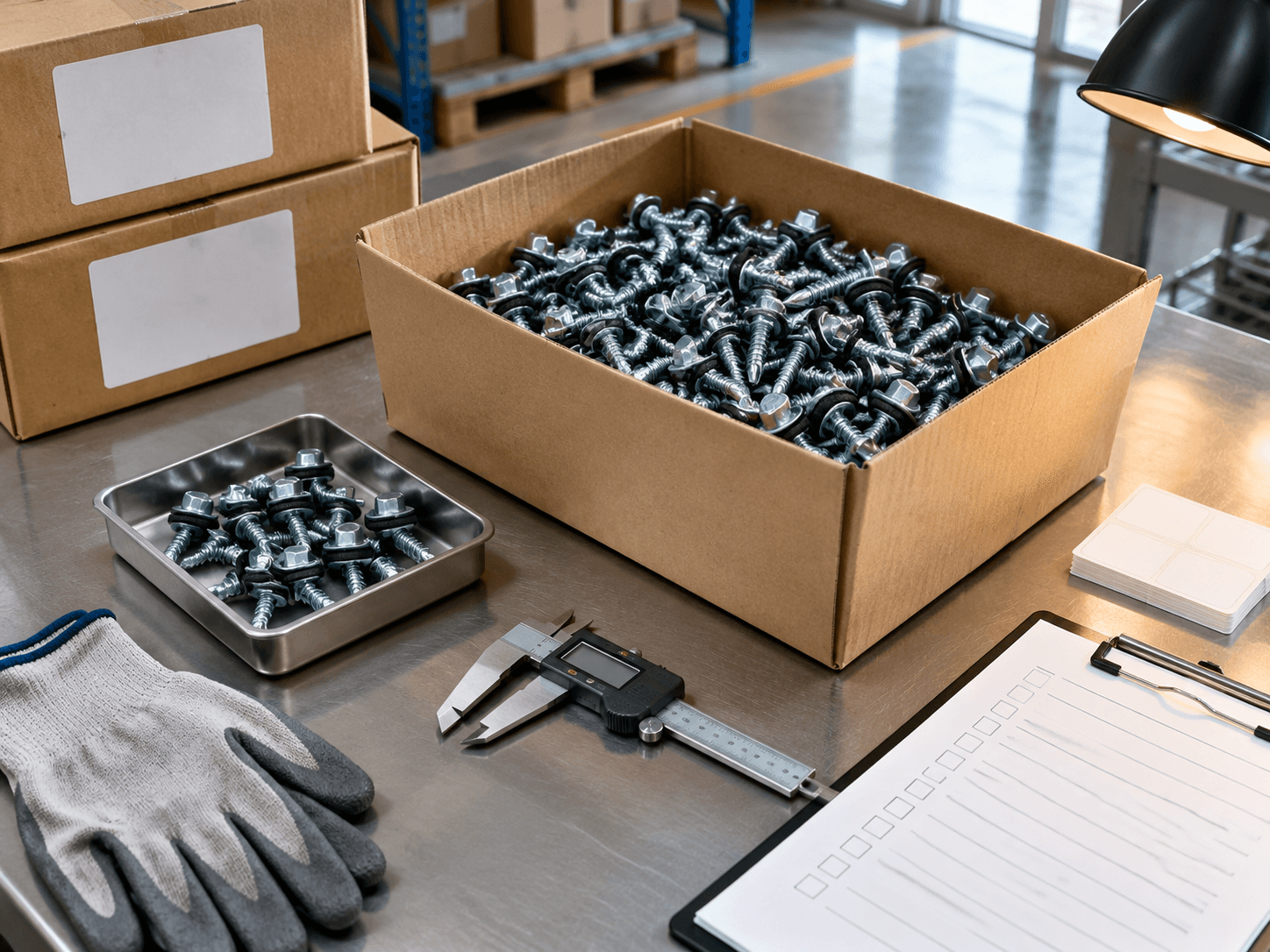
Inspeção de Parafusos Autoperfurantes a Granel: Correspondência entre Amostras Aprovadas e Lotes Entregues

Han Congming
AutorTemos experiência na fabricação e venda de parafusos e fixadores, operamos nossa própria unidade de produção com capacidade estável em grande escala. Somos especialistas em parafusos autoperfurantes, parafusos para drywall, parafusos para aglomerado, parafusos de máquina, pernos e fixadores personalizados para aplicações de construção e indústria.
The sample has been approved. The goods have arrived. The screws look good, and the cardboard label shows the expected size. Is this enough to put them in inventory?
For importers, distributors, or manufacturing buyers, the question is more specific: Can you connect the delivered screws with approved specifications, reference samples, and inspection evidence required by the order?
The useful inspection of bulk self drilling screws does not start with testing machines. It starts with product identity. If no one can determine which product or batch it represents, the value of measurement or testing results is limited.
This guide specifies the incoming inspection workflow for this connection. It is the buyer's work list, not a universal sampling plan, nor a substitute for applicable product and project requirements.
Determine what the approved sample actually represents
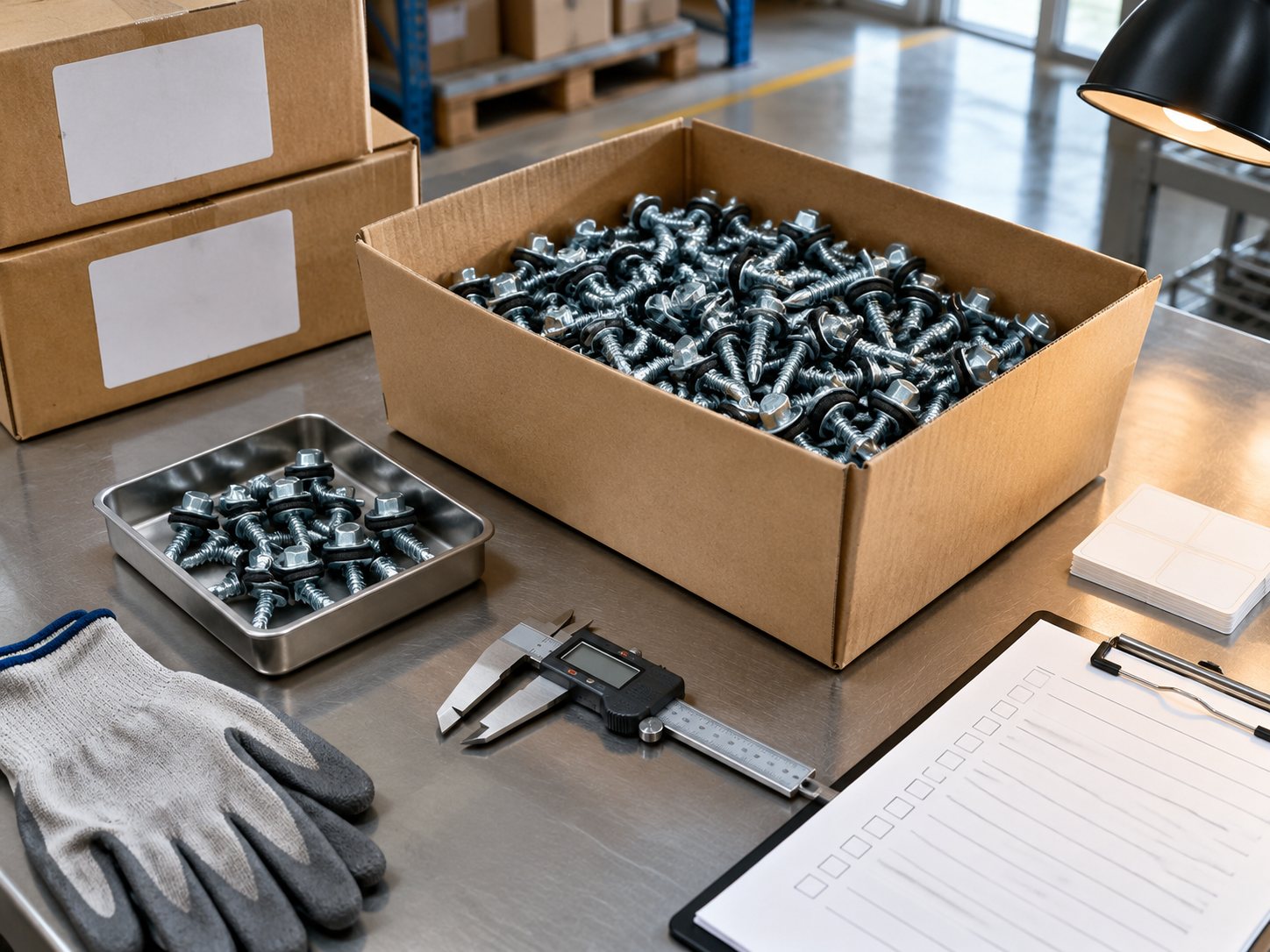
Before opening the cardboard box, collect purchase orders, approved drawings or specifications, sample approval records, and agreed upon inspection requirements. Check if they reference the same product version.
The approved sample is a useful physical reference, but it cannot replace written requirements. It may have been approved for appearance, packaging, or specific trial assembly, rather than various aspects of performance. Sample approval cannot guarantee that every subsequent production batch meets the requirements.
Record the approved content and the content that still needs to be verified:
- Buyer SKU and supplier part number.
- Revision and approval date of drawings or specifications.
- Sample reference and approval scope.
- Diameter, length, thread, drill tip, drill bit, and drive configuration.
- Materials, surface treatment, and gasket configuration (if applicable).
- Agreed testing, document requirements, and acceptance criteria.
For self drilling screws with washers, please label the complete components, not just the screws. The matching nominal screw size cannot determine that the washer material, size, or structure remains unchanged.
If there is a conflict between the sample and the drawing, or if there is a change in specifications after approval, please authorize procurement or technical review personnel to resolve the conflict. Don't let the receiving team choose the easiest reference to meet.
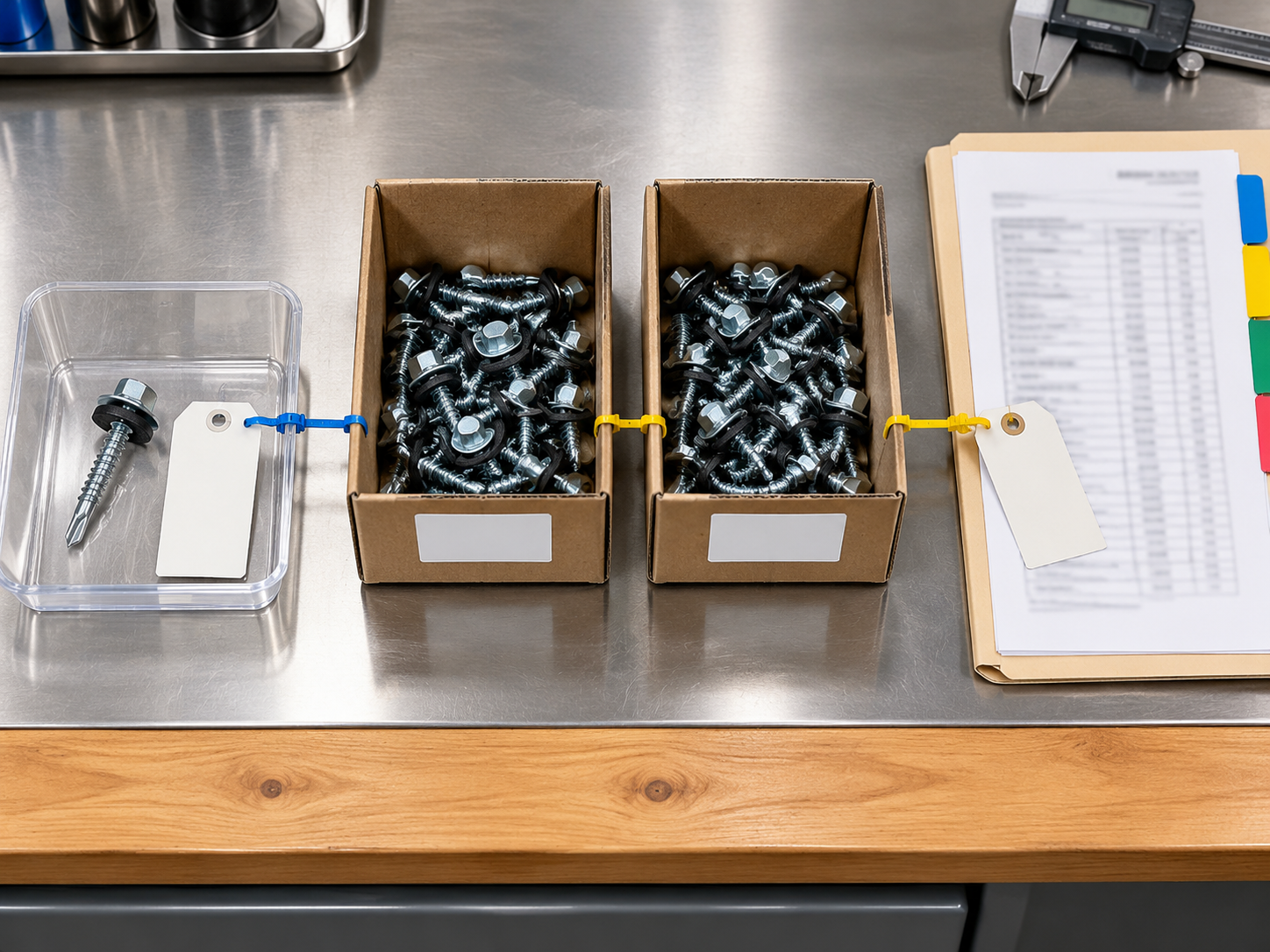
Separate the goods from the batches inside
A batch of goods can contain multiple SKUs and multiple production batches. A manufacturing batch can also be divided between cartons or deliveries. Therefore, the container number or purchase order number itself cannot serve as evidence of a single manufacturing batch.
For the traceability of fastener batches, determine the relationship between supplier identifiers and delivered goods. Manufacturing, coating, packaging, and shipping references may vary. They may not necessarily require the same code, but where traceability is needed, the connections between them need to be clear.
Before mixing the goods into the warehouse inventory, please use the following comparison table:
| Link to establish | Record at receiving | Question to resolve |
|---|---|---|
| Order to specification | PO line, buyer SKU, supplier part number, revision | Is this the product version that was ordered? |
| Specification to sample | Sample reference and approval scope | What did the approved sample establish? |
| Goods to lot | Carton identifiers and supplier lot references | Which cartons belong to which identified lot? |
| Lot to documents | Report number, tested product and relevant lot reference | What evidence connects the report to these goods? |
| Receipt to stock | Receiving record and internal location or container ID | Can the identity be retained after opening or repacking? |
If there is no available batch identification for the goods, record the discrepancy and request clarification. Internal receiving numbers can help control the inventory you receive, but they cannot reconstruct lost manufacturing history.
Check the delivered configuration according to written specifications
The self tapping screw inspection checklist should distinguish between the content that can be inspected upon receipt and the content that requires appropriate testing or expert review.
Visual comparison helps identify significant differences. Measurement requires specified methods, appropriate equipment, and relevant tolerances. The screws that appear to be approved samples are not automatically within the specification range.
| Check area | Compare with the approved requirement | Do not assume |
|---|---|---|
| Dimensions | Diameter, defined length measurement, head dimensions and other specified features | The size printed on the carton proves dimensional conformity |
| Drill point and thread | Point configuration, thread form and specified geometry | A matching trade name establishes drilling capacity |
| Head and drive | Head form, drive type and fit with the specified tool | Similar-looking heads are interchangeable |
| Washer assembly | Specified size, backing, seal and assembly condition | The presence of a washer proves sealing performance |
| Surface and condition | Specified finish, damage, contamination or visible corrosion | Color proves coating type, thickness or corrosion resistance |
| Packaging and identity | Labels, product segregation and agreed pack configuration | Correct outer labels prove every inner pack is correct |
Record actual observations and measurement results, rather than just stating 'same as sample'. Link the photos and results to the carton and batch references so that another reviewer can understand the content being inspected.
Quantity verification should follow the agreed counting or weighing method. For the difference between individual items, net weight, and cardboard boxes, please refer to the purchase of self tapping screws by weight or quantity.
Match inspection documents with products and orders
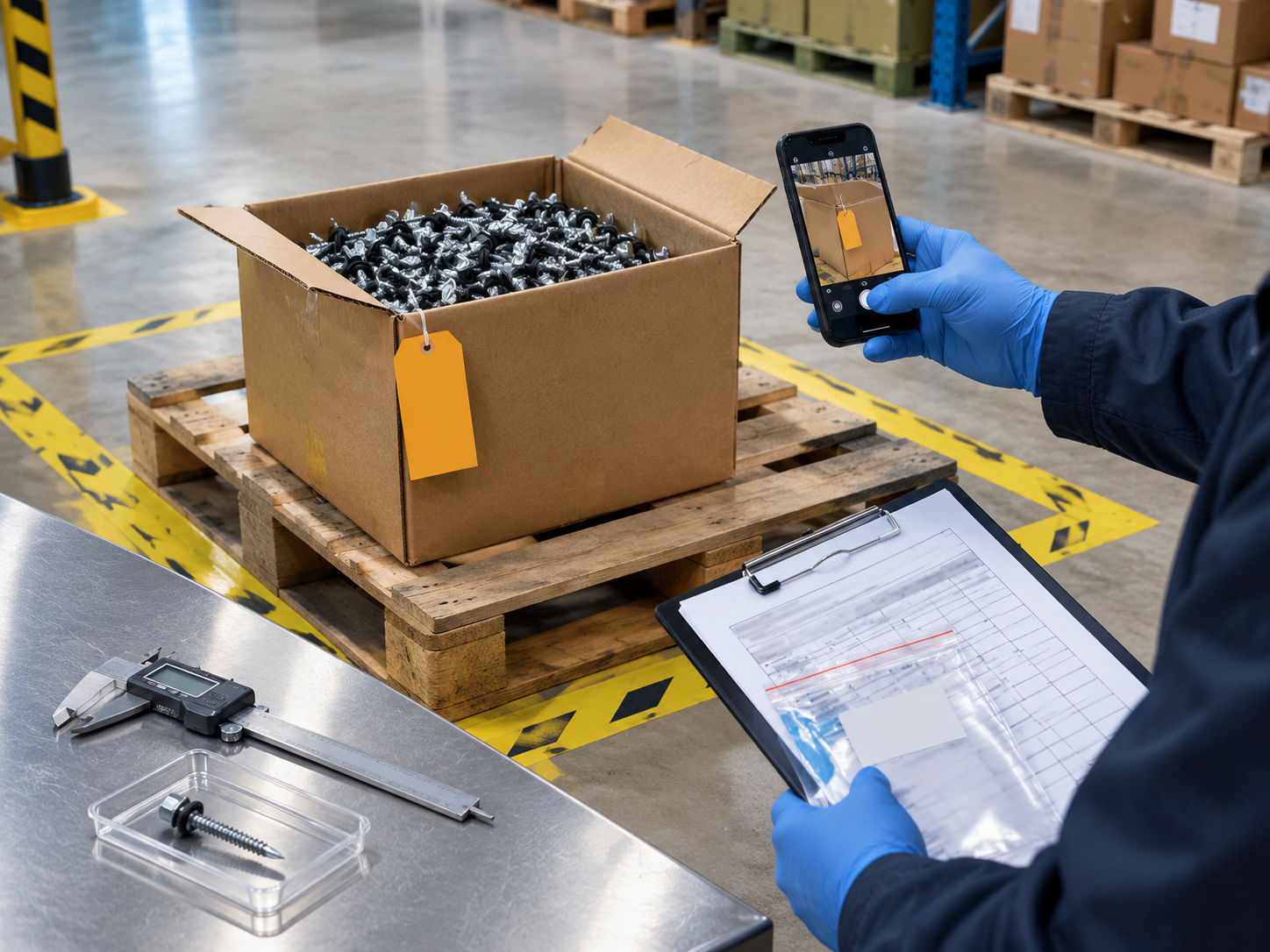
The report in the shipping folder will not automatically serve as evidence for each screw in the shipment. Before relying on its results, please check its identity and scope.
Question:
- Does the document identify the relevant products, materials, and surface treatments?
- Does it include the testing or declaration required by the order?
- Is it associated with the delivered batch, or does it describe different batches or representative products?
- Are the methods, conditions, results, and acceptance requirements clear enough for the expected review?
- Who released or verified it, and does it comply with the agreed upon document requirements?
For example, raw material files cannot replace every completed screw test. Without further evidence, the coating reports for different product configurations cannot determine the condition of the delivered screws. If a report covers multiple batches, please ask the supplier to explain the mapping instead of assuming that all cartons are included.
ISO 16228:2017 specifies the types and contents of fastener inspection documents required at the time of ordering. Its scope reinforces an actual procurement point: specifying the required documents before production and shipment, rather than requesting undefined 'quality certificates' upon arrival.
It is necessary to confirm the availability and relevance of files for specific orders. Do not consider every report type as a mandatory requirement for every bulk purchase of screws.
Use appropriate inspection plans instead of arbitrary sample counting
There is no single sample quantity or AQL that can be safely allocated to all bulk self drilling screw orders in this article. The scope of inspection depends on the product, batch definition, application, agreed requirements, and applicable procedures.
Before inspection, confirm which features will be checked, how to select samples, which methods and limitations are applicable, and who has the authority to decide on acceptance. Pulling out a convenient screw from an open cardboard box may not represent all batches delivered.
ISO 3269:2019 describes the reference procedure for buyer acceptance inspection and certain disputed situations. The scope of its announcement does not include large-scale machine assembly and specialized or special engineering applications that require more advanced control and traceability. It should not be applied as a package solution to every screw order.
If drilling or installation inspection is required, please determine the relevant substrate, material thickness, tool settings, methods, and acceptance criteria. Informal comparison of unidentified steel scraps is not equivalent to controlled testing or project qualification.
Similarly, visual inspection cannot determine hardness, torsional performance, or corrosion resistance. Refer to agreed upon evidence or appropriate testing for these requirements. Satisfactory inspection of selected samples does not guarantee that every part in a batch is defect free.
Suspend unresolved goods and preserve evidence
Assuming the carton label indicates the expected screws, but the washer configuration is different from the approved reference. Or the batch code delivered cannot be connected to the provided report.
Neither of these situations should be resolved by silently re labeling the goods or accepting verbal assurances.
A practical response would be:
- Identify and isolate affected goods according to the receiving detention procedure.
- Record purchase order lines SKU、 Carton and batch reference, affected quantity, and observed differences.
- Link photos, measurements, original labels, and related samples with records.
- Request missing mappings, corrected files, or explanations for deviations from suppliers.
- Have the authorized examiner determine whether clarification, further inspection, replacement, return, or recording concessions are appropriate.
The lack of an identifier itself does not prove that the screw does not meet physical requirements. This does mean that the required evidence may be incomplete. On the contrary, the matching paperwork will not cover the measured nonconformities.
Clearly distinguish and record the reasons for the final disposal. Publishing should follow authorization decisions, not just the arrival of another email attachment.
Compact incoming inspection records
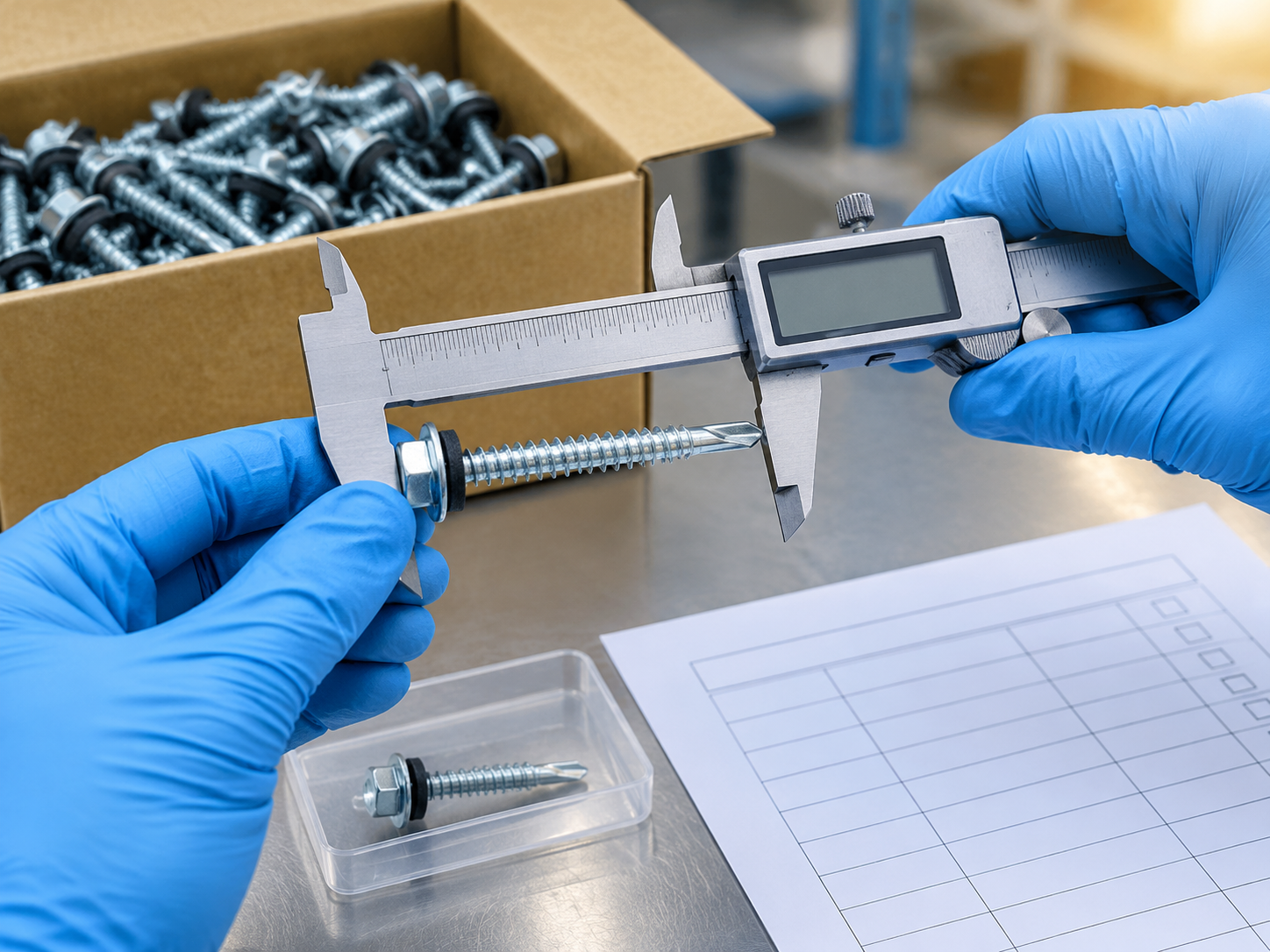
Use a record for each defined inspection batch, or provide a clear mapping when the record covers multiple inspection batches. The following is a starting template, not a complete inspection report.
| Record field | Information to enter |
|---|---|
| Receipt identity | Receiving date, PO line, buyer SKU and supplier part number |
| Approved baseline | Drawing revision, sample reference and approval scope |
| Delivered identity | Carton references, lot codes and internal stock reference |
| Document review | Report numbers, coverage and any unresolved links |
| Inspection basis | Characteristics, sampling procedure, methods and criteria |
| Results | Measurements, observations, test references and discrepancies |
| Disposition | Released, held or other authorized outcome, with reason |
| Authorization | Reviewer, decision date and follow-up reference |
If the cardboard box is opened or repackaged, please retain the link between the original label and the new inventory container. Otherwise, the receiving records may be complete, and traceability may be lost in the next warehouse step.
Agree on evidence before the next batch of bulk orders
The most useful quality inspection for bulk screws can be explained by both the buyer and the supplier. It links the ordered specifications, approved references, delivered goods, and evidence used to make acceptance decisions.
For duplicate orders, carry forward approved revisions, resolved deviations, and document requirements. Don't assume that the report or sample from the previous order will automatically cover the next production batch.
When discussing bulk self drilling screw orders with ScrewTrade, please provide drawings or product specifications, approved sample references (if any), quantity, packaging labeling requirements, and required inspection documents. Explain the inspection or traceability requirements for any specific application in order to review the scope prior to order confirmation.
To prepare these inputs, please use the bulk self drilling screw inquiry list or contact ScrewTrade to discuss the product and document requirements for your order.
Related News
Other news you might be interested in

O Mapa da Demanda por Fixadores em 2027: Centros de Dados, Energia e Projetos Industriais
A perspectiva para fixadores em 2027 não é uma recuperação ampla. É um mapa de bolsões de projetos—e os bolsões mais fortes são centros de dados, energia e trabalhos industriais selecionados. A direção já é visível nos resultados das empresas no final de 2026. A Hilti relatou crescimento de vendas em moeda local de 5,9% nos primeiros oito meses de 2026, com crescimento de dois dígitos nas Américas e na Ásia-Pacífico, enquanto descreveu a construção tradicional como fraca. As vendas aeroespaciais da LISI cresceram 14,3% nos primeiros nove meses, mas suas vendas automotivas caíram 5,2%. As vendas do terceiro trimestre da Bossard cresceram 12%, impulsionadas pela demanda de centros de dados nas Américas e pela expansão de semicondutores e eletrônicos na Ásia.

O que é um parafuso bimetálico e por que o telhado de alumínio precisa dele?
Um parafuso bimetálico é um fixador feito de dois metais com funções diferentes. Em telhados, a construção comum é uma cabeça e corpo de aço inoxidável com uma ponta de perfuração e rosca de aço carbono endurecido. A seção de aço inoxidável resiste à corrosão no telhado exposto; a ponta endurecida perfura a terça, a viga ou a estrutura de aço. Telhados de alumínio geralmente exigem essa combinação quando um painel de alumínio é fixado diretamente a uma subestrutura de aço, porque o painel é macio e resistente à corrosão, mas o parafuso ainda precisa perfurar o aço e resistir ao clima. O bimetálico não é uma garantia: o grau do aço inoxidável, a capacidade da ponta, o revestimento, a arruela e o detalhe alumínio-aço ainda precisam ser especificados.
Want to know more?
Get in touch with us for more information about our services and products.