
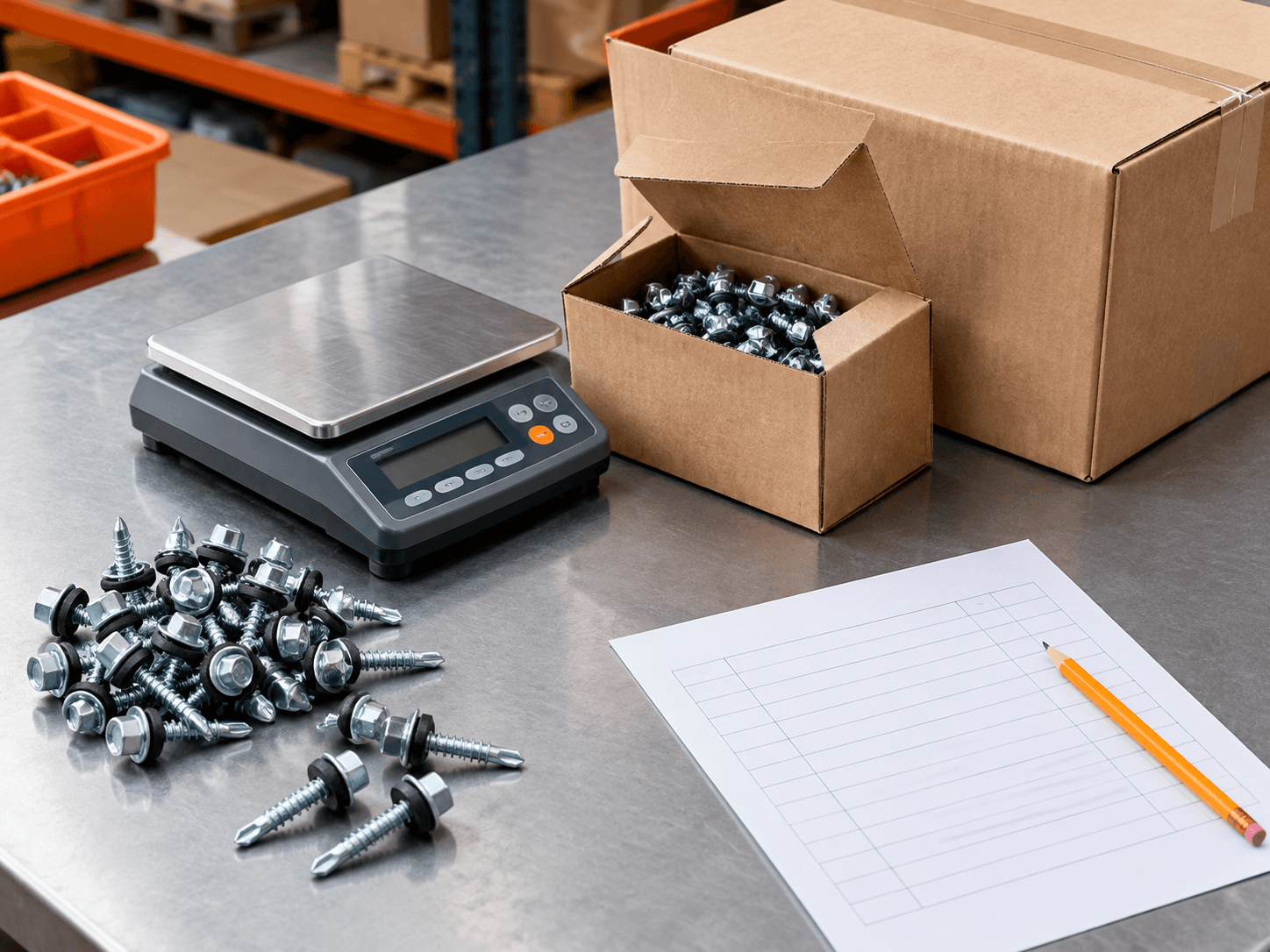
Comprando Parafusos Auto-Perfurantes por Peso ou por Contagem: Conciliando Peças, Peso Líquido e Caixas

Han Congming
AutorTemos experiência na fabricação e venda de parafusos e fixadores, operamos nossa própria unidade de produção com capacidade estável em grande escala. Somos especialistas em parafusos autoperfurantes, parafusos para drywall, parafusos para aglomerado, parafusos de máquina, pernos e fixadores personalizados para aplicações de construção e indústria.
When one supplier quotes in kilograms and another supplier quotes every 1000, it may be difficult to compare two quotes for the same self tapping screw. The packing list may add a third criterion: cardboard boxes. These units will not automatically make mistakes. The problem begins when buyers compare without confirming that they describe the same product, the same quantity, and the same packaging.
Therefore, a useful comparison begins with a simpler question: What exactly did you buy?
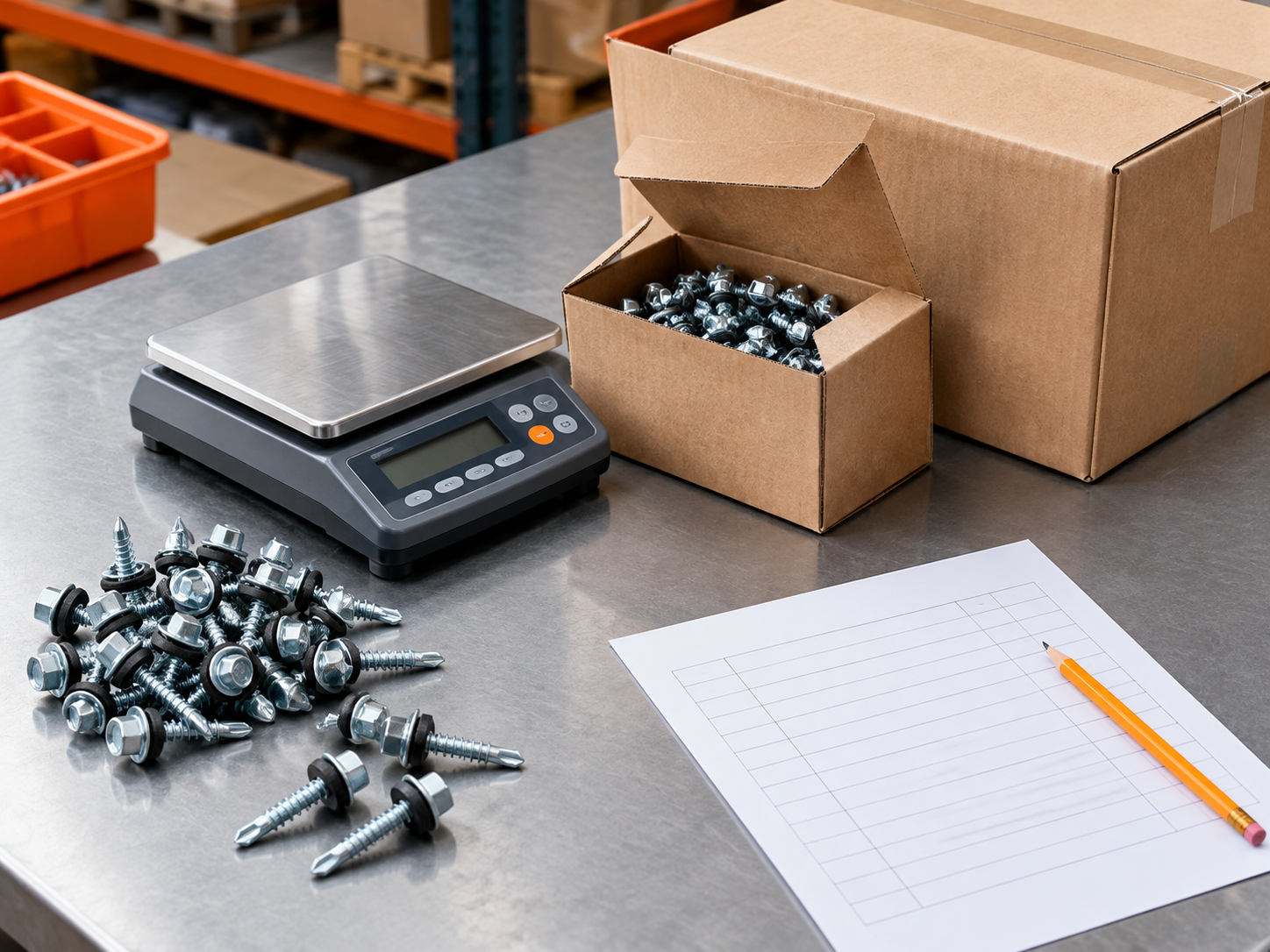
Define SKU before converting units
Self drilling screws cannot be identified solely by their nominal diameter and length. The item may also vary depending on the head style, driver, thread, tip, material, coating, gasket, and packaging configuration.
These differences will affect the price and weight. The weight of the hexagonal washer head is different from that of the countersunk head. The bonded EPDM gasket adds an additional component to the assembly. Even if the basic screws look similar, different coatings may alter the weight of the finished product. If the washing machine is supplied separately, the buyer also needs to know if the quotation includes the washing machine.
For procurement purposes, consider the entire sellable product as one SKU. If screws and washers are provided as a component, please determine if they are considered as a whole. If they are packaged separately, please list two quantities separately.
Buyer's question: "Does the quotation refer to the complete screw and washer assembly, or only to the screws
Do not compare the price of assembled roof screws with the price of bare screws unless the difference is clearly stated.

Choose a quantity basis before comparing prices
Common B2B quotation units include:
- Price per item.
- The price per 1000 pieces.
- Price per kilogram.
- The price of each inner box.
- Price per box.
Each unit may be useful, but each unit requires supporting information. '$2.50 per kilogram' does not tell the buyer how many pieces there are per kilogram. '$80 per 1000 pieces' does not display net weight or packaging quantity. Before specifying the number of cardboard boxes, '$45 per box' is incomplete.
The purchase order should specify:
- The exact SKU and specifications.
- The unit on which the price is based.
- Is the price based on theoretical net weight or actual net weight.
- The number of pieces in each inner box and each cardboard box.
- Whether packaging, labeling, pallets, testing, and shipping are included or charged separately.
- Currency and any agreed rounding or quantity tolerances.
If any of these projects are different, the quotation is not yet comparable.
For a more comprehensive pre price list covering drawings, samples, documents, and delivery terms, please refer to ScrewTrade's bulk self drilling screw inquiry guide.
Construct weight reference based on counting samples

When suppliers provide weight data, or when buyers want weight based cross checking, the reference should come from the actual SKU rather than a generic table.
Use samples representing the production project, including the same screws, materials, surface treatment, head, washer configuration, and packaging status. Count the number of items and weigh the unpackaged products. If multiple samples are used, please record how they were selected and keep a single result, not just the average.
The two basic calculations are:
Weight per 1000 pieces
Net sample weight ÷ number of samples × 1000
Quantity per kilogram
Number of samples ÷ Net weight of samples
Just as an example
Assuming the net weight of a counting sample of 500 screws is 3.25 kilograms.
- Weight per 1000 pieces: 3.25 ÷ 500 × 1000=6.50 kilograms
- Approximate number of pieces per kilogram: 500 ÷ 3.25=153.8 pieces/kilogram
For an order of 120000 pieces, the estimated net weight of the product is:
120000 ÷ 1000 × 6.50=780 kg
This is a mathematical estimation based on counting samples. It is not a universal weight chart for every # 10, # 12, or # 14 screw. These numbers will vary with length, head geometry, threads, material density, coating, gasket, and manufacturing changes.
The simplest way to introduce errors is to use a "screw weight calculator" and reference weights from others. The reliability of a calculator depends on the input reference data. For duplicate orders, please save the approved sample weight and measurement method together with the SKU record.
Buyer's question: "What kind of samples, quantity, and net weight should be used to calculate the weight per 1000 pieces
Separate net weight, tare weight, and gross weight
When all parties use the same definition, weight reconciliation becomes clearer.
Net weight refers to the weight of the product itself, excluding packaging.
Tare weight refers to the weight of an empty packaging or container at an agreed level.
Gross weight is the net weight plus the applicable tare weight.
The basic relationship is:
Gross weight=Net weight+Tare weight
The comparison between net weight and gross weight is only meaningful when two numbers use the same packaging level and tare weight basis.
The level of packaging is very important. Buyers may need to distinguish:
- Net weight of the product.
- Empty inner box weight.
- Empty outer box weight.
- Transport packaging such as pallets, straps, corner boards, etc.
- When requesting container liquid level data, container tare weight.
For screw and washer components, indicate whether the washer is included in the net weight of the product. Also indicate whether the bag, inner box, or separator is part of the tare weight you are measuring.
Continuing with illustrative examples
Assuming the same order packaging is as follows:
- Each inner box contains 1000 pieces.
- Each box contains 5 inner boxes.
- Each box contains 5000 pieces.
- 120000 pieces ÷ 5000=24 boxes.
- To illustrate, the total empty packaging of each cardboard box is 0.90 kilograms.
The packaging weight is:
24 boxes x 0.90 kg=21.6 kg
The estimated total weight before palletizing and bundling is:
780 kg net weight+21.6 kg packaging=801.6 kg
These numbers are just an example. They do not represent ScrewTrade products and should not be reused as quotations.
Buyer's question: "Is the weight stated net or gross, and at which packaging level is tare measured
When checking the packing list, confirm if the relationship is consistent: gross weight should include applicable packaging, while net weight should be excluded. If the numbers are inconsistent, please inquire about the packaging details before assuming a shortage or excess.
Convert each quotation into a universal basis
Once the SKU, weight benchmark, and packaging quantity are known, the quotation can be converted into universal units.
Use the same agreed net weight reference in each of the following calculations.
Use the following formula:
Equivalent price per 1000 pieces
Price per kilogram and equivalent price per 1000 pieces
Price per kilogram x 1000 pieces per unit
Convert the price per 1000 pieces to the equivalent price per kilogram
Price per 1000 pieces ÷ Weight per 1000 pieces
Equivalent price per 1000 pieces in the price per box
Price per box ÷ Number of pieces per box × 1000
The price per box is equal to the price per 1000 pieces
Every 1000 pieces x per box ÷ 1000
These formulas can only be applied after confirming that both quotations include the same product and commercial scope. If a quotation does not include gaskets, labels, trays, testing, or agreed packaging methods, then a lower conversion price cannot save costs.
This is also where many 'per box screws' and' per carton screws' fail. The quantity of parts in the packaging box is based on the packaging specifications, not just the characteristics of the screws. Suppliers can provide multiple legal packaging configurations for the same item.
Verify orders, packing lists, and incoming goods
The actual receiving inspection will compare several layers, rather than relying on a total number.
| Check | What to compare |
|---|---|
| SKU | Product description, drawing or item reference, material, finish, head, point, and washer |
| Unit count | Ordered pieces, pieces per box, boxes per carton, and total cartons |
| Net weight | Calculated or agreed product weight, excluding packaging |
| Tare | Empty inner box, carton, pallet, or other packaging at the agreed level |
| Gross weight | Net weight plus applicable tare |
| Labels | Buyer SKU, product description, quantity, packing level, and batch or lot reference where required |
| Documents | Packing list, inspection record, and any report or certificate agreed in the order |
When receiving goods, first count the shipping units. Check the carton and inner box labels against the purchase order. Weigh the selected cardboard box, and if the weight is part of the agreed validation method, subtract the applicable tare weight. Keep the scale units consistent with the decimal point recorded.
Do not create universal quantity tolerances for each screw order. Acceptable methods and any permitted changes should be agreed upon in the purchase order, supplier quality agreement, or applicable acceptance procedures. ISO 3269:2019 describes a fastener acceptance procedure without prior agreement, but its scope does not include certain large-scale machine assemblies and special engineering applications. It should not be used as a universal inspection rule for every batch of goods.
If differences are found, record SKU, carton and inner box quantities, measured weight, tare weight reference, label information, photos, and retained samples. Before deciding whether the issue is counting differences, packaging differences, or weight reference errors, please have the supplier verify the calculation results.
Consistent use of batch and packaging information

Weight reconciliation cannot replace product labeling. The correct total weight cannot prove that the carton contains approved items.
If the buyer or trading partner requires batch level scanning, GS1-128 can encode batch or lot number information and support the receiving and traceability process. This does not mean that every cardboard box must use GS1-128. The demand should come from buyers, distributors, projects, or target markets.
For any barcode or label requirements, please specify:
- Which packaging level comes with a label.
- Which data fields are required.
- Does the label have to label the screw and washer components as one SKU.
- Do you need batch, batch, production date, or other traceable data.
- Who approves the label illustrations and revisions.
Packaging errors may cause the same commercial problems as counting errors. A cardboard box labeled with the correct screw description but with incorrect surface treatment, washers, or packaging quantity is not delivered correctly.
What should be sent when inquiring
To receive a quotation that can be compared and checked, please send ScrewTrade:
- The exact screw specifications or drawings.
- Diameter, length, thread, tip, head, driver, material, coating, and gasket details.
- The quantity listed by SKU.
- Required quotation units: pieces, 1000 pieces, kilograms, boxes or cartons.
- The required quantity of inner boxes and cardboard packaging.
- Does it include a washing machine and how to package it.
- Any required labels, barcodes, batches, or traceability data.
- Destination and required delivery criteria.
- Any sample, inspection or acceptance requirements.
Please ask the supplier to indicate whether the reported weight is net or gross weight, and whether the reported packaging quantity is only applicable to screws or the entire component.
For buyers managing duplicate orders, please put together the following: approved SKUs and drawing revisions, counted sample weights, approved packaging configurations, label art, and receiving records. This enables the inspection of the weight of every 1000 self drilling screws, every kilogram of screws, and every box of screws to be repeated in the future, rather than starting from new assumptions every time.
The goal is not to choose weight or counting as the "better" purchasing method. This is to clarify the selected unit, calculate from the correct SKU, and reconcile through the same packaging hierarchy from quotation to delivery.
To discuss a specific order, please send the product specifications, quantity, packaging requirements, and destination to ScrewTrade. We can review the product and pricing basis, and determine which weights, packaging, labels, and verification details of the SKU still need to be confirmed.
Related News
Other news you might be interested in

O Mapa da Demanda por Fixadores em 2027: Centros de Dados, Energia e Projetos Industriais
A perspectiva para fixadores em 2027 não é uma recuperação ampla. É um mapa de bolsões de projetos—e os bolsões mais fortes são centros de dados, energia e trabalhos industriais selecionados. A direção já é visível nos resultados das empresas no final de 2026. A Hilti relatou crescimento de vendas em moeda local de 5,9% nos primeiros oito meses de 2026, com crescimento de dois dígitos nas Américas e na Ásia-Pacífico, enquanto descreveu a construção tradicional como fraca. As vendas aeroespaciais da LISI cresceram 14,3% nos primeiros nove meses, mas suas vendas automotivas caíram 5,2%. As vendas do terceiro trimestre da Bossard cresceram 12%, impulsionadas pela demanda de centros de dados nas Américas e pela expansão de semicondutores e eletrônicos na Ásia.

O que é um parafuso bimetálico e por que o telhado de alumínio precisa dele?
Um parafuso bimetálico é um fixador feito de dois metais com funções diferentes. Em telhados, a construção comum é uma cabeça e corpo de aço inoxidável com uma ponta de perfuração e rosca de aço carbono endurecido. A seção de aço inoxidável resiste à corrosão no telhado exposto; a ponta endurecida perfura a terça, a viga ou a estrutura de aço. Telhados de alumínio geralmente exigem essa combinação quando um painel de alumínio é fixado diretamente a uma subestrutura de aço, porque o painel é macio e resistente à corrosão, mas o parafuso ainda precisa perfurar o aço e resistir ao clima. O bimetálico não é uma garantia: o grau do aço inoxidável, a capacidade da ponta, o revestimento, a arruela e o detalhe alumínio-aço ainda precisam ser especificados.
Want to know more?
Get in touch with us for more information about our services and products.