
Como Escolher um Fornecedor de Fixadores para um Projeto no GCC

Han Congming
AutorTemos experiência na fabricação e venda de parafusos e fixadores, operamos nossa própria unidade de produção com capacidade estável em grande escala. Somos especialistas em parafusos autoperfurantes, parafusos para drywall, parafusos para aglomerado, parafusos de máquina, pernos e fixadores personalizados para aplicações de construção e indústria.
If you are choosing a fastener supplier for a GCC project this November, your shortlist may already be forming around Saudi Build, ADIPEC and Big 5 Global. Saudi Build and ADIPEC run from 2 to 5 November 2026, and Big 5 Global runs from 23 to 26 November 2026. These events put many suppliers in one place. They do not tell you which supplier can support a project after the exhibition stand is packed away.
A catalogue, a low price and a business card are not enough. The supplier you choose has to match the connection, the environment, the documents and the delivery date. This guide gives you a practical way to compare suppliers for metal roofing, sandwich panels, PEB, HVAC and electrical support projects in Saudi Arabia, the UAE and the wider GCC.

Start with the connection, not the catalogue
Before you ask for a price, write down what is being joined. The same screw can look right in a catalogue and still be wrong for the connection.
| Application | What to define before you ask for a quote |
|---|---|
| Metal roof or wall cladding | Panel profile, purlin or support, steel thickness, exposed or concealed fixing, insulation, expected movement |
| Sandwich panel | Panel type, core, skin, steel support, joint detail, fixing spacing |
| Pre-engineered steel building (PEB) or light steel frame | Frame member, plate thickness, connection type, access for the tool |
| HVAC or sheet metal | Duct gauge, number of layers, fixed or removable panel, sealing requirement |
| Electrical support | Cable tray, busbar, switchgear enclosure, grounding, vibration and maintenance access |
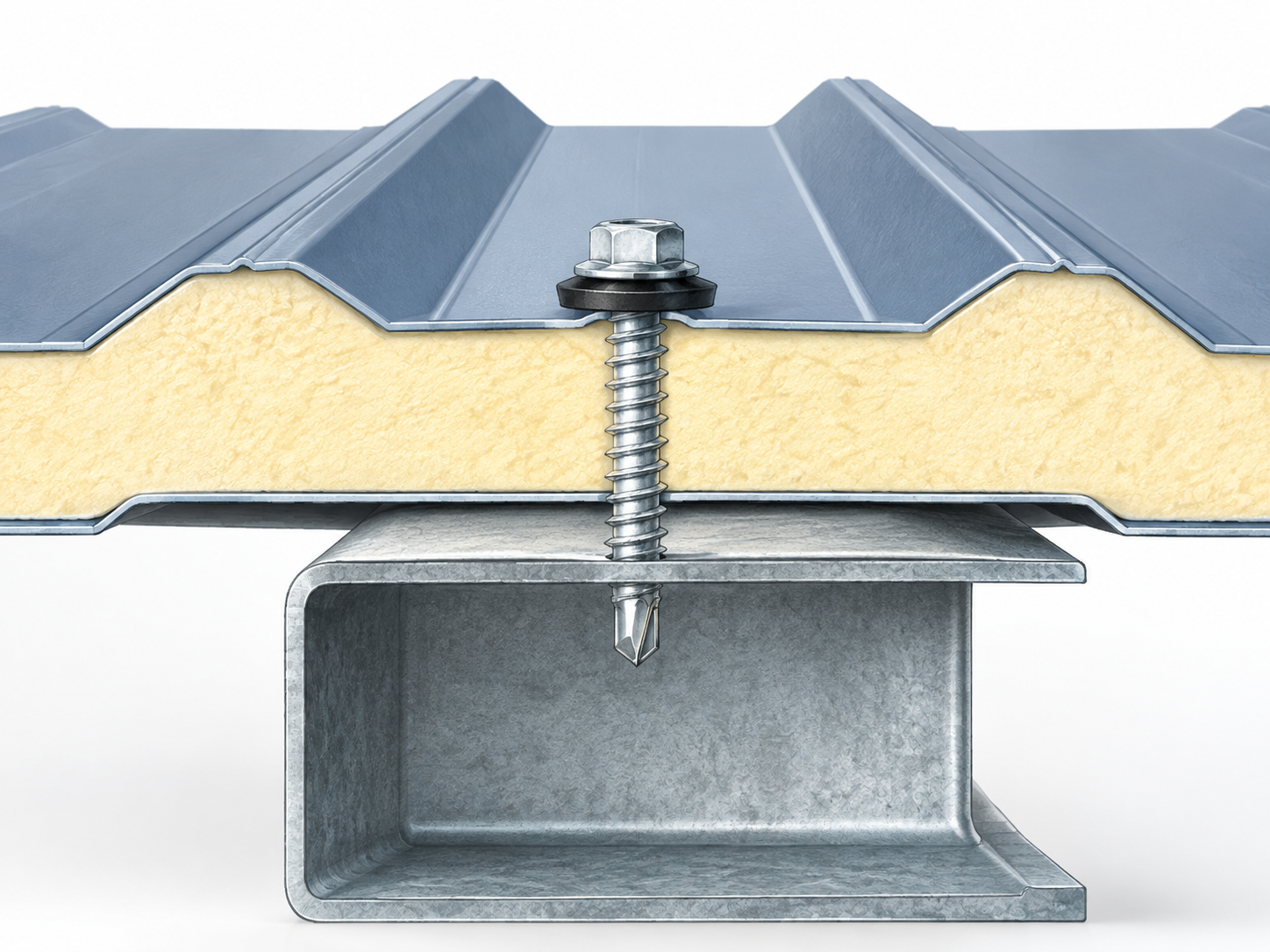
Send the same application sheet to every supplier. A supplier who quotes a screw without asking these questions is guessing. A supplier who asks for the drawing, the substrate and the installation condition is showing you how they will handle the order.
Ask what the supplier is actually quoting
Two offers can use the same diameter and length and still describe different products. Check the thread, drill point, head, drive, washer, material and coating. Ask for the drawing revision and the data sheet that apply to the quoted item.
If the supplier proposes a substitute, ask for a written comparison. What changes? Why is it suitable? Which approval does the change need? "Equivalent" is not a specification. A substitute should remain a separate option until your technical reviewer accepts it.
Question to send: "Please confirm the exact product reference, drawing revision, material, coating, washer and any difference from our specification."
Check the evidence behind the product

A test report is only useful if it applies to the quoted product and the test condition. Ask for the documents that connect the product to the order, not a generic brochure.
| What to ask for | Why it matters |
|---|---|
| Product drawing and revision | Confirms the geometry, thread, point and head |
| Material certificate or mill certificate | Shows the grade and lot behind the shipment |
| Coating specification and thickness | Connects the finish to the exposure, not just the colour |
| Salt-spray report | Shows the method, duration and acceptance criteria; it is not a service-life guarantee |
| Washer specification | Confirms the EPDM compound, hardness and dimensions |
| Packaging and label sample | Shows how the batch will be identified on site |
If a document is not available, record the gap. A supplier who explains the gap is easier to work with than one who sends an unrelated certificate.
Make sure the product suits GCC conditions
The GCC is not one climate. Coastal sites combine humidity, salt-laden air and strong sunlight. Inland sites are hot and dry, but dust and temperature swings still affect the assembly. A product that performs on one site may not be the right choice on another.
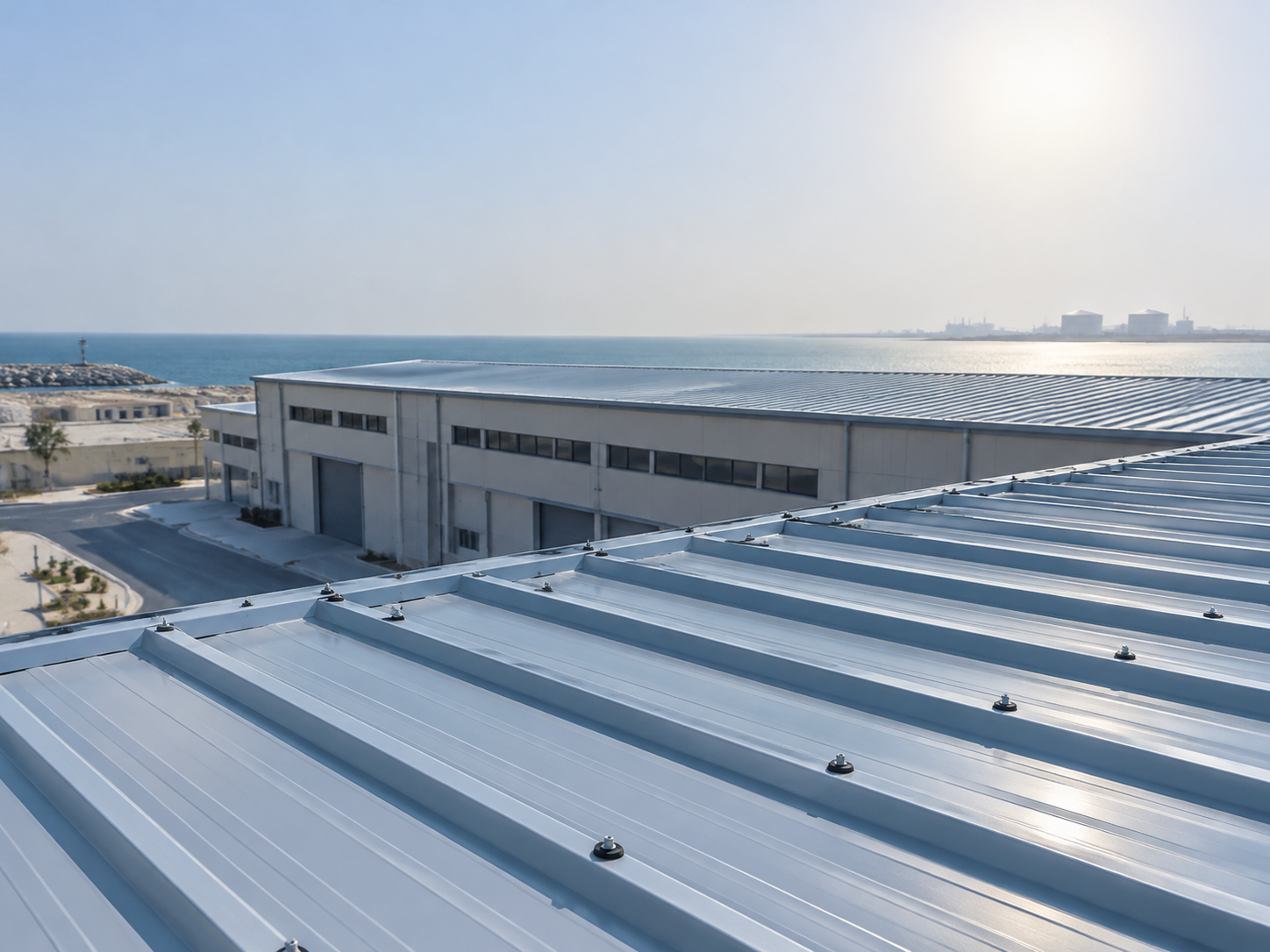
Ask how the coating was selected, not only whether it is "zinc plated" or "stainless steel". For roofing and cladding, the washer is part of the assembly. Ask for the EPDM compound, hardness and dimensions, and how the washer behaves under compression. If two different metals are in contact, ask about galvanic corrosion and whether isolation is needed.
Salt-spray hours are a laboratory condition. They do not translate directly into years of service on a Gulf roof. Use the report to compare suppliers under the same test method, not to promise a service life.
For Saudi Arabia, ask your importer or an authorised body whether the specific product and HS code fall under SASO/SABER requirements. Do not assume that one certificate covers every fastener in the catalogue.
For related technical background, see the metal roofing screw specification checklist and the 304, 410 and bi-metal comparison.
Decide between local stock and factory direct
GCC projects often need both routes: a small urgent quantity from local stock, and the balance direct from the factory. Both can be valid. The mistake is treating them as the same offer.
| Route | Best for | What to confirm |
|---|---|---|
| Local stock | Urgent repair, small quantity, short window | Actual stock, brand, specification, delivery point and price basis |
| Factory direct | Planned quantity, custom specification, lower unit cost | MOQ, lead-time trigger, production schedule, packing and shipping |
Keep the same approved specification across both routes. A local substitute may be faster, but it still needs approval. Ask what starts the lead time: order acceptance, deposit, drawing approval or sample approval. For phased projects, ask which quantities can ship together and which will be dispatched later.
If you are planning a project around the November exhibition season, start this conversation before Big 5 Global, not after the stands close. The suppliers who can answer these questions during the show are usually the ones who can answer them after the order is placed.
Compare the full commercial offer, not the unit price
A lower unit price can be more expensive after packing, freight, duty, inspection and delay. Put every offer on the same basis before you rank it.
Check the price unit (piece, box or carton), the quantity used for the quotation, the packing count, the currency and the quotation validity. Ask whether freight, insurance, inspection and sample costs are included, and where the goods will be delivered. If one supplier quotes FOB and another quotes delivered, add the missing costs before you compare.
Ask for a landed-cost worksheet. The cheapest offer is not always the cheapest order.
Check documents, labels and problem handling
A project buyer needs to receive the right product and be able to prove it. Ask for the packing list, lot or batch identification, labels, material certificate, origin information and any project-specific marking. Confirm that different sizes will be separated and labelled clearly.
Also ask what happens if the shipment is short, damaged or does not match the approved sample. Who investigates? What evidence is needed? How is a replacement arranged? Put the agreed process in the order, not in a verbal promise.
Shortlist three suppliers and test before you commit
Use the same RFQ and the same application sheet for every supplier. Score them on the points that matter to the project, not on the quality of the brochure.
| Decision area | What a good answer looks like |
|---|---|
| Application fit | The supplier asks for the connection, substrate and thickness before quoting |
| Product evidence | The drawing, data sheet and reports match the quoted item |
| GCC suitability | Coating, washer and dissimilar-metal questions are answered with evidence |
| Delivery plan | The lead-time trigger, shipping route and split shipments are clear |
| Commercial clarity | The price basis, packing count and exclusions are written down |
| Problem handling | The complaint and replacement process is agreed before the order |
A sample or trial order is not a formality. It lets you check the product, the packing, the labels and the supplier's response when something is not right. Record the approved sample and the drawing revision. Use them for the first shipment and every repeat order.
Choosing a supplier for an upcoming GCC project?

Send ScrewTrade the application, substrate and thickness, drawing or sample reference, quantity by SKU, destination and required arrival date. We will review the requirement against our self-drilling and self-tapping screw range and confirm which product details need to be verified before a quotation or sample.
Related News
Other news you might be interested in

O Mapa da Demanda por Fixadores em 2027: Centros de Dados, Energia e Projetos Industriais
A perspectiva para fixadores em 2027 não é uma recuperação ampla. É um mapa de bolsões de projetos—e os bolsões mais fortes são centros de dados, energia e trabalhos industriais selecionados. A direção já é visível nos resultados das empresas no final de 2026. A Hilti relatou crescimento de vendas em moeda local de 5,9% nos primeiros oito meses de 2026, com crescimento de dois dígitos nas Américas e na Ásia-Pacífico, enquanto descreveu a construção tradicional como fraca. As vendas aeroespaciais da LISI cresceram 14,3% nos primeiros nove meses, mas suas vendas automotivas caíram 5,2%. As vendas do terceiro trimestre da Bossard cresceram 12%, impulsionadas pela demanda de centros de dados nas Américas e pela expansão de semicondutores e eletrônicos na Ásia.

O que é um parafuso bimetálico e por que o telhado de alumínio precisa dele?
Um parafuso bimetálico é um fixador feito de dois metais com funções diferentes. Em telhados, a construção comum é uma cabeça e corpo de aço inoxidável com uma ponta de perfuração e rosca de aço carbono endurecido. A seção de aço inoxidável resiste à corrosão no telhado exposto; a ponta endurecida perfura a terça, a viga ou a estrutura de aço. Telhados de alumínio geralmente exigem essa combinação quando um painel de alumínio é fixado diretamente a uma subestrutura de aço, porque o painel é macio e resistente à corrosão, mas o parafuso ainda precisa perfurar o aço e resistir ao clima. O bimetálico não é uma garantia: o grau do aço inoxidável, a capacidade da ponta, o revestimento, a arruela e o detalhe alumínio-aço ainda precisam ser especificados.
Want to know more?
Get in touch with us for more information about our services and products.