
براغي ذاتية الحفر برأس سداسي مع فلنجة لتثبيت الهياكل الفولاذية: تركيب فعال دون حفر مسبق

Han Congming
الكاتبلدينا خبرة في تصنيع وبيع البراغي والمثبتات، وندير منشأة إنتاج خاصة بنا بقدرة إنتاجية مستقرة على نطاق واسع. نحن متخصصون في براغي الحفر الذاتي، وبراغي الجدران الجافة، وبراغي ألواح الخشب، والبراغي الميكانيكية، والمسامير، والمثبتات المخصصة لتطبيقات البناء والصناعة.
A steel building is rarely defined by a handful of large bolts. It is defined by the hundreds or thousands of small connections that hold purlins, girts, panels, brackets and supports in place. Each connection carries a cost beyond the fastener itself: marking the position, drilling a hole, changing tools, aligning the parts, handling washers, and checking the result.
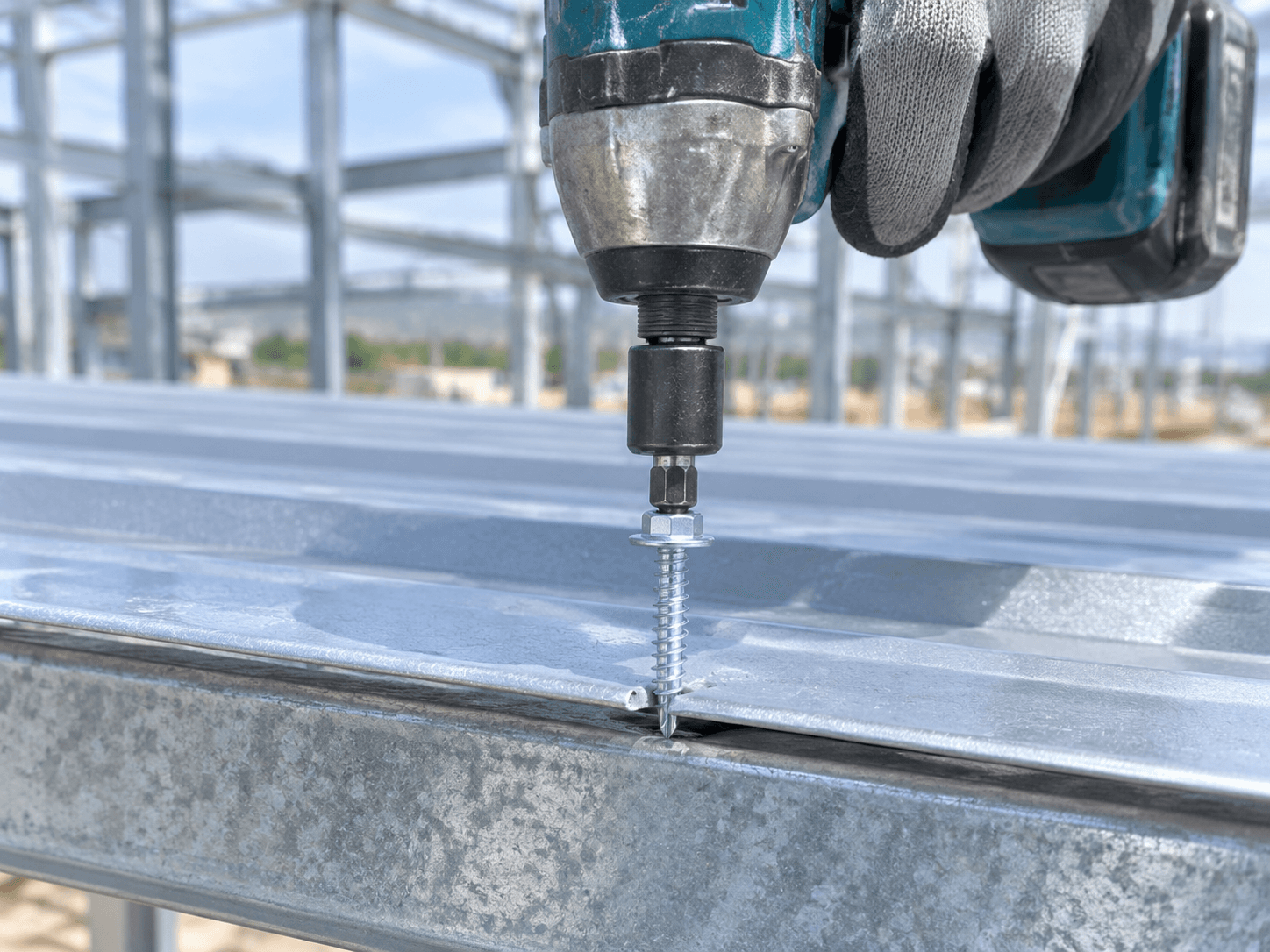
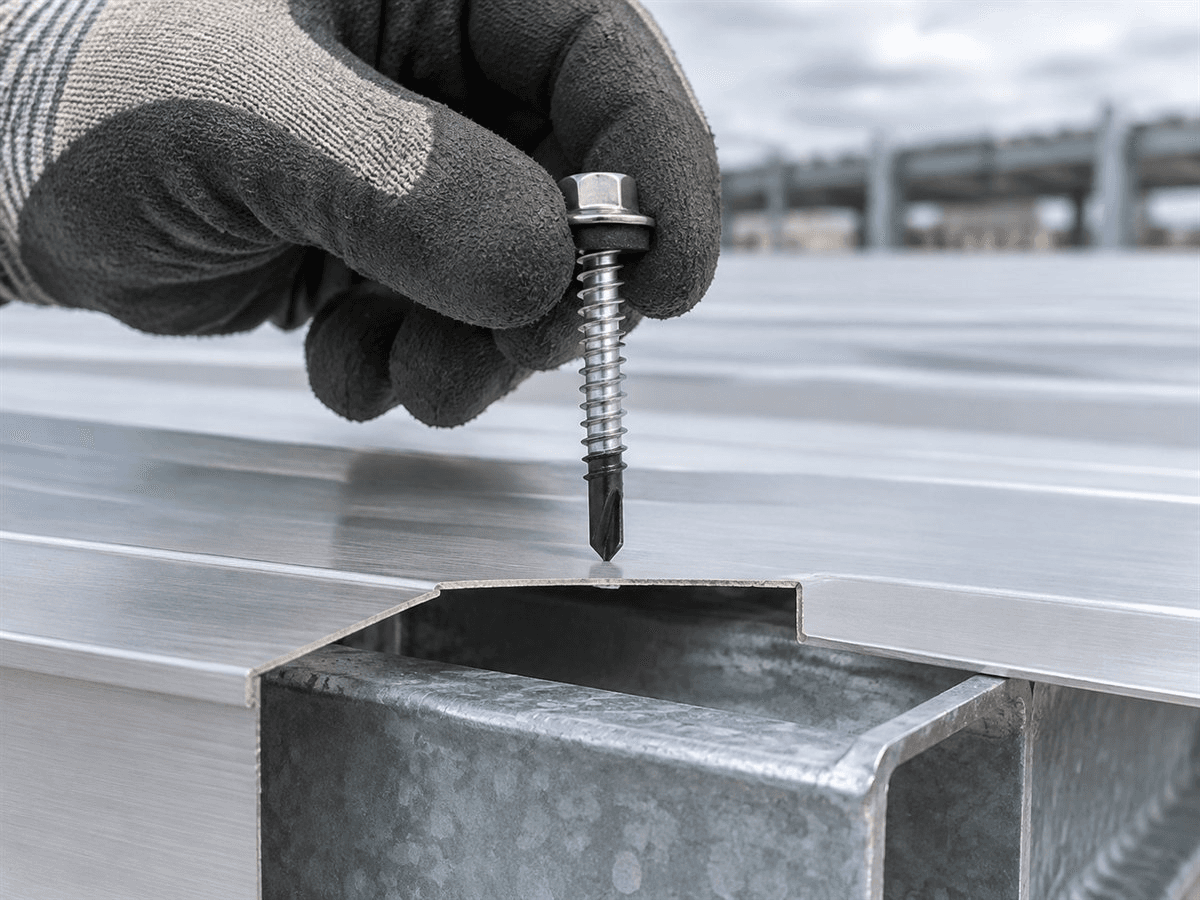
Hex flange self-drilling screws are designed to remove several of those steps. The drill point cuts its own hole, the thread forms its own engagement, and the integrated flange gives the hex head a built-in bearing surface. In the right connection, the screw can be positioned and driven in one pass, without a separate pilot hole.
That is the practical promise of “without pre-drilling.” It is real, but it is conditional.
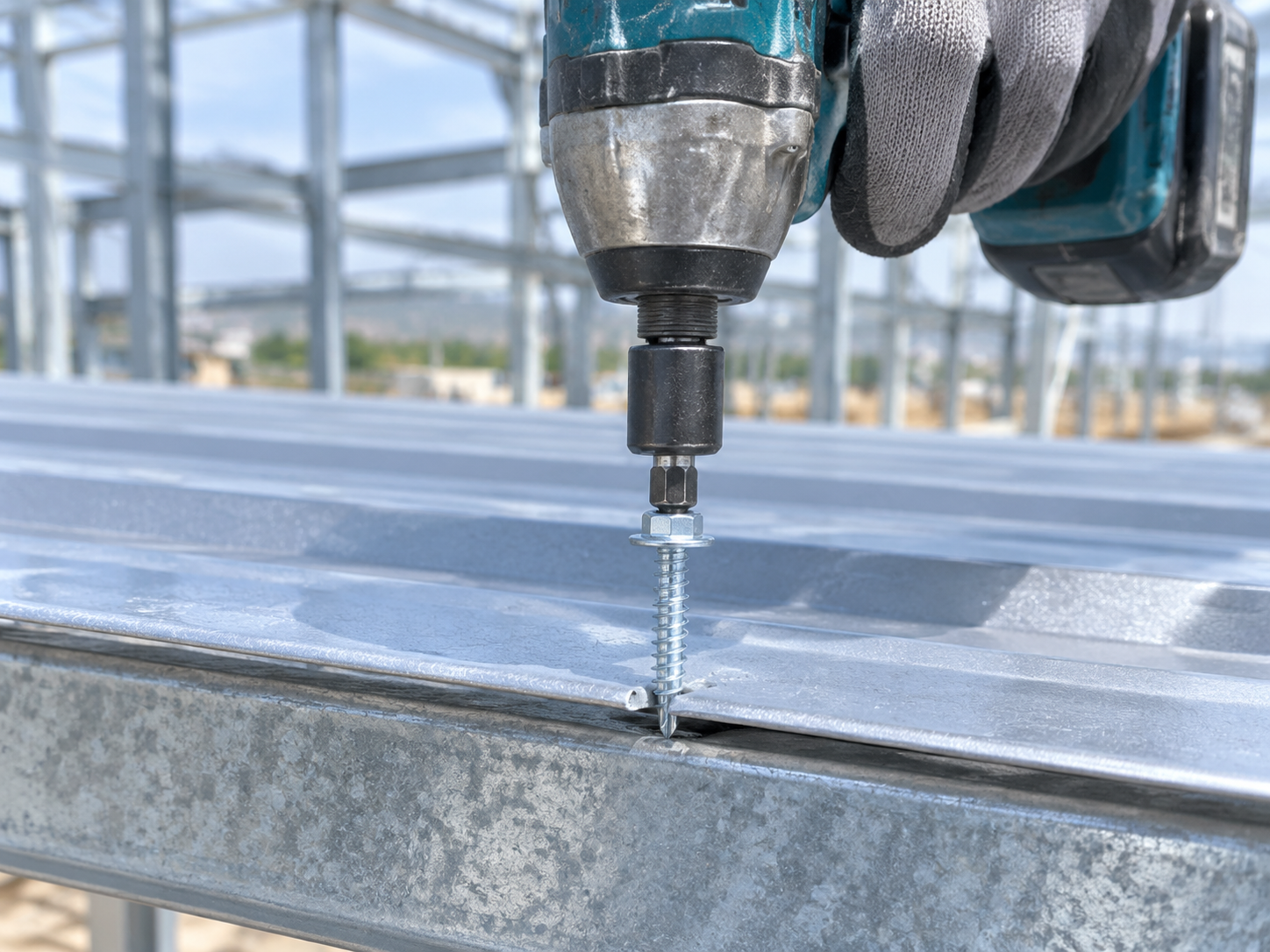
one fastener, one pass — when the joint matches
A hex flange self-drilling screw combines four functions in one part:
- a drill point that cuts through the steel;
- a thread that forms a mating thread in the supporting member;
- a hex drive that accepts a socket or nutsetter;
- an integrated flange that spreads the clamping load under the head.
In light-gauge steel framing, secondary steel members and steel-sheet assemblies, this can replace a separate drill-and-fastener sequence with one installation pass. That is where the efficient installation comes from: fewer operations, not a faster trigger pull. The screw still has to match the total steel thickness, the steel grade, the length of the joint and the installation tool. “Without pre-drilling” does not mean “without engineering.”
What “without pre-drilling” actually means
The term is often used loosely. In this article, it means one specific thing: the screw’s drill point is capable of cutting its own hole through the intended steel stack, so a separate pilot hole is not required before the screw is driven.
It does not mean that every self-drilling screw will work in every steel structure.
| The claim | What it requires |
|---|---|
| No separate pilot hole | A drill point rated for the total thickness and grade of the steel it must pass through |
| One-pass installation | Enough screw length to reach the support and leave the required thread engagement |
| Secure clamping | The correct bit, tool speed and torque, with the flange or washer seated without overdrive |
| A suitable connection | Light-gauge steel, secondary steel or a steel-sheet assembly — not a primary structural connection |
Self-drilling is not the same as self-tapping
The two terms are related, but they are not interchangeable.
- A self-tapping screw forms or cuts its own mating thread. It may start in a prepared hole.
- A self-drilling screw is a self-tapping screw with a drill point. It creates the hole and the thread in one operation.
The head style does not make a screw self-drilling. A hex flange head can be put on a self-tapping screw that needs a pilot hole, or on a self-drilling screw with a drill point. The point and the thread are separate decisions. For a broader explanation of the category, see Self-Tapping Is a Category, Not a Specification.
The four conditions behind a successful “no pre-drill” installation
- The point matches the stack. The drill point must pass through every layer before the thread can engage the load-bearing member. A point selected only for the top panel can stall, burn or break in a thicker purlin behind it.
- The length matches the joint. The screw must be long enough to reach through the compressed layers and leave the required thread engagement, but not so long that it bottoms out, protrudes excessively or distorts the assembly.
- The tool matches the screw. A socket or nutsetter must seat fully on the hex. Speed, pressure and torque have to suit the screw, the substrate and the washer.
- The connection is appropriate. A self-drilling screw is not a structural bolt. It is not a substitute for welding, a moment connection, a shear connection designed with structural bolts, or a tested fire-rated assembly.
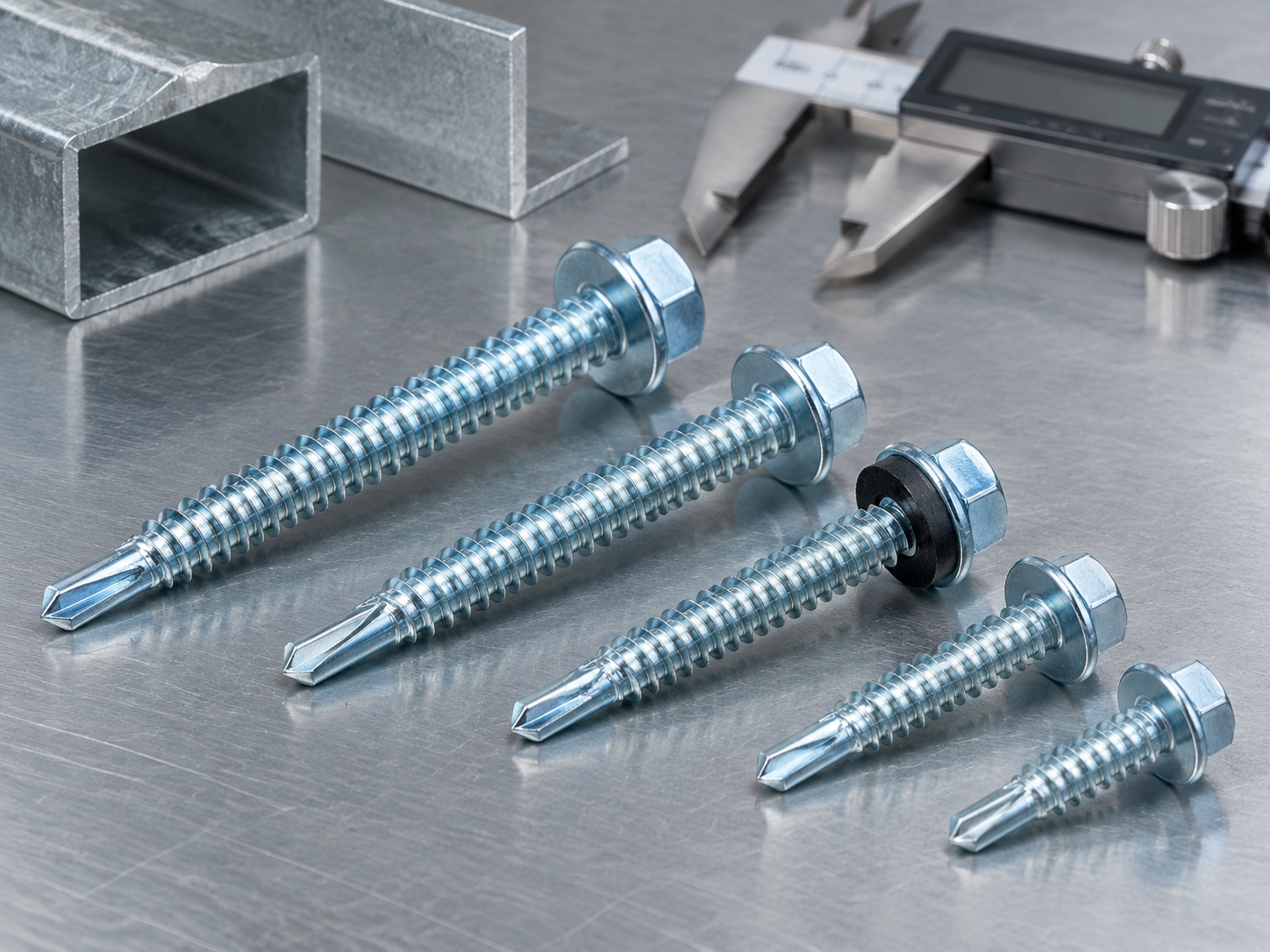
Why the hex flange head matters
The head is not just a drive interface. It is the part that transfers the clamping force into the connected material.
Hex drive: direct torque transfer
The hex head gives the installation tool a positive, reusable engagement. A socket or nutsetter can grip the head on six flats, which is useful in overhead work, repetitive framing and locations where a Phillips or square drive might cam out. The tool can be a screw gun, a cordless drill with a clutch, or an impact driver — but the tool still has to be controlled. More torque is not the same as a better connection.
Integrated flange: bearing area without a loose washer
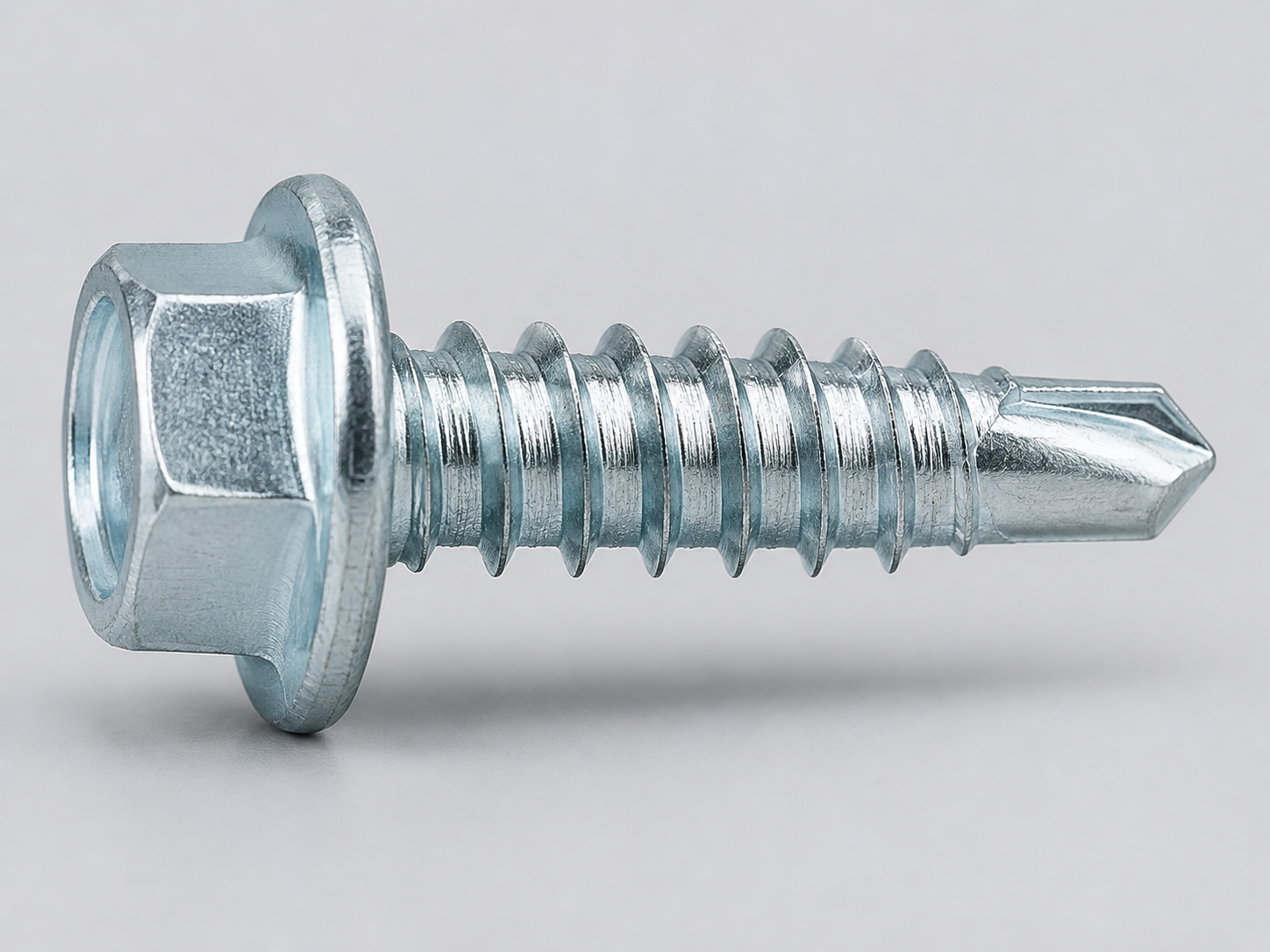
The flange is the widened collar under the hex head. It increases the bearing area compared with a plain hex head and helps spread the clamping load into the panel, purlin or bracket. Because the flange is part of the screw, there is no separate loose washer to pick up, drop, misalign or forget.
That does not make the flange a universal replacement for a washer. The actual bearing diameter matters, and some connections need a larger washer, a bonded EPDM washer or a specific sealing detail. The advantage is practical: fewer loose parts and a more consistent seating surface in assemblies where a separate washer is not required.
EPDM options for weather-exposed connections
For metal roofing and wall cladding, water management is part of the fastening decision. ScrewTrade also lists a Hex Flange Head Self Drilling Screw With 16mm EPDM Washer. The EPDM washer compresses against the panel around the hole to form the sealing interface.
The washer does not compensate for a bad hole, an angled screw or excessive torque. It works when the panel is pulled down evenly, the washer is compressed within its intended range and the screw is not overdriven. A sealing washer is a component of the connection, not an add-on that fixes a poor installation.
Hex flange vs hex washer head
Both head families can be self-drilling, and both can have a large bearing surface. The difference is in how that surface is created and how the sealing washer is configured.
| Feature | Hex flange head | Hex washer head |
|---|---|---|
| Bearing surface | Integrated flange under the hex | Hex head plus a captive, assembled or loose washer |
| Loose parts | No separate washer in the basic configuration | Washer may be part of the assembly or supplied separately |
| Sealing | Add an EPDM washer where the connection is exposed | Often paired with a bonded or separate EPDM sealing washer |
| Typical fit | Light-gauge framing, brackets and supports where an integrated bearing surface and fewer loose parts are useful | Exposed roofing and cladding where a larger or specific sealing washer is required |
The choice should follow the connection, not the name on the box. Confirm the actual flange diameter, washer OD/ID, washer thickness, panel profile and installation torque before comparing two “hex head” screws.
Five steel structure applications
In this article, “steel structure fastening” refers to the light-gauge and secondary steel work around a building: studs, tracks, joists, purlins, girts, eave struts, deck and panel supports, and the brackets that connect them. It does not refer to the primary frame, moment connections or engineered structural steel joints.
1. Light-gauge steel framing
Light-gauge steel framing uses thin-walled studs, tracks, joists and built-up members. The connections are numerous, repetitive and often made from one side.
Typical uses include:
- stud-to-track connections;
- joist or bearer connections in non-structural or engineer-specified framing;
- panel, board and sheathing attachment to light-gauge members;
- bracing, spacer and support brackets;
- modular frames, partitions and site-built steel assemblies.
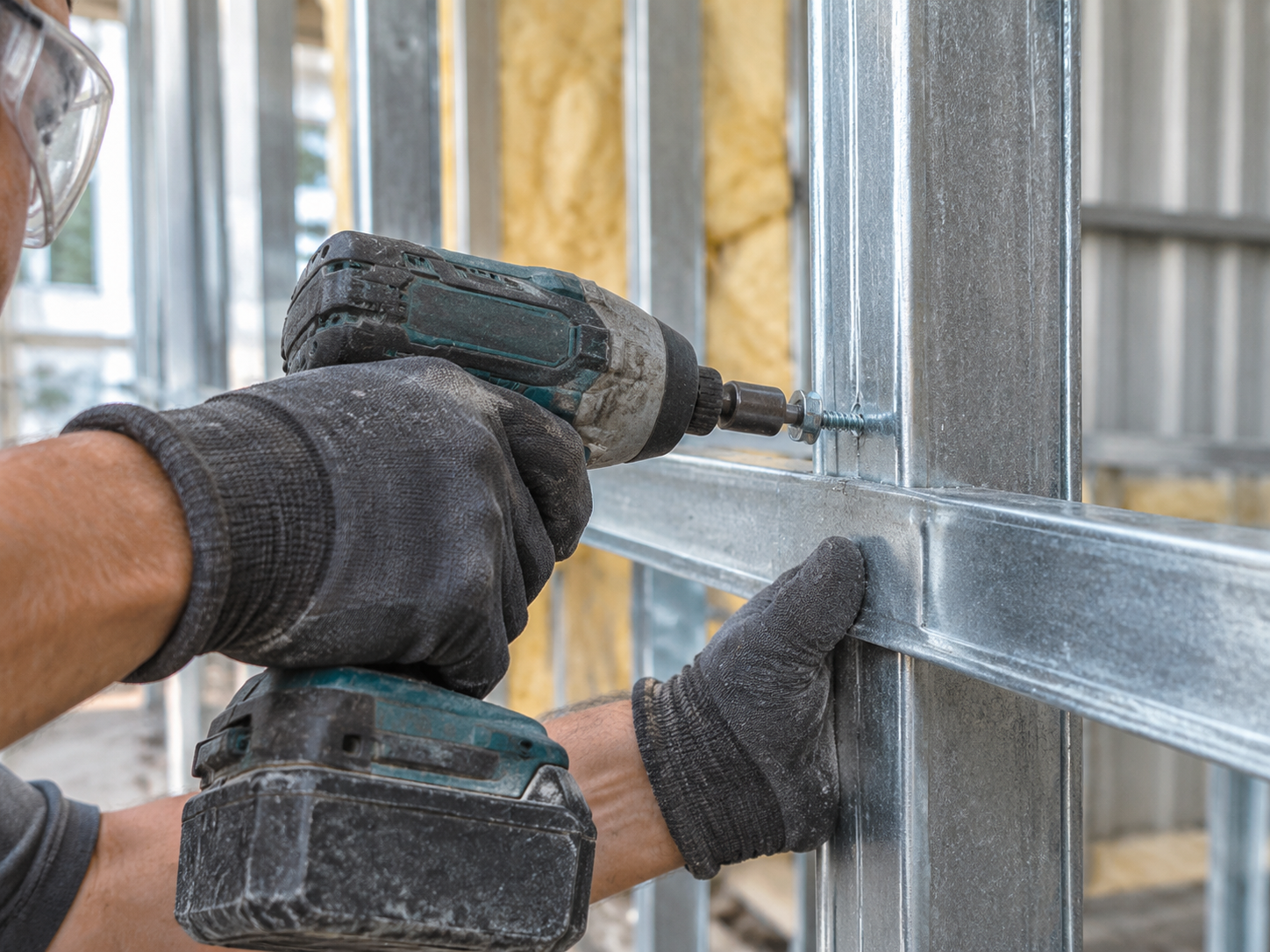
The benefit here is speed and repeatability. A self-drilling screw can be positioned at the connection and driven without a separate pilot hole, provided the point is rated for the combined thickness of the members. The flange gives the head a bearing surface on the thinner member, which helps avoid local crushing when the screw is seated correctly.
2. Metal building secondary framing
Pre-engineered metal buildings and other steel buildings rely on secondary members — purlins, girts, eave struts, flange bracing and miscellaneous supports — to carry the envelope and stabilize the frame. These are not the same as the primary rigid frame.
Hex flange self-drilling screws can be used for:
- purlin-to-purlin and girt-to-girt connections where the design permits screwed connections;
- attachment of light-gauge secondary members and brackets;
- roof and wall panel attachment to purlins and girts;
- eave, ridge and corner trim supports;
- repair or reinforcement of non-structural secondary framing.
On a metal building, the screw often has to drill through a panel or a thin secondary member and then engage a thicker purlin or girt. That is why the point and length must be selected from the full stack, not from the panel thickness alone. The self-drilling screw drill point chart is a useful starting point, but the final choice still needs a trial on the actual assembly.
3. Metal roof and wall panel assemblies
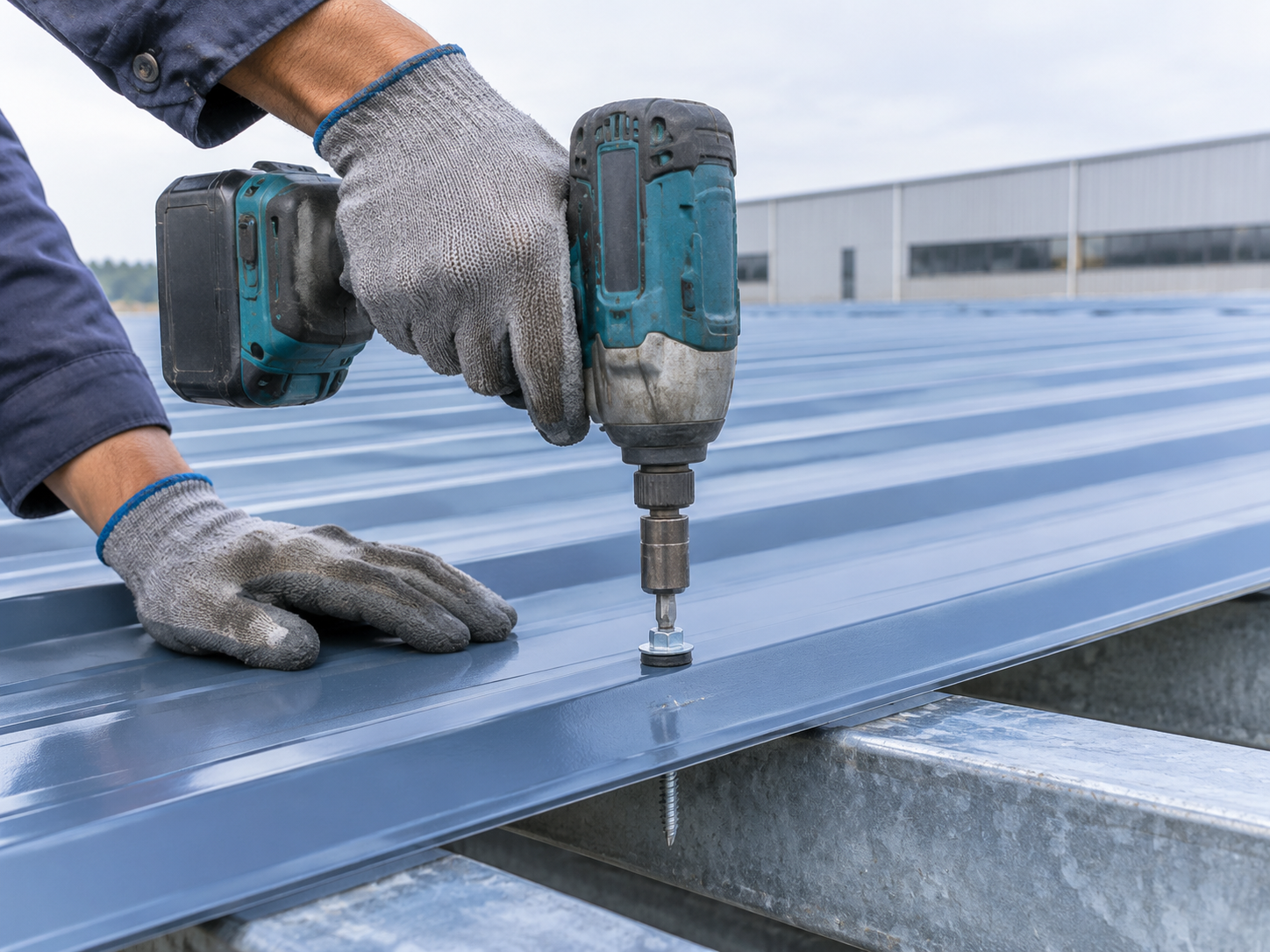
Exposed-fastener metal roofing and wall cladding are among the most direct applications. The screw passes through the panel and into the purlin, girt or support, and the head/washer assembly seals and clamps the panel at the fastener location.
Typical uses include:
- single-skin corrugated or trapezoidal roof panels to steel purlins;
- wall cladding to steel girts;
- ridge, eave and trim components;
- roof-mounted equipment supports and enclosure panels;
- repair, re-cladding and retrofit work where the existing support can be reached.
For weather-exposed connections, use an EPDM washer and control the compression. The screw should be perpendicular to the panel, the panel should be pulled down evenly, and the washer should not be crushed past its working range. Standing-seam roofs are a concealed-fastener system and should not be detailed with the same logic as an exposed-fastener panel.
4. Steel deck and panel assemblies
Steel deck, floor deck and roof deck can use screwed attachments where the project design specifies them. The screw may attach deck sheets to supports, stitch side laps or fix accessory components.
Typical uses include:
- roof deck to purlins or beams where screwed attachment is specified;
- floor deck to supports in non-composite or engineer-approved details;
- side-lap and stitching connections;
- edge trim, perimeter angles and opening reinforcement;
- temporary or permanent access panels and guards.
A self-drilling screw is not a substitute for welding, shear studs, structural bolts or a composite deck design. If the deck is part of a diaphragm, fire-rated assembly or composite floor system, the connection must follow the engineered design and the approved fastening schedule.
5. Industrial supports, enclosures and retrofit work
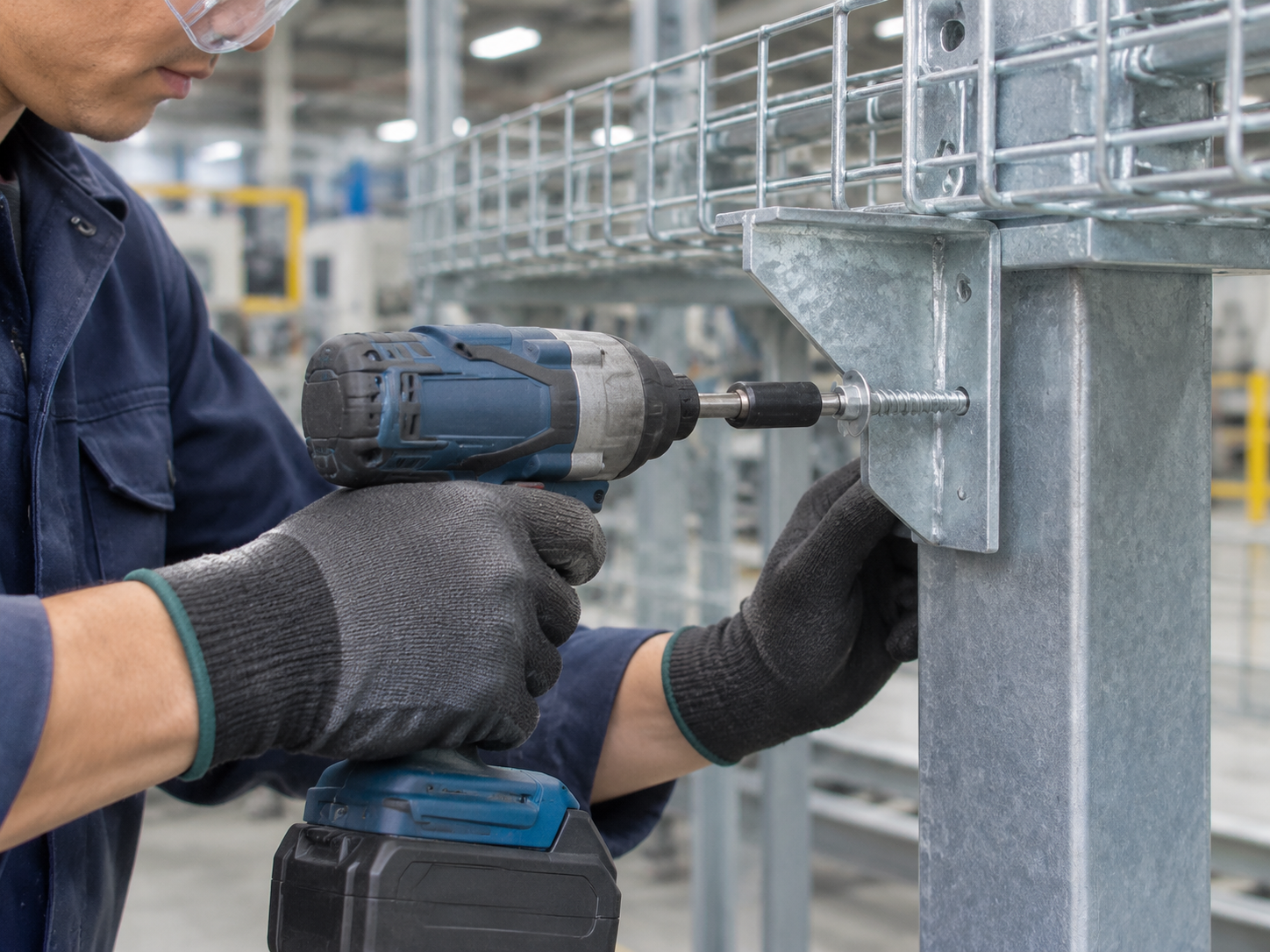
Many steel connections in an industrial building are not part of the primary frame. They support equipment, route services, protect machinery or close an opening.
Typical uses include:
- HVAC duct and equipment supports;
- cable tray, conduit and pipe supports;
- machine guards, access doors and inspection panels;
- enclosure frames, skids and shelving;
- signage, fencing and site-built support frames;
- data-center support steel, cabinet frames and cable-tray brackets where the connection is non-structural and the project specification permits it.
These connections often involve vibration, repeated loading or a corrosive environment. The screw must be matched to the support thickness, the service environment and the required coating. A bracket that carries equipment may need a different safety factor, washer or fixing pattern from a simple trim panel; those decisions belong to the project engineer.
Where the installation efficiency comes from
The efficiency of a self-drilling screw is not that it drives faster. It is that it removes operations from the installation sequence.
| Step | A typical drill-and-bolt connection | A hex flange self-drilling connection |
|---|---|---|
| Mark the position | Yes | Yes |
| Drill a pilot hole | Yes | No separate pilot hole when the point is rated for the stack |
| Deburr or clean the hole | Often | Usually no separate deburring step |
| Align the hole and the parts | Yes | Position the screw at the marked point |
| Insert the fastener | Bolt, washer and nut | One screw |
| Tighten | Often requires access to both sides | Usually one-sided access |
| Check the result | Torque and engagement | Seating, engagement and washer compression |
This table compares operations, not guaranteed productivity. Actual speed depends on access, tool, operator, substrate and the number of connections. But the direction is clear: fewer steps mean fewer opportunities for a missed hole, a lost washer or a tool change.
The integrated flange adds a second efficiency: it gives the screw a bearing surface without a separate loose washer in assemblies that do not need one. On a roof or a framing crew, fewer loose parts means less handling and fewer dropped components.
The saving disappears if the screw is wrong. A point that is too short for the stack will stall. A screw that is too long may bottom out or distort the panel. An impact driver with no clutch control can overdrive the washer or strip the thread. The cost of one rework can exceed the saving from many correct installations.
How to specify the right screw
Start with the connection, not the catalog page.
Describe the joint
Record:
- the application and connection type;
- every layer the screw must pass through;
- the material and thickness of each layer;
- the steel grade or strength, if known;
- whether the connection is structural, non-structural or engineer-specified;
- the access available to the installer;
- the exposure: indoor, outdoor, coastal, industrial or chemical.
Match the drill point to the total stack
The drill point must cut through all the layers before the thread engages the supporting member. A point selected for a 0.5 mm panel may not perform in a 3 mm purlin. The point number is a useful family reference, not a universal capacity rating. Confirm the point’s rated steel thickness and the steel grade with the supplier, then verify it on a sample.
Match the length and thread to the joint
Nominal length is not the same as grip range. The screw must:
- pass through the compressed layers;
- clear the unthreaded drill point;
- leave enough thread engaged in the supporting steel;
- avoid bottoming out or protruding excessively.
A practical planning check is:
compressed stack thickness + unthreaded point length + required thread engagement + installation allowance
The required engagement comes from the project design, not from a catalog. Confirm the length datum as well: for hex head screws, length is usually measured from under the head or washer to the tip, but the supplier’s definition should be written on the drawing.
Choose the head and washer for the connection
Use a hex flange head where the integrated bearing surface and the reduced parts count fit the assembly. Use a hex washer head, or a flange head with a separate EPDM washer, where the sealing detail or washer size requires it.
For exposed roofing and cladding, confirm:
- washer OD and ID;
- metal backing diameter and thickness;
- EPDM thickness and hardness;
- bonded or loose washer;
- panel profile and rib height;
- recommended compression and installation method.
Match the material and coating to the environment
ScrewTrade’s product page lists carbon steel and stainless steel options, with zinc plated or customized finish options. The page describes the product as designed for indoor and outdoor service environments. That is a product-family description, not a guarantee for every environment.
For a coastal, industrial or chemical exposure, ask for:
- the exact body material and grade;
- the coating system and thickness;
- the test method and acceptance criterion;
- whether the test was run on the actual screw or on a flat coupon;
- how the coating performs at the drill point, thread crest and cut edges.
A salt-spray number alone is not a service-life prediction. The test method, specimen, coating and failure criterion have to match before two results can be compared.
Confirm the tool and torque
The installation tool is part of the specification. Confirm:
- the socket or nutsetter size and fit;
- the tool type: screw gun, drill with clutch, or impact driver;
- the speed and torque setting;
- the pressure needed to start the drill point;
- the seating criterion for the flange or washer.
An impact driver can deliver high torque in a fraction of a second. That is useful for driving, but it can also overdrive a washer or strip a thread. Run a first-piece trial and adjust the tool before production.
Put the product page range in context
ScrewTrade’s public product page for the Hex Head Flange Self Drilling Screw lists the following range:
| Parameter | Product page listing | What to confirm for the order |
|---|---|---|
| Material | Carbon steel / stainless steel options | Exact grade, strength and corrosion performance |
| Surface treatment | Zinc plated / customized finish options | Coating system, thickness, color and test method |
| Diameter range | 4.0 mm to 12.0 mm (customizable) | Exact diameter and tolerance |
| Length range | 16 mm to 150 mm (customizable) | Length datum, thread length and grip range |
| Temperature range | -40°C to 120°C (application-dependent) | Actual service temperature, washer and coating limits |
| Corrosion resistance | Designed for indoor and outdoor service environments | Actual exposure, expected life and test evidence |
| Reference standard | Produced under agreed B2B quality control specification | The project standard, if a published standard is required |
| Packaging | Bulk carton or pallet packaging with export labels | Label, mixed-SKU rules and pallet configuration |
| OEM/ODM | Branding, dimensions and packaging customizable | Drawing approval, sample process and order terms |
This is a product-page range, not a stock matrix. Not every diameter, length, head, washer, material and coating combination is automatically available. The exact SKU still has to be confirmed.
Installation rules that protect the benefit
Prepare the connection
- Confirm the steel layers are in contact and the assembly is aligned before driving.
- Remove loose scale, debris or obstructions that could prevent the point from starting.
- Use a marker or a light center punch for location if needed. A center punch is not a pilot hole; it only helps the point start.
- Check that the socket or nutsetter fits the hex completely.
Drive the screw correctly
- Hold the tool perpendicular to the work surface.
- Apply steady pressure and let the drill point cut. Do not spin the point on the surface.
- Keep the screw aligned with the connection; an angled screw can enlarge the hole, damage the thread or seat the washer unevenly.
- Drive until the flange or washer seats. Do not keep the trigger down after seating.
- For a weather-exposed connection, watch the washer compression and the panel around the head. Stop before the panel distorts or the washer extrudes.
Check the first piece
Before a production run, install a sample on the actual assembly and record:
- the material and thickness of every layer;
- the steel grade, if known;
- the screw reference, point and length;
- the tool, speed and torque setting;
- the installer and the installation direction;
- whether the screw penetrated fully;
- whether the thread engaged the support;
- whether the head or washer seated correctly;
- whether the panel, coating or washer was damaged.
If the sample fails, change one variable at a time: point, length, tool setting or washer. Do not “fix” a drilling problem by pushing harder.
Inspect the work
A practical inspection checklist for a completed connection:
- the screw passes through all intended layers;
- the drill point has cleared the support;
- the thread is engaged in the supporting member;
- the head/flange is seated, not buried or standing off;
- the washer is compressed evenly and not split or extruded;
- the panel or sheet is not deformed around the head;
- there is no spinning, stripping or visible cracking;
- the coating is not gouged or missing at the head and thread;
- swarf has been removed from the work area;
- the fixing pattern matches the approved spacing and edge distance.
When not to use a self-drilling screw
A self-drilling screw is the wrong tool when the connection needs something else. Do not use one for:
- Primary structural steel connections. Rigid frames, moment connections, braced-frame connections and other engineered structural joints should use the structural bolts, welds or connectors specified by the engineer.
- Connections beyond the drill point’s capacity. If the total stack, steel grade or hardness is outside the point’s rated range, the screw may stall, overheat, break or produce an oversized hole.
- Connections that require a specific preload. Structural bolts are designed for controlled preload. A self-drilling screw is not a substitute.
- Connections that will be repeatedly disassembled. A machine screw or bolt with a matched nut is usually more appropriate.
- Concrete, masonry or brick. Use an anchor designed for the base material.
- Fire-rated, seismic or other tested assemblies. The fastener must be part of the tested system. Do not substitute a generic screw.
- Thin sheet where head pull-over is a risk. Use a larger bearing head or washer, or change the connection detail.
- Dissimilar-metal or severe-corrosion joints without the right material and isolation detail. The fastener, washer and coating have to suit the environment.
When in doubt, ask the project engineer. The cost of a conservative connection is usually lower than the cost of a failed one.
RFQ and quality checklist
What to send with the inquiry
- application and connection drawing or photo;
- each layer, material and thickness;
- steel grade or strength, if known;
- indoor, outdoor, coastal, industrial or chemical exposure;
- expected service life and maintenance assumption;
- screw type, point, diameter, length and thread, if already specified;
- head style, flange or washer requirement;
- coating system, color and test requirement;
- installation tool, access and torque limit;
- sample quantity and trial method;
- standard, test report and batch traceability requirements;
- packaging, labeling, OEM requirements, MOQ and destination.
What to ask the supplier
- What drill point is recommended for this total stack and steel grade?
- What is the point’s tested capacity, and on what material?
- What length leaves the required thread engagement without bottoming out?
- What is the actual flange diameter and bearing area?
- Is the washer bonded, captive or loose?
- What material and coating are proposed for the exposure?
- What test method and acceptance criterion support the coating claim?
- Can you provide a sample and a first-article report?
- How is the batch traced from wire to finished screw?
- What is the packaging and labeling standard?
“Self-drilling” is not a complete specification. A quotation that does not state the point, length, thread, head, washer, material and coating is not yet comparable with another quotation.
Conclusion: the right connection, not the universal screw
Hex flange self-drilling screws are a practical fastening solution for light-gauge steel framing, secondary steel members, metal roof and wall panels, steel deck assemblies and industrial supports. They combine drilling, thread forming and clamping in one part, and the integrated flange gives the hex head a bearing surface without a separate loose washer in many assemblies.
The efficiency is real, but it comes from matching the screw to the connection. The point must suit the total steel stack. The length must leave enough thread engaged. The head and washer must suit the panel and the exposure. The tool and torque must seat the fastener without overdriving it. And the connection must be one where a self-drilling screw is allowed.
If you have a steel structure connection that you want to convert from a drill-and-bolt sequence, send the drawing or a photo of the joint, the material and thickness of each layer, the steel grade, the installation tool and the expected quantity. ScrewTrade can help confirm whether a hex flange self-drilling screw is suitable, which product family fits, and which dimensions need to be locked before quoting or sampling.
Related News
Other news you might be interested in

خريطة الطلب على أدوات التثبيت لعام 2027: مراكز البيانات والطاقة والمشاريع الصناعية
توقعات أدوات التثبيت لعام 2027 ليست انتعاشًا واسعًا. إنها خريطة لقطاعات مشاريع محددة—وأقوى القطاعات هي مراكز البيانات والطاقة وأعمال صناعية مختارة. الاتجاه واضح بالفعل في نتائج الشركات في أواخر عام 2026. أعلنت شركة هيلتي عن نمو مبيعاتها بالعملة المحلية بنسبة 5.9% في الأشهر الثمانية الأولى من عام 2026، مع نمو مزدوج الرقم في الأمريكتين وآسيا والمحيط الهادئ، بينما وصفت البناء التقليدي بأنه ضعيف. ارتفعت مبيعات LISI في قطاع الطيران بنسبة 14.3% في الأشهر التسعة الأولى، لكن مبيعاتها في قطاع السيارات انخفضت بنسبة 5.2%. نمت مبيعات بوسارد في الربع الثالث بنسبة 12%، بفضل الطلب على مراكز البيانات في الأمريكتين وتوسع أشباه الموصلات والإلكترونيات في آسيا.
ما هو المسمار ثنائي المعدن ولماذا يحتاج السقف المصنوع من الألمنيوم إليه؟
المسمار ثنائي المعدن هو قفل واحد مصنوع من معدنين بمهام مختلفة. في التسقيف، البناء الشائع هو رأس وجسم من الفولاذ المقاوم للصدأ مع نقطة حفر وجزء ملولب من الفولاذ الكربوني المقوى. الجزء المصنوع من الفولاذ المقاوم للصدأ يقاوم التآكل على السقف المكشوف؛ النقطة المقواة تحفر في العارضة الفولاذية أو الركيزة أو الإطار. غالبًا ما يتطلب التسقيف بالألمنيوم هذا المزيج عندما يتم تثبيت لوح ألمنيوم مباشرة على هيكل فولاذي سفلي، لأن اللوح ناعم ومقاوم للتآكل، لكن المسمار لا يزال يتعين عليه حفر الفولاذ وتحمل الطقس. المسمار ثنائي المعدن ليس ضمانًا: يجب تحديد درجة الفولاذ المقاوم للصدأ، وقدرة النقطة، والطلاء، والحلقة، وتفاصيل الألمنيوم إلى الفولاذ.
Want to know more?
Get in touch with us for more information about our services and products.