
Fiberboard vs. Fiber Cement Screws: A U.S. Siding Buyer’s Selection and RFQ Checklist

Han Congming
AuthorWith experience in screw and fastener manufacturing and sales, we operate our own production facility with stable large-scale capacity. We are specialists in self-drilling screws, drywall screws, chipboard screws, machine screws, bolts, and customized fasteners for construction and industrial applications.
“Fiberboard screws” and “fiber cement screws” sound like two names for the same family. In a U.S. siding or trim package, that assumption can lead to the wrong fastener, a failed inspection, or a callback after the first rain.
The two products are not interchangeable. One is normally a wood-panel screw. The other is a fastener for a cement-based exterior board. The correct choice depends on the board, the framing, the exposure, and the approval behind the specific screw.
This checklist is written for siding distributors, exterior contractors, and purchasing teams who need to compare quotations without treating every “fiber” screw as equal.
The short answer
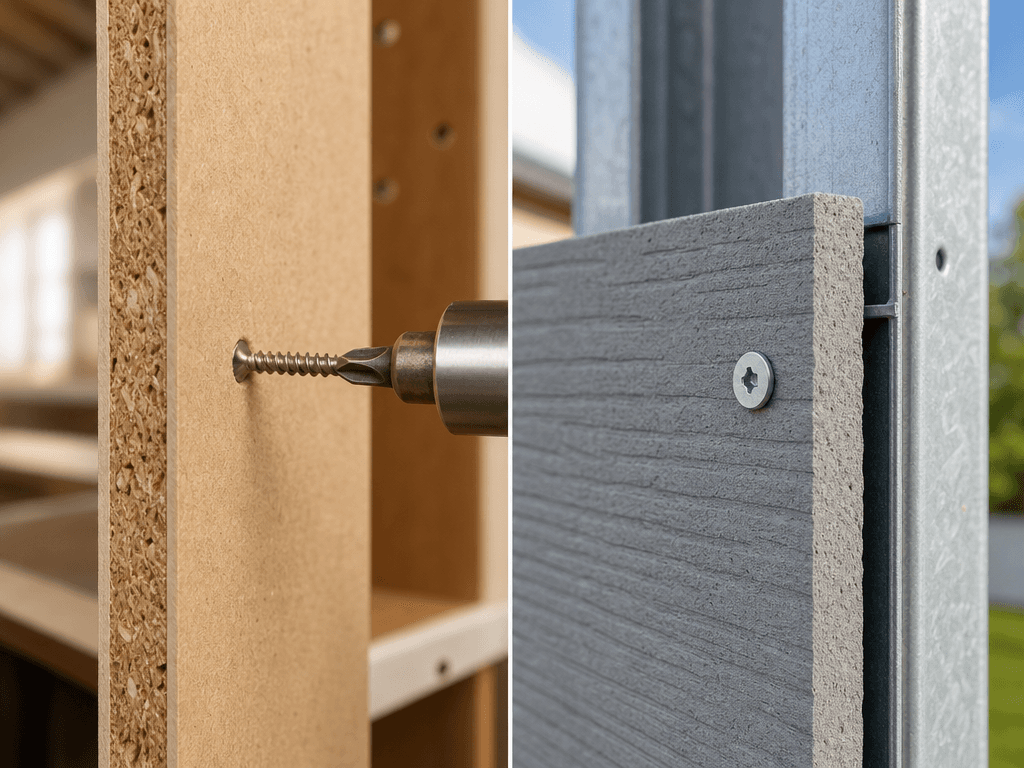
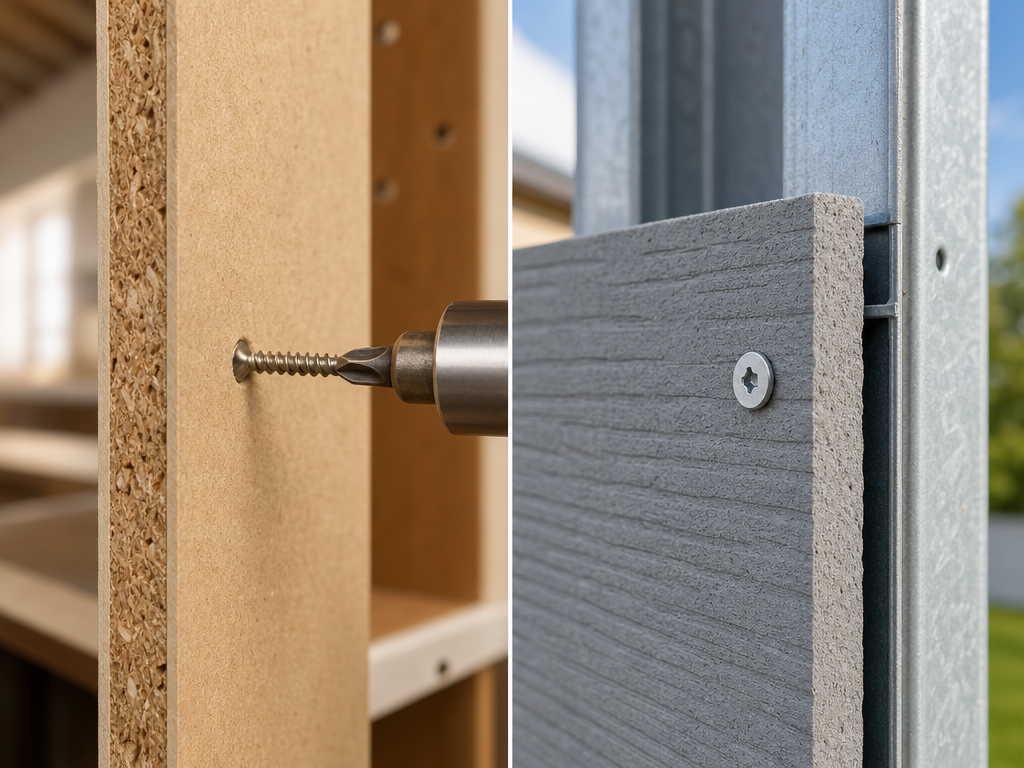
- Fiberboard screws are generally used for wood-based panels such as MDF, particleboard, plywood, and wood-based fiberboard. They commonly have a sharp self-tapping point, a deep or coarse thread, and a countersunk, pan, or round head. They are used in furniture, cabinets, wood packaging, interior panels, and light wood assemblies.
- Fiber cement screws are used for fiber cement siding, trim, and cement backer board. The fastener must be approved for the specific board and framing. Steel framing often calls for a self-drilling screw with reamer wings; wood framing may use a suitable fiber cement screw designed for wood framing. Corrosion resistance and head style are part of the selection.
- A standard fiberboard screw should not be substituted for a fiber cement screw unless the exact screw is approved for that board, framing, and exposure.
The word “fiber” describes the board category, not the fastener. The screw has to match the job.
Fiberboard and fiber cement are different substrates
In North America, “fiberboard” can refer to several wood-based panels. The common point is that the panel is made from wood fibers or particles with a resin binder. It is not a cement board.
ScrewTrade’s public fiberboard screw page describes its product as a chipboard screw for fiberboard, particleboard, plywood, MDF, and wood. The listed features are a sharp self-tapping point, a coarse or deep thread, and common head and drive options such as countersunk, pan, Phillips, Pozi, and hex socket. The page lists furniture, cabinets, wooden packaging, interior decoration, and light wood frame installation as typical applications.
That is a different starting point from fiber cement siding. Fiber cement is a cement-based board used in exterior cladding and wet-area backer applications. It is dense, relatively brittle at edges, and exposed to weather or moisture. The fastener must hold the board without cracking it, pull through, or create a corrosion point. The board manufacturer’s installation instructions and the project specification control the accepted fastener.
| Buyer question | Wood-based fiberboard, MDF, particleboard, plywood | Fiber cement siding, trim, cement backer board |
|---|---|---|
| What is the board made of? | Wood fibers or particles with resin | Cement, cellulose, and other mineral components |
| Typical use | Furniture, cabinets, interior panels, packaging, light wood assemblies | Exterior siding, trim, soffit, cement backer board |
| Common screw family | Fiberboard or chipboard screw; sharp point; deep or coarse thread | Fiber cement screw; approved head, point, thread, and coating |
| Typical head | Countersunk, pan, or round | Wafer, ribbed flat, or another head specified by the board manufacturer |
| Framing | Usually wood | Wood or steel; the screw and point must match the framing |
| Main exposure | Mostly interior or protected; some exterior sheathing is covered by cladding | Exterior, wet, or humid service |
| Common failure to avoid | Splitting, stripping, loose joints | Cracking, overdriving, pull-through, corrosion staining |
| Approval basis | Buyer drawing, sample, and agreed specification | Board manufacturer’s installation instructions, code, and project approval |
What U.S. buyers usually ask
Can I use fiberboard screws for fiber cement siding?
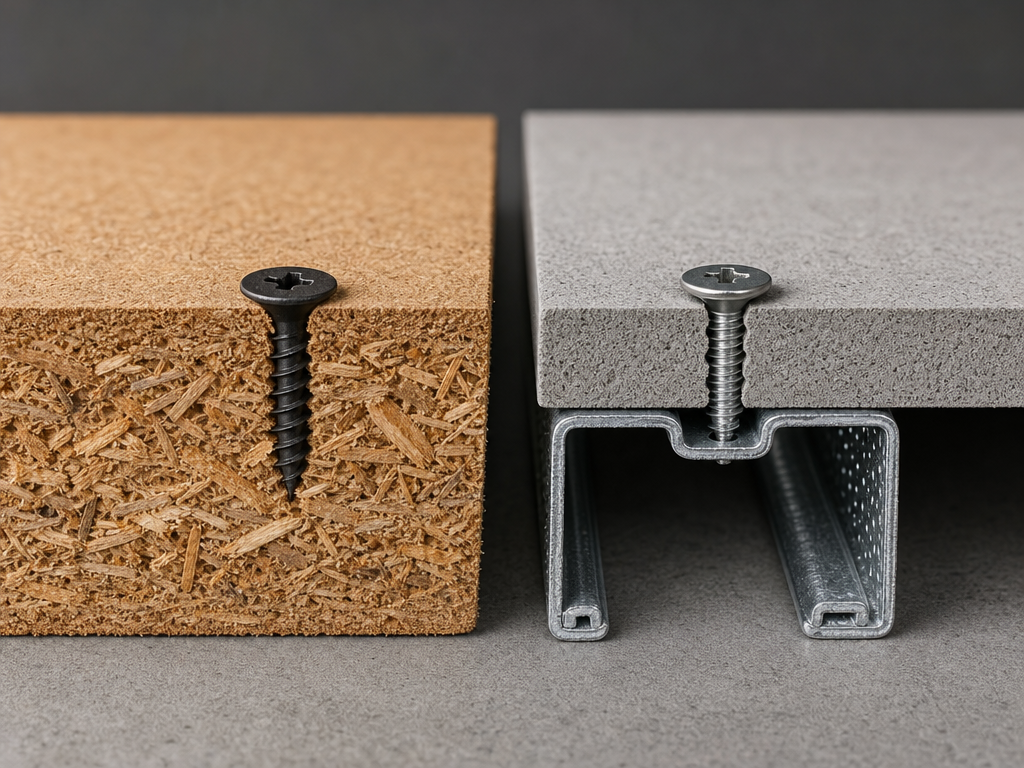
No, not as a default. A fiberboard screw is designed around a wood-based panel. A fiber cement board has different density, edge behavior, and exposure requirements. Use a screw that the board manufacturer or project specification approves for fiber cement.
If a supplier offers “fiber cement screws,” ask for the exact product, the approved board types, the framing material and thickness, the head and point, the coating, and the available test or approval documents. “Fiber cement screw” is a product family, not a complete specification.
What screw should be used for fiber cement to steel framing?
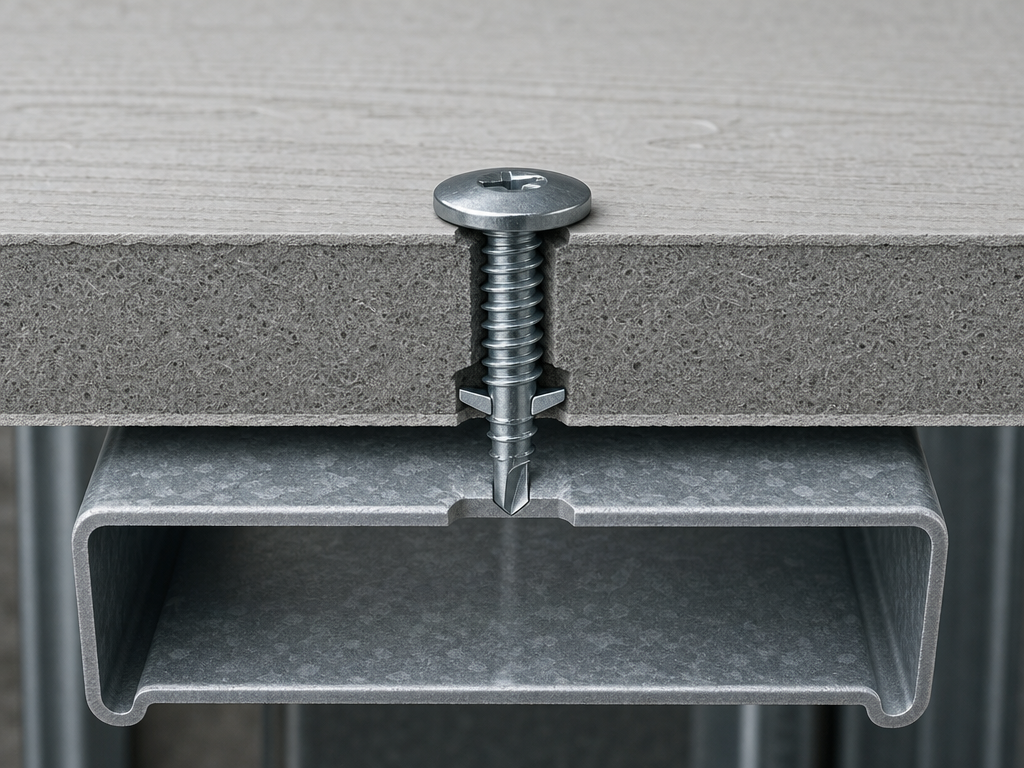
The common approach is a self-drilling screw designed for fiber cement and thin-gauge steel. Many products use a drill point with reamer wings. The wings enlarge the hole through the board, then break off when the point reaches the steel. That allows the board to pull tight to the framing without the thread engaging the board too early.
This is not a universal rule for every board or every steel thickness. Confirm the screw’s steel capacity, the required penetration, and whether the board manufacturer requires wings or pre-drilling. Allura’s fiber cement installation manual, for example, states that screws used to attach to steel studs or furring must have wing tips, and that pre-drilling is required if the screws do not have wing tips. That requirement belongs to that system; always check the manual for the board being installed.
What screw should be used for fiber cement to wood framing?
Wood framing changes the point and thread question. A fiber cement screw designed for wood framing may be appropriate, but the screw still needs the correct point, head, corrosion protection, length, and board approval. Confirm the point and thread with the board manufacturer rather than assuming that every fiber cement screw is a wood-framing screw. The screw must penetrate the structural framing by the amount required in the board manufacturer’s instructions.
Allura’s manual, for example, specifies a minimum of 3/4 inch penetration into wood framing when screws are used. That is an example from one manufacturer, not a universal number. The board manual and project specification take priority.
What head type is correct?
Fiber cement siding and trim commonly use a wafer or ribbed flat head with a bearing area that suits the board. Some products have self-countersinking nibs. The head must seat as the board manufacturer requires without crushing the board or leaving a path for water.
A standard countersunk wood screw is not automatically correct. A metal roofing screw with an EPDM washer is also not automatically a fiber cement screw. Those products belong to different assemblies and different sealing logic.
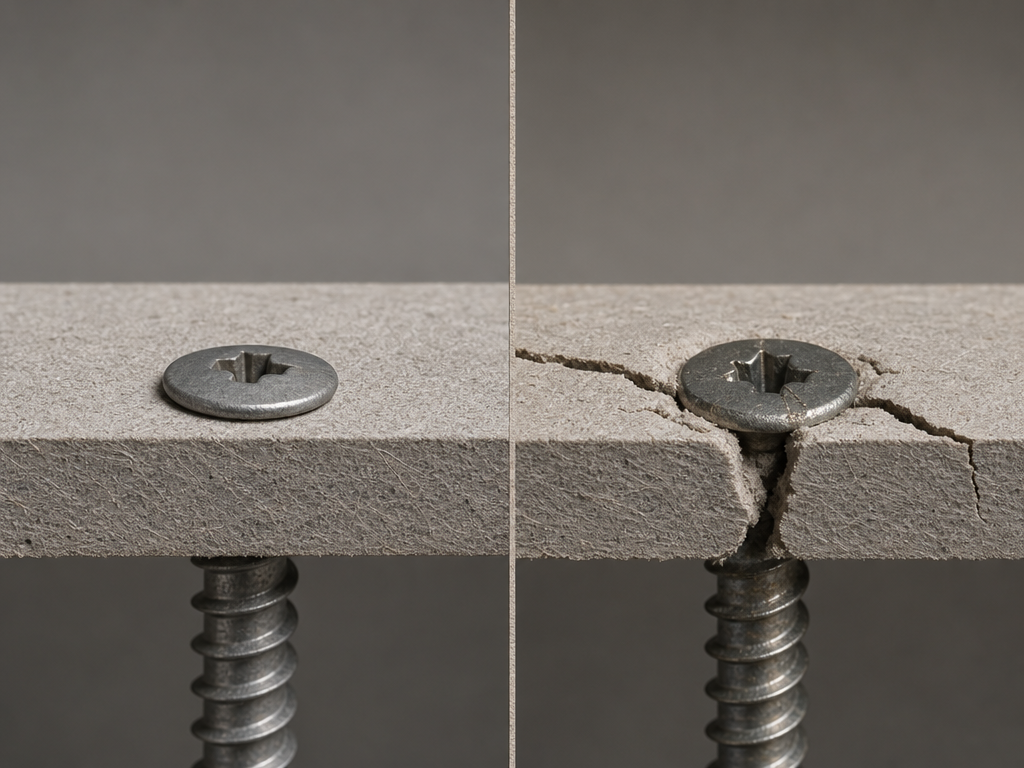
Seating depth also varies. Some siding instructions require the head to sit proud of the surface; some backer board instructions require the head flush. In both cases, overdriving is a defect. Follow the specific board manual rather than a generic “drive it tight” rule.
What coating or material should I specify?
Fiber cement is an exterior product, and the fastener is part of the corrosion system. Manufacturers commonly require corrosion-resistant, galvanized, or stainless steel fasteners. The exact material and coating must match the exposure, the framing, and the board manufacturer’s warranty requirements.
“Stainless” is not a complete answer. The grade, the coating, the base material, and the contact with other metals matter. A coated steel screw, a 410 stainless screw, and a 304 or 316 stainless screw do not have the same corrosion profile. Ask for the exact material and coating, not just a family name.
For Hardie siding, James Hardie’s public FAQ directs buyers to fasteners approved by ICC-ES ESR-2290 and spaced according to the applicable wind load tables. It also states that fasteners must be corrosion resistant, galvanized, or stainless steel. That is a product-specific requirement; other boards may use a different approval path.
What length do I need?
Length is a stack-up calculation, not a catalogue guess. Start with:
- board thickness;
- any furring, sheathing, or spacer;
- the required penetration into the framing;
- the screw’s usable length under the head;
- the head and point geometry.
For steel framing, Allura’s manual gives a minimum of 1/4 inch or three threads into the metal. For wood framing, its example is 3/4 inch into the structural framing. These are examples from one installation manual. The correct number for a project comes from the board manufacturer, the engineer, and the approved fastener.
Do not choose a longer screw to compensate for an unknown substrate. A longer screw can bottom out, damage the board, reduce edge distance, or change the drill path.
Do I need to pre-drill?
Not always, but do not assume pre-drilling is unnecessary because the screw is called self-drilling. The answer depends on the board, the screw point, the framing, and the manufacturer’s instructions.
Allura’s manual states that pre-drilling is required when screws without wing tips are used to attach to steel studs or furring. Other systems may require pre-drilling near edges, with thicker boards, or under specific installation conditions. The safe RFQ question is: “Does this exact screw require pre-drilling for this board and framing, and what hole size and edge distance apply?”
What documents should I ask for?
Ask for documents that connect the fastener to the actual product and application:
- the exact product reference and drawing;
- the approved board types and framing conditions;
- the head, point, thread, length, and coating;
- the steel thickness capacity, where relevant;
- the applicable code evaluation or board-manufacturer approval;
- coating or material test information, with the tested product and method;
- batch identification and packaging details;
- the sample approval record.
A certificate with no product reference is not enough. A test report for a different screw, coating, or board is not enough. The document must match the SKU being quoted.
Can I mix sizes or packaging in one order?
Possibly, but mixed sizes and packaging should be written into the quotation. Ask for:
- quantity by SKU;
- unit pack, carton, and pallet quantity;
- label and barcode requirements;
- mixed-carton rules;
- batch identification;
- whether the mix affects price, lead time, or inspection.
Do not let a mixed order hide a substitution. Every SKU should remain tied to the approved board, framing, and coating.
Selection conditions that belong in the RFQ
| Condition | What the buyer should record | Why it changes the screw |
|---|---|---|
| Board identity | Fiberboard, MDF, particleboard, plywood, fiber cement siding, trim, or cement backer board | Determines the screw family and approval path |
| Board thickness | Nominal and actual thickness, plus tolerance | Affects length, head seating, and cracking risk |
| Framing | Wood species or steel stud/furring; gauge or thickness | Determines point, thread, wings, and penetration |
| Intermediary layers | Sheathing, furring, insulation, spacer, or air gap | Changes the required screw length and grip |
| Exposure | Interior, exterior, coastal, humid, industrial, or protected | Drives material and coating selection |
| Head | Wafer, ribbed flat, countersunk, pan, or board-specified head | Controls bearing area and finish |
| Point and thread | Self-tapping, self-drilling, winged drill point, fine or coarse thread | Must match board and framing |
| Corrosion system | Base material, coating, stainless grade, contact with other metals | Affects staining, corrosion, and warranty |
| Length and penetration | Usable length, board stack, required framing penetration | Prevents short engagement or bottoming out |
| Installation | Tool, speed, torque control, pre-drill, seating condition | Controls cracking and overdriving |
| Approval | Board manufacturer, code evaluation, project specification, sample | Establishes that the screw is accepted for the job |
| Commercial scope | Quantity by SKU, packaging, labels, destination, lead time | Makes the quotation comparable and repeatable |
RFQ checklist
Send the supplier the following information before asking for a fiber cement or fiberboard screw quotation:
- Board type and thickness.
- Interior or exterior application, including the exposure condition.
- Framing material, gauge or thickness, and spacing.
- Whether furring, sheathing, or a spacer is part of the assembly.
- Required head type and finish.
- Required point and thread, or the board manufacturer’s approved fastener reference.
- Required material and coating, including any stainless grade.
- Required length and penetration into the framing.
- Installation method, tool, and any pre-drilling requirement.
- Quantity by SKU and the expected order pattern.
- Packaging, labels, mixed-size rules, and destination.
- Required approval, test report, sample, and batch traceability.
If the buyer cannot answer one of these items, mark it as unknown. A supplier should not fill the gap with a generic “standard” screw.

Common mistakes
Treating “fiber” as one material. Fiberboard and fiber cement are different boards. The screw family follows the board.
Buying by length alone. Diameter, head, point, thread, coating, and penetration all change the connection. A screw that reaches the framing is not necessarily the right screw.
Using drywall or general wood screws outdoors. A screw intended for interior gypsum or wood is not automatically acceptable for exterior fiber cement.
Assuming stainless is universal. Grade and environment matter. Confirm the exact stainless grade and any coating, especially near coastal or humid exposures.
Overdriving the head. A crushed board, a broken edge, or a deformed head can create a water path and reduce holding power.
Mixing winged and non-winged screws. The wing geometry changes how the board is pulled to the framing. Do not substitute one for the other without approval.
Accepting a certificate without a SKU. The document must identify the product, board, framing, coating, and test method it covers.
Next step
If you are sourcing fiberboard screws for MDF, particleboard, plywood, or wood-based panels, send the board type, thickness, head and drive preference, coating, quantity, and packaging requirements.
If you are sourcing fiber cement screws for siding, trim, or cement board, send the board brand and thickness, wood or steel framing, framing gauge, exposure, required head and point, quantity, and the approval or test documents your project requires through the contact page. ScrewTrade can then confirm which available product family fits the application—or identify the information that is still missing.
Do not substitute a fiberboard screw for a fiber cement screw without written approval for the exact board, framing, and exposure. The right answer is not the closest screw in the catalogue; it is the screw that the board system and project can accept.
Related News
Other news you might be interested in

The 2027 Fastener Demand Map: Data Centers, Energy and Industrial Projects
The 2027 fastener outlook is not a broad recovery. It is a map of project pockets—and the strongest pockets are data centers, energy and selected industrial work.The direction is already visible in late-2026 company results. Hilti reported local-currency sales growth of 5.9% in the first eight months of 2026, with double-digit growth in the Americas and Asia Pacific, while describing traditional construction as soft. LISI’s aerospace sales rose 14.3% in the first nine months, but its automotive sales fell 5.2%. Bossard’s third-quarter sales grew 12%, helped by data-center demand in the Americas and semiconductor and electronics expansion in Asia.

What Is a Bi-Metal Screw and Why Does Aluminum Roofing Need One?
a bi-metal screw is one fastener made from two metals with different jobs. In roofing, the common construction is a stainless steel head and body with a hardened carbon steel drill point and lead thread. The stainless section resists corrosion on the exposed roof; the hardened point drills the steel purlin, girt or frame. Aluminum roofing often calls for this combination when an aluminum panel is fixed directly to a steel substructure, because the panel is soft and corrosion-resistant, but the screw still has to drill steel and survive the weather. Bi-metal is not a guarantee: the stainless grade, point capacity, coating, washer and aluminum-to-steel detail still have to be specified.
Want to know more?
Get in touch with us for more information about our services and products.