

Where Will Fastener Demand Grow in North America's H2 2026 Construction Rebound?

Han Congming
AuthorWith experience in screw and fastener manufacturing and sales, we operate our own production facility with stable large-scale capacity. We are specialists in self-drilling screws, drywall screws, chipboard screws, machine screws, bolts, and customized fasteners for construction and industrial applications.
The rebound is real in one segment, but it is not broad. Through September 2026, total U.S. construction spending was still below both the prior month and the prior year. What turned positive was private nonresidential spending — and most of that increase came from data centers and power projects. For fastener suppliers, demand is growing in four pockets: data centers and power infrastructure; manufacturing and warehouse projects already under construction; healthcare, education, and public/institutional work; and metal roofing, retrofit, and rooftop solar. Residential, general commercial, and most office and hotel work are not providing the same pull.
That distinction matters because a generic “construction rebound” story leads distributors to stock the wrong SKUs. The projects driving 2026 demand are not asking for a broader version of the same assortment. They are asking for project-specific fastening systems, documented batches, and delivery schedules that match construction sequencing.
The rebound is narrower than the headline
The U.S. Census Bureau’s September 2026 release is the clearest starting point. Total construction spending was $2,186.1 billion at a seasonally adjusted annual rate, down 1.9% from August and 2.7% below September 2025. For the first nine months of 2026, spending was 2.9% below the same period in 2025. Private residential spending fell 5.5% from August. Public spending was essentially flat.
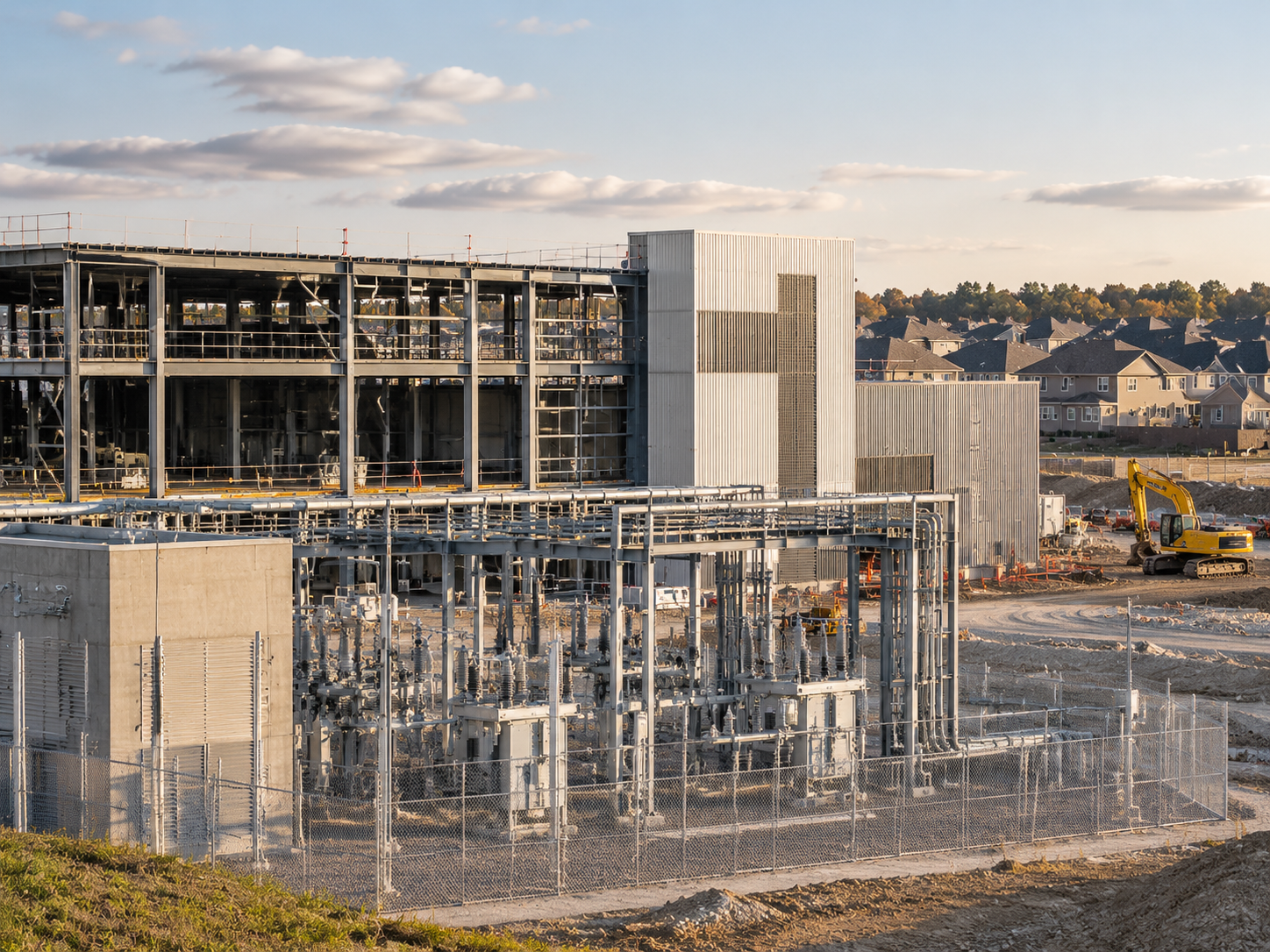
The positive number was private nonresidential: $790.6 billion, up 1.1% from August. That was the sixth consecutive monthly increase. But the composition is unusually concentrated. According to Associated Builders and Contractors’ analysis of the Census data, data center construction rose 8.6% in September and was up 90% year over year. Private power investment was up 14% year over year. All other private nonresidential categories combined were down 7.8% year over year. Excluding data centers and power, nonresidential spending actually fell in September.
That is the central fact of the H2 2026 story: the rebound is a data-center and power rebound, with a few adjacent project types benefiting from it. It is not a rising tide across commercial construction.
Table 1. U.S. construction spending and related indicators, latest available
| Indicator | Latest reading | Change | What it tells a fastener supplier |
|---|---|---|---|
| Total construction spending | $2,186.1B SAAR (Sept 2026) | -1.9% MoM; -2.7% YoY | The overall market is still contracting |
| Private residential | $848.8B SAAR | -5.5% MoM | Do not build a residential inventory case on this “rebound” |
| Private nonresidential | $790.6B SAAR | +1.1% MoM; sixth straight gain | The positive edge is real, but narrow |
| Data center construction | ABC analysis | +8.6% MoM; +90% YoY | The strongest single demand pocket |
| Private power investment | ABC analysis | +14% YoY | A second, related pocket |
| All other private nonresidential | ABC analysis | -7.8% YoY | The rest of commercial is still cutting back |
| Dodge Momentum Index | 260.4 (Oct 2026) | -9.0% MoM; -2.4% YoY | Planning weakened; do not extrapolate current starts |
| AIA/Deltek ABI | 44.7 (Sept 2026) | Below 50 for another month | Design demand is still contracting |
The leading indicators make the same point from a different direction. The Dodge Momentum Index fell 9.0% in October to 260.4. Commercial planning dropped 13.4%, led by weaker data center and warehouse planning; institutional planning fell 1.5%. Year over year, the commercial component was down 17.6%, while the institutional component was up 33.4%. The AIA/Deltek Architecture Billings Index was 44.7 in September, below the 50 no-change line, with newly signed design contracts declining and backlogs easing from 6.6 months at the end of Q1 to 6.2 months at the end of Q3.
So the market is not in a new, broad upcycle. It is working through projects that were financed and designed earlier. That is still demand — but it is demand with a known expiration date unless planning and design improve.
Four pockets where fastener demand is actually growing
Data centers and power infrastructure
Data centers are the largest single source of nonresidential growth in the U.S. ConstructConnect recorded $9.4 billion of data center construction starts across 18 projects in September 2026 — less than half of August’s revised record of $25.8 billion, which shows how lumpy the monthly numbers are. Year-to-date starts reached $135.8 billion across 178 projects, and data centers accounted for 27% of total U.S. nonresidential building starts in 2026. ConstructConnect’s tracking puts 2026 data center starts on pace to exceed $180 billion.
The forward pipeline is also unusually visible. ConstructConnect is tracking $74.8 billion across 115 planned data center projects with start dates in the next six months. About 80% of that planned spending is in the South. Year-to-date, the largest regional concentrations were the West South Central division, including Texas and Arkansas ($33.6 billion), the South Atlantic division ($36.2 billion), and the Wisconsin-to-Ohio corridor (more than $40 billion).
Power infrastructure is the second leg. ConstructConnect reports that U.S. power infrastructure starts were up 167.4% year to date in 2026, after growing at an average annual rate of 52.2% from 2021 to 2025. That matters because data centers do not arrive with their own electrical supply; the generation, transmission, and substation work is part of the same buildout.
For fasteners, “data center demand” is not one product. It is a set of assemblies:
- Light-gauge steel framing, interior partitions, ceilings, and equipment screens
- Cable tray, conduit support, HVAC ductwork, and electrical enclosures
- Sandwich panels and metal cladding on the building envelope
- Anchoring of pumps, generators, cooling equipment, and other mechanical and electrical equipment
- Rooftop equipment and penetration sealing
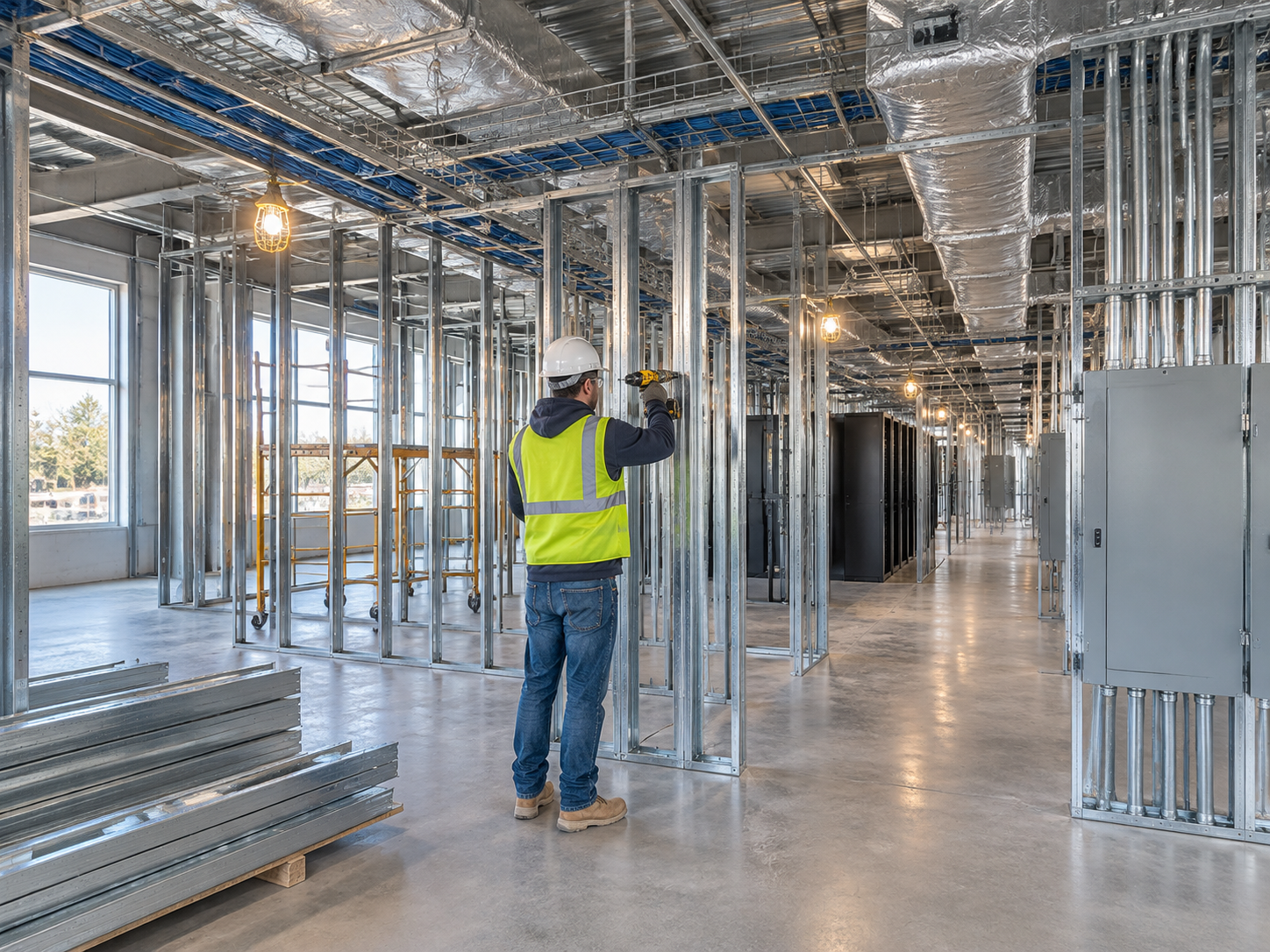
That maps to self-drilling screws for sheet metal and light-gauge steel, concrete screws and wedge anchors for equipment and base connections, and EPDM or storm washers where the fastener penetrates a weather barrier. The project specification still governs: substrate thickness, coating system, fire and smoke requirements, seismic or vibration conditions, and the approved submittal package all have to be checked. There is no generic “data center screw” that can be substituted across projects.
Warehouses and manufacturing projects already under construction
Manufacturing and warehouse work is the second pocket, but it is more cyclical than data centers. Fastenal’s Q3 2026 release showed daily sales to heavy manufacturing customers up 20.2% and total manufacturing up 17.2%. That is a distributor’s sell-through signal, not a market forecast, but it confirms that industrial maintenance and project spending were still active in the third quarter.
The planning side is weaker. Dodge reported that warehouse planning was one of the drags on the October commercial index, along with data centers, parking garages, offices, and hotels. That does not mean warehouse construction has stopped. It means the projects in construction now were planned earlier, while new planning is slowing. A supplier should qualify the project stage before quoting: under construction, awarded, or still in planning.
The fastener cluster for this pocket is familiar but specification-heavy: sandwich panel screws, purlin and roofing screws, EPDM sealing washers, and concrete or wedge anchors for racking, dock equipment, and machinery. The buying questions are less about the screw head and more about the panel system, purlin gauge, span, insulation, warranty, and installation sequence. For a more detailed selection framework, see Sandwich Panel Screws: How to Select the Right Length, Drill Point, and Sealing Solution for Steel Structures.

Healthcare, education, and public/institutional projects
Institutional construction is the most resilient part of the planning data, even as design billings weaken. Dodge’s institutional component was up 33.4% year over year in October, and the month’s largest planned projects included a $336 million medical campus in California, a $257 million acute care building in North Carolina, and a $200 million life science laboratory in San Diego. Healthcare, public government, and recreational building planning accelerated; education and religious building planning weakened.
The AIA data adds an important timing caveat. Institutional billings declined for the sixth consecutive month in September, and multifamily billings declined for the fifth consecutive month. Architecture billings lead nonresidential construction by roughly 9–12 months. So the institutional projects in construction today are largely funded work from earlier design cycles; the next wave is not yet visible in the billings data.
For fastener suppliers, this pocket is about interior fit-out and building systems: drywall and light-gauge framing screws, concrete anchors for mechanical and electrical supports, washers for dissimilar materials, and roofing fasteners where the scope includes envelope work. Healthcare projects add submittal, infection-control, and fire and smoke requirements that a generic distributor catalog will not satisfy.
Metal roofing, retrofit, and rooftop solar
Metal roofing is a different kind of demand: it is less dependent on new building starts and more dependent on replacement, resilience, and retrofit. The Metal Construction Association’s 2026 market study, as reported by Roofing Contractor, expects residential replacement to account for about 96% of all residential metal roofing activity through 2030, and forecasts residential metal roofing to reach roughly 16% of the total U.S. residential roofing market within four years.
That is a large, multi-year replacement market. It also has a commercial and industrial edge: warehouse roofs, data center roofs, and manufacturing roofs all need durable penetration sealing, and rooftop solar adds mounting interfaces on top of the roof. The fastest-moving products in this pocket are exposed-fastener roofing screws, EPDM sealing washers, storm washers, side-lap and stitching screws, and solar mounting bolts such as DIN 1055 T-bolts.

Two cautions matter. First, not every metal roof uses exposed fasteners. Standing seam roofs use hidden clips and seams, so the fastener opportunity is concentrated in exposed-fastener profiles, retrofit, and mounting interfaces — not in every metal roof. Second, the fastener, washer, panel coating, and substrate have to be treated as a system. A larger washer does not automatically fix a poor penetration detail, and a corrosion-resistant screw does not compensate for an incompatible metal pair. For retrofit-specific selection, see Metal Roofing Retrofit Screws: Why Standard Assortments No Longer Fit.
Where the rebound is not
The same data that identifies the four pockets also rules out several assumptions.
Residential is not the driver. Private residential spending fell 5.5% in September from August. Multifamily design billings have declined for five consecutive months, and multifamily backlogs fell from 6.2 months in March to 4.8 months in September. A residential-led inventory build is not supported by this data.
General commercial is still weak. Dodge’s commercial component was down 17.6% year over year in October, and retail stores were the only commercial sector to see planning growth for the month. Offices, hotels, parking garages, and warehouses all weakened in planning. The AIA’s commercial/industrial billings showed slight growth for the second consecutive month, but signed design contracts declined overall. That is a mixed signal, not a green light for broad commercial stocking.
Public infrastructure is slow. Public construction spending was down 0.1% in September, and highway spending was down 0.3%. Infrastructure money is real, but it moves through appropriations, design, and letting schedules. It is not a same-quarter fastener order.
Canada and Mexico are not one market. Fastenal’s October release showed U.S. daily sales up 16.5% and Canada/Mexico combined up 20.9%. The company does not split Canada and Mexico, so the combined figure cannot be assigned to either country. Mexico’s manufacturing and nearshoring story is a structural reason to qualify suppliers and projects, but this review did not find current, fastener-specific demand data that justifies a country-level forecast. Canada should be managed through distributor sell-through and project pipeline, not through a single headline.
What this means for fastener buyers and distributors
The practical response is not “buy more of everything.” It is to build SKU clusters around the project types that are actually moving, and to qualify each project before committing inventory.
| Project type | What is driving demand | Fastener cluster to review | RFQ questions that change the answer |
|---|---|---|---|
| Data center / power | Electrical and mechanical buildout, envelope, equipment anchoring | Self-drilling screws for light-gauge steel and sheet metal; concrete screws; wedge anchors; EPDM washers | Substrate and gauge; coating; fire and smoke; vibration; submittal and batch requirements |
| Warehouse / manufacturing | Envelope, interior framing, equipment installation | Sandwich panel screws; purlin and roofing screws; sealing washers; anchors | Panel system; purlin gauge; span; insulation; warranty; installation sequence |
| Healthcare / education / public | Interior fit-out, MEP supports, envelope | Drywall and light-gauge screws; concrete anchors; washers; roofing fasteners | Fire rating; infection control; corrosion; submittal; inspection requirements |
| Metal roofing / retrofit / solar | Replacement, resilience, rooftop PV | Roofing screws; EPDM and storm washers; side-lap and stitching screws; solar T-bolts | Panel profile; fastener spacing; wind uplift; sealant compatibility; coating system |

Three operating rules follow from the data.
Plan by project stage, not by industry label. A data center that is under construction is a near-term order; a data center that is in planning is a pipeline item. The same distinction applies to warehouses and hospitals. Ask for the project stage, the awarded package, and the expected release date before quoting.
Use mixed-SKU replenishment instead of a single safety-stock number. The four pockets need different diameters, lengths, head styles, washers, and coatings. A distributor that sets one safety-stock rule for all SKUs will either run out of the fast movers or bury cash in the slow ones. Use 8–12 weeks of sell-through, project pipeline, MOQ, carton and pallet configuration, and supplier lead time to set replenishment by SKU.
Put the evidence package with the quote. For project work, the buyer needs more than a price: material certificate, dimensional report, coating specification, batch traceability, packaging and labeling, and the applicable test reports. If a test or certification is not available, say so. Do not let a generic “ISO” or “corrosion-resistant” claim stand in for a project submittal.
Cost and trade policy belong in the same conversation, but they are not demand. U.S. Section 232 duties on steel articles and the scheduled November 9, 2026 expiration of the Section 301 exclusions, as set by the December 2025 extension, can change landed cost and sourcing decisions. They do not change the physical number of fasteners a project needs. Keep the demand forecast and the cost forecast separate, and confirm the current tariff treatment with the importer of record or a trade professional.
North America beyond the U.S.
The U.S. has the deepest public data set, which is why most of this analysis uses it. For Canada and Mexico, the honest position is narrower:
- Fastenal’s Canada/Mexico combined daily sales grew faster than its U.S. daily sales in October (+20.9% vs. +16.5%), but the company does not split the two countries.
- Mexico’s manufacturing and nearshoring investment is a structural reason to qualify industrial fastener opportunities, but it is not a substitute for project-level qualification.
- Canada’s construction market should be assessed through provincial project pipelines, distributor sell-through, and building permit data rather than a continental average.
A North American supplier can use the same four-pocket framework, but should not import U.S. growth rates into Canada or Mexico without local evidence.
Three indicators to watch
If you want to know whether the rebound is broadening, track these three, in this order:
- Dodge Momentum Index. October’s 9.0% decline and the weakness in commercial planning suggest the current rebound is execution-led. A sustained recovery in commercial planning excluding data centers would be the first sign of a broader 2027 pipeline.
- AIA/Deltek ABI. A move above 50, especially with growth in signed design contracts, would signal that new nonresidential work is being designed again. Until then, current construction is largely working through older design cycles.
- Census private nonresidential spending excluding data centers and power. This is the cleanest test of breadth. In September, the excluding-data-center-and-power figure fell. A turn toward positive growth in that series would mean the rebound is spreading beyond the AI buildout.
Fastenal’s monthly daily-sales release is a useful sell-through check, but it is company-specific and includes price, mix, and share effects. Use it to confirm direction, not to size the market.
Bottom line
North America’s H2 2026 construction rebound is a narrow, nonresidential-led rebound. Fastener demand is growing where funded projects are in execution: data centers and power infrastructure, manufacturing and warehouse work already under construction, healthcare and institutional projects, and metal roofing and retrofit with rooftop solar.
It is not growing evenly across residential, general commercial, office, hotel, or public infrastructure. The suppliers that benefit will be the ones that match SKU clusters to project type, document the batch, and replenish mixed specifications without forcing the customer into a generic assortment.
The question is not “Is construction rebounding?” It is “Which project type is releasing the next purchase order?” That is the question a fastener supplier can actually plan around.
Related News
Other news you might be interested in

The 2027 Fastener Demand Map: Data Centers, Energy and Industrial Projects
The 2027 fastener outlook is not a broad recovery. It is a map of project pockets—and the strongest pockets are data centers, energy and selected industrial work.The direction is already visible in late-2026 company results. Hilti reported local-currency sales growth of 5.9% in the first eight months of 2026, with double-digit growth in the Americas and Asia Pacific, while describing traditional construction as soft. LISI’s aerospace sales rose 14.3% in the first nine months, but its automotive sales fell 5.2%. Bossard’s third-quarter sales grew 12%, helped by data-center demand in the Americas and semiconductor and electronics expansion in Asia.

What Is a Bi-Metal Screw and Why Does Aluminum Roofing Need One?
a bi-metal screw is one fastener made from two metals with different jobs. In roofing, the common construction is a stainless steel head and body with a hardened carbon steel drill point and lead thread. The stainless section resists corrosion on the exposed roof; the hardened point drills the steel purlin, girt or frame. Aluminum roofing often calls for this combination when an aluminum panel is fixed directly to a steel substructure, because the panel is soft and corrosion-resistant, but the screw still has to drill steel and survive the weather. Bi-metal is not a guarantee: the stainless grade, point capacity, coating, washer and aluminum-to-steel detail still have to be specified.
Want to know more?
Get in touch with us for more information about our services and products.