
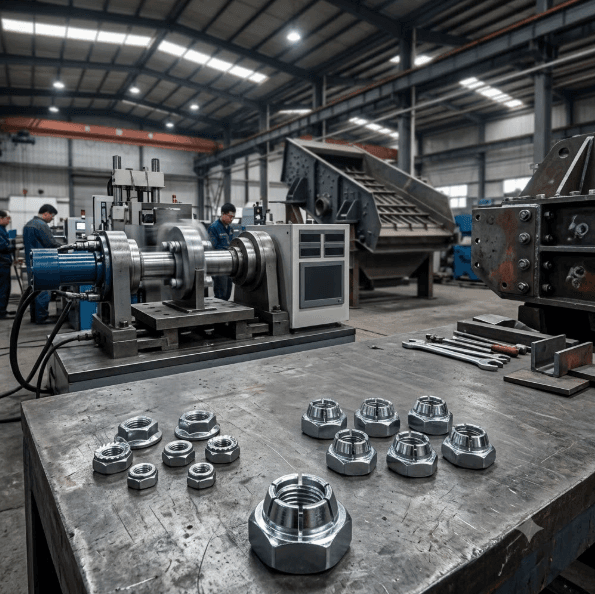
Why Do Standard Flange Nuts Fail Under Transverse Vibration? (And the Mechanical Fix)

Han Congming
AuthorWith experience in screw and fastener manufacturing and sales, we operate our own production facility with stable large-scale capacity. We are specialists in self-drilling screws, drywall screws, chipboard screws, machine screws, bolts, and customized fasteners for construction and industrial applications.
In heavy-duty industrial applications—such as automotive chassis, mining equipment, vibratory screens, and steel structures—fastener reliability is non-negotiable. Yet, one of the most persistent headaches for maintenance engineers and procurement managers is the gradual loss of clamping force in standard flange nuts.
If your machinery suffers from recurrent downtime due to joint loosening, you are not alone. This guide breaks down the precise physics of why standard serrated or smooth flange nuts fail under transverse vibration (lateral shearing forces) and introduces the permanent, patented mechanical fix that eliminates retightening schedules.
1. The Physics of Failure: Why Standard Flange Nuts Lose Torque
Standard flange nuts rely entirely on friction between the mating threads and the bearing surface to maintain their initial tightening torque. Under static loads, this design works perfectly. However, when subjected to transverse vibration (dynamic forces acting perpendicular to the bolt axis), the mechanics change drastically.
The Micro-Slip Phenomenon
External lateral vibrations introduce cyclical forces that cause microscopic displacement between the nut’s flange face and the joint material.
The Radical Friction Drop
Once this relative motion initiates at the bearing surface, the coefficient of friction between the male and female threads plummets to near-zero levels.
Rotational Backing-Off
The helix angle of the thread profile essentially acts like an inclined plane. Without sufficient friction to hold the assembly in place, the stored energy within the elongated bolt body forces the nut to rotate backward, shedding its clamping force within minutes.
The Limitation of Serrations
While serrated flange nuts attempt to lock by biting into the joint surface, they damage protective surface coatings, accelerate corrosion, and lose effectiveness once the mating material wears down under high-frequency load cycles.
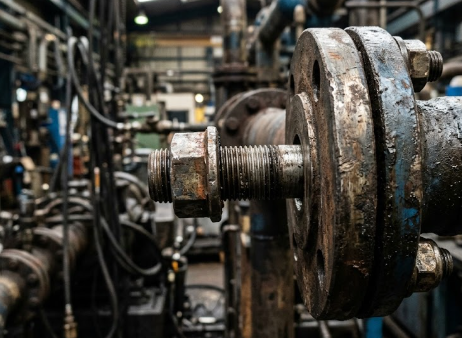
2. Testing the Limits: What the Junker Test Tells Us
To quantify this structural failure, engineers utilize the GB/T 10431-2008 or DIN 65151 Transverse Vibration Test (commonly known as the Junker Test).
When a standard M16 flange nut is placed on a Junker test rig under continuous transverse shear load, the machine records an exponential drop in clamping force within the first few hundred cycles.
| Fastener Type (M16 Specification) | Initial Clamping Force | Residual Force After 5,000 Cycles | Status After 30,000+ Cycles |
|---|---|---|---|
| Standard Flange Nut | 100% | < 20% (Critical Loosening) | Completely Loose / Detached |
| Nylon Insert Lock Nut | 100% | ~40% (Degraded by Heat/Wear) | Failed Structural Inspection |
| BENCHI Patented Tapered Nut | 100% | 98% (Stable Torque Retention) | Passed (34,000+ Cycles Non-Loosening) |
Relying on standard commoditized nuts in dynamic load zones leads to a continuous, costly cycle of loosening, equipment damage, and emergency maintenance downtime.
3. The Ultimate Mechanical Fix: BENCHI Patented Concave-Convex Technology
To permanently solve transverse dynamic loosening, the fastening system must transition from friction-dependent locking to positive mechanical interlocking. This is exactly how the BENCHI Patented Anti-Loosening Nut operates.
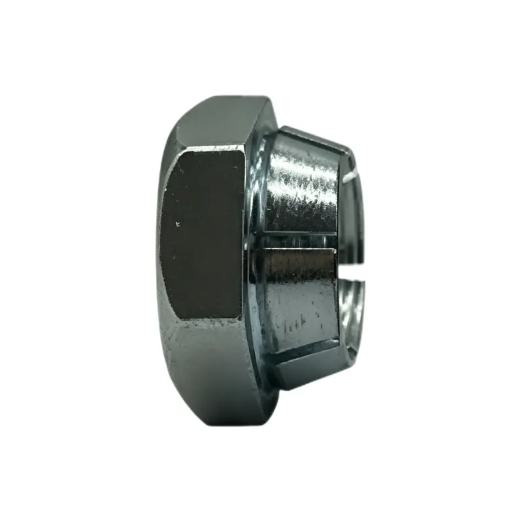
Instead of a single nut, the BENCHI system utilizes an engineered, two-piece configuration featuring a top male nut with a convex taper and a bottom female nut with a matching concave recess.
The 360° All-Round Locking Process
- Concentric Pre-Tightening: The lower female nut is installed first, establishing the necessary initial clamping force against the structural joint.
- Eccentric Wedging & Interlocking: As the upper male nut is driven into the concave recess of the lower nut, the specialized tapered surfaces exert powerful radial pressure around the bolt shank. This creates a comprehensive mechanical interlock.
- Vibration Absorption: When transverse shear forces strike the joint, the concave-convex interface prevents relative rotational movement. Instead of backing off, the dynamic energy is absorbed across the interlocking surfaces, allowing the nut to remain absolutely secure over 34,000+ continuous vibration cycles.
4. Engineering Specifications for Heavy Industries
Manufactured in Handan, Hebei—China's premium fastener manufacturing hub—ScrewTrade's patented lock nuts are engineered for high-reliability environments:
- Material Integrity: Forged from high-strength alloy steel with advanced precision cold heading and customized heat treatment to ensure the perfect balance of surface hardness and core toughness.
- Dimensional Standards: Features a standard Width Across Flats (WAF) of approximately 23.5mm and a standard metric thread pitch for M16 lineups, allowing direct replacement of failing standard nuts without altering existing bolt specifications.
- Corrosion Resistance: Available in multiple industrial surface treatments, including black phosphating for oily/dry mechanical environments, alongside heavy zinc-white coatings for humid, harsh outdoor structural layouts.
5. Stop Managing Fastener Failures. Upgrade Your Supply Chain.
For fastener importers, industrial distributors, and OEM factory owners, carrying standard commodities means competing entirely on thin price margins. Introducing a patented, high-value technical solution like the BENCHI Never Loosen Nut allows you to solve your end-users' most expensive operational pain points while building an exclusive market advantage.
Partner with ScrewTrade for Direct Factory Supply
- Direct Manufacturer Communication: Eliminate trading intermediaries and work directly with our engineering team in China for custom sizes, material grades, and thread protocols.
- Full OEM Support: Tailored export pallet packaging, custom box markings, and barcode integration for global logistics compliance.
Ready to eliminate vibrational loosening in your projects?
Contact ScrewTrade’s technical procurement team today to request structural blueprints, national certified test reports, or a batch of free samples for your own testing rig.
- Email: [email protected]
- Phone/WhatsApp: +86 17692000315
- Business Hours: Mon - Sat: 8:00 - 18:00 (GMT+8)
Related News
Other news you might be interested in
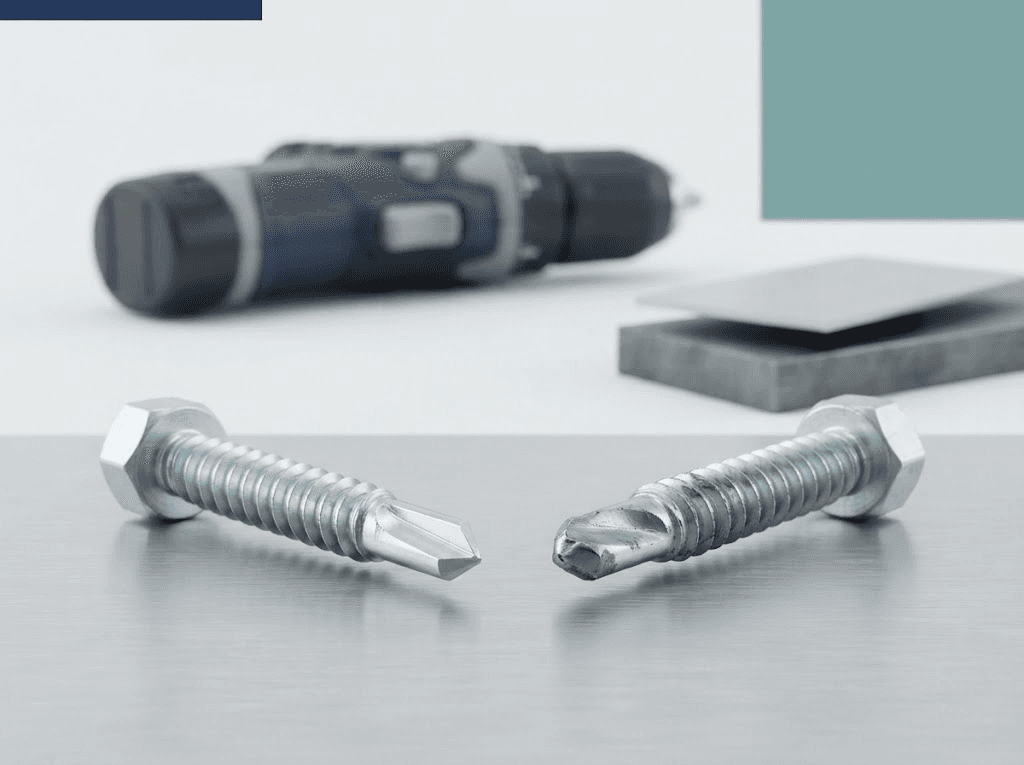
Why Self-Drilling Screws Fail to Drill: A Substrate and Installation Checklist
When a self-drilling screw spins against steel without making progress, the purchasing decision becomes urgent: should the installer change the tool settings, should the buyer order a different screw, or should the supplier investigate the batch?A useful diagnosis starts by identifying exactly where drilling stops. Record the material at that point, check the selected screw against the assembly, and then compare installation conditions. This approach gives buyers a clearer basis for deciding what to change and what evidence to request.
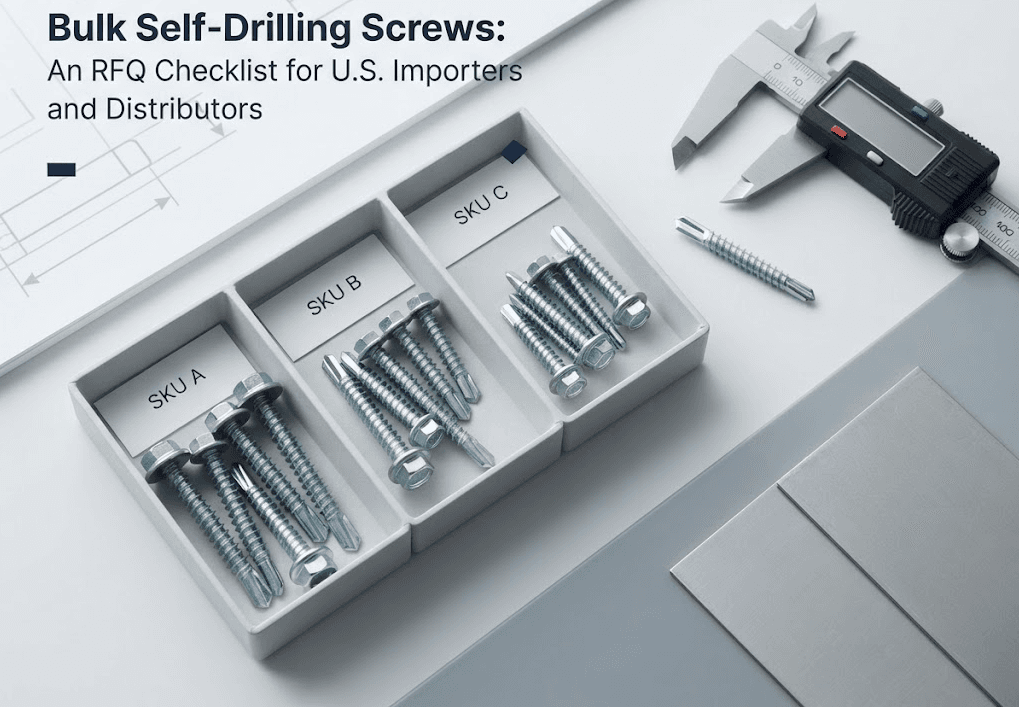
Bulk Self-Drilling Screws: An RFQ Checklist for U.S. Importers and Distributors
When sourcing bulk self-drilling screws, a unit price is only useful if you know exactly what it covers. Two quotations may appear to describe the same product while differing in dimensions, coating, packaging, or delivery conditions. For U.S. importers and distributors managing several SKUs, those differences can make supplier comparisons difficult. A clear request for quotation—an RFQ—helps suppliers understand your requirements and gives your purchasing team a consistent basis for reviewing their offers. This checklist explains what to include, which details need confirmation, and how to turn an initial inquiry into a specification that both buyer and supplier can review.
Want to know more?
Get in touch with us for more information about our services and products.