

Why Hex Washer Head Screws Are the Go To Choice for Steel Structures?

Han Congming
AuthorWith experience in screw and fastener manufacturing and sales, we operate our own production facility with stable large-scale capacity. We are specialists in self-drilling screws, drywall screws, chipboard screws, machine screws, bolts, and customized fasteners for construction and industrial applications.
Steel structures are held together by a hierarchy of connections: primary frame members designed for moment and shear, secondary members that carry the envelope, and thousands of small attachments that keep panels, brackets and services in place.
Hex washer head screws live mostly in that third group, and at the boundary of the second. That is why they appear everywhere on a steel job while still not being a universal structural fastener.
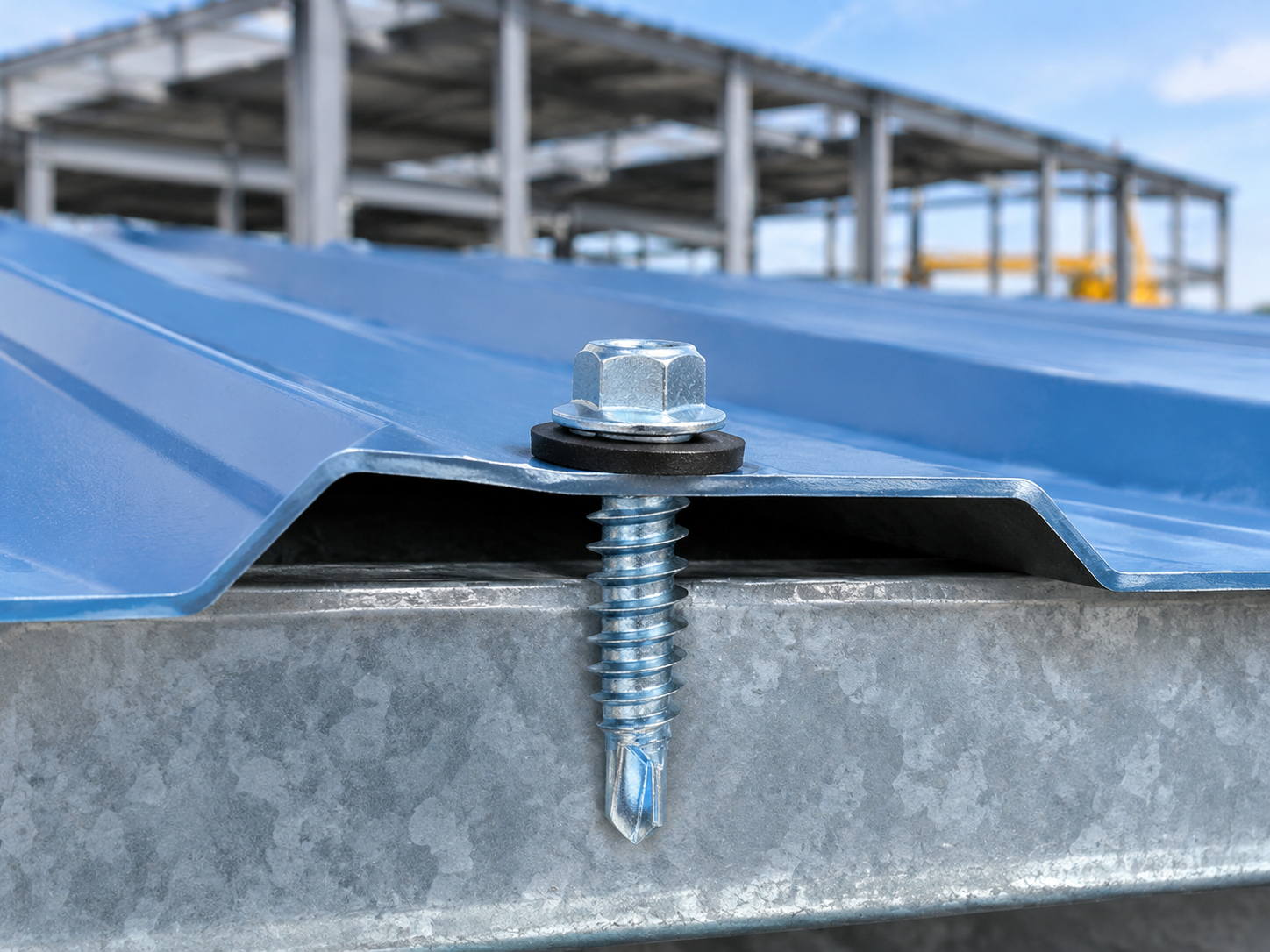
a go-to head for the right steel connection
Hex washer head screws are a go-to choice in a specific, practical sense. In light-gauge steel, secondary framing and steel-sheet assemblies, one fastener can combine a six-sided drive, a wider bearing face, a drill point, a thread and an optional bonded sealing washer.
That combination reduces the number of operations, tools and loose parts on a repetitive connection. It also gives the installer a better chance of controlling where the clamp force goes.
It does not make the screw a structural bolt. It does not make every hex washer head screw suitable for every steel grade. It does not turn a primary frame connection, a moment connection, a shear connection designed with structural bolts, a weld or a shear-stud assembly into a screw joint.
The useful answer is therefore not “yes, because hex washer heads are strongest.” It is: hex washer head screws are the go-to choice where the connection is a light-gauge or secondary steel connection, the drill point and thread match the steel stack, the head and washer suit the bearing and sealing conditions, and the project design permits a screwed connection.
What a hex washer head actually is
The name describes the top of the fastener, not the whole fastener. A hex washer head has a six-sided drive surface and a bearing surface beneath it. That bearing surface may be a washer face formed integrally with the head, a captive or assembled metal washer, a metal-backed EPDM sealing washer, or a separate washer supplied with the screw.
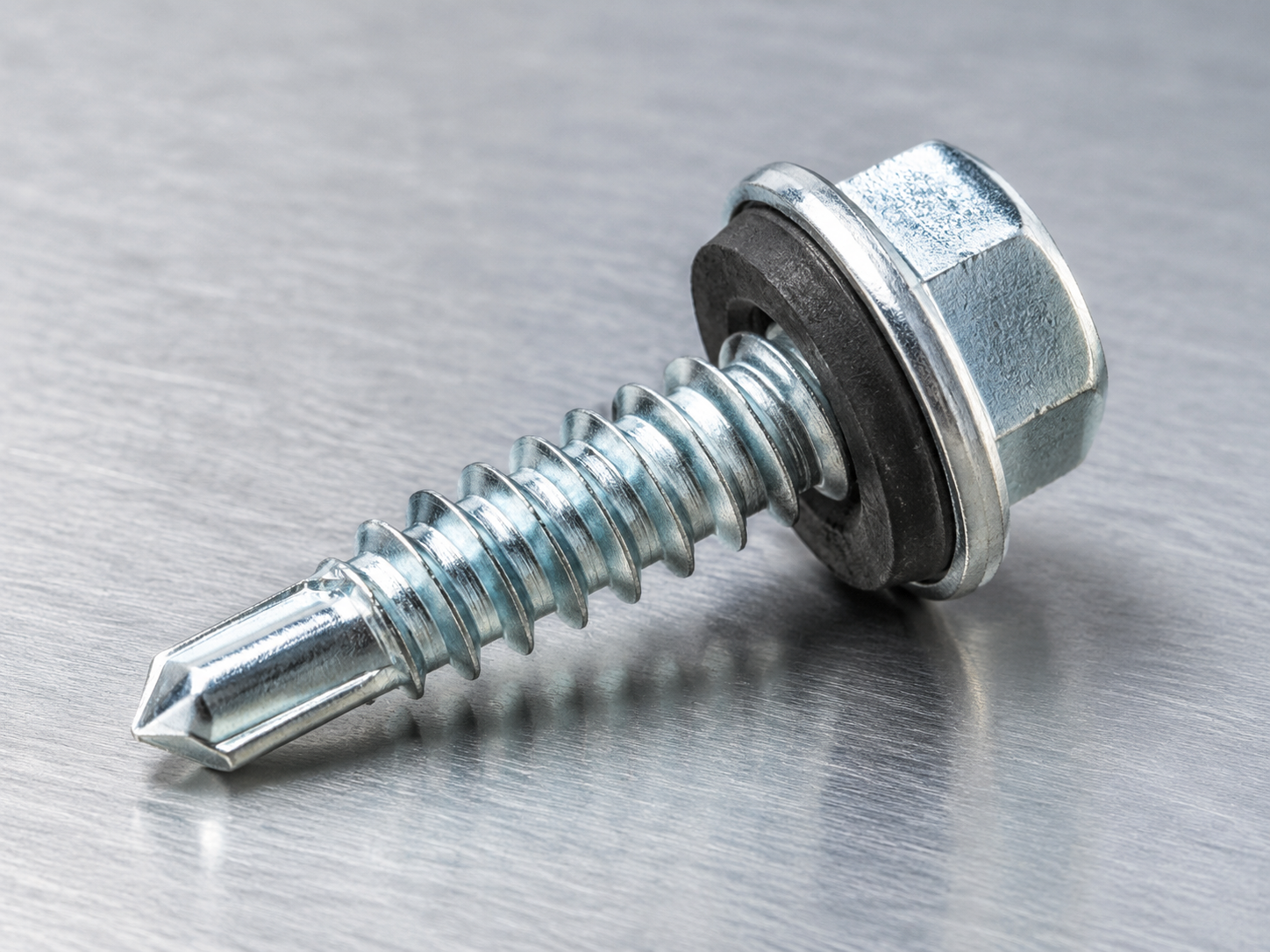
Suppliers do not always use the same name for the same geometry. “Hex washer head,” “hex flange head” and “hex head with washer” are sometimes used loosely. In a drawing or RFQ, define the actual head diameter, washer outside diameter, washer thickness, drive across flats, head height and washer construction.
The second point is more important: the head does not make the screw self-drilling. The drill point does. A hex washer head can be formed on a self-tapping screw that starts in a prepared hole, or on a self-drilling screw that cuts its own hole. It can also be paired with different threads, lengths and materials. Head style, point type, thread, length and coating are separate decisions.
That is why a product can look right in a photograph and still be wrong for a steel connection. A hex washer head is a useful interface, not a specification by itself.
Five reasons it became a common choice on steel jobs
The head style became common because it solves several recurring problems at once.
A stable interface for controlled drive
A six-sided head gives a socket or nutsetter a positive engagement on six flats. Compared with a shallow recess drive, the socket is less likely to cam out when the screw meets resistance. That matters on repetitive overhead work, scaffolding and locations where the installer cannot easily reposition the tool.
The benefit is not unlimited torque. It is repeatability. A depth-sensitive screwgun and the correct socket can deliver the screw to the intended seating depth without the bit dancing out of the recess. The tool still has to be set correctly, and the operator still has to hold the screw perpendicular to the work.
A bearing face where thin steel needs one
The washer face transfers the clamp force into the sheet, panel or bracket. A plain hex head concentrates that force under a relatively small area; a hex washer head spreads it over a larger ring. On thin-gauge steel, that can be the difference between a head that seats cleanly and a panel that dimples around the fastener. It can also reduce the chance of cracking or scarring a pre-painted coating.
The qualification is important: a small formed washer face is not the same as a large, thick bonded washer. The actual bearing diameter and thickness matter, as do the sheet thickness and tensile strength. “Wider” is a direction, not a performance guarantee.
Drilling, tapping and clamping in one pass
A self-drilling screw combines three actions that would otherwise require separate steps: the drill point cuts the hole, the thread forms or cuts engagement in the supporting member, and the head clamps the joined materials. On a purlin, girt, track, bracket or panel support, that can remove a pilot drill, a drill-bit change, a second alignment step and a separate fastener.
The saving is operational. It is real when the point can cut the full steel stack, the unthreaded point section is long enough to clear the material before the thread engages, and the screw length leaves the required thread engagement. It is not a saving when the point is too short, the screw bottoms out, the thread strips or the installer has to stop and redrill.
Installation from one side
Many steel connections are difficult to bolt because the back side is closed, insulated, obstructed or unsafe to reach. A screw needs access to the drive side; a bolt usually needs access to both sides for the washer and nut.
That single-sided installation is often the real reason the hex washer head wins on a steel building. It is useful for roof and wall panels fixed to purlins or girts, light-gauge tracks and brackets in closed assemblies, eave and ridge details, equipment enclosures and retrofit work where the existing support can be reached from one face. Single-sided access does not remove the need for engineering; it only changes the installation method.
A practical route to a sealed penetration
On an exposed-fastener metal roof or wall, the fastener penetrates the weather barrier. A hex washer head with a bonded EPDM washer gives the seal a supported, relatively flat seat. When the screw is driven perpendicular and stopped at the correct compression, the washer can close the gap around the hole.
The seal is a system, not a property of the head. It depends on washer material and thickness, panel profile, hole quality, screw alignment, installation torque and coating compatibility. A sealing washer does not fix an oversized hole, a skewed screw or a crushed washer.
What AISI S100-16 says about the head and washer
The head is not just a convenient place to put a socket. In structural design, the head and washer can be part of the limit state.
AISI S100-16, Section J4, covers steel-to-steel screw connections used for cold-formed steel structural members. It applies to screws with a nominal diameter from 2.03 mm to 6.35 mm, whether thread-forming or thread-cutting, with or without a self-drilling point. It also requires installation and tightening in accordance with the manufacturer’s recommendations.
Within that scope, the specification defines dh as the screw head diameter or the hex washer head integral washer diameter. For screws carrying tension, the head or washer diameter must be at least 7.94 mm (5/16 in.). The nominal washer thickness requirements vary with the thickness of the member in contact with the head or washer:
- at least 1.27 mm when the contact member is thicker than 0.686 mm;
- at least 0.610 mm when the contact member is 0.686 mm or thinner;
- at least 1.60 mm when the washer diameter is greater than 15.9 mm and not more than 19.1 mm.
The pull-over check makes the geometry explicit:
Pnov = 1.5 t1 d’w Fu1
where t1 is the thickness of the member in contact with the head or washer, Fu1 is its tensile strength, and d’w is the effective pull-over diameter. For a hex washer head without an independent solid steel washer, d’w = dh, but not more than 19.1 mm. With a separate steel washer, the effective diameter can include the washer thickness, subject to the same upper limit.
The same section sets minimum spacing of 3d between screw centers and a minimum edge or end distance of 1.5d.
These provisions confirm three things:
- The diameter under the head is part of the connection calculation, not a cosmetic feature.
- The washer has to be thick enough for the sheet it bears on; a thin stamped washer is not automatically equivalent to a heavier one.
- A larger bearing diameter can improve calculated pull-over resistance, but it is not the only variable. Sheet thickness, sheet strength, thread engagement, installation and the screw itself still matter.
The limits are equally important. AISI S100-16 is a North American specification for cold-formed steel design. It is not a global product approval, it does not prove that a particular screw is suitable for a particular project, and it does not replace local building codes, the engineer’s design or the manufacturer’s test data. The values above are a framework for asking better questions, not a claim that every ScrewTrade screw meets every provision.
Where the head is genuinely the go-to choice
The hex washer head is most defensible in connections that share four characteristics: relatively thin steel, repetitive installation, one-sided access and a need for a practical bearing or sealing surface.
Light-gauge framing and built-up components
Light-gauge steel framing uses thin-walled studs, tracks, joists and built-up members. The connections are numerous and often made from one side. A hex washer head screw can attach studs to tracks, joists and blocking in engineer-specified framing, sheathing or panel components to light-gauge members, bracing and support brackets, and modular frames or site-built steel assemblies.
The washer face helps distribute the clamp force on the thinner member, and the hex drive suits a socket on a repetitive framing crew. The connection still has to be designed. A screw that is adequate for a non-structural partition may be completely wrong for a diaphragm, a shear wall or a fire-rated assembly.
PEB and metal-building secondary framing
Pre-engineered buildings and other metal buildings use purlins, girts, eave struts, flange bracing and miscellaneous supports to carry the envelope and stabilize the frame. These are secondary members, not the primary rigid frame.

Hex washer head self-drilling screws are commonly used for purlin-to-purlin and girt-to-girt connections where the design permits screwed connections, attachment of light-gauge secondary members and clips, roof and wall panel attachment to purlins and girts, eave and ridge trim supports, and repair or reinforcement of non-structural secondary framing.
This is the classic application. The screw often passes through a thin panel or clip and then engages a thicker purlin or girt. The washer bears on the outside face; the thread engages the support. The drill point and length must be selected from the complete stack, not from the panel thickness alone.
Exposed-fastener roof and wall systems
Exposed-fastener metal roofing and wall cladding are direct applications. The screw passes through the panel and into the purlin, girt or support. The head and washer clamp the panel at the fastener location, and the EPDM washer provides the sealing interface.
Typical details include single-skin corrugated or trapezoidal roof panels to steel purlins, wall cladding to steel girts, ridge and eave trim, roof-mounted equipment supports, and repair or re-cladding work where the existing support can be reached.
Standing-seam roofs are different. They use concealed clips and seams, so the exposed-fastener logic does not transfer. A hex washer head screw is not a universal metal-roof fastener; it belongs to the exposed-fastener family and to the specific panel system that has been designed for it.
Steel deck, side laps and stitching
Steel deck and steel-sheet assemblies can use screwed attachments where the project design specifies them. The screw may attach deck sheets to supports, close side laps, stitch panels or fix accessory components.
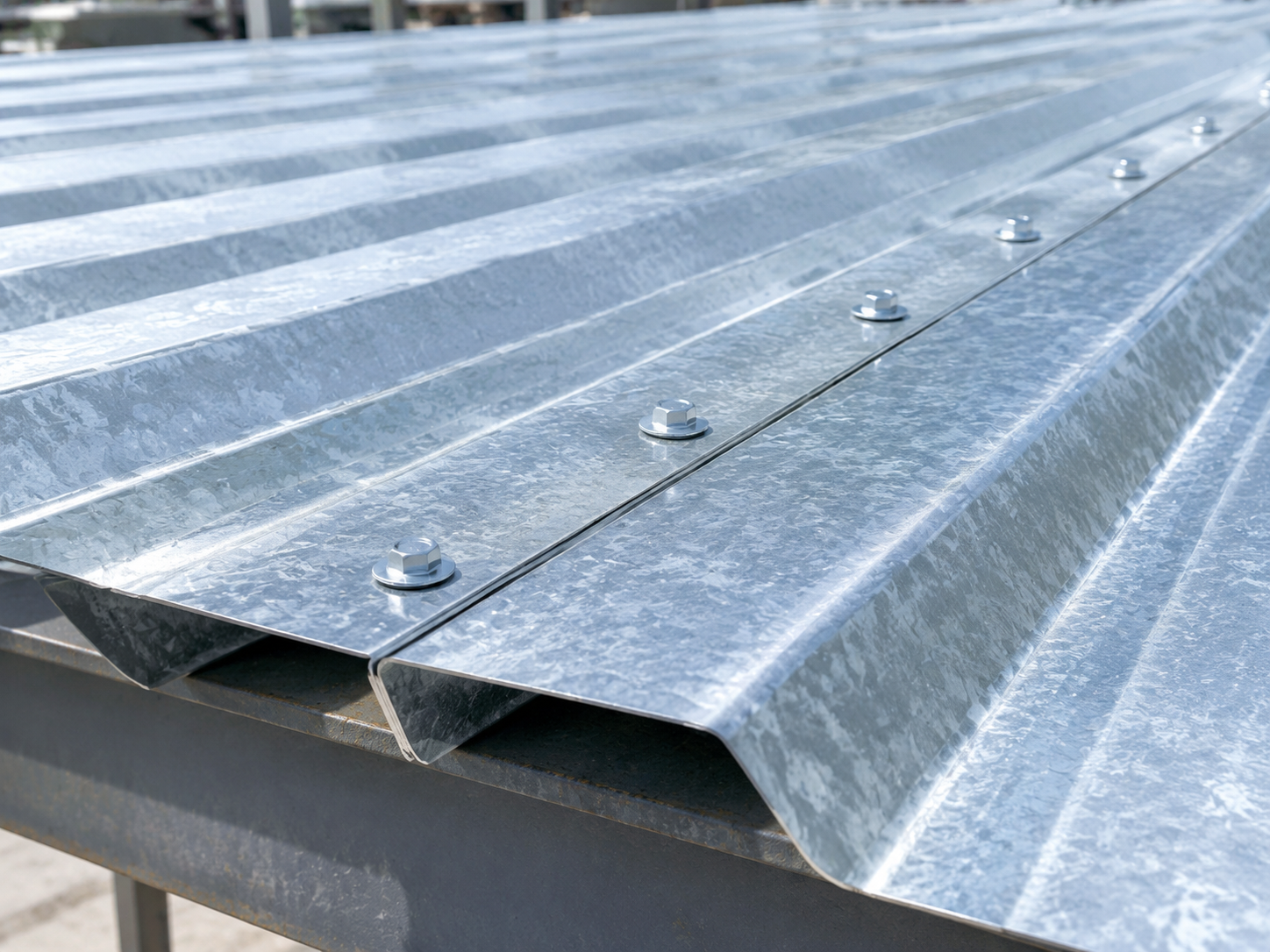
Typical uses include roof deck to purlins or beams where screwed attachment is specified, floor deck to supports in non-composite or engineer-approved details, side-lap and stitching connections, edge trim and opening reinforcement, and temporary or permanent access panels.
A self-drilling screw is not a substitute for welding, shear studs, structural bolts or a composite deck design. If the deck is part of a diaphragm, a fire-rated assembly or a composite floor system, the connection must follow the engineered design and the approved fastening schedule. The head style does not change that.
Industrial supports, enclosures and retrofit work
Many steel connections in an industrial building are not part of the primary frame. They support equipment, route services, protect machinery or close an opening. Typical uses include HVAC duct and equipment supports, cable tray and conduit supports, machine guards, access doors, enclosure frames, signage, fencing and repair of existing secondary steel.
These connections may carry vibration, repeated loading or a corrosive environment. A bracket that supports equipment may need a different safety factor, washer or fixing pattern from a simple trim panel. The project engineer still owns that decision.
Where the hex washer head stops being the answer
A hex washer head is a screw head. It does not change the load path, the required preload or the test basis of a connection.
Do not treat it as the go-to fastener for:
- Primary structural steel connections. Rigid frames, moment connections, braced-frame connections and other engineered structural joints should use the structural bolts, welds or connectors specified by the engineer.
- Connections that rely on structural bolts. A hex washer head screw does not provide the controlled preload of a structural bolt and is not a substitute for one.
- Welded, shear-stud or composite-deck connections. The fastener must be part of the designed system, not a field substitution.
- Concrete, masonry or brick. Use an anchor designed for the base material.
- Connections beyond the drill point’s capacity. If the total stack, steel grade or hardness is outside the point’s rated range, the screw may stall, overheat, break or produce an oversized hole.
- Joints that require repeated disassembly. A machine screw or bolt with a matched nut is usually more appropriate.
- Fire-rated, seismic or other tested assemblies. The fastener must be part of the tested system. Do not substitute a generic screw because it has the same head shape.
- Joints with dissimilar metals or severe corrosion exposure. The fastener, washer and coating must suit the environment, and the joint may need isolation or a different material.
The product-specific evidence matters here. Simpson Strong-Tie lists a stainless steel self-drilling hex-washer head screw with a #3 drill point, but its stated application is aluminum and fiberglass fastening, not steel. The head looks plausible for a steel connection. The manufacturer’s application statement says otherwise.
The lesson is not that hex washer head screws are unsuitable for steel. The lesson is that the head name does not establish the substrate. Material, thread, point geometry, hardness, coating and the manufacturer’s tested application all have to match the joint.
Hex washer head versus other head styles
The right comparison is not “which head is strongest.” It is “which head puts the drive, bearing and sealing geometry where this connection needs it.”
| Head style | Drive | Bearing surface | Sealing option | Typical fit | Main limitation |
|---|---|---|---|---|---|
| Hex washer head | External hex, socket or nutsetter | Formed washer face, captive washer or bonded washer | EPDM or other sealing washer on selected products | Light-gauge and secondary steel, exposed panels, brackets and supports | Not a structural bolt; actual head and washer dimensions must be confirmed |
| Hex flange head | External hex, socket or nutsetter | Flange formed into the head | Separate or bonded washer depending on product | Similar to hex washer head where a flange is preferred | Names are not consistent across suppliers; check the drawing |
| Plain hex head | External hex, socket or nutsetter | Smaller bearing area under the hex | Usually requires a separate washer | Thicker steel, pre-drilled connections or joints with a specified washer | Concentrated bearing pressure can damage thin sheet |
| Pan or wafer head | Recess drive | Low-profile or wide wafer face | Limited; usually not a weather seal | Light sheet, interior components and low-profile assemblies | Drive and bearing capacity vary; often not the first choice for exposed structural steel |
| Countersunk head | Recess drive | Flush conical seat | Not typical | Flush-finish panels and some metal-to-wood details | Requires a matching countersink; can concentrate load around the hole in thin sheet |
Supplier terminology varies. A “hex flange” and a “hex washer” may both have an integral bearing surface, or one may use a captive washer. Compare the actual dimensions, not the label. A larger head is also not automatically a stronger connection. Screw diameter, thread engagement, steel thickness, steel strength, installation and the number and spacing of fasteners can matter more than the head alone.
How to specify a hex washer head screw by the joint
Start with the connection. The catalog page comes later.
- Define the connection role. State whether it is primary structural, secondary structural or non-structural; designed by an engineer or selected from a published table; part of a diaphragm, fire-rated assembly, seismic system or composite deck; and subject to vibration, wind uplift, repeated loading or frequent disassembly. If the answer is “primary structural” or “part of a tested assembly,” confirm the approved connection before choosing a screw.
- Measure the complete steel stack. Record every layer, its material and thickness, the steel grade or strength, whether the layers are in contact or separated, the coating on each face and the access available to the installer. The screw must drill through every layer before the thread engages the load-bearing member.
- Select the drill point, thread and length. The point number is a family reference, not a universal capacity rating. Confirm the point’s rated steel thickness and the steel grade with the supplier, then verify it on the actual assembly. The screw needs enough length to pass through the compressed stack, clear the unthreaded point section and leave the required thread engagement without bottoming out or protruding excessively.
- Define the head and washer. Ask for head diameter, hex across flats, head height, washer outside and inside diameter, washer thickness, whether the washer is formed, captive, bonded or separate, and EPDM thickness and hardness if sealing is required. A drawing that says only “hex washer head” is incomplete.
- Match material and coating to the exposure. ScrewTrade’s public product page lists carbon steel and stainless steel options, zinc plated or customized finishes, a diameter range of 4.0 mm to 12.0 mm and a length range of 16 mm to 150 mm, with bulk carton or pallet packaging and OEM/ODM support. Those are product-family options, not a promise that every combination is available or suitable for every environment. For a coastal, industrial or chemical exposure, ask for the exact material and grade, the coating system and thickness, the test method and acceptance criterion, and evidence from the actual screw rather than a flat coupon.
- Confirm the tool and torque. Check the socket size and condition, the tool type, the speed and torque setting, the depth stop or nosepiece, and the required seating criterion for the head and washer. An impact driver can deliver a large amount of torque very quickly. That may be useful for driving, but it can also overdrive a washer, strip a thread or twist off a screw.
- Validate before the production run. Install a sample on the real joint and record the materials, thicknesses, steel grade, screw reference, point, length, tool setting, installer and result. Check full penetration, thread engagement, head or washer seating, panel distortion and coating damage. If the sample fails, change one variable at a time: point, length, tool setting or washer.
Installation rules that protect the advantage
The head only works if the screw stops at the right depth.
- Confirm the steel layers are in contact and the assembly is aligned before driving.
- Remove loose scale, debris or obstructions that could prevent the point from starting.
- Use a marker or a light center punch for location if needed. A center punch is not a pilot hole; it only helps the point start.
- Check that the socket or nutsetter fits the hex completely.
- Hold the tool perpendicular to the work surface and apply steady pressure. Do not spin the point on the surface.
- Drive until the head or washer seats. Do not keep the trigger down after seating.
- For a weather-exposed connection, watch the washer compression and the panel around the head. Stop before the panel distorts or the washer extrudes.
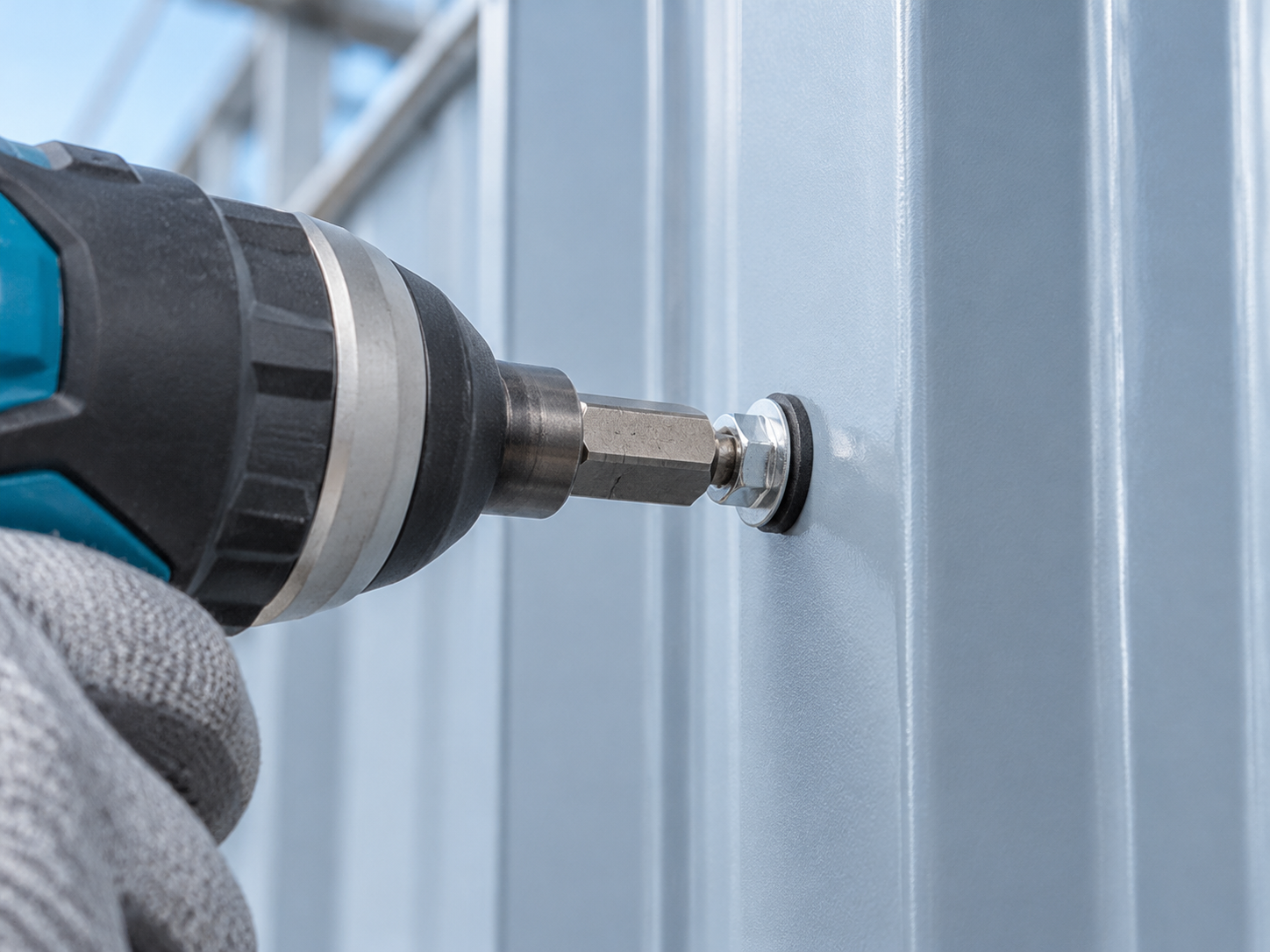
ITW’s published TEKS installation guidance recommends a screwgun with a depth-sensitive nosepiece, states that the fastener is fully seated when the head is flush with the work surface, warns that overdriving may cause torsional failure or substrate stripout, and requires the fastener to penetrate beyond the metal structure by at least three thread pitches. Those are ITW’s instructions for its products, not a universal substitute for the screw manufacturer’s instructions or the project specification. The underlying principle is general: control the depth, do not overdrive, and verify engagement.
Inspect the completed connection for full penetration, thread engagement in the support, a seated head or washer, even washer compression, panel distortion, stripping or cracking, coating damage and swarf. The fixing pattern should match the approved spacing and edge distance.
RFQ and quality checklist
Send the supplier the application and connection drawing or a clear photograph, each layer’s material and thickness, the steel grade or strength, whether the connection is structural or non-structural, the exposure, the expected service life, the screw type or point if already specified, the head and washer requirement, the coating and test requirement, the installation tool and torque limit, the sample quantity, the standard and batch-traceability requirement, and the packaging, quantity and destination.
Ask the supplier:
- What drill point is recommended for this total stack and steel grade?
- What is the point’s tested capacity, and on what material?
- What length leaves the required thread engagement without bottoming out?
- What are the actual head diameter and washer dimensions?
- Is the washer formed, captive, bonded or separate?
- What material and coating are proposed for the exposure?
- What test method and acceptance criterion support the coating claim?
- Can you provide a sample and a first-article report?
- How is the batch traced from wire to finished screw?
- What packaging and labeling standard applies?
“Self-drilling” is not a complete specification. A quotation that does not state the point, diameter, thread, length, head, washer, material and coating is not yet comparable with another quotation.
FAQ
Are hex washer head screws structural bolts?
No. A hex washer head describes the drive and bearing geometry. A structural bolt is a different fastener with a different design basis, preload requirement and installation method. Do not substitute one for the other without the engineer’s approval.
Can hex washer head screws be used on primary steel?
They can be used where the engineer specifies a suitable screwed connection or a tested proprietary system. They should not be used as a default substitute for structural bolts, welds or a designed moment or shear connection.
What is the difference between a hex washer head and a hex flange head?
Both can provide a wider bearing surface than a plain hex head. A hex flange head usually has a flange formed into the head; a hex washer head may have an integral washer face, a captive washer or a separate washer. Suppliers use the terms inconsistently, so compare the actual dimensions and washer construction.
Do all hex washer head screws work in steel?
No. A screw can have a hex washer head and a drill point and still be intended for aluminum, fiberglass, wood or another substrate. Check the manufacturer’s stated application, material, point, thread and steel thickness range. The Simpson Strong-Tie example above shows why the head shape alone is not enough.
Can hex washer head screws be used outdoors?
Only when the material, coating, washer and installation detail suit the exposure. An EPDM sealing washer can help at a weather-exposed penetration, but it does not compensate for an unsuitable coating, a poor hole, an angled screw or overdriving.
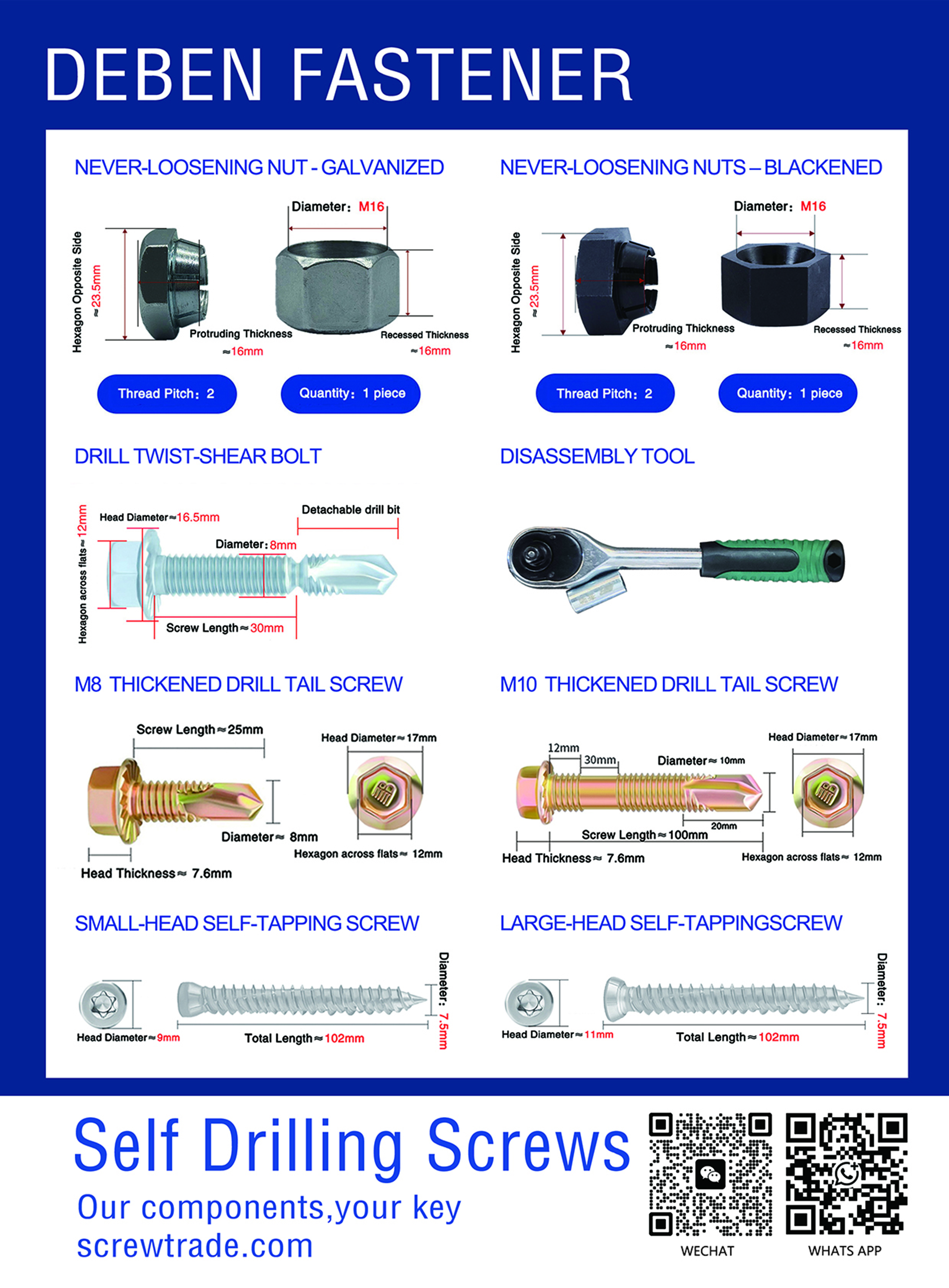
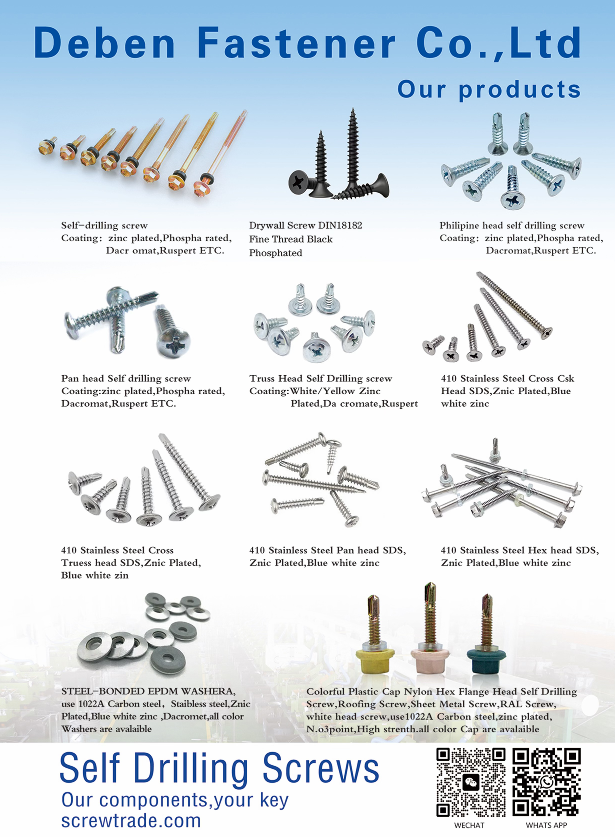
Conclusion: the head is a system, not a guarantee
Hex washer head screws are the go-to choice for many steel structures because they solve a common set of field problems in one part. The hex drive gives the installer a stable connection to the tool. The washer face spreads the clamp force and gives the seal a seat. The drill point and thread turn the fastener into a one-pass installation. The optional EPDM washer makes the same family useful at exposed roof and wall penetrations.
That combination is genuinely valuable in light-gauge framing, PEB secondary steel, exposed-fastener panels, steel deck and industrial supports. It is not valuable when the connection needs a structural bolt, a weld, a shear stud, a tested fire assembly or a design that is outside the drill point’s capacity.
The practical rule is simple: choose the hex washer head for the joint it fits, then specify the joint completely. Confirm the steel stack, the point, the thread, the length, the head and washer dimensions, the material and coating, the tool and the acceptance criteria. The head can then do the job it is good at, without being asked to do a job it was never designed for.
If you have a steel connection that you want to convert from a drill-and-bolt sequence, send ScrewTrade the drawing or a photograph of the joint, the material and thickness of each layer, the steel grade, the installation tool and the expected quantity. We can help confirm whether a hex washer head self-drilling screw is suitable, which product family fits, and which dimensions need to be locked before quoting or sampling.
Related News
Other news you might be interested in

The 2027 Fastener Demand Map: Data Centers, Energy and Industrial Projects
The 2027 fastener outlook is not a broad recovery. It is a map of project pockets—and the strongest pockets are data centers, energy and selected industrial work.The direction is already visible in late-2026 company results. Hilti reported local-currency sales growth of 5.9% in the first eight months of 2026, with double-digit growth in the Americas and Asia Pacific, while describing traditional construction as soft. LISI’s aerospace sales rose 14.3% in the first nine months, but its automotive sales fell 5.2%. Bossard’s third-quarter sales grew 12%, helped by data-center demand in the Americas and semiconductor and electronics expansion in Asia.

What Is a Bi-Metal Screw and Why Does Aluminum Roofing Need One?
a bi-metal screw is one fastener made from two metals with different jobs. In roofing, the common construction is a stainless steel head and body with a hardened carbon steel drill point and lead thread. The stainless section resists corrosion on the exposed roof; the hardened point drills the steel purlin, girt or frame. Aluminum roofing often calls for this combination when an aluminum panel is fixed directly to a steel substructure, because the panel is soft and corrosion-resistant, but the screw still has to drill steel and survive the weather. Bi-metal is not a guarantee: the stainless grade, point capacity, coating, washer and aluminum-to-steel detail still have to be specified.
Want to know more?
Get in touch with us for more information about our services and products.