
Sekrup Self-Drilling 304 vs. 410 vs. Bi-Metal: Memilih untuk Ketahanan Korosi dan Kinerja Pengeboran

Han Congming
PenulisKami berpengalaman dalam produksi dan penjualan sekrup serta pengencang, dengan fasilitas produksi sendiri dan kapasitas produksi skala besar yang stabil. Kami adalah spesialis sekrup bor mandiri, sekrup drywall, sekrup papan partikel, sekrup mesin, baut, dan pengencang khusus untuk aplikasi konstruksi dan industri.
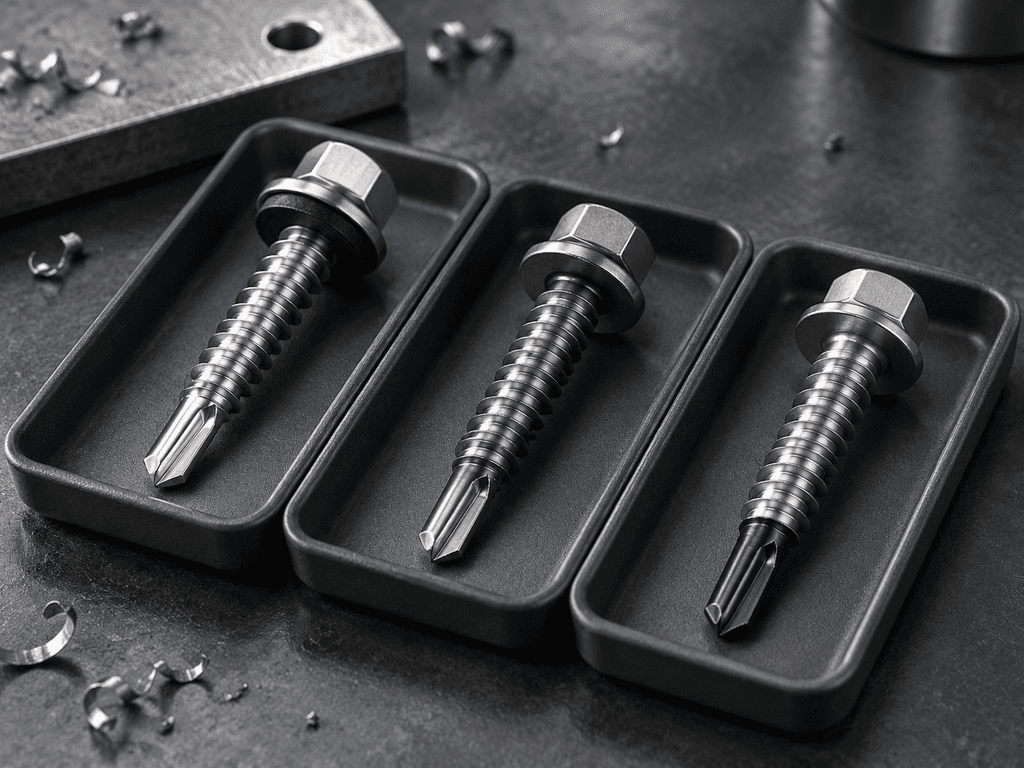
Choosing between 304, 410 and bi-metal self-drilling screws can look like a simple material comparison. It is not.
304 and 410 are stainless steel grades. Bi-metal describes how a screw is constructed. A bi-metal screw can have a 304 or 316 stainless steel body and a hardened carbon steel drill point. That means the three options do not sit on one neat scale from “good” to “better.”
The practical question is narrower:
What has to be drilled, how thick and how hard is it, what will remain exposed, and what evidence can the supplier provide for the exact screw being quoted?
This guide explains where each option fits, what buyers often overlook, and which details belong in an RFQ before a sample is approved.
Quick answer: 304, 410 and bi-metal in one view
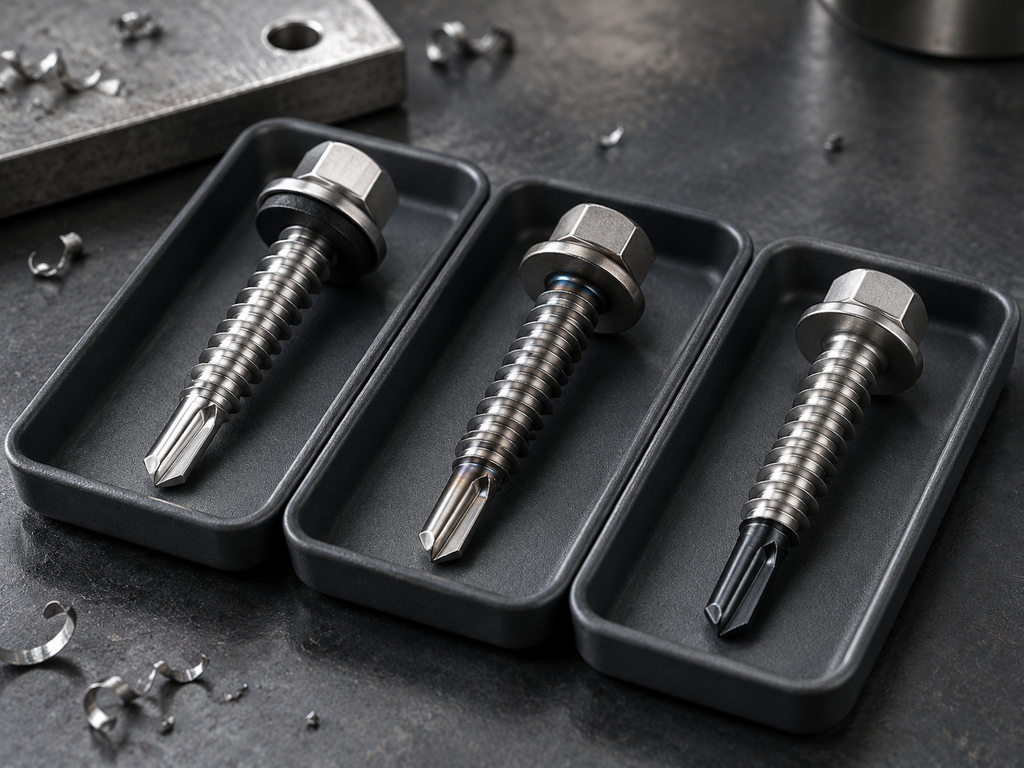
- 304 stainless steel self-drilling screws are usually chosen when corrosion resistance is the main concern. The grade is austenitic and offers good resistance in many atmospheric environments, but it is not a universal coastal or chemical-service answer. The finished drill point and its hardness must still be confirmed.
- 410 stainless steel self-drilling screws are chosen when hardness and drilling capability matter more than maximum corrosion resistance. Grade 410 is martensitic and can be heat treated to develop strength and hardness. It is generally less corrosion resistant than 304 in aggressive environments, so the exposure and coating system need careful review.
- Bi-metal self-drilling screws combine a corrosion-resistant stainless steel body with a hardened carbon steel drill point, usually joined by welding. They seek a middle path: stainless protection on the exposed body and carbon-steel drilling performance at the tip. The body grade, point material, weld zone, coating and drill capacity still have to be specified.
There is no automatic winner. A 304 screw is not always the most corrosion-resistant finished product, and a bi-metal screw is not automatically “rust-proof.” The correct choice depends on the whole fastening system.
First, separate a material grade from a screw construction
This distinction matters because buyers often compare labels that describe different things.
304 and 410 are stainless steel grades
Grade 304 is an austenitic stainless steel, commonly known as 18/8 stainless because of its chromium and nickel content. It is widely used for its combination of corrosion resistance, formability and toughness. It is also subject to pitting and crevice corrosion in warm chloride environments, so “304” should not be read as “suitable for every coastal project.”
Grade 410 is a martensitic stainless steel with roughly 12% chromium. It can be hardened and tempered to achieve higher strength and wear resistance. Its corrosion resistance is generally lower than that of austenitic grades such as 304, particularly in aggressive or chloride-rich conditions.
Bi-metal describes how the screw is made
A bi-metal self-drilling screw is not a single stainless grade. It normally has:
- a stainless steel upper body and head, often in 304 or 316;
- a hardened carbon steel drill point and lead thread;
- a welded transition between the two materials;
- a coating or surface treatment selected for the point and finished screw.
That construction can be useful when a stainless body is wanted but the drill point must be hard enough to penetrate steel. It also creates additional questions: Which stainless grade is used for the body? Which carbon steel is used for the point? How is the weld protected? What is the actual drill capacity? What coating covers the point and the transition?
Those questions cannot be answered by the word “bi-metal” alone.
304 stainless steel self-drilling screws: corrosion first, but confirm the point
The main appeal of 304 is its corrosion resistance in many outdoor, humid and general atmospheric environments. It is a sensible starting point for visible metal roof and wall fittings, light steel structures, ventilation ducts, metal cladding and outdoor sheet metal assemblies where a stainless finish is required.
ScrewTrade’s 304 hex washer head self-drilling screw page describes these general application areas, including metal roof and wall fittings, light steel structures, ventilation ducts and metal cladding. Those are application directions, not a blanket statement that every 304 screw suits every coastal, chemical or structural condition.
The important buying point is this: the body grade does not, by itself, tell you how well the finished screw will drill.
A 304 screw may have a specially formed or hardened point, or it may be intended for a different substrate and thickness range. The same is true of the thread, head and coating. Buyers should ask for the finished product’s drill-point type, recommended steel thickness, installation guidance and available test information rather than inferring performance from “304” alone.
304 is also not the end of the stainless discussion. In more severe chloride exposure, a higher-alloy stainless grade such as 316 may be more appropriate. That is a project decision, not a label upgrade that can be made without reviewing the environment and the rest of the assembly.
410 stainless steel self-drilling screws: hardness with a corrosion trade-off
Grade 410 is often considered when the screw needs to be hardened for drilling or when a martensitic stainless grade is specified. It can be heat treated to a higher hardness than 304, which is why 410 appears in some self-drilling and self-tapping fastener discussions.
The trade-off is corrosion resistance. Grade 410 is generally less resistant than 304 in wet, chloride-rich or polluted environments. A 410 screw may be acceptable in a controlled indoor application or under a suitable coating system, but it should not be treated as an outdoor equivalent simply because it is called stainless.
This is where many quotations become difficult to compare. One supplier may quote “410 stainless self-drilling screw” without stating:
- whether the whole screw or only part of it is 410;
- the heat-treatment condition;
- the coating and its coverage;
- the drill-point geometry and target steel thickness;
- the washer material and backing;
- the test method and report scope.
If 410 is being considered, ask for those details in writing. Also ask whether the supplier’s proposed product has been evaluated for the actual exposure, not just for a generic indoor application.
Bi-metal self-drilling screws: a stainless body with a hard drilling point
Bi-metal screws are designed to address a common conflict: stainless steel is useful for corrosion resistance, but a stainless body may not provide the drill-point hardness needed for every steel fastening task.
In a typical bi-metal construction, the upper body and head are stainless steel, while the drill point and lead threads are made from hardenable carbon steel. The two parts are joined, often by welding, and the point is hardened. The exposed upper body is intended to provide corrosion resistance, while the point does the drilling.
This is why bi-metal screws are often discussed for metal roofing, wall panels, steel framing and other exterior metal connections. The concept can be a good fit when the application needs both a stainless exterior and reliable drilling into a steel substrate.
But “bi-metal” is not a performance guarantee. The buyer still needs to know:
- Body grade: Is the stainless part 304, 316 or another grade?
- Point material: Is the drill point carbon steel, 410/420 stainless or another hardenable material?
- Joint quality: How is the weld or transition controlled, inspected and protected?
- Drill capacity: What total steel thickness and steel strength has the point been designed for?
- Coating: What covers the point, the weld area and the finished screw?
- Washer system: Is the washer bonded, what backing does it use, and how does it behave under compression?
- Test evidence: Does the report cover the exact model, material combination and manufacturing batch?
The drill point may be largely embedded after installation, but that does not make every bi-metal screw immune to corrosion. Water can remain in the connection, coatings can be damaged during installation, and the joint between dissimilar materials can be a sensitive area. The correct question is not “Will bi-metal rust?” but “Which bi-metal construction, coating and installation method is appropriate for this exposure?”
Corrosion resistance is a system, not a grade name
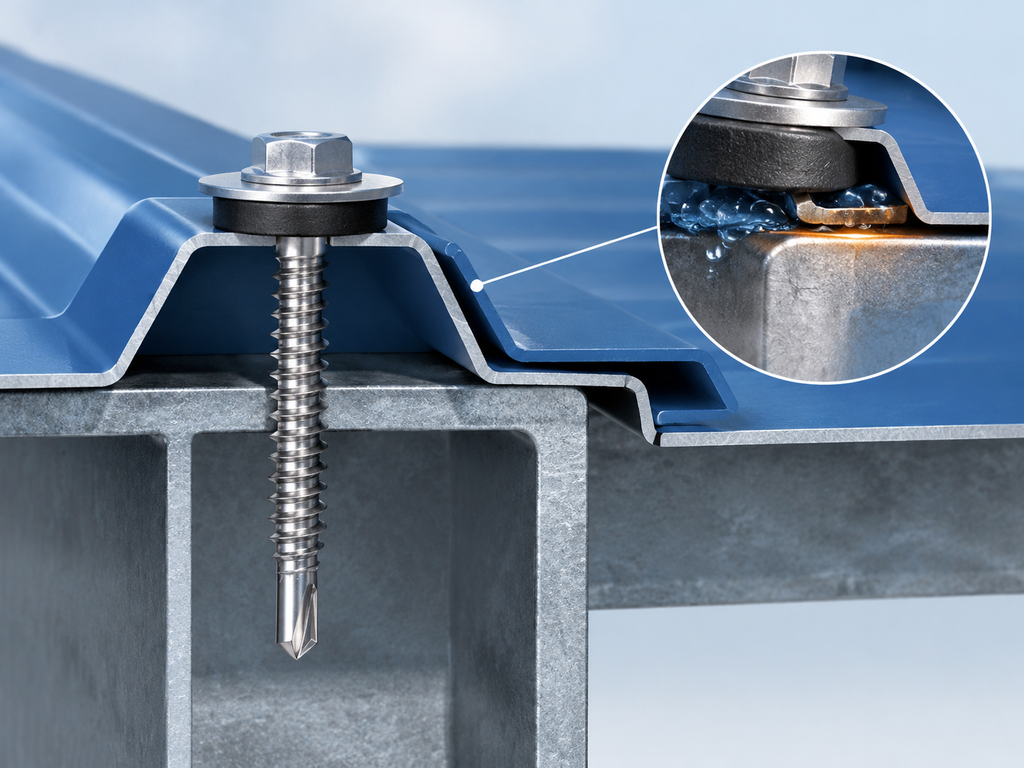
Two screws with the same “304” or “bi-metal” label can behave differently because corrosion depends on the complete assembly.
1. The environment
Humidity, salt spray, chloride concentration, industrial pollutants, cleaning chemicals and temperature cycles all affect the risk. A roof in a mild inland climate is not the same service condition as a coastal façade, a swimming pool enclosure or a food-processing plant.
2. Water traps and crevices
Water can remain under a washer, between lapped sheets, inside an open profile or around an imperfectly seated screw. A material with good general atmospheric resistance can still suffer crevice corrosion when the geometry keeps chlorides and moisture in contact with the surface.
3. Contact with other metals
Stainless steel fasteners are often used with aluminum, galvanized steel or coated steel components. Dissimilar metals in a wet environment can create a galvanic couple. The severity depends on the metals, the area ratio, the electrolyte and the design. An isolating washer, coating or different material combination may be needed; that decision belongs in the joint design, not in a generic screw description.
4. Installation damage
Scratches, over-driving, a damaged coating, a deformed washer or metal debris left on the surface can create corrosion initiation points. Installation instructions and a sample trial are part of the corrosion-control story.
5. Surface contamination
Stainless steel can develop local rust-like staining when iron particles or other contamination are left on its surface. That is different from the stainless steel body corroding through, and it is one reason a “stainless screw is rusting” complaint needs investigation rather than an automatic material change.
6. Maintenance and inspection
The expected maintenance regime matters. A connection that can be inspected and cleaned is different from one sealed behind a finished façade. If the design assumes a long maintenance-free life, the evidence and material selection should reflect that.
For these reasons, a salt-spray hour count is not an outdoor service life. Test duration, test method, coating, surface preparation, failure criterion and the exact product must match before two reports can be compared meaningfully.
Drilling performance is also a system
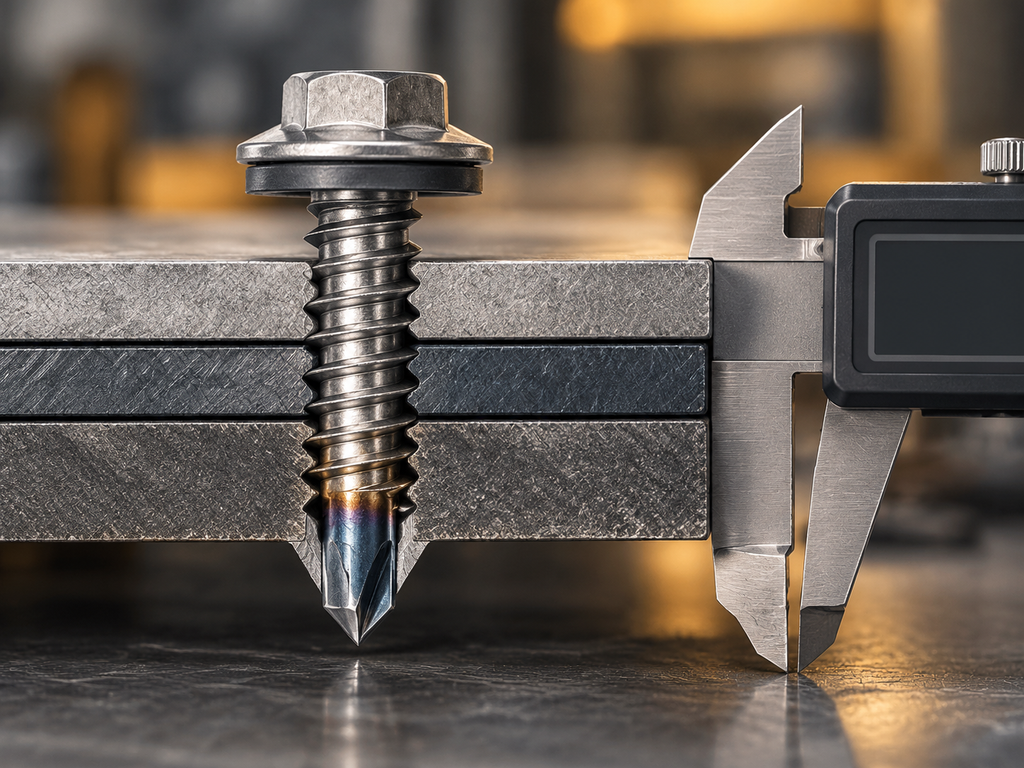
Drilling is not determined by the word “stainless” or by the color of the point.
The relevant factors include:
- the drill-point type and geometry;
- the hardness and heat treatment of the point;
- the steel grade and tensile strength of the substrate;
- the total thickness of all steel layers;
- the thread form and engagement;
- the screw diameter and length;
- the driver, speed, torque and operator technique;
- lubrication and coating;
- whether the sheets are clamped together during installation.
A screw that drills one 0.8 mm steel sheet may not be suitable for a 6 mm structural section. A point that performs well in a bench trial may behave differently when the installer cannot apply the recommended axial force, or when the panel is not held tight against the substrate.
This is why a drill-point chart is useful for shortlisting, but not sufficient for approval. Use the chart to narrow the options, then confirm the exact product and run a trial on the actual assembly.
Comparison table for buyers
| Consideration | 304 stainless self-drilling screw | 410 stainless self-drilling screw | Bi-metal self-drilling screw |
|---|---|---|---|
| Basic description | Austenitic stainless body | Martensitic, heat-treatable stainless | Stainless body plus hardened carbon steel point |
| Main strength | Good general corrosion resistance | Hardness and drilling capability | Combines stainless exterior with carbon-steel drilling performance |
| Main trade-off | Drill-point capability must be verified for the substrate | Lower corrosion resistance; coating and exposure matter | Joint, point coating and material combination must be controlled |
| Typical buying question | “Is the finished drill point suitable for my steel thickness?” | “Is the corrosion system adequate for the real exposure?” | “What are the body grade, point grade, coating and drill capacity?” |
| Evidence to request | Grade certificate, point specification, drill trial, coating details | Heat-treatment condition, coating, corrosion test, drill trial | Body and point specification, weld control, coating, drill trial, test scope |
| Avoid assuming | That 304 is automatically coastal-grade | That “stainless” means maintenance-free outdoors | That bi-metal is automatically rust-proof or interchangeable across suppliers |
The table is a starting point for questions, not a specification. The final choice should follow the application drawing and the supplier’s verified product data.
How to choose for common buyer situations
Indoor sheet-metal assembly with a dry, controlled environment
A coated carbon steel screw may be the most economical baseline if the specification does not require stainless. If a stainless screw is required for cleanliness, appearance or another project reason, compare 304 and bi-metal by their actual drill-point capability and finish, not by grade alone.
Exposed metal roofing or wall cladding
Review the panel profile, substrate, washer, exposure and expected maintenance. A 304 or bi-metal option may be relevant, but the fastener must suit the panel and the steel thickness. For a coastal or high-chloride site, ask whether 316 or another higher-alloy option is required and whether the washer and accessories are equally suitable.
Steel-to-steel connection with thicker or harder substrate
Do not approve the screw from a generic material description. Confirm the drill-point capacity for the total steel thickness and strength, then test the actual joint. A 410 or bi-metal construction may enter the discussion, but only with the point, coating and installation method defined.
Aluminum or dissimilar-metal assembly
The risk is not limited to the screw’s stainless grade. Review the galvanic couple, water exposure, contact area and the need for isolation. A washer or coating chosen only for sealing may not solve a galvanic-corrosion problem.
Visible architectural finish
Color matching, coating appearance and touch-up requirements may matter as much as the base material. Ask how the head, washer and any cut or damaged area should be treated. Do not assume that a painted head and an uncoated point have the same corrosion performance.
What to put in the RFQ
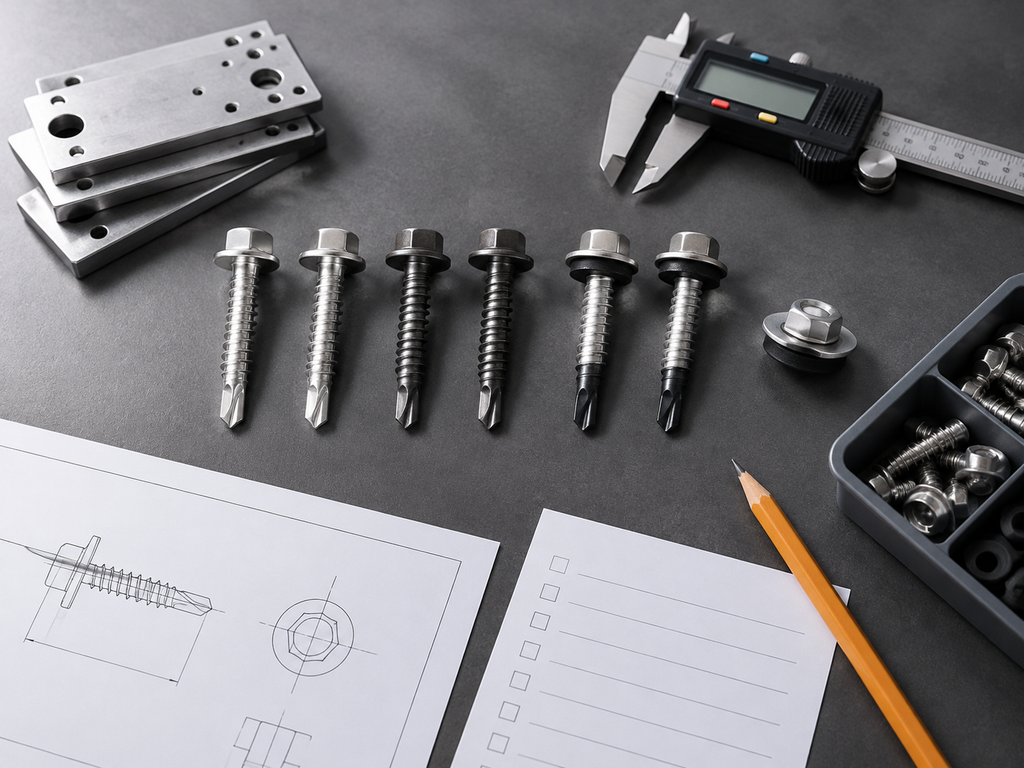
A useful RFQ lets the supplier quote a defined system rather than a generic screw. Include:
- product type: self-drilling screw, self-tapping screw or a named existing model;
- application and connection drawing or photo;
- each substrate layer, material and thickness;
- steel grade or strength, if known;
- indoor, outdoor, coastal, industrial or other exposure;
- expected service life and maintenance assumptions;
- head type, drive, diameter, length and thread;
- required body grade and drill-point type;
- washer type, backing material and sealing requirement;
- coating or finish, including color and coverage;
- installation tool, access and torque/speed limits;
- required sample quantity and trial method;
- inspection documents, certificate scope and batch traceability;
- packaging, labeling and destination;
- whether an existing approved sample must be matched.
If the buyer does not know one of these items, say so and ask what information the supplier needs. A short technical conversation is usually better than filling the RFQ with assumptions.
Questions to ask before approving a sample
- Does the sample match the quoted body grade and point material?
- What is the stated drill capacity, and on what steel grade and thickness was it established?
- Does the sample drill the actual assembly without excessive heat, walking or point failure?
- Does the thread engage the substrate as intended, and is the screw length correct for the joint?
- Does the washer seat without excessive compression, distortion or a visible gap?
- Is the coating intact after installation, including at the point and around the washer?
- Do the certificate and test report identify the same model, material and batch as the sample?
- Is the installation method suitable for the available tool and access?
Do not use a warehouse “looks right” check as a substitute for a defined trial. Record the substrate, tool, settings, sample identification and result so the approval can be repeated.
A practical selection rule
Start with the environment and the joint, not the material name:
Exposure and expected life -> substrate and total thickness -> required drill point -> body material and coating -> washer and installation -> sample and documentation.
If two options both pass the functional trial, compare the evidence and total installed cost. A lower purchase price is not a saving if the screw needs extra pilot operations, fails at installation or creates a corrosion callback.
Frequently asked questions
Is 304 always better than 410 for corrosion?
In general atmospheric conditions, 304 usually offers better corrosion resistance than 410. That does not make every 304 screw suitable for every project, and it does not mean 410 cannot work in a controlled environment with an appropriate coating. The exposure, joint design and finished product evidence still decide.
Is a bi-metal screw rust-proof?
No fastener should be described as rust-proof without defined conditions. A bi-metal screw is designed to put a corrosion-resistant stainless body on the exposed portion and a hardenable steel point at the drilling end. The body grade, point protection, weld zone, coating, installation damage and environment all affect performance.
Can I replace a 304 screw with a bi-metal screw?
Only after comparing the complete specification. Check head, drive, diameter, length, thread, drill point, drill capacity, washer, coating, substrate and installation method. A similar appearance is not a substitution approval.
Does a longer salt-spray test always mean a better screw?
Not necessarily. Reports can use different methods, specimens, preparation, failure criteria and exposure conditions. Compare the exact product and test scope, and treat the result as one piece of evidence rather than a service-life guarantee.
Can I use 304 screws on an aluminum assembly?
304 may be considered, but aluminum and stainless steel form a galvanic couple when moisture is present. Review the design with the joint engineer and ask about isolation, coating, washer material and drainage. The screw grade alone does not answer the question.
Send the application, not just a product name
The fastest way to narrow the choice is to share the actual connection:
- what is being fixed to what;
- the material and thickness of each layer;
- the exposure and expected life;
- the existing screw, drawing or sample;
- the washer and finish requirement;
- the installation tool and access.
ScrewTrade can review the requirement against its 304 and bi-metal self-drilling screw ranges and confirm which details need to be verified before a sample. Send your application details or RFQ with a drawing, photo or existing sample reference.
For related technical background, see the self-drilling screw drill point chart, the bi-metal self-drilling screw guide, and the stainless steel rust investigation guide.
Related News
Other news you might be interested in

Peta Permintaan Pengencang 2027: Pusat Data, Energi, dan Proyek Industri
Prospek pengencang 2027 bukanlah pemulihan yang luas. Ini adalah peta kantong-kantong proyek—dan kantong terkuat adalah pusat data, energi, dan pekerjaan industri tertentu. Arahnya sudah terlihat dari hasil perusahaan pada akhir tahun 2026. Hilti melaporkan pertumbuhan penjualan mata uang lokal sebesar 5,9% dalam delapan bulan pertama tahun 2026, dengan pertumbuhan dua digit di Amerika dan Asia Pasifik, sementara menggambarkan konstruksi tradisional sebagai lemah. Penjualan kedirgantaraan LISI naik 14,3% dalam sembilan bulan pertama, tetapi penjualan otomotifnya turun 5,2%. Penjualan kuartal ketiga Bossard tumbuh 12%, didukung oleh permintaan pusat data di Amerika dan ekspansi semikonduktor serta elektronik di Asia.

Apa itu Sekrup Bi-Logam dan Mengapa Atap Aluminium Membutuhkannya?
Sekrup bi-logam adalah satu pengikat yang terbuat dari dua logam dengan fungsi berbeda. Dalam atap, konstruksi umumnya adalah kepala dan badan baja tahan karat dengan titik bor baja karbon keras dan ulir pemimpin. Bagian baja tahan karat menahan korosi pada atap yang terbuka; titik yang dikeraskan mengebor purlin baja, girt, atau rangka. Atap aluminium sering membutuhkan kombinasi ini ketika panel aluminium dipasang langsung ke substruktur baja, karena panelnya lembut dan tahan korosi, tetapi sekrupnya tetap harus mengebor baja dan bertahan dari cuaca. Bi-logam bukan jaminan: kelas baja tahan karat, kapasitas titik, lapisan, ring, dan detail aluminium-ke-baja masih harus ditentukan.
Want to know more?
Get in touch with us for more information about our services and products.