
Why Are Stainless Steel Self-Drilling Screws Still Rusting? A Guide for Buyers

Han Congming
AuthorWith experience in screw and fastener manufacturing and sales, we operate our own production facility with stable large-scale capacity. We are specialists in self-drilling screws, drywall screws, chipboard screws, machine screws, bolts, and customized fasteners for construction and industrial applications.
You have specified stainless steel self drilling screws to avoid corrosion complaints. Now, there are brown marks, stained washers, or rusty drill tips around the drill bit. Should you reject the batch, replace the materials, or review what happened during the installation process?
Firstly, determine the cause and location of corrosion. Stainless steel can produce surface stains or more severe corrosion, while iron contamination can also leave rust on the surface of stainless steel. Merely relying on appearance cannot determine the cause.
For buyers, a useful next step is to link evidence with screw structure, exposure conditions, and installation history before approving replacement.
Check if there is rust on or around the screw
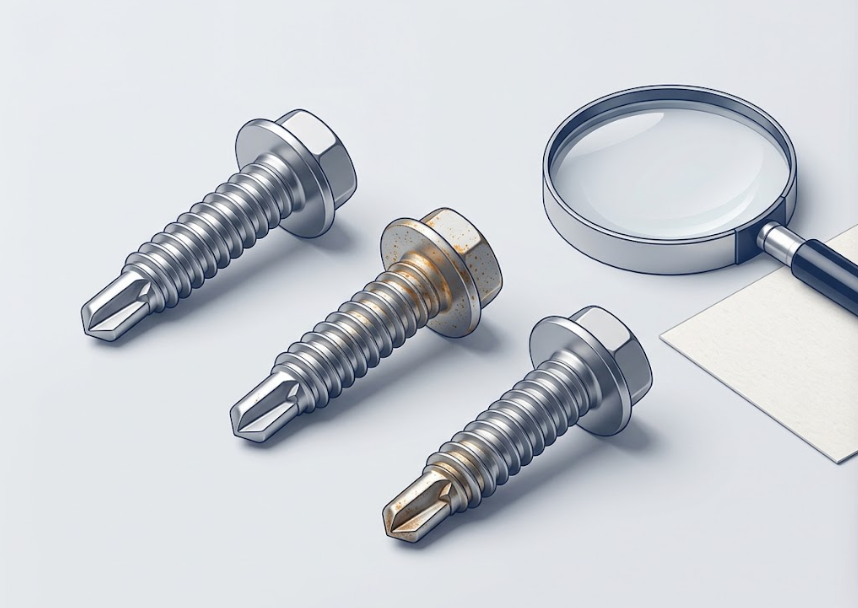
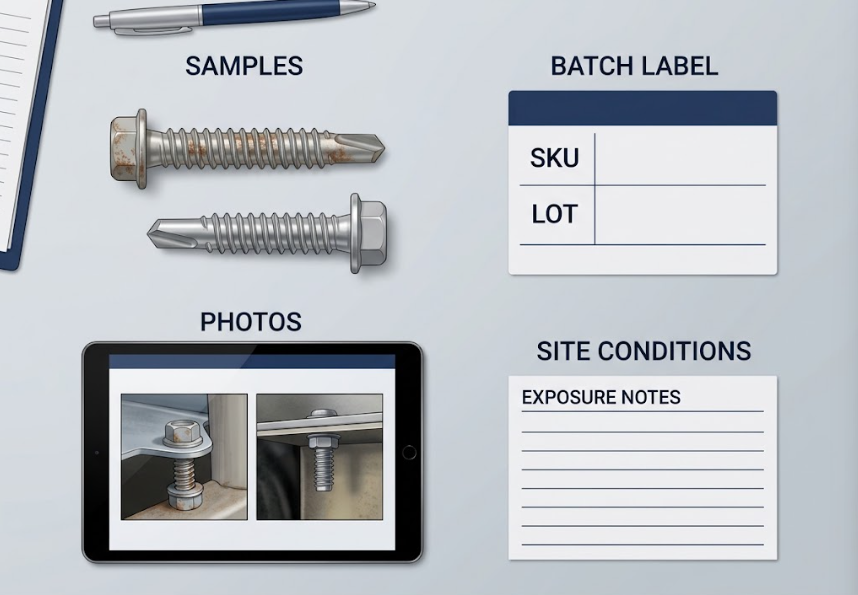
Before cleaning or replacing anything, please take close-up photos of the entire connection and affected area. Compare the affected screws with unused samples from the same batch (if any).
Use these questions to organize the investigation:
| What you observe | What to investigate next |
|---|---|
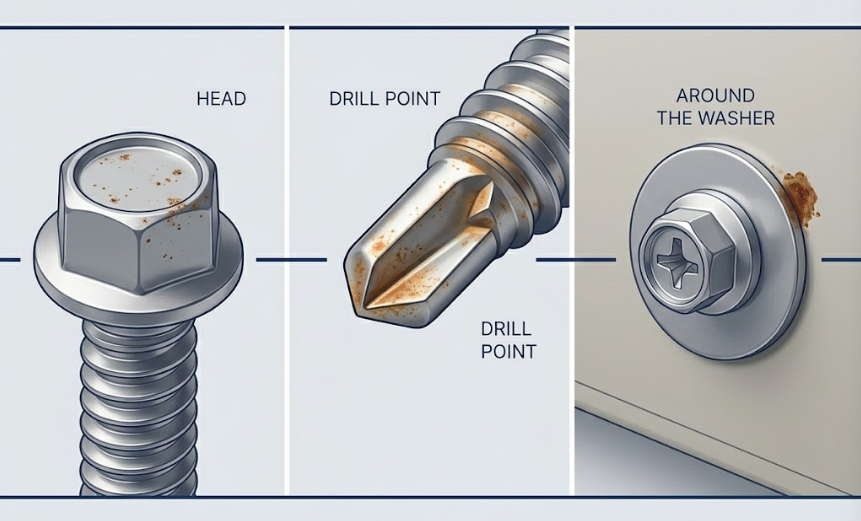
| Brown spots on the head or exposed surface | Confirm the grade; investigate surface deposits and nearby cutting or grinding work. |
| Rust concentrated at the drill point | Establish whether the screw is single-material or bi-metal, and identify the tip material. |
| Staining around the washer or hole | Inspect the washer, cut edge, debris, and moisture-trapping details. |
| Pits or visible loss of metal | Arrange a technical assessment of the affected connection before deciding on cleaning or replacement. |
| Affected installed screws but apparently clean unused samples | Compare exposure and installation conditions; retain both sets for examination. |
These observation results are only used to guide the investigation, not to prove the diagnosis. Please avoid judging the entire batch of products as unqualified or qualified based solely on one photo.
Confirm the meaning of "stainless steel" for this screw
A procurement instruction that only states' stainless steel Tek screws' leaves an important question: which material is used for each component?
410 stainless steel is a hardenable martensitic grade. Its strength and hardness can be used for fasteners, but its corrosion resistance is different from austenitic grades such as 304. The products selected for drilling performance should not be automatically considered suitable for erosive coastal exposure.
304 and 316 stainless steel are also different choices. Special attention should be paid to marine exposure: 304 is not suitable for seawater environments, and even 316 can experience pitting or crevice corrosion under adverse conditions. Therefore, 'ocean grade' should trigger discussions on the actual environment, rather than unconditional anti rust commitments.
For replacement orders, it is required to provide exact levels, structures, and recorded drilling capabilities. Don't replace screws just because their material description sounds more corrosion-resistant.
Search for salt, retained water, and iron pollution
Salt exposure may be more severe than expected
When local conditions exceed the resistance of the selected grade and surface conditions, stainless steel will produce tea stains. The accumulation of salt, obstruction during washing, poor drainage, and cracks will result in higher exposure requirements. Confirm whether the location is affected by coastal salt, polluted spray or persistent sediment, not just "outdoor".
Rust may originate from pollution
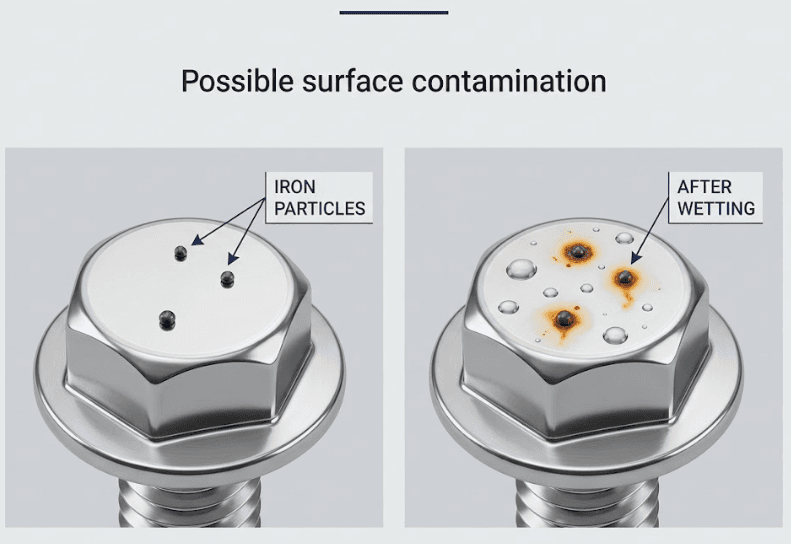
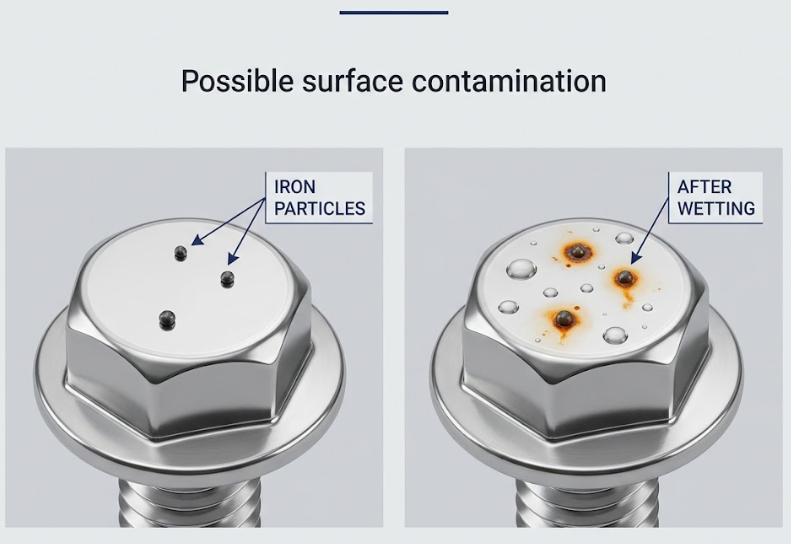
Carbon steel cutting or grinding debris can contaminate the surface of stainless steel. Shared tools and handling equipment are other possible sources. When the deposited iron becomes wet, rust will form. Cleaning must remove pollutants and must not spread them to other areas.
Inquire with the installation personnel whether the steel in the vicinity has been cut or ground, whether debris has been removed, and which tools have come into contact with the fasteners. These pieces of information help distinguish between material selection issues and contamination introduced after delivery.
The surrounding seams also need to be checked
Cracks and water accumulation can promote local corrosion. As part of the investigation, review the details of the head, gasket, and connecting materials. More corrosion-resistant screws do not eliminate the need to evaluate a complete connection.
If the screw is bimetallic, please identify these two materials
Some bimetallic self drilling screws combine stainless steel bodies with hardened carbon steel drill bits. This structure separates the corrosion resistance of the main body from the drilling performance requirements of the tip. The published manufacturer documents indicate that drilling capacity and minimum protrusion requirements are product specific.
If rust is concentrated at the tip, please ask the supplier to determine its material and explain the allowable exposure and installation conditions for the product. Confirm the position of the stainless steel load-bearing thread in the completed component.
Whether it's' rust on the tip, so the entire screw is defective 'or' just the tip, so it's okay ', it's not a sufficient acceptance decision. Require product specific evaluation based on connection requirements.
Choose alternative solutions based on the actual situation
Before discussing the price or placing another bulk order, please prepare a brief explanation about the malfunction and application.
| Selection condition | Information to provide or confirm |
|---|---|
| Exposure | Indoor or outdoor location; coastal salts; chemicals; wetting and drying; cleaning arrangements. |
| Connected materials | Roof panel, sheet, framing, or other substrate materials; thickness of each layer. |
| Fastener construction | Exact body and drill-point materials; single-material or bi-metal design. |
| Installation | Selected screw length, drill point, supplier instructions, and completed connection details. |
| Acceptance | Required appearance, relevant corrosion evidence, and the process for reviewing affected parts. |
For relatively mild exposures, evaluate the product based on its recorded limitations. If the exposure to chloride is high, please review materials or structures that are more corrosion-resistant with the supplier and project designated personnel. Severe or continuously humid conditions may require expert evaluation, not just changing from 304 to 316.
If a corrosion test report is provided, please inquire about which product was tested, how it was prepared, which method was used, and what the acceptance criteria are. Check if the evidence is applicable to the proposed screw, rather than different materials or product lines.
What should buyers do when rust has already appeared?
Save evidence before attempting remedial measures. Save affected samples, unused samples (if any), carton labels, batch identification, and records of the first discovery of staining.
Sending supplier:
- Close up photos and overview of connections.
- Order reference, screw specifications, and batch details.
- Location of rust: head, washer, handle, tip or surrounding material.
- Exposure conditions and time after installation.
- Installation, cutting, grinding, and cleaning history.
Request a written explanation of the suspicious cause, evidence necessary to confirm the cause, and proposed corrective measures.
Surface cleaning may be suitable for certain contaminations or stains, but it cannot restore the metal that has been lost due to pitting. Agree on appropriate methods before handling, and have qualified project professionals review significantly damaged load-bearing connections.
Can magnets prove that the supplied stainless steel is incorrect?
Merely relying on magnets cannot verify the level. Martensitic stainless steel has magnetism, while the magnetic response of austenitic stainless steel varies with composition, cold working, and heat treatment. When level verification is required, use material documentation and appropriate identification testing.
Discuss your corrosion issue with ScrewTrade
If your stainless steel self drilling screws rust, please send ScrewTrade the current specifications, photos, substrate details, and exposure conditions. Please indicate if you need assistance in viewing the affected batches or selecting alternatives.
For new orders, written confirmation is required for the proposed material structure, drilling capability, installation conditions, and related supporting documents. Resolving these issues before placing an order provides a clearer basis for buyers and suppliers to evaluate applicability.
Related News
Other news you might be interested in

Why Self-Drilling Screws Fail to Drill: A Substrate and Installation Checklist
When a self-drilling screw spins against steel without making progress, the purchasing decision becomes urgent: should the installer change the tool settings, should the buyer order a different screw, or should the supplier investigate the batch?A useful diagnosis starts by identifying exactly where drilling stops. Record the material at that point, check the selected screw against the assembly, and then compare installation conditions. This approach gives buyers a clearer basis for deciding what to change and what evidence to request.

Bulk Self-Drilling Screws: An RFQ Checklist for U.S. Importers and Distributors
When sourcing bulk self-drilling screws, a unit price is only useful if you know exactly what it covers. Two quotations may appear to describe the same product while differing in dimensions, coating, packaging, or delivery conditions. For U.S. importers and distributors managing several SKUs, those differences can make supplier comparisons difficult. A clear request for quotation—an RFQ—helps suppliers understand your requirements and gives your purchasing team a consistent basis for reviewing their offers. This checklist explains what to include, which details need confirmation, and how to turn an initial inquiry into a specification that both buyer and supplier can review.
Want to know more?
Get in touch with us for more information about our services and products.