
Sekrup Retrofit Atap Logam: Mengapa Rakitan Standar Tidak Lagi Cocok

Han Congming
PenulisKami berpengalaman dalam produksi dan penjualan sekrup serta pengencang, dengan fasilitas produksi sendiri dan kapasitas produksi skala besar yang stabil. Kami adalah spesialis sekrup bor mandiri, sekrup drywall, sekrup papan partikel, sekrup mesin, baut, dan pengencang khusus untuk aplikasi konstruksi dan industri.
A standard metal roofing screw range is built around a useful commercial assumption: the next project will look broadly like the last one. The panel will have a familiar profile, the purlin will fall within a known thickness range, the installer will follow a repeatable fastening pattern, and the screw length can be selected from a compact matrix.
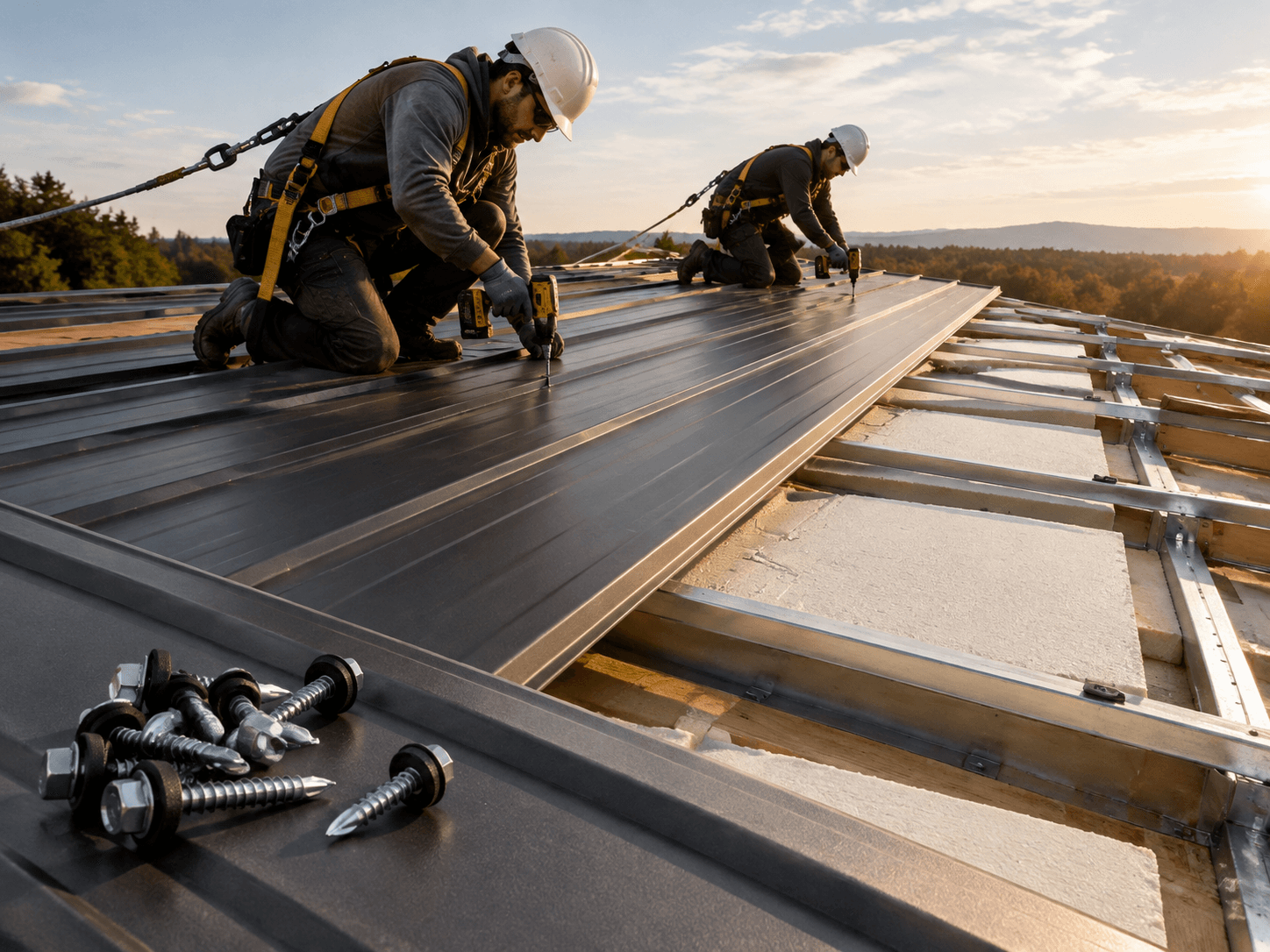
Retrofit work breaks that assumption. A recover roof may add insulation, subframing or a new panel system over the existing roof. A tear-off may expose damaged purlins, irregular framing and old penetrations. A repair may reuse panels and holes that were never part of the original design intent. Each case changes the fastener path, the support condition and the evidence needed before a screw can be approved.
That is why the standard assortment still matters, but it can no longer be the only answer. Distributors and suppliers that treat retrofit as “the same roof screw, only longer” will quote too quickly, stock the wrong extensions and discover the real requirement after the first installation trial.
The market signal is strong enough to justify a different range strategy. Roofing Contractor reported in October 2026 that an MCA/FMI forecast expects about 96% of residential metal roofing by 2030 to come from retrofit or replacement. That is a forecast, not today’s market share, and it does not mean every retrofit consumes self-drilling screws. It does mean that a growing part of the metal roofing conversation will be shaped by existing buildings rather than clean new-build conditions.
Retrofit is not one screw market
The first mistake is to use “retrofit” as a single product category. Three project models behave differently.
| Retrofit model | What changes for fasteners | What the assortment must support |
|---|---|---|
| Tear-off and replacement | Old panels are removed; framing, purlins and deck condition become visible; new holes and layouts are established | New-build-style roof screws, but with a verified support condition and an exception route for damaged or irregular framing |
| Recover or overclad | The existing roof stays in place; subframing, insulation and long fasteners may be added; the new panel may sit well above the original support | Longer fastener paths, different drill-point demands, project-specific lengths, clips or subpurlin connections, and mixed screw families |
| Repair or re-fastening | Existing panels and holes remain; failed screws, degraded washers, corrosion and loose panels are replaced | Replacement roofing screws, controlled sealing, old-hole assessment, traceability and a documented approval rule for any change in diameter or length |
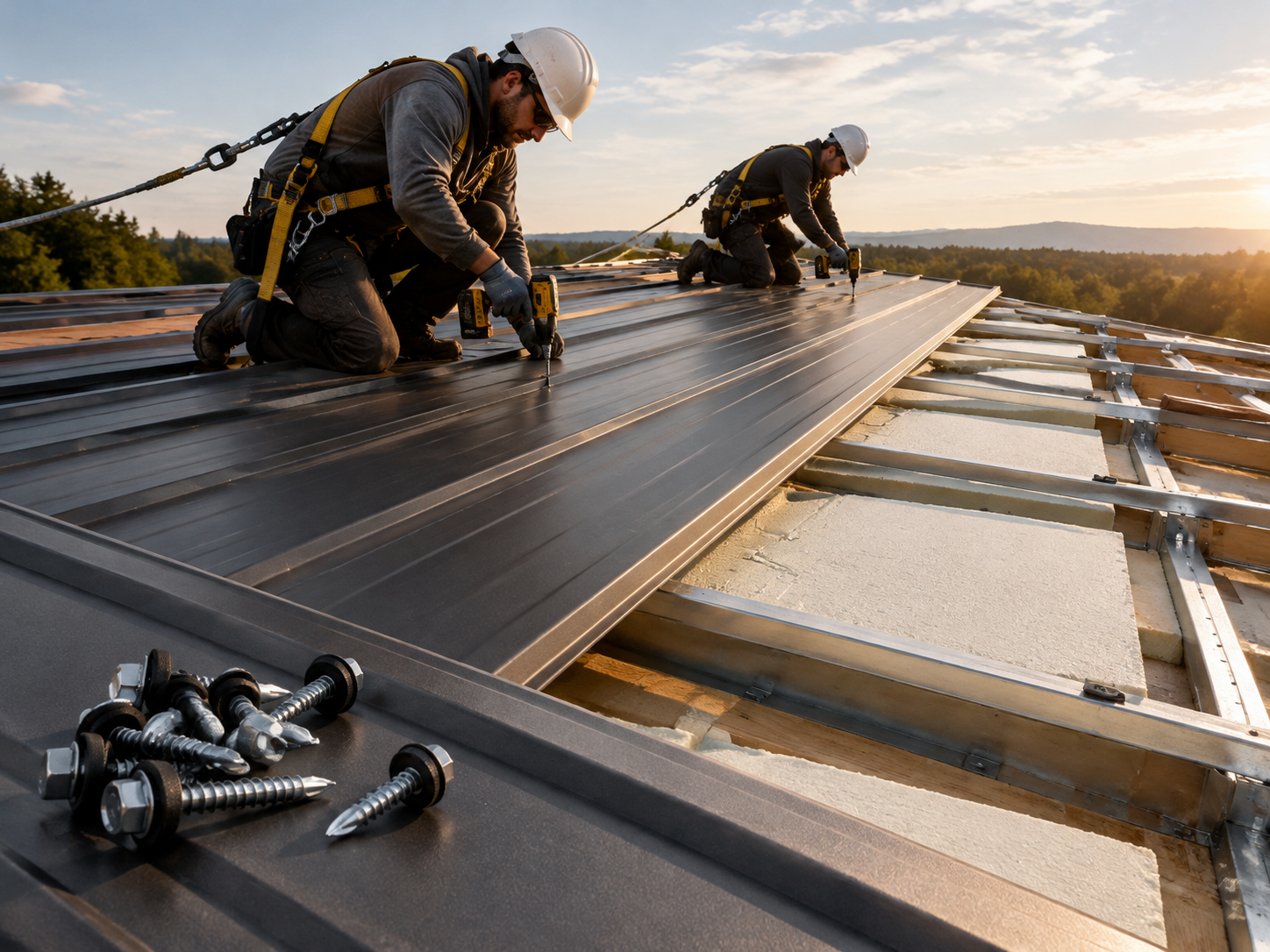
A recover roof is not simply a tear-off with less labor. McElroy Metal describes several metal-over-metal methods, including notched purlins, hat-over-zee framing, criss-cross grids, rigid insulation with long fasteners and tall clips. Some systems use framing. Some use long screws through insulation back to the original purlins. Some use concealed clips. The fastener requirement follows the system, not the project label.
Standing seam also needs its own qualification. It is often a concealed-fix system, so a forecast for standing-seam growth cannot be converted directly into demand for exposed self-drilling roofing screws. The more useful question is: which existing panel is being recovered, which new panel is being installed, and what is the actual connection between them?
The hidden assumptions inside a standard assortment
A compact roofing screw range usually works because several conditions repeat:
- the panel profile and thickness are known;
- the purlin material, gauge and strength are consistent;
- the screw passes through one panel and into one support;
- the hole is new and created by the fastener;
- the washer seats on a defined flat area;
- one or two coating systems cover most orders;
- the installer can reproduce the approved tool setting.
Retrofit projects remove several of those controls at once. The existing roof may have ribs, laps, fasteners, sealant, corrosion, insulation or previous repairs in the screw path. The purlin may be a full structural member, a thinner subpurlin, a clip, a purlin extension or a support that cannot be identified from below. The new panel may have a different profile and bearing surface. The color and coating may need to match an occupied building rather than a new specification.
IIBEC’s October 2025 technical article makes the structural point clearly: purlins and subpurlins are not interchangeable, and pullout performance can vary substantially with gauge and steel grade. The article reports that some 16-gauge Grade 30 subpurlin material can produce pullout values as much as 50% lower than Grade 50 alternatives.
That is the practical meaning of “the standard assortment no longer fits.” The same screw may be correct for the panel and wrong for the support. A catalog based only on diameter, length and head style cannot resolve that.
Length is a stack-up decision, not a one-size-up decision
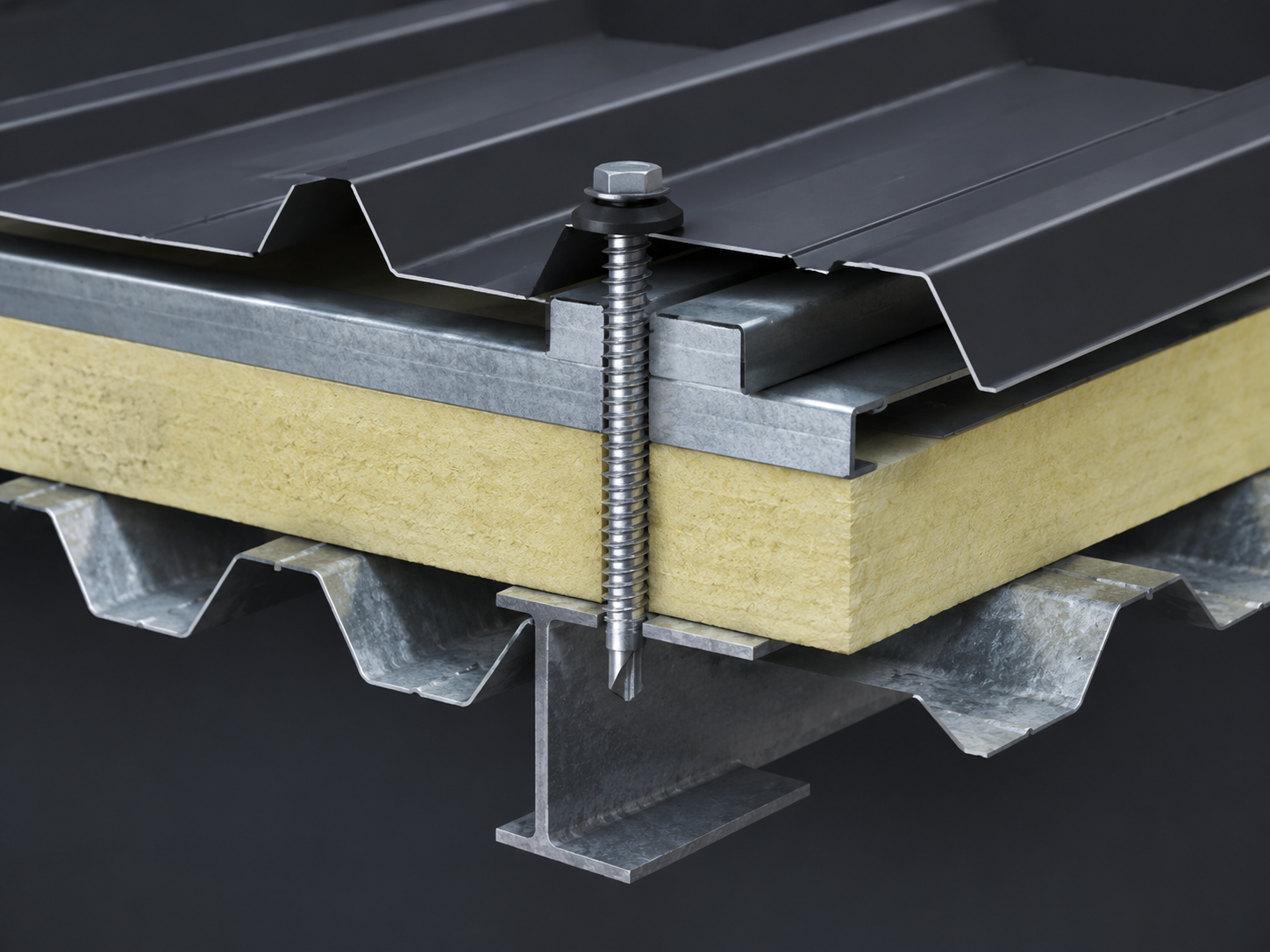
In a simple new-build connection, the screw length calculation can look routine: panel thickness, plus the required engagement in the purlin, with allowances defined by the panel system. Retrofit adds layers and uncertainty.
A long-fastener recover system may pass through the new panel, a bearing plate or clip, new rigid insulation, the existing roof and then into the original purlin. A framed recover may fasten a subpurlin to the existing structure and use a different screw to attach the new panel to that subpurlin. A repair may need to reach the original support through a panel that has deflected, compressed insulation or a sealant-filled hole.
Under those conditions, “one size longer” is not a specification. It is a guess with a part number.
Two details deserve particular attention.
Define the length basis
Suppliers do not always use the same measuring basis. One drawing may state length under the head, another under the washer, and another overall length including the drill point. Two screws that look equivalent in a quotation can therefore create different usable grip.
For a retrofit RFQ, require the supplier to state the measuring basis and show the complete assembly: head, washer, shank, thread, drill point and usable length. Then compare that with the actual stack-up drawing. This is more useful than asking for “a 125 mm screw” without knowing where the 125 mm starts and ends.
Confirm the drill path and the support
The drill point must handle the complete path, not only the new panel. Existing steel, additional framing, insulation washers, spacer plates and the final purlin all affect drilling and clamping. The thread must also engage the intended support, not merely pass through it.
IIBEC notes that retrofit panel performance can differ when a panel is attached to subpurlins rather than full-depth purlins, and that system testing is needed across the actual assembly. The same logic applies to the fastener: select the point and thread from the assembly, not from a general TEK number or a single steel-thickness claim.
Old holes change the exception process
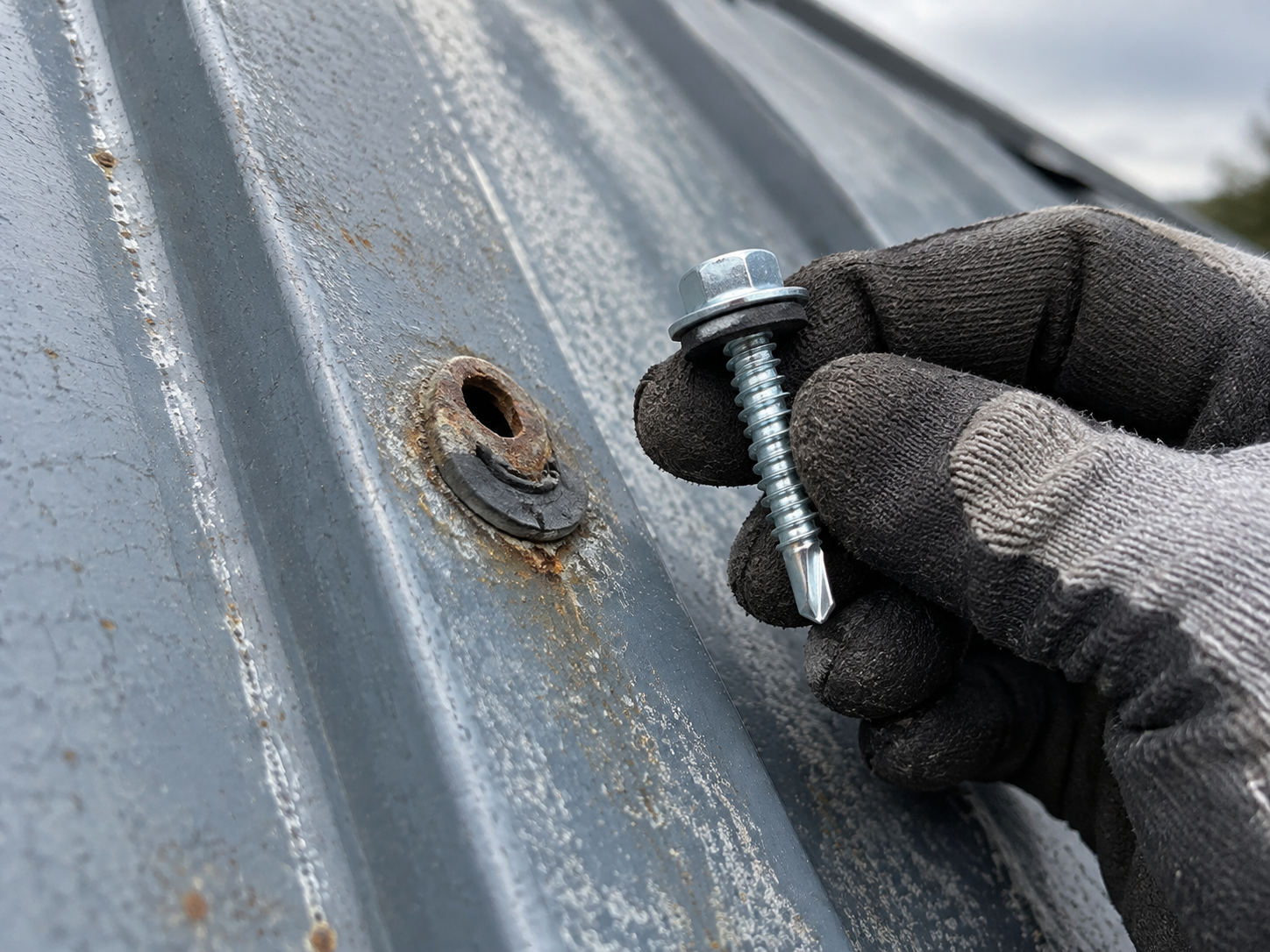
Repair and partial replacement projects create a different risk. The original screw may have backed out, corroded, stripped the support or enlarged the panel hole. The washer may have degraded. Water may have damaged the panel coating or the steel beneath it.
SFS’s public guidance on replacing metal roof screws notes that a replacement screw may need a different diameter to form new threads in an existing hole, and that the assessment should include substrate deterioration, panel flatness, fastener spacing and flashing condition . That does not make “go one size wider” a universal rule. A larger screw can change the drill-point requirement, reduce edge distance, damage a thin support or create a new sealing problem.
The safer commercial process is an exception protocol:
- Identify the original screw, washer, panel and support.
- Record whether the hole is round, elongated, corroded, stripped or contaminated.
- Confirm whether the panel manufacturer or project engineer permits reuse of the hole.
- If not, define the approved offset, replacement panel detail or connection repair.
- Approve any diameter, length or point change through a sample and a written deviation.
- Keep the approved sample and batch reference with the order.
This is where a distributor can add more value than a catalog. The customer is not buying a box of replacement roofing screws; the customer is buying a defensible decision about a connection that already has a history.
The connection may need several screw families
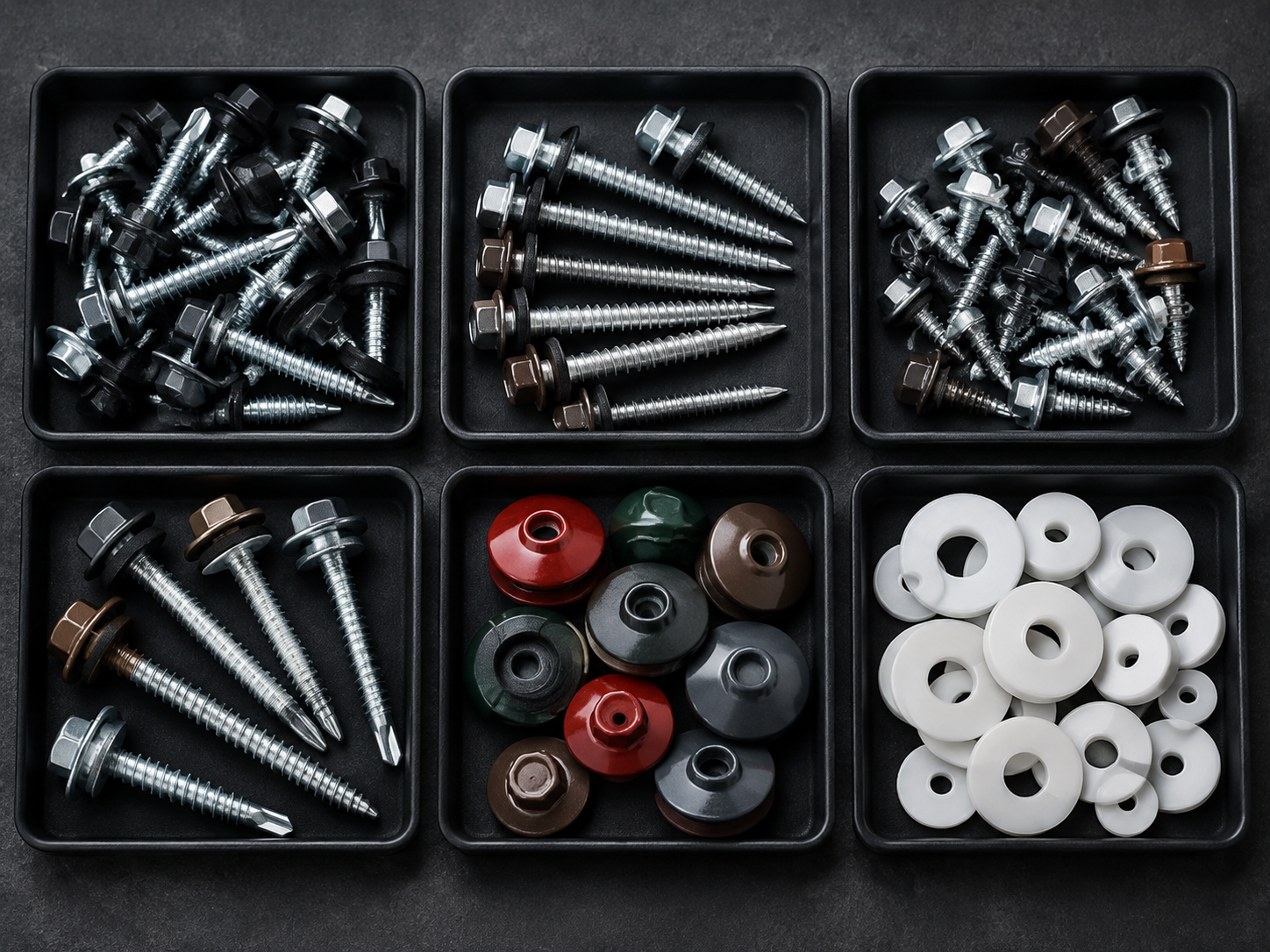
Retrofit roofs rarely reduce to one SKU. The base attachment, side laps, panel stitching and insulation system may each require a different fastener.
Self-drilling roofing screws with EPDM washers are the primary family for exposed-fastener panel attachment. The washer is part of the connection: it must fit the panel profile, compress evenly and remain in contact with the intended bearing surface. A wider washer is not a cure for an oversized hole, a damaged panel or an incorrect fixing location. The existing ScrewTrade guide to EPDM washer size explains why assembly geometry matters more than diameter alone.
Side lap screws and stitching screws serve panel-to-panel connections. They should not be treated as substitutes for the structural fixing that attaches the panel to the purlin. The difference becomes more important on a retrofit because existing laps may be distorted, dirty or previously sealed.
Sandwich panel screws enter the discussion when the retrofit adds an insulated panel system. Here the screw path includes two metal facings and an insulation core before reaching the support. Length, thread, sealing and panel compression all need to be reviewed together.
Storm washers, dome roofing washers and PVC washers extend the range for specific profiles, exposure conditions or appearance requirements. They are useful assortment extensions, but they are not automatic upgrades. Each must be matched to the screw, panel and fixing location.
ScrewTrade’s current public range includes side lap screws, stitching screws, sandwich panel screws, storm washers, dome roofing washers and PVC washers. That breadth is commercially useful only when the sales team can separate the families by connection function.
Build a three-tier assortment instead of a larger catalog
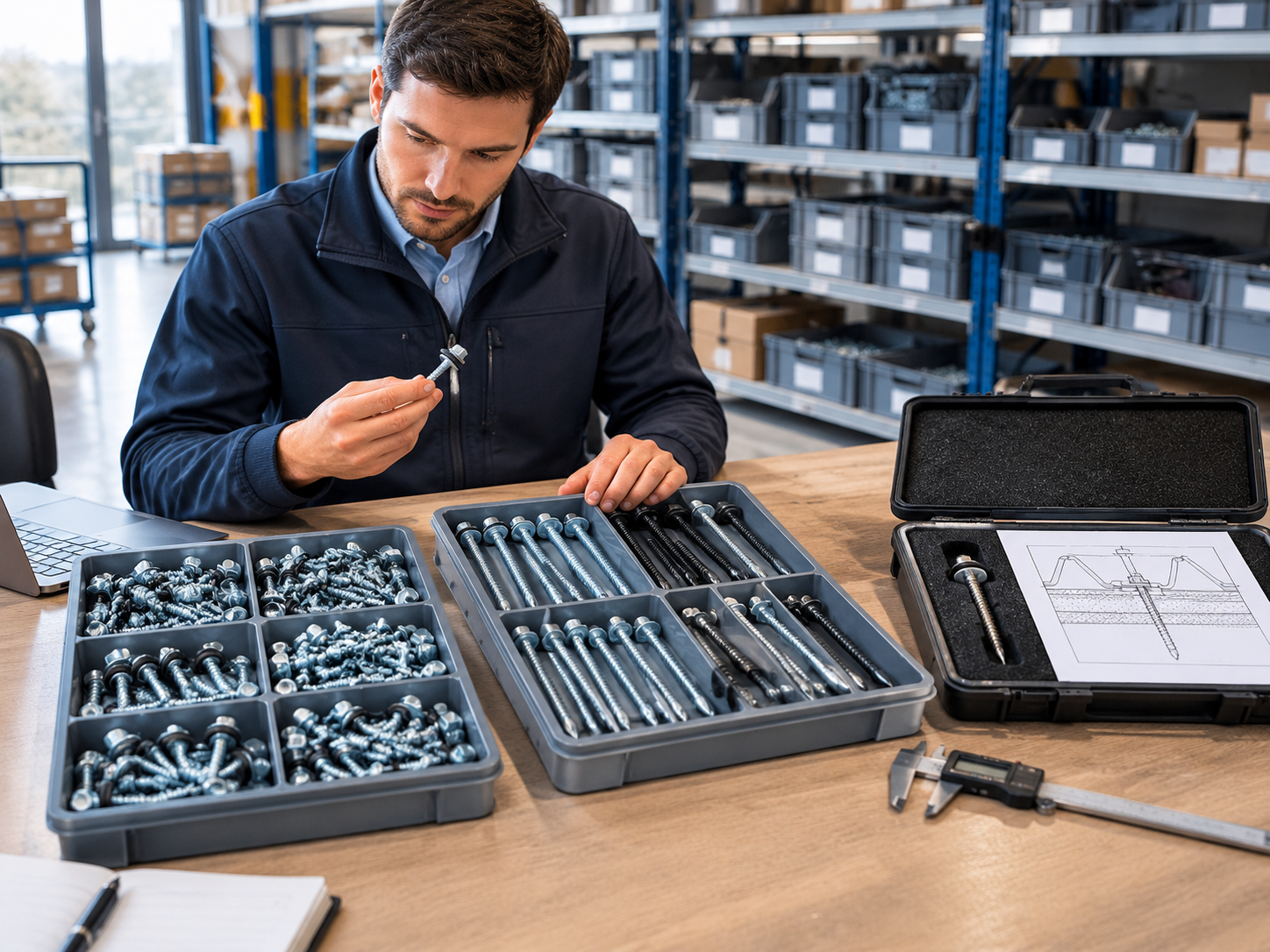
The answer is not to multiply every standard SKU by every possible retrofit condition. That creates slow-moving inventory and quotation errors. A more practical structure has three tiers.
Tier 1: core stock
Keep the high-turn roofing screws that support repeatable exposed-fastener work: common diameters, the most frequently used lengths, standard head and drive combinations, and the coating and washer configurations that serve the main markets. This is the base service level.
Tier 2: retrofit extension
Add a controlled set of long lengths, alternate drill points, common color and coating variants, and the side-lap, stitching, sandwich-panel and washer families that retrofit projects repeatedly request. The objective is not to stock every possibility. It is to shorten the path from a known retrofit condition to a validated option.
Tier 3: engineered exception
Some projects will fall outside the extension. They may need a non-standard length, a specific drill point, a special head, a particular color, a project-approved sample or a combination that has not been supplied before. Treat these as an engineered exception with a drawing, trial, approval record and controlled batch.
This three-tier model gives sales teams a clear answer:
- This is standard stock and can be quoted now.
- This is a known retrofit extension and needs the stack-up confirmed.
- This is a project-specific item and cannot be promised until the drawing and sample are approved.
That is more credible than claiming that a broad catalog can solve every retrofit.
What a useful retrofit quotation must establish
A retrofit RFQ should not become a generic checklist with fifty empty fields. It should establish the few facts that change the product decision.
Start with the connection section: existing roof profile and condition, new panel or system, insulation or subframing, purlin or support, and the path of the fastener. Add the existing fastener or approved sample where one exists. State the length basis and the required engagement rule. Identify the exposure and the required coating or color. Finally, define how the first installation will be approved: sample, trial assembly, tool setting, washer seating and batch record.
The commercial terms follow from those facts. A supplier that knows the project is a recover system with long fasteners through rigid insulation can quote the right extension and packaging plan. A supplier that receives only “roofing screws, 1,000 boxes” cannot know whether it is quoting a standard panel screw, a replacement screw for an old hole or a long fastener for a subpurlin.
For distributors, this is also an inventory question. The sales team should record which retrofit conditions produced repeat demand, which exceptions became repeatable, and which “special” orders should be promoted into Tier 2. The assortment then evolves from evidence rather than from a competitor’s catalog.
The commercial advantage is controlled flexibility
The retrofit market rewards suppliers that can move from a standard product to a verified exception without losing control of quality. That requires more than additional lengths. It requires a clear length basis, a drill-point and support review, washer and panel compatibility, an old-hole policy, sample approval and batch traceability.
Standard assortments are still the right foundation. They keep cost, lead time and inventory manageable. But a standard assortment alone assumes a repeatability that retrofit projects do not provide.
The stronger position is therefore not “we have every screw.” It is:
We know which standard roofing screw fits the repeatable connection, which retrofit extension fits the known exception, and which project must be engineered and sampled before we quote.
That is the difference between selling replacement hardware and supporting a retrofit roof that has to perform after the installation crew has left.
ScrewTrade supplies self-drilling and self-tapping screws, metal roofing screws and related washer options for bulk B2B requirements. To review a retrofit application, send the existing and new roof build-up, purlin or support details, panel profile, length basis, exposure conditions and any approved sample or drawing through the contact page.
Related News
Other news you might be interested in
Peta Permintaan Pengencang 2027: Pusat Data, Energi, dan Proyek Industri
Prospek pengencang 2027 bukanlah pemulihan yang luas. Ini adalah peta kantong-kantong proyek—dan kantong terkuat adalah pusat data, energi, dan pekerjaan industri tertentu. Arahnya sudah terlihat dari hasil perusahaan pada akhir tahun 2026. Hilti melaporkan pertumbuhan penjualan mata uang lokal sebesar 5,9% dalam delapan bulan pertama tahun 2026, dengan pertumbuhan dua digit di Amerika dan Asia Pasifik, sementara menggambarkan konstruksi tradisional sebagai lemah. Penjualan kedirgantaraan LISI naik 14,3% dalam sembilan bulan pertama, tetapi penjualan otomotifnya turun 5,2%. Penjualan kuartal ketiga Bossard tumbuh 12%, didukung oleh permintaan pusat data di Amerika dan ekspansi semikonduktor serta elektronik di Asia.
Apa itu Sekrup Bi-Logam dan Mengapa Atap Aluminium Membutuhkannya?
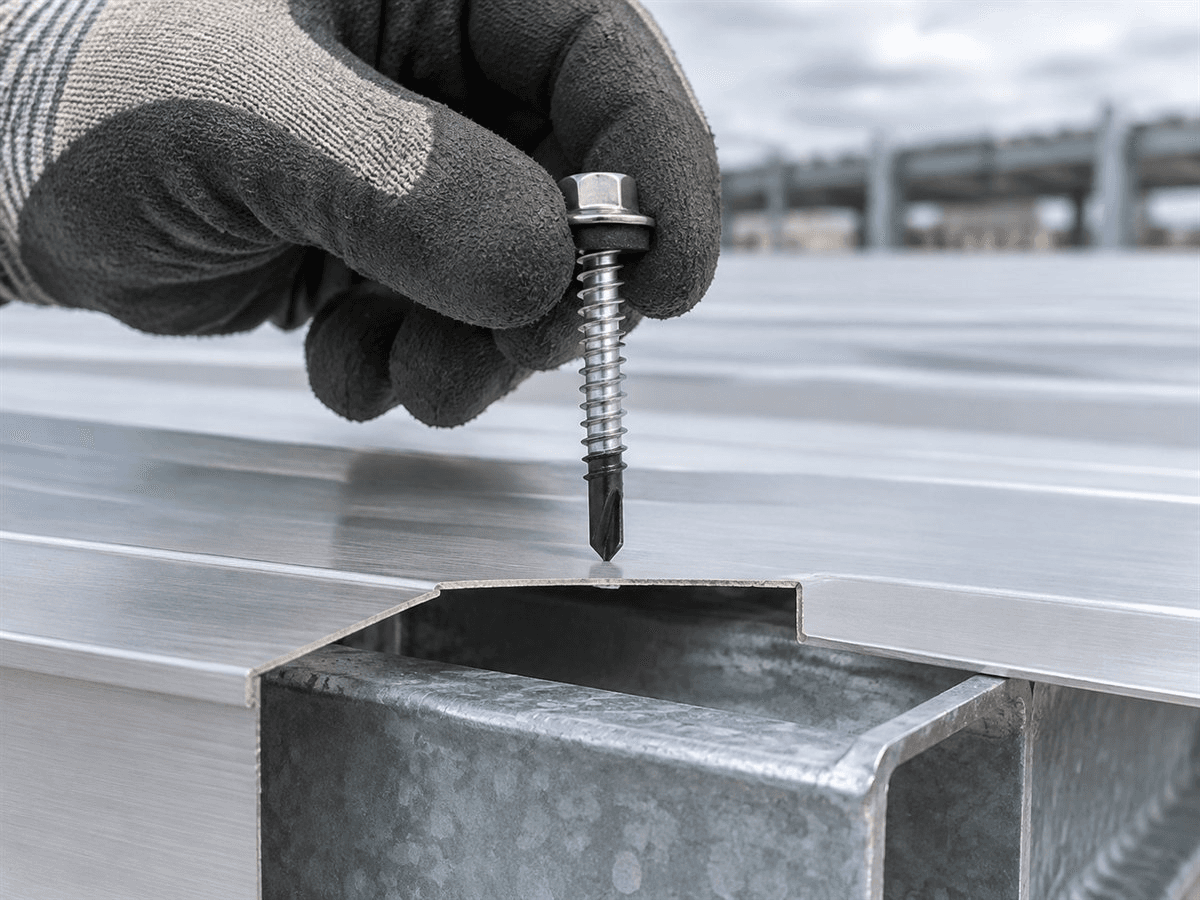
Sekrup bi-logam adalah satu pengikat yang terbuat dari dua logam dengan fungsi berbeda. Dalam atap, konstruksi umumnya adalah kepala dan badan baja tahan karat dengan titik bor baja karbon keras dan ulir pemimpin. Bagian baja tahan karat menahan korosi pada atap yang terbuka; titik yang dikeraskan mengebor purlin baja, girt, atau rangka. Atap aluminium sering membutuhkan kombinasi ini ketika panel aluminium dipasang langsung ke substruktur baja, karena panelnya lembut dan tahan korosi, tetapi sekrupnya tetap harus mengebor baja dan bertahan dari cuaca. Bi-logam bukan jaminan: kelas baja tahan karat, kapasitas titik, lapisan, ring, dan detail aluminium-ke-baja masih harus ditentukan.
Want to know more?
Get in touch with us for more information about our services and products.