

Размеры саморезов: практическое руководство по кровельным саморезам

Han Congming
АвторМы обладаем опытом производства и продаж винтов и крепежных изделий, располагаем собственным производственным предприятием со стабильными крупносерийными мощностями. Мы специализируемся на самосверлящих винтах, винтах для гипсокартона, винтах для ДСП, машинных винтах, болтах и индивидуальных крепежных изделиях для строительства и промышленности.
A roofing screw callout such as 12-14 × 2-1/2 in looks complete. It names a diameter, a thread count and a length. It is still not a purchase specification.
It does not say which head is on the screw, how large the bearing surface is, whether the washer is bonded or loose, what drill point is on the tip, how much of the length is threaded, or where the length is measured from. On a roof, those missing dimensions decide whether the screw seals, clamps and engages — or whether it spins, crushes the panel and leaves a leak path behind the head.
This guide breaks a self-tapping or self-drilling roofing screw into its dimensional parts. It then shows how to turn a catalog range into a specification that can be quoted, sampled, inspected and repeated.

Short answer: the dimensions that actually define the screw
| Dimension | What it controls | What belongs on the drawing or RFQ |
|---|---|---|
| Nominal diameter | Screw size, hole size, thread engagement, head scale | #12, ST5.5, or the exact product standard |
| Thread pitch / TPI | How fast the screw advances, thread form, material compatibility | 14 TPI, 1.81 mm pitch, or ST5.5-1.81 |
| Length and length datum | Whether the screw reaches the support and leaves enough thread | Nominal length plus “under washer to tip” or “top of head to tip” |
| Thread length | Usable engagement in the support | Thread length or grip range, not only overall length |
| Head | Bearing area, drive, clearance, countersink fit | Head style, AF, head diameter, head height, angle |
| Washer | Sealing, load distribution, compression | OD, ID, metal backing, EPDM thickness, bonded or loose |
| Drill point | Drilling capacity and point length | Point number, point length, rated steel thickness |
| Tolerance and inspection | Whether two lots are the same product | Standard, tolerance class, gauges and records |
A callout is a name. The dimensional set is the specification.
What “12-14 × 2-1/2” actually means
Take the common roofing callout apart:
- 12 is the nominal diameter, not a 12 mm diameter. In the inch series, a #12 screw has a nominal major diameter of about 0.216 in (5.49 mm).
- 14 is the number of threads per inch. It is not a length and it is not a point number. At 14 TPI, the pitch is about 1.81 mm.
- 2-1/2 is the nominal length in inches.
The callout still leaves out the head, drive, washer, point, thread length, material, coating and tolerances. Two suppliers can both ship a “12-14 × 2-1/2” screw that will not interchange in the same assembly.
That is why the first question is not “Do you have this size?” It is “Which product is this size, and how is each dimension defined?”
Diameter: inch sizes and metric ST sizes are not interchangeable by arithmetic
The inch series and the metric ST series overlap closely enough to be confusing.
| Inch callout | Nominal major diameter | Approx. metric equivalent | Common TPI | Approx. pitch |
|---|---|---|---|---|
| #8 | 0.164 in | 4.2 mm | 18 | 1.41 mm |
| #10 | 0.190 in | 4.8 mm | 16 | 1.59 mm |
| #12 | 0.216 in | 5.5 mm | 14 | 1.81 mm |
| #14 | 0.242 in | 6.2 mm | 14 | 1.81 mm |
The metric tapping-screw series uses ST sizes:
| Metric size | Nominal diameter | Coarse pitch | Closest inch reference |
|---|---|---|---|
| ST4.2 | 4.2 mm | 1.41 mm | #8-18 |
| ST4.8 | 4.8 mm | 1.59 mm | #10-16 |
| ST5.5 | 5.5 mm | 1.81 mm | #12-14 |
| ST6.3 | 6.3 mm | 1.81 mm | #14-14 |
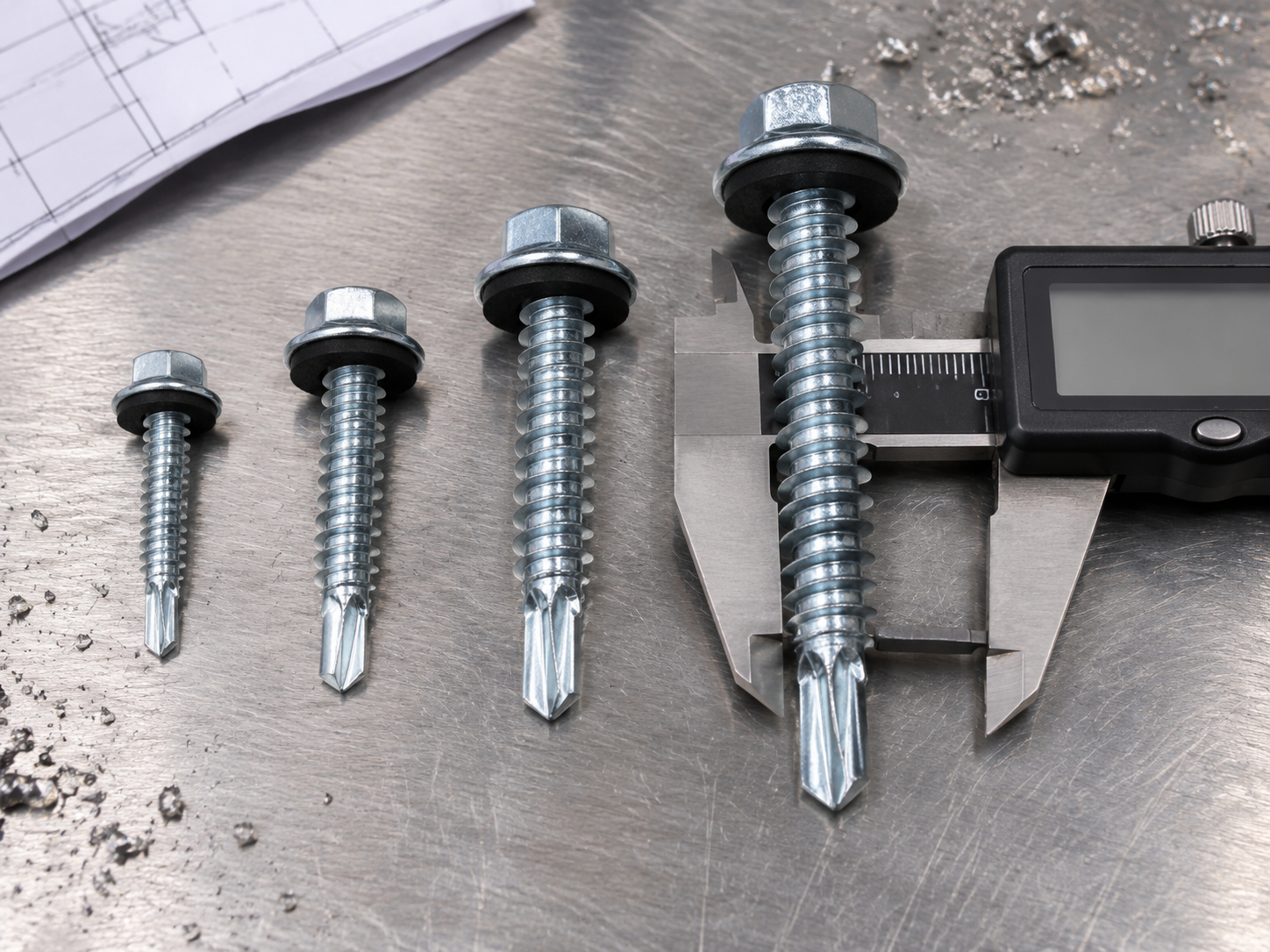
These comparisons are useful for recognizing a size. They are not a substitution rule.
A #12 screw and an ST5.5 screw can share a nominal diameter and still differ in major diameter, minor diameter, thread form, point, head, washer and tolerance. The same is true between two #12 screws from different suppliers. If a drawing calls for #12-14, an ST5.5 screw is not automatically equivalent — and the reverse is also true.
The number on the box is the nominal size. The drawing has to define the actual product.
Thread pitch: the second number is a distance, not a count of “starts”
TPI means threads per inch. It describes how many thread crests fit in one inch of thread length.
| TPI | Pitch |
|---|---|
| 10 | 2.54 mm |
| 12 | 2.12 mm |
| 14 | 1.81 mm |
| 16 | 1.59 mm |
| 18 | 1.41 mm |
A 12-14 screw has 14 threads per inch, so the pitch is about 1.81 mm. A 10-16 screw has a finer pitch, about 1.59 mm. An 8-18 screw is finer still, about 1.41 mm.
Pitch is not a quality ranking. It is a design choice.
In general, thinner fastened material tends to use a coarser thread, and thicker support material tends to use a finer thread. The reason is practical: a coarse thread can develop clamping force in thin sheet without the thread stripping through, while a finer thread can tap into thicker material with lower installation torque. But this is a general principle, not a universal rule. The screw design, point, material, hardness and installation tool all take part.
The important distinction is between self-tapping and self-drilling:
- A self-tapping screw forms or cuts its own mating thread. It may start in a prepared hole.
- A self-drilling screw is a self-tapping screw with a drill point. It creates the hole and the thread in one operation.
The thread and the point are separate decisions. A fine thread does not make a screw self-drilling, and a drill point does not tell you what thread form is behind it.
Length: the same number can mean two different things
Length is where most dimensional arguments start, because different head styles use different measurement datums.
For hex, pan and wafer head screws, the length is measured from the bottom of the washer or the underside of the head to the point of the screw.
For countersunk and bugle head screws, the length is measured from the top of the head to the point of the screw.
| Head type | Length measured from | Includes the point? | What changes the usable length |
|---|---|---|---|
| Hex washer head | Bottom of washer / under head | Yes | Washer thickness and compression |
| Pan head | Under head | Yes | Washer thickness if a loose washer is added |
| Wafer / truss / straw hat | Under head | Yes | Head bearing area and panel profile |
| Countersunk (CSK) | Top of head | Yes | Countersink depth |
| Bugle head | Top of head | Yes | Countersink depth and board compression |
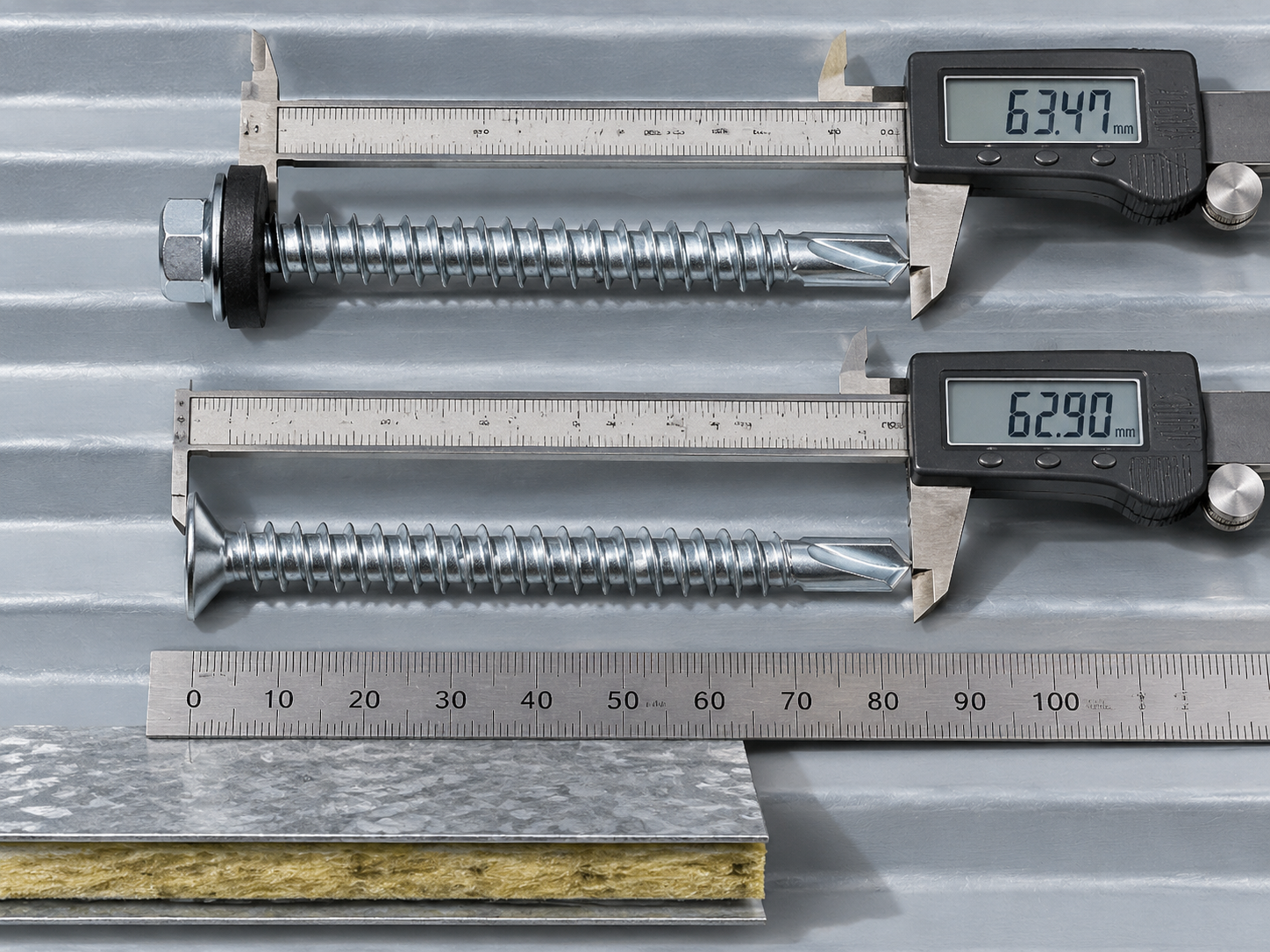
This matters because a 65 mm screw measured one way is not the same as a 65 mm screw measured the other way. The difference can be the thickness of the washer, the height of the head, or the depth of the countersink — often 1–3 mm. That is enough to change whether the screw engages the purlin or bottoms out.
There is a second length inside the screw: the thread length. A self-drilling screw has an unthreaded drill point at the tip. The first thread starts behind that point. If the screw is part-threaded, there may also be an unthreaded shank below the head.
So “length” can mean:
- overall length from the datum to the tip;
- thread length from the first thread to the last thread;
- unthreaded point length;
- unthreaded shank length;
- usable grip range.
A supplier who quotes only the overall length has not quoted the dimension that controls clamping.
A 65 mm example
Imagine a roof build-up:
- 0.5 mm steel panel
- 50 mm insulation, compressed to 45 mm under the washer
- 1.5 mm steel purlin
- a drill point with a 3 mm unthreaded length
The compressed stack is about 47 mm. If the screw is 65 mm long, the first thread sits about 62 mm below the bearing surface. That leaves roughly 15 mm of thread beyond the back of the purlin — more than the three-thread planning minimum.
Now change the point to an 8 mm long drill point. The first thread starts at about 57 mm. Only about 10 mm remains beyond the purlin. Depending on pitch, that may be less than three full threads. The overall length did not change, but the usable engagement did.
That is why the point length and thread length belong in the same conversation as the nominal length.
Effective grip and MT: the number that should be quoted
The most useful dimensional value for a roofing screw is not the overall length. It is the grip range — the range of stack thickness the screw can clamp while still leaving enough thread engaged.
One manufacturer’s technical guide uses the term MT, or maximum total thickness:
MT is the thread length reduced by the first three threads that must protrude past the back side of the base material.
That is a practical definition. It treats the last three threads as the minimum engagement reserve, not as usable clamping thickness.
A planning expression for the minimum nominal length is:
L_min ≈ compressed stack thickness + unthreaded point length + 3 × thread pitch + installation allowance
This is a starting expression, not a universal formula. Each term has to come from the actual assembly:
- Compressed stack thickness: panel, membrane, insulation, batten, purlin — measured after clamping, not loose.
- Unthreaded point length: the drill point consumes length before the first thread can engage.
- Three thread pitches: a common planning minimum, not a substitute for the project’s structural requirement.
- Installation allowance: washer compression, purlin tolerances, panel rib height and normal driving variation.
Too short is obvious: the point does not clear the support, the threads do not develop engagement, or the washer does not compress. Too long is less obvious but equally expensive: the point can protrude through the purlin, the screw can bottom out, the panel can distort around the head, or the threads can sit past the support so the joint never clamps.
A longer screw is not a safer screw. The right screw is the one that lands the thread in the support and leaves the correct reserve.
Head dimensions: AF, head diameter, head height and angle
The head is not just a drive interface. It is the bearing surface that transfers the clamping load into the panel and washer.
For a hex washer head, the key dimensions are:
- Width across flats (AF): the socket or nutsetter size.
- Head / washer bearing diameter: how much area bears on the panel or sealing washer.
- Washer thickness: how much the head stands off the surface and how much compression is available.
A published ASME B18.6.3 table for hex and hex washer heads gives these nominal values for common sizes:
| Size | Width across flats | Head / washer OD | Washer thickness |
|---|---|---|---|
| #8 | 0.250 in | 0.348–0.322 in | 0.031–0.019 in |
| #10 | 0.312 in | 0.414–0.384 in | 0.031–0.019 in |
| #12 | 0.312 in | 0.432–0.398 in | 0.039–0.022 in |
| #14 | 0.375 in | 0.520–0.480 in | 0.050–0.030 in |
Those are the dimensions of the metal hex washer head. A roofing screw often carries a separate or bonded EPDM sealing washer with a larger outside diameter. The head bearing diameter and the sealing washer OD are two different dimensions; do not use one as a substitute for the other.
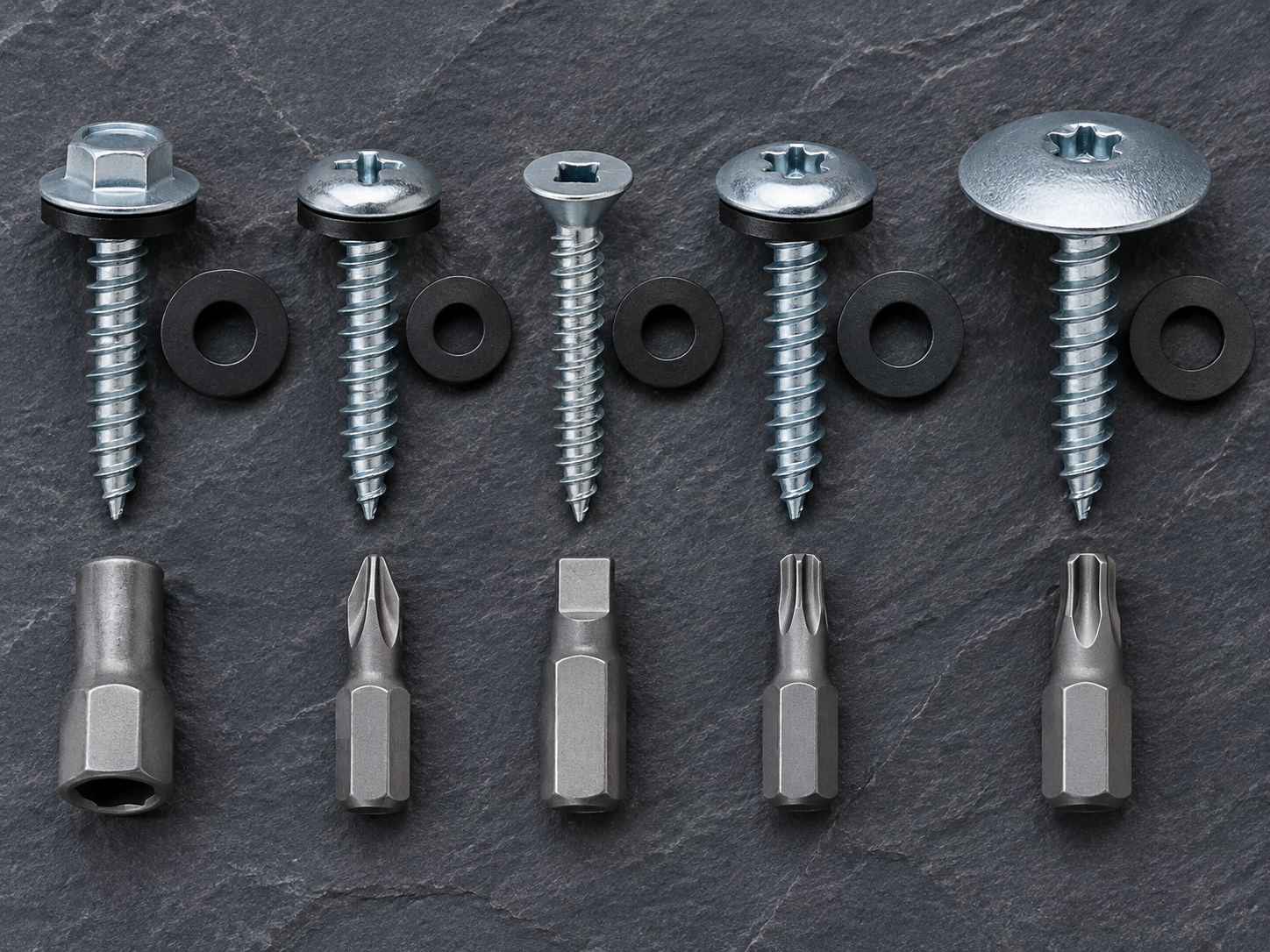
For a pan head screw, the relevant dimensions are head diameter (dk) and head height (k). A published DIN 7981 table gives, for example:
| Size | Head diameter dk, max | Head height k, max | Pitch |
|---|---|---|---|
| ST4.2 | 8.2 mm | 2.5 mm | 1.41 mm |
| ST4.8 | 9.5 mm | 2.9 mm | 1.59 mm |
| ST5.5 | 10.9 mm | 3.3 mm | 1.81 mm |
| ST6.3 | 12.5 mm | 3.8 mm | 1.81 mm |
For a countersunk screw, the head angle is a dimension in its own right. Inch-series flat heads commonly use an 82° angle; metric countersunk heads commonly use 90°. A 90° screw in an 82° countersink — or the reverse — will not seat flush. It may feel tight, but the contact is a line rather than a face, and the joint can loosen or damage the panel.
For truss, wafer and straw hat heads, the design intent is a large bearing area with a low profile. The head diameter helps distribute load on thin sheet or soft panels; the head height affects clearance and how the washer compresses against the rib.
The head has to match the panel profile, not just the screw size. A head that is too small can pull through thin sheet. A head that is too large can bridge a narrow rib, fail to seat, or crush the panel at the high point.
Washer dimensions: EPDM is a sealing component, not an accessory
On an exposed-fastener roof, the washer is part of the fastener. It creates the sealing interface around the hole and distributes the clamping load.
The dimensions that matter are:
- Outside diameter (OD): the sealing footprint on the panel.
- Inside diameter (ID): the clearance around the screw shank.
- Metal backing OD and thickness: the load path from the head into the EPDM.
- EPDM thickness and free height: how much compression is available.
- Durometer / hardness: how the rubber conforms to the panel.
- Bonding method: chemically bonded, mechanically retained, or loose.
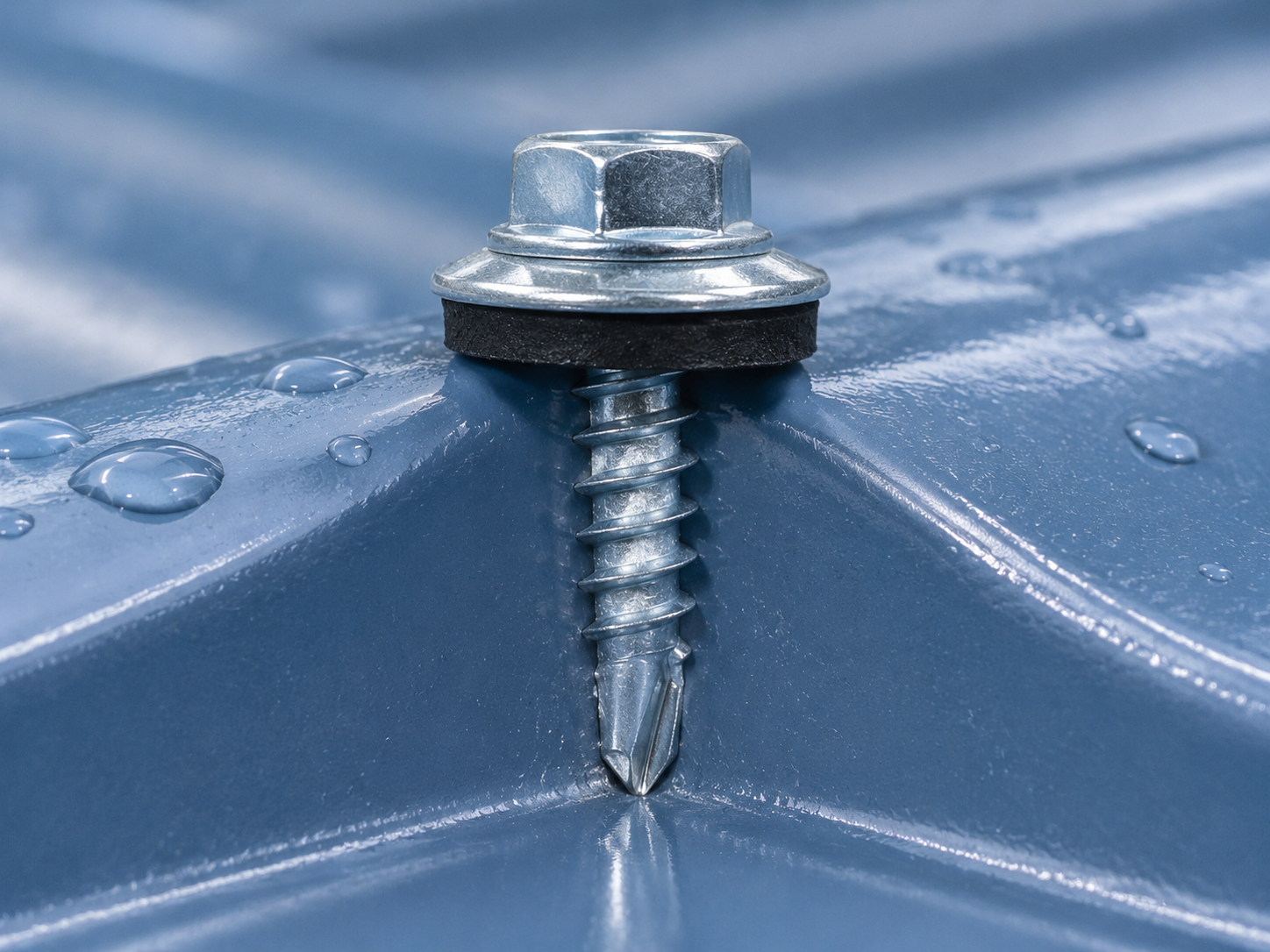
A larger OD is not automatically better. If the washer is wider than the flat area around the rib, it can bridge the profile, lift on one side, or trap water. If it is too small, it may not cover the hole and the surrounding coating damage.
The ID has the same kind of trade-off. Too tight, and the washer can bind or spin with the screw. Too loose, and it can sit off-center, leaving an uneven seal.
Compression is controlled by the tool and the seating condition. Over-compressed EPDM can extrude or split. Under-compressed EPDM can leave a capillary path. The right compression is the one that seals the specific panel profile without deforming it — and that is a trial-assembly question, not a catalog lookup.
This is why the washer dimensions belong on the drawing next to the screw dimensions. “With EPDM washer” is not a specification. The OD, ID, thickness, backing and bonding method are.
Drill point: the point number is a family, not a dimension
A self-drilling screw’s point has to drill through every layer before the thread engages. The drill point number is a useful shorthand, but it is not a complete dimensional specification.
Published technical guides give typical point lengths:
| Point | Typical drill-point length | Typical role |
|---|---|---|
| #1 | 0.016–0.031 in (0.4–0.8 mm) | Very thin sheet, stitching, light assemblies |
| #2 | 0.050–0.070 in (1.3–1.8 mm) | Light-gauge sheet, standard roofing details |
| #3 | 0.115–0.130 in (2.9–3.3 mm) | Standard framing, purlins, medium steel |
| #4 | 0.190–0.200 in (4.8–5.1 mm) | Heavier steel, thicker assemblies |
| #5 | 0.250–0.315 in (6.4–8.0 mm) | Structural steel up to about 1/2 in |
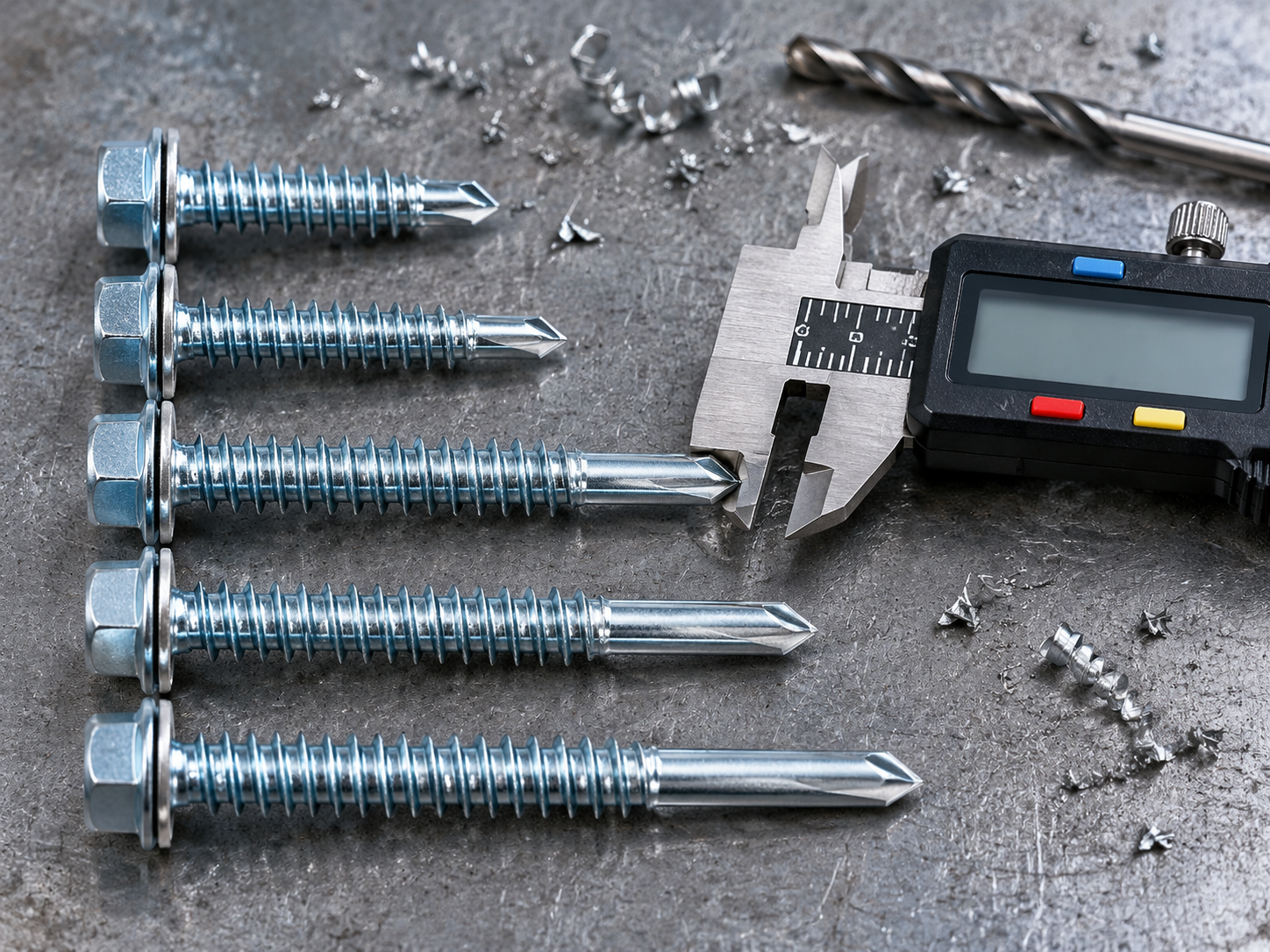
These are point lengths, not drilling-capacity guarantees. The capacity of a point depends on its geometry, flute length, material, heat treatment, coating, tool speed and installation pressure. Two screws with the same point number can behave differently.
The practical selection rule is to match the point to the total thickness of every layer it must drill, not just the top panel. A roof panel may be 0.5 mm thick, but the purlin below may be 2 mm or 5 mm. The point has to clear the complete stack.
The flute length matters as well. The flutes carry chips out of the hole. If the flutes become completely buried in the material, chips pack, cutting stops and the point can overheat or break. A point that is too short for the stack will stall before the thread reaches the support. A point that is unnecessarily long for thin sheet can leave a larger hole or reduce the thread engagement behind it.
There is also a standards boundary: SAE J78 covers carbon steel self-drilling tapping screws with point styles 2, 3, 4 and 5. Point style 1 is outside that scope. If a drawing calls for a #1 point, do not assume SAE J78 covers the product without confirming the applicable specification.
Tolerances and standards: the difference between “same size” and “same product”
A nominal size is not a tolerance. Two screws can both be “12-14 × 2-1/2” and differ in actual diameter, thread pitch, length, head height, point length, washer thickness and coating.
The main dimensional references are:
- ISO 1478:1999 — tapping screw thread and thread ends, sizes ST1.5 to ST9.5.
- ISO 7049 / DIN 7981 — cross-recessed pan head tapping screws.
- ISO 7050 / DIN 7982 — cross-recessed countersunk (flat) head tapping screws.
- ISO 7051 / DIN 7983 — cross-recessed raised countersunk (oval) head tapping screws.
- ASME B18.6.1 — inch-series tapping screws.
- ASME B18.6.3 — hex and hex washer heads for self-tapping and self-drilling screws.
- SAE J78 — carbon steel self-drilling tapping screws, point styles 2–5.
- DIN 7504 — a common European reference for self-drilling screws.
These standards define the product. They do not define the roof.
A standard can tell you that a pan head has a certain dk and k. It cannot tell you whether that head will seat on a particular rib, whether the washer will seal at the fastener location, or whether the purlin is thick enough for the point. Those are assembly questions.
A practical incoming inspection for a roofing screw covers:
| Check | Method | Record |
|---|---|---|
| Major diameter | Caliper or micrometer | Measured value vs drawing |
| Thread pitch / TPI | Thread pitch gauge | Pitch and direction |
| Thread form | Go / no-go ring or plug gauge | Pass / fail |
| Overall length | Caliper from the agreed datum | L and datum used |
| Thread length | Caliper or thread gauge | Lt |
| Head diameter and height | Caliper | dk, k |
| Hex AF | Caliper or socket gauge | AF |
| Countersink angle | Angle gauge or comparator | 82° / 90° |
| Drill point | Comparator and visual | Point number, point length |
| Washer | Caliper and pull test | OD, ID, thickness, bond |
| Coating | Thickness gauge, adhesion and salt-spray per project spec | µm / hours |
| Material | Certificate and hardness test | Grade / hardness |
The drawing should state which of these are critical, what the tolerance is, and what record is required. “Commercial tolerance” is not a substitute for a drawing requirement when the screw controls a roof seal.
Roofing connections: where the dimensions start
The same screw size can be right in one connection and wrong in another. Start with the connection, then choose the dimensions.
| Connection | Typical diameter starting point | Length logic | Dimensions to lock |
|---|---|---|---|
| Panel lap / side lap | #10 or #12 | Short screw; point clears both sheets without excessive protrusion | Diameter, TPI, length, point, head, washer |
| Panel to steel purlin | #12 or #14 | Panel + purlin + point length + at least 3 pitches | Diameter, TPI, length, thread length, point, washer |
| Panel + insulation to purlin | #12 or #14 | Add compressed insulation thickness to the stack | Diameter, TPI, length, thread length, point, washer, insulation compression |
| Sandwich panel | #12 / #14 or a dedicated sandwich screw | Full panel thickness + purlin + point + engagement | Diameter, length, thread length, point, washer, core compression |
| Stitching | #10 or #12 | Short screw through two thin sheets | Diameter, length, point, head |
| Metal to wood | #10, #12 or #14 | Embedment per the wood design; Type 17 point and coarse thread are common | Diameter, length, point, thread, coating |
These are starting points, not approvals. The panel manufacturer’s fastening chart, the structural design, the wind-uplift requirement and the project specification take priority. A standing-seam roof is a concealed-fastener system and should not be detailed with the same exposed-fastener logic as a corrugated panel.
The most common connection mistake is measuring only the panel. The screw may pass through the panel and still fail to develop thread engagement in the purlin. The second most common is copying the old fastener without checking whether the new panel, insulation or purlin changed the stack.
From catalog range to locked specification
ScrewTrade’s public product pages for self-tapping and self-drilling screws list a diameter range of 4.0 mm to 12.0 mm and a length range of 16 mm to 150 mm, with dimensions customizable under OEM/ODM support.
That is a manufacturing envelope. It is not a statement that every diameter is available in every head style, thread, material, length and washer combination. The catalog range tells you what can be quoted; the drawing tells you what is being bought.
The product families map to different dimensional decisions:
| Product family | Dimensional role | What to lock |
|---|---|---|
| DIN 7981 Pan Head Self Tapping Screw | Metric pan head for sheet-metal assembly | Diameter, pitch, length, dk/k, drive |
| Self Tapping Screw Hex Flange Head | Integrated flange bearing surface | Diameter, TPI, length, AF, flange OD |
| Straw Hat Head Self Tapping Screw | Large low-profile bearing for thin or soft panels | Diameter, length, head OD, rib clearance |
| 410 Stainless Steel CSK Head STS | Flush countersunk finish | Diameter, length, head angle, dk, material |
| 410 Stainless Steel Hex Head EPDM Bonded Washer SDS | Roofing screw with sealing washer | Diameter, TPI, length, washer OD/ID, point |
| EPDM Sealing Washer for Self-Drilling Screws | Separate sealing component | OD, ID, thickness, metal backing, bonding |
| Sandwich Panel Screws | Long screw for insulated panels | Full panel thickness, thread length, point, washer |
| Side Lap Screws | Short screw for panel-to-panel laps | Diameter, length, point, head |
| Stitching Screws for Metal for Roofing | Short stitching screw for thin metal | Diameter, length, point, head |
| Hex Washer Head Self Drilling Screw | General roofing and framing | Diameter, TPI, length, AF, washer |
| Bi-Metal Self-Drilling Screws | Drilling into steel with corrosion resistance | Diameter, point, length, material |
| Stainless Steel Philips Truss Head Self Drilling Screw Coarse Thread | Large bearing with coarse thread | Diameter, length, head OD, thread |
A locked specification can be written as a single line, but each field has to be present. For example:
12-14 × 2-1/2 in, hex washer head, 5/16 in AF, EPDM bonded washer, #3 drill point, full thread, carbon steel with project-approved coating, length measured from the underside of the washer to the tip, minimum three full threads beyond the purlin, dimensional report with the lot.
That line is not perfect for every project, but it is a specification. It tells the supplier what to make, how to measure it and what evidence to provide.
A simple RFQ block
Use a table like this for each item:
| Field | Entry |
|---|---|
| Application / connection | Panel to steel purlin, exposed fastener |
| Panel | Profile, material, thickness, rib height |
| Insulation / membrane | Type, nominal thickness, compressed thickness |
| Purlin / substrate | Steel or wood, grade, thickness |
| Screw type | Self-drilling or self-tapping |
| Nominal diameter | #12 / ST5.5 / drawing |
| Thread | 14 TPI / 1.81 mm pitch / thread form |
| Length and datum | 2-1/2 in under washer to tip |
| Thread length | Full thread or stated thread length |
| Point | #3, with rated steel thickness |
| Head | Hex washer, 5/16 in AF, head OD |
| Washer | EPDM bonded, OD, ID, thickness, backing |
| Material / coating | Carbon steel / 410 / 304 / 316; coating and color |
| Tolerance / inspection | Standard, critical dimensions, records |
| Packaging | Bulk carton, OEM label, mixed container |
If the supplier cannot fill in the “length datum,” “thread length,” “point” and “washer” rows, the quotation is not yet comparable.
Common dimensional mistakes
- Writing only “12 × 2” without TPI, point, head and washer. The callout is incomplete before the quotation starts.
- Treating #12 and ST5.5 as interchangeable. They are close in nominal diameter, not identical in product.
- Measuring length from the wrong datum. A hex washer screw and a countersunk screw do not use the same reference.
- Ignoring the unthreaded drill point. A long point consumes length that the thread cannot use.
- Quoting overall length instead of grip range. The overall length does not tell you how much stack the screw can clamp.
- Mixing 82° and 90° countersinks. The screw may not seat flush even if the diameter matches.
- Using the head diameter as the washer diameter. The sealing washer is a separate dimension.
- Assuming a bigger washer is better. It can bridge the rib, lift, or trap water.
- Assuming a higher point number is better. A point that is too aggressive for thin sheet can leave a poor hole.
- Leaving tolerances and inspection out of the drawing. “Same as sample” is not a dimensional specification.
Frequently asked questions
What does 12-14 × 2-1/2 mean on a roofing screw?
It means a #12 nominal diameter, 14 threads per inch, and a 2-1/2 inch nominal length. It does not define the head, washer, point, thread length, material or length datum.
How is a roofing screw length measured?
For hex, pan and wafer head screws, it is normally measured from the bottom of the washer or the underside of the head to the point. For countersunk and bugle head screws, it is measured from the top of the head to the point. Confirm the supplier’s datum before approving a drawing.
Is a #12 screw the same as an ST5.5 screw?
They are close in nominal diameter, but not automatically interchangeable. Check the actual major diameter, pitch, thread form, point, head, washer and tolerance.
What is the difference between 14 TPI and 1.81 mm pitch?
They describe the same approximate thread spacing. 14 TPI means 14 threads per inch; 1.81 mm is the corresponding pitch.
Do self-tapping screws need a pilot hole?
It depends on the screw design. Thread-forming and thread-cutting screws commonly start in a prepared hole in thin sheet. Self-drilling screws are intended to create their own hole with the drill point. The product data and installation instructions decide the starting condition.
How many threads should engage in the purlin?
A common planning minimum is three full threads beyond the back of the support, but the project requirement can be higher. The manufacturer’s technical guide and the structural design take priority.
Can I use a longer screw if the insulation is thicker?
Only after checking the full stack. A longer screw can bottom out, protrude through the purlin, reduce thread engagement or distort the panel. Add the compressed insulation thickness, point length and required engagement, then confirm with a trial.
What is the difference between point #2 and point #3?
Point #2 is generally for light-gauge sheet and thinner assemblies. Point #3 has a longer drill point and is generally for standard framing and purlins. The point number alone is not a capacity rating; confirm the rated steel thickness.
Why do 82° and 90° countersinks matter?
They are different head angles. A mismatched screw and countersink will not seat on a full contact face, which can cause loosening, panel damage or a poor finish.
Can ScrewTrade make a custom dimension?
The public catalog lists a 4.0–12.0 mm diameter range and a 16–150 mm length range, with customizable dimensions under OEM/ODM support. The exact combination still has to be confirmed model by model, including head, thread, point, washer, material, coating and tolerance.
The dimensional checklist to send with an RFQ
If you want a quotation that can be compared, samplable and repeated, send:
- a section drawing of the connection;
- the material and thickness of every layer;
- the compressed insulation or membrane thickness;
- the purlin or substrate material, grade and thickness;
- the current screw reference, drawing or sample;
- the required length datum and thread length;
- the head style, AF and bearing diameter;
- the washer OD, ID, thickness and bonding method;
- the drill point number and rated steel thickness;
- the material, coating and color;
- the tolerance and inspection requirements;
- the packaging and labeling requirements.
The useful next step is not to choose a catalog page. It is to lock the dimensional set against the actual roof assembly, then prove it with a trial.
For a specific roofing or metal-to-metal connection, send the drawing or cross-section, the layer thicknesses, the current fastener and the installation method through the ScrewTrade contact page. The team can confirm the product family and the dimensions that need to be fixed before quoting.
Related News
Other news you might be interested in

Карта спроса на крепеж в 2027 году: центры обработки данных, энергетика и промышленные проекты
Прогноз по крепежу на 2027 год — это не широкое восстановление. Это карта проектных ниш — и самые сильные ниши — это центры обработки данных, энергетика и отдельные промышленные работы. Направление уже видно в результатах компаний за конец 2026 года. Hilti сообщила о росте продаж в местной валюте на 5,9% за первые восемь месяцев 2026 года, с двузначным ростом в Америке и Азиатско-Тихоокеанском регионе, при этом описав традиционное строительство как слабое. Продажи LISI в аэрокосмической отрасли выросли на 14,3% за первые девять месяцев, но продажи в автомобильной отрасли упали на 5,2%. Продажи Bossard в третьем квартале выросли на 12%, чему способствовал спрос на центры обработки данных в Америке и расширение полупроводниковой и электронной промышленности в Азии.
Что такое биметаллический саморез и зачем он нужен для алюминиевой кровли?
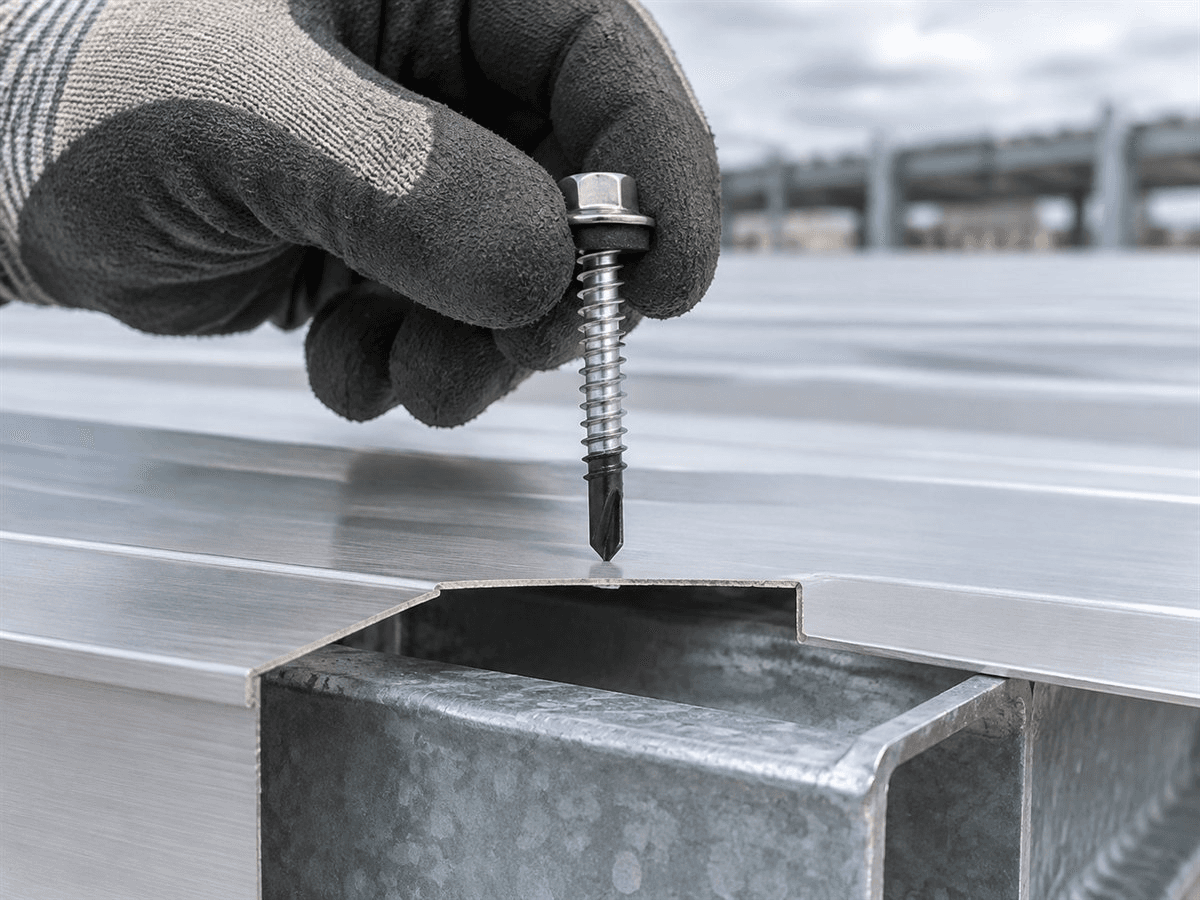
Биметаллический саморез — это крепежное изделие, изготовленное из двух металлов, выполняющих разные функции. В кровельных работах распространенная конструкция включает головку и корпус из нержавеющей стали, а также закаленную углеродистую сталь для сверла и ведущей резьбы. Нержавеющая часть обеспечивает устойчивость к коррозии на открытой кровле; закаленное сверло просверливает стальной прогон, ригель или каркас. Алюминиевая кровля часто требует такой комбинации, когда алюминиевая панель крепится непосредственно к стальной подконструкции, поскольку панель мягкая и коррозионностойкая, но саморез должен просверлить сталь и выдержать погодные условия. Биметаллический саморез не является гарантией: марка нержавеющей стали, способность сверла, покрытие, шайба и детали соединения алюминия со сталью все равно должны быть определены.
Want to know more?
Get in touch with us for more information about our services and products.