
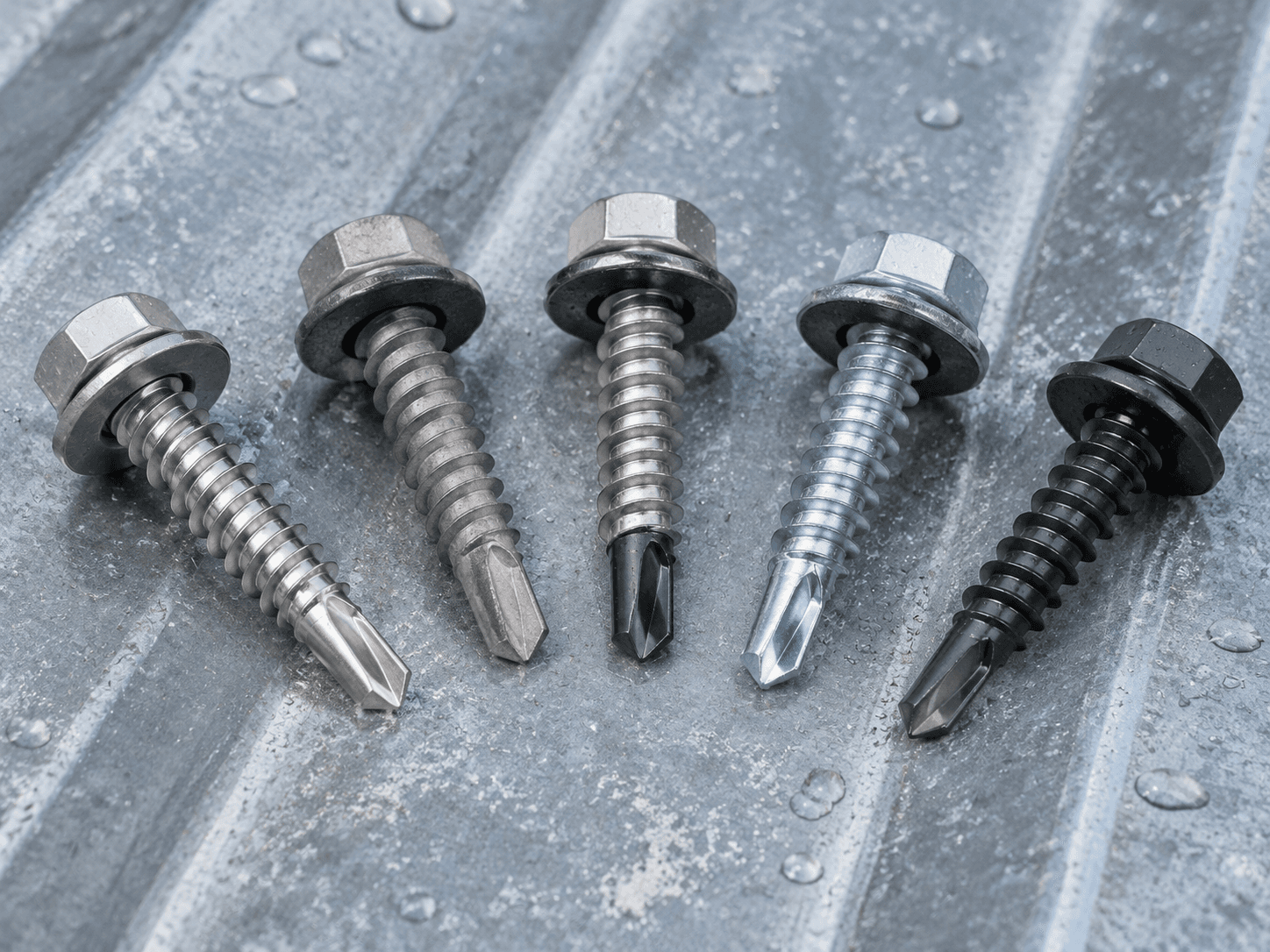
Какой саморез по металлу обеспечивает лучшую защиту от коррозии?

Han Congming
АвторМы обладаем опытом производства и продаж винтов и крепежных изделий, располагаем собственным производственным предприятием со стабильными крупносерийными мощностями. Мы специализируемся на самосверлящих винтах, винтах для гипсокартона, винтах для ДСП, машинных винтах, болтах и индивидуальных крепежных изделиях для строительства и промышленности.
For general outdoor exposure, 304 stainless steel usually provides better corrosion resistance than uncoated 410 stainless steel. Where airborne salt or chlorides make the environment more aggressive, 316 stainless steel generally offers a greater margin than 304. If the screw also needs to drill into steel, a bi-metal design with the appropriate stainless body and a hardened drill point is often a practical way to combine corrosion resistance with drilling performance.
Coated carbon steel offers another route. A specified outdoor coating can provide useful protection, while ordinary thin zinc plating is generally better suited to dry, protected applications. The coating process, coverage, installation damage and test evidence determine how much protection the finished screw provides.
The choice therefore starts with the exposure and the connection. A screw for an indoor enclosure faces a different corrosion risk from one on a coastal roof, even when both have the same diameter and head shape.
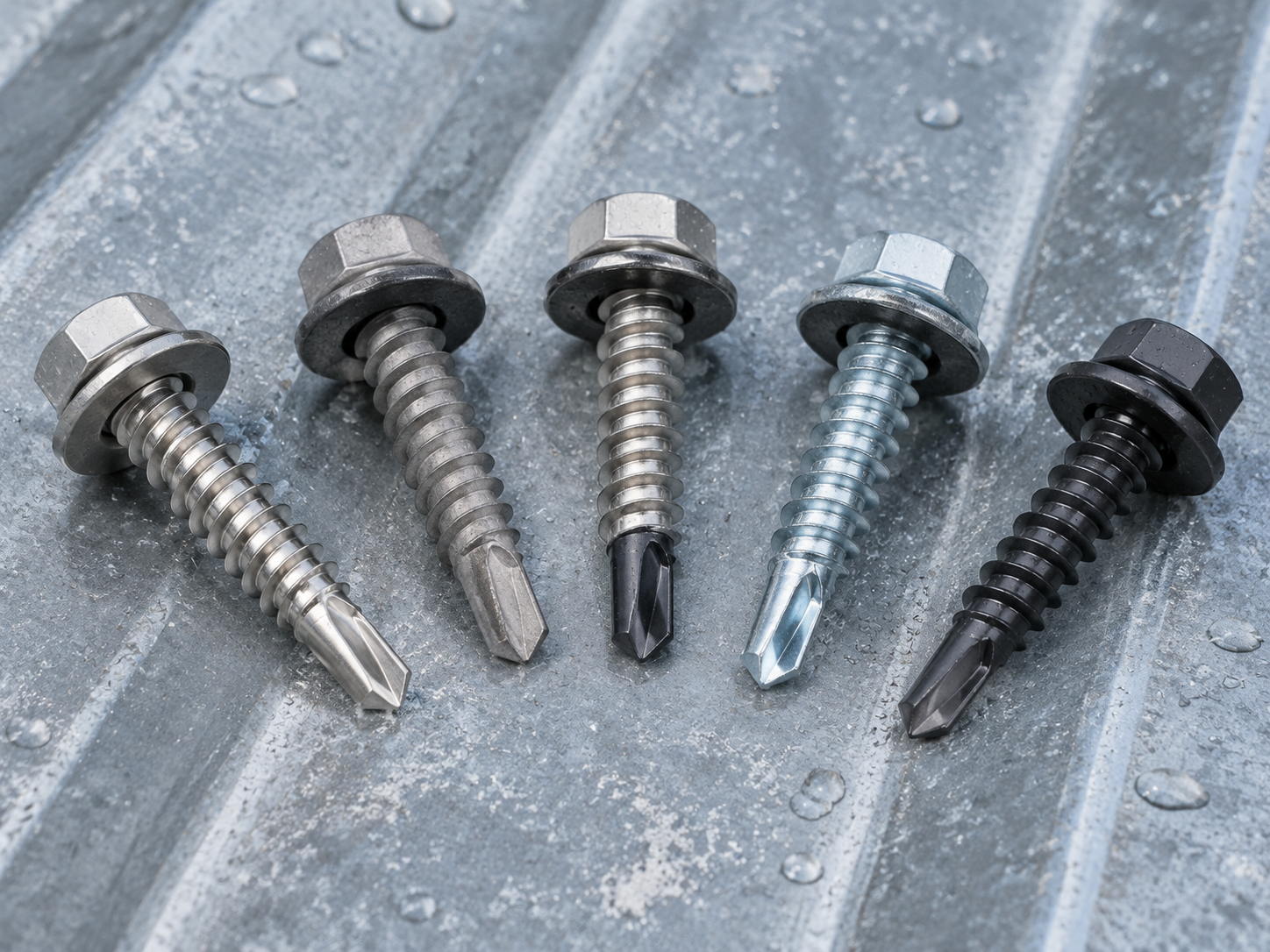
How the main self-drilling screw options compare
Stainless grades describe the metal. Ruspert and Dacromet describe proprietary coating systems. Bi-metal describes a construction using two materials. Comparing them requires looking at the complete screw rather than placing their names on one universal performance scale.
| Screw option | How it resists corrosion | Where to consider it | Main limitation |
|---|---|---|---|
| Zinc-plated carbon steel | Zinc provides sacrificial protection | Dry indoor and protected assemblies | A light coating has limited reserve for persistent wetting or salt |
| Carbon steel with a specified outdoor coating | A defined coating system protects the underlying steel | Roofing, cladding and outdoor assemblies within the product specification | Performance depends on the exact coating and its condition after installation |
| Uncoated 410 stainless steel | The stainless alloy provides corrosion resistance | Connections needing a hardenable point in mild exposure | Generally less corrosion resistant than 304 or 316 |
| 304 stainless steel | A chromium-rich passive surface film protects the metal | Many inland outdoor and humid applications | Chlorides and crevices can exceed its resistance |
| 316 stainless steel | Molybdenum improves resistance to localized chloride attack | Coastal atmospheric exposure and other specified chloride conditions | Severe exposure may require a higher alloy or different joint design |
| Bi-metal with a 304 or 316 body | Stainless protects the head and body; a harder material forms the drilling end | Steel connections needing both a stainless body and verified drilling capability | Body grade, point protection and installed thread position must be confirmed |
These are selection starting points. They do not establish a corrosion life, drilling capacity or project approval for a particular product.
Is 304 or 410 stainless steel better for corrosion protection?
For corrosion resistance in many atmospheric environments, 304 is generally the stronger choice. Grade 410 is useful because it can be heat treated to develop the hardness needed in fasteners and drill points. Its corrosion resistance is lower than that of 304, so the word “stainless” alone does not make the two interchangeable.
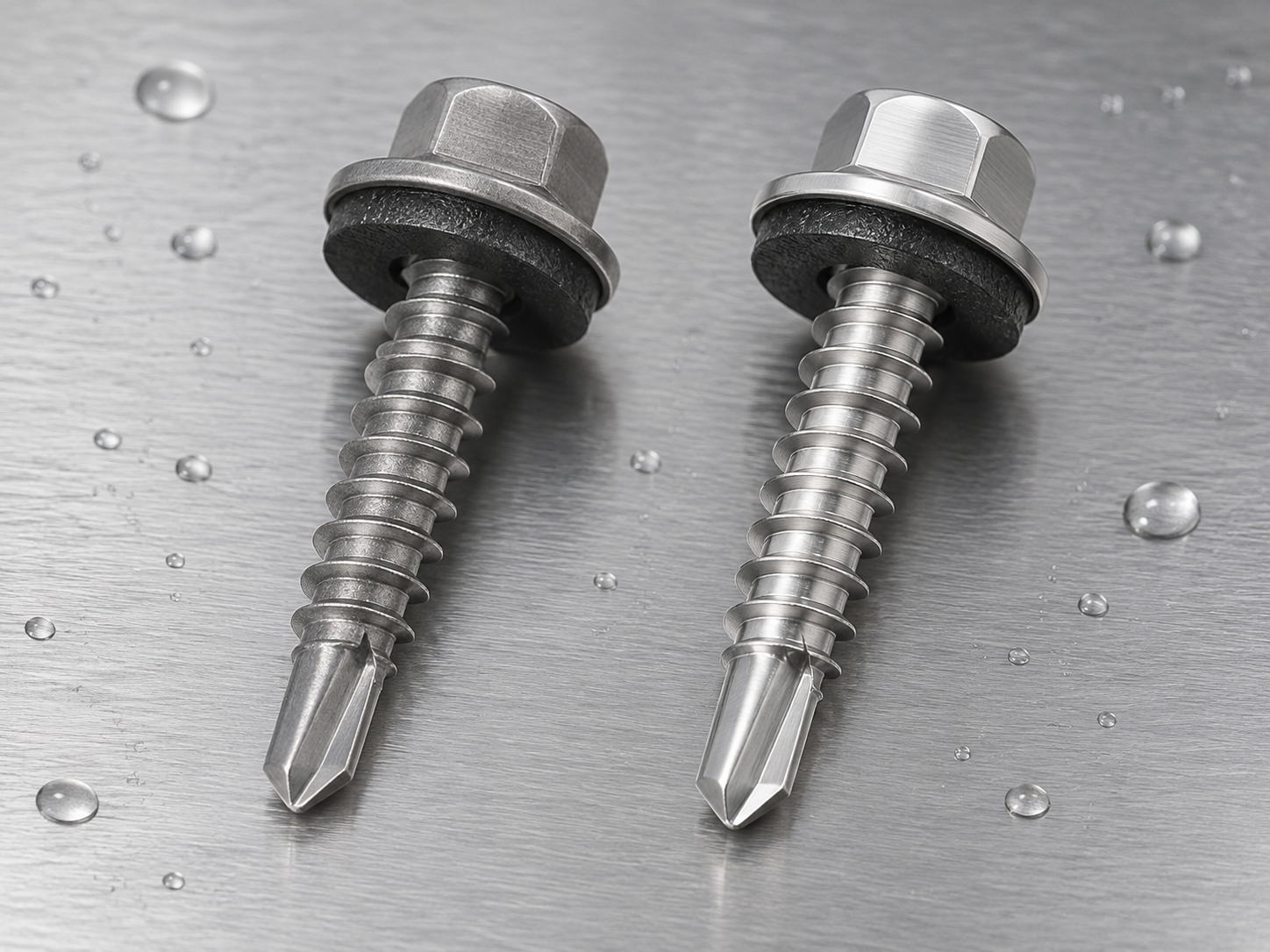
Carpenter Technology's guidance on stainless fastener alloys explains this trade-off: 304 offers good corrosion resistance but cannot be hardened by heat treatment, while 410 develops strength and hardness through heat treatment with a lower corrosion margin.
This distinction matters when purchasing self-drilling screws. A 410 screw may drill a suitable steel substrate effectively, yet still be the weaker corrosion choice for an exposed, wet connection. A coating can add protection, but that coating must be included in the specification.
ScrewTrade lists both SS 304 self-drilling screws and 410 stainless steel hex head self-drilling screws. Compare the exact point construction, finish and exposure limits when choosing between them. The grade name does not establish how thick or hard a steel section the finished screw can drill.
When does 316 provide better protection than 304?
Grade 316 contains molybdenum, which generally improves resistance to pitting and crevice corrosion in chloride-bearing environments. That makes it a stronger starting point than 304 when salt deposition is a significant concern.
The difference becomes relevant on coastal roofs, exposed wall cladding and equipment subject to salt-laden air. The Australian Stainless Steel Development Association identifies grade selection, surface condition, drainage, salt accumulation and cleaning as factors in coastal corrosion. Lower-alloy grades such as 304 can develop staining or more serious corrosion where marine conditions exceed their resistance.
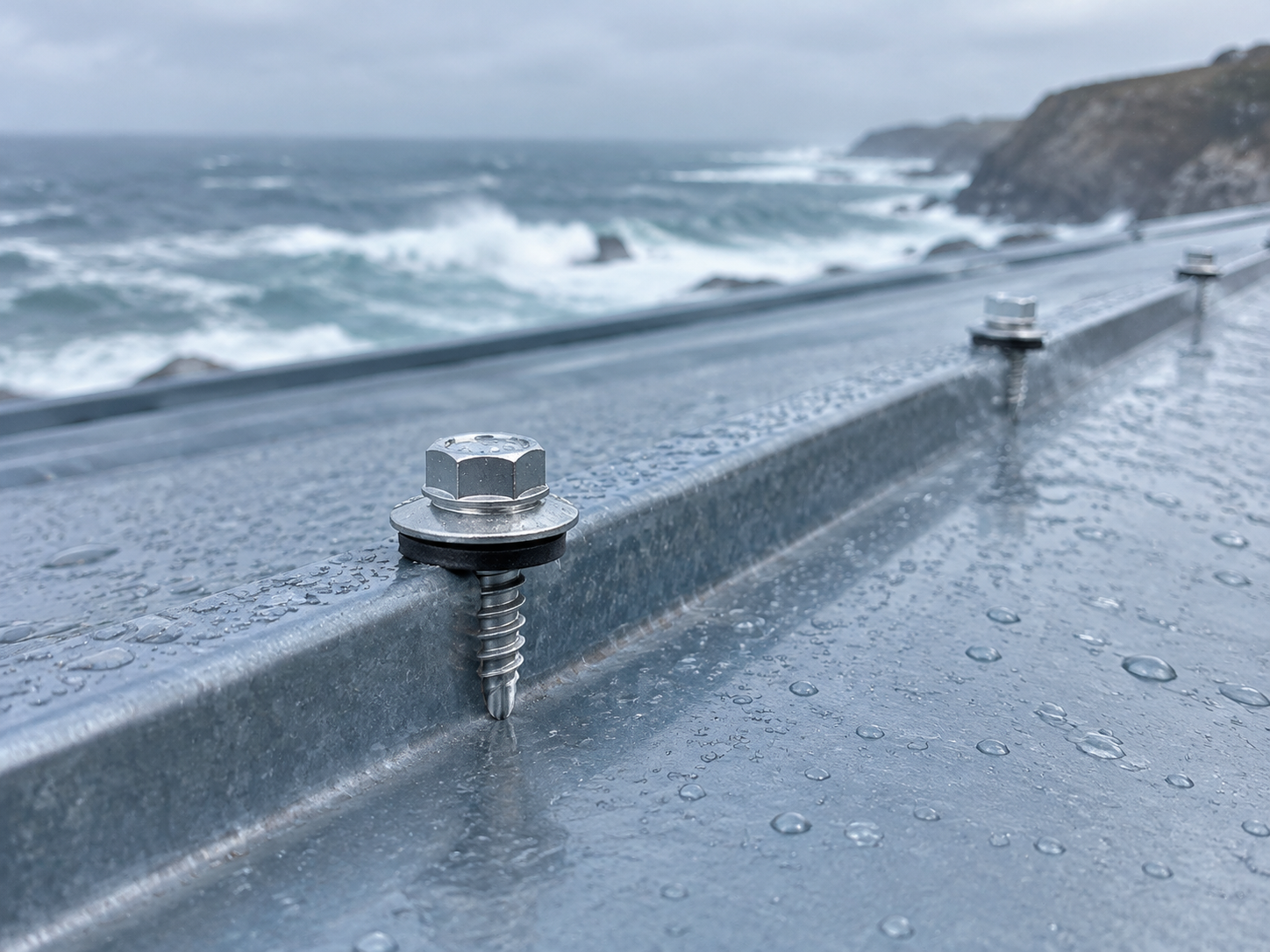
However, coastal atmosphere and direct seawater contact are different exposures. The British Stainless Steel Association cautions that 304 should not be considered suitable for seawater service, while even 316 has limitations and can suffer pitting or crevice attack. A seawater splash zone, trapped saline water or severe chemical exposure needs a more detailed assessment than a simple upgrade to 316.
For self-drilling screws, also confirm how the drilling end is made. A 316 body does not prove that the point can penetrate the required steel. Depending on the application, a suitable bi-metal construction may be needed.
The availability of a particular 316 self-drilling model must be confirmed separately; it should not be inferred from a 304 product listing.
Do bi-metal self-drilling screws offer better corrosion protection?
A bi-metal screw can offer a better balance of corrosion protection and steel-drilling performance, but its corrosion resistance depends on the stainless grade and the rest of its construction.
A common design combines a stainless steel head and body with a hardened carbon steel drill point and lead threads. In many designs, the two sections are joined by welding. EJOT's manufacturing explanation shows how its bi-metal design uses local hardening at the drilling end while retaining the corrosion-resistant stainless upper section.
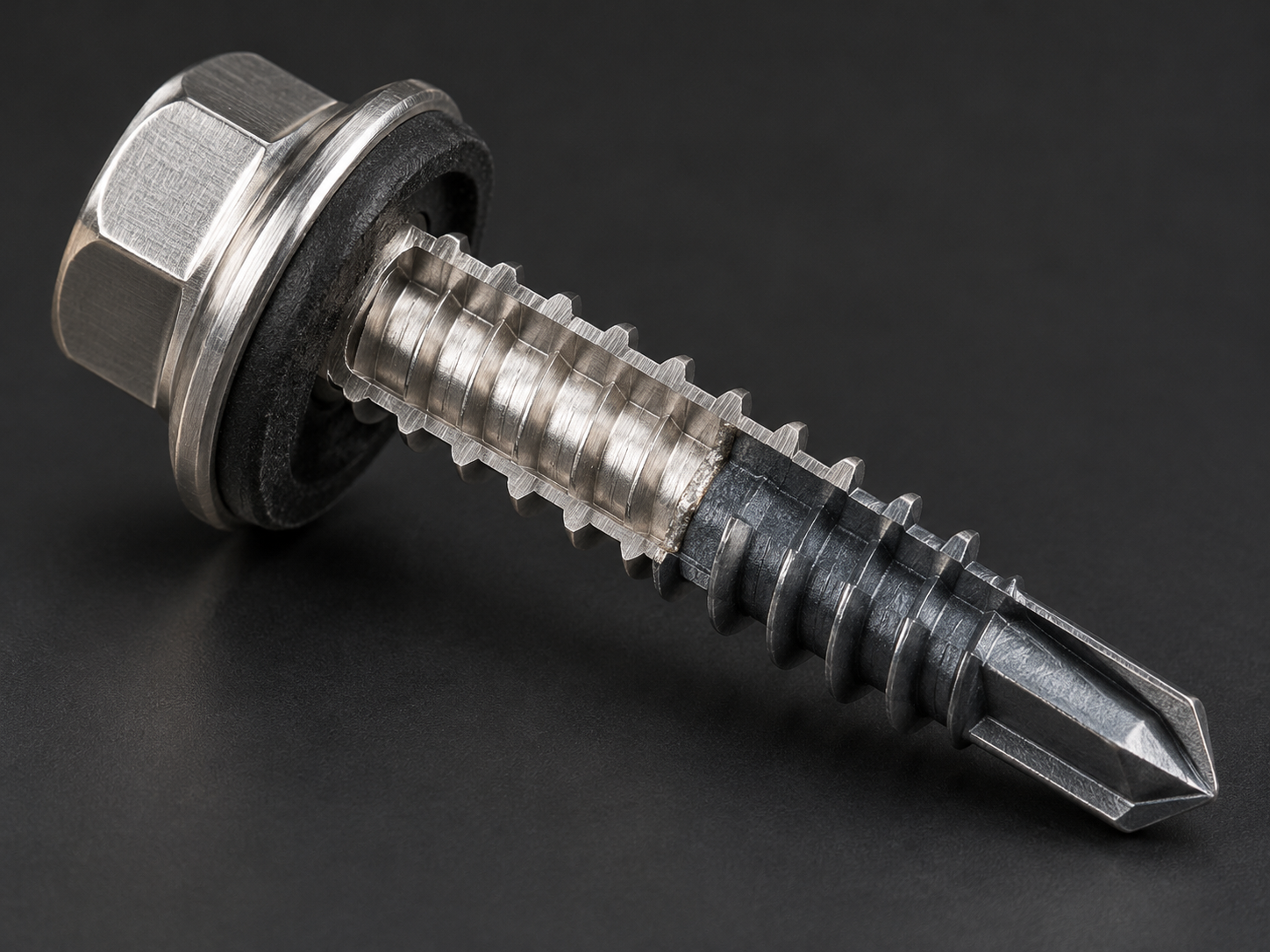
Compared with an uncoated 410 screw, a bi-metal screw with a suitable 304 or 316 body can provide a higher corrosion margin at the exposed head and body. Compared with a single-material 304 screw, its main benefit may be drilling capability rather than a higher stainless grade.
Before choosing a bi-metal self-drilling screw, confirm:
- The stainless grade used for the head and body.
- The drill-point material and its protective finish.
- How the material transition is controlled and protected.
- Which threads engage the supporting steel after installation.
- The permitted substrate, steel thickness and installation conditions.
The installed position matters. Do not assume that the hardened tip or lead threads provide the same corrosion resistance as the stainless body, or that those threads are permitted to form the load-bearing engagement. Follow the exact product's installation requirements.
Bi-metal is consequently a useful construction choice for demanding exterior metal-to-steel connections. It still requires an exposure assessment and product-specific evidence.
Which coating offers better protection on carbon steel screws?
For carbon steel, protection depends heavily on the coating. Zinc protects sacrificially: it can corrode preferentially and protect nearby exposed steel. A small scratch therefore does not always cause immediate red rust. Protection becomes less effective as the available zinc is consumed or the damage exceeds the coating's ability to protect the exposed area.
Ordinary light zinc plating is generally a practical option for dry indoor assemblies. For sustained outdoor wetting, salt or a long maintenance interval, evaluate a coating specifically documented for those conditions.
Ruspert and Dacromet should be compared as distinct systems
Ruspert and Dacromet are often grouped together in quotations, but their coating structures differ. Nihon Ruspert's technical explanation describes Ruspert as a multilayer system made from a metallic zinc layer, a special chemical conversion film and a surface baked layer, combining plating and painting. Dacromet is described in archived NOF product information as passivated zinc and aluminum flakes in a binder.
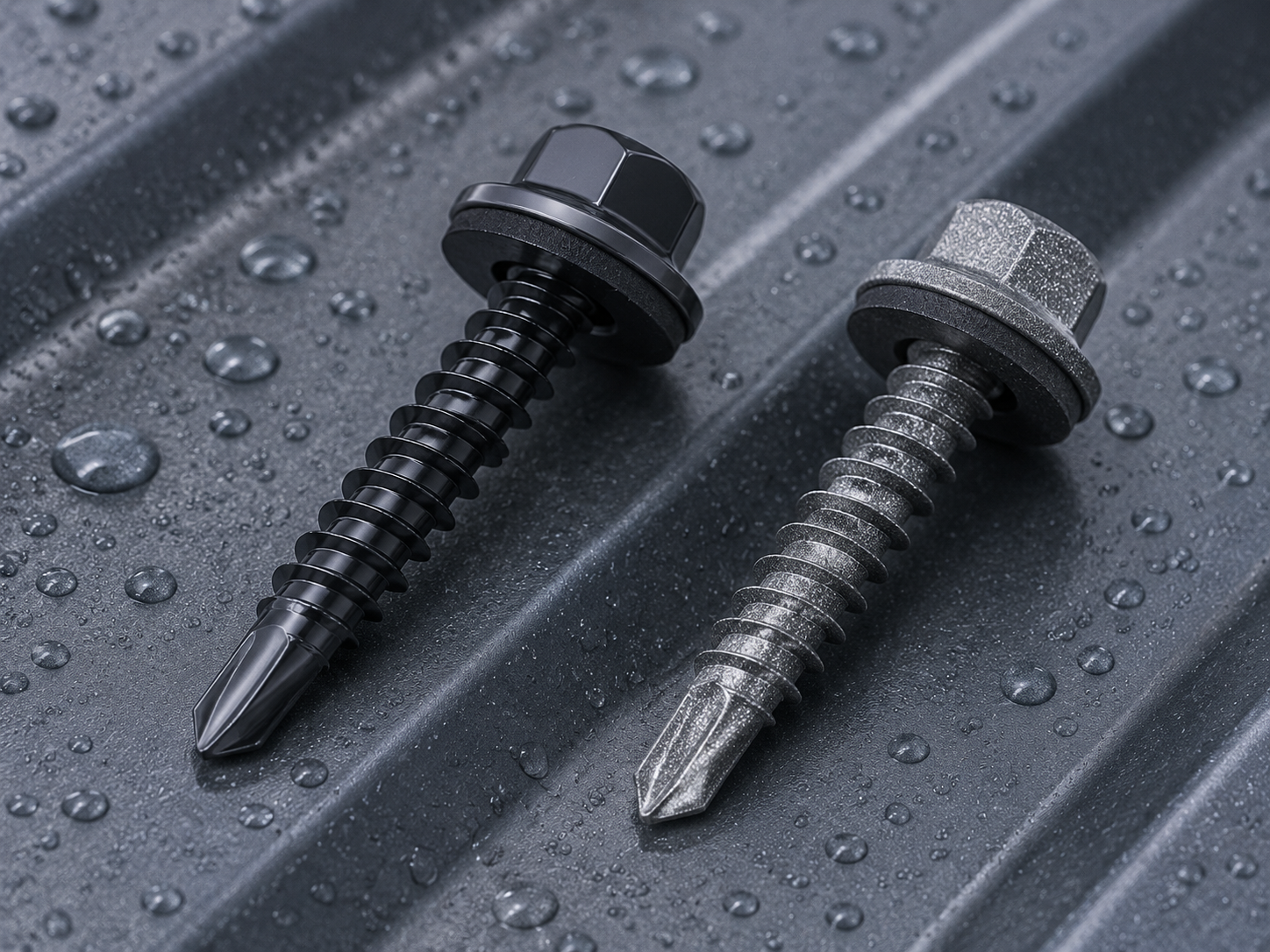
Neither name alone establishes that one quoted screw will outperform another. Ask for the exact coating designation, layer system, coverage, adhesion requirements and corrosion-test criteria. An outdoor coating also needs to retain useful protection after the screw has been driven through the actual assembly.
“Galvanized” and “Class 4” need a defined specification
Hot-dip galvanizing and electroplating apply zinc through different processes. Their coating structure, thickness and coverage depend on the exact specification, while availability, thread geometry and drilling performance still need to be checked for the finished self-drilling screw.
AS 3566.2 uses Class 4 as a corrosion-resistance classification, and the current AS 3566.2:2025 listing still includes Class 4 requirements in its published table of contents. The earlier AS 3566.2-2002 edition is superseded. Class 4 does not, by itself, identify a hot-dip galvanizing process, and a product label should not be assumed to meet either edition without the applicable test evidence. A corrosion classification should also not be confused with a drill-point number or a guaranteed number of service years.
When reviewing ScrewTrade's Galvanised Class 4 self-drilling screw family, request the applicable standard, coating process and evidence for the exact model. The catalogue name is the starting point for that discussion.
What can reduce corrosion protection after installation?
The screw material or coating may be appropriate while the connection detail creates a more aggressive local environment. Four checks are particularly useful.
Water under the head or washer. A correctly selected and seated sealing washer helps limit water entry. Underdriving can leave a gap; overdriving can damage the seal or distort the panel. The washer's metal backing also needs suitable corrosion protection.
Chlorides trapped in crevices. Salt and moisture can accumulate beneath a head, in a panel lap or around deposits. SSINA explains that these conditions can promote localized corrosion even when other exposed stainless surfaces remain unaffected. Better drainage and an appropriate alloy both contribute to protection.
Contact with other metals. Stainless steel, aluminum, galvanized steel and other metals may form galvanic couples when electrically connected and regularly bridged by moisture. The metal pair, relative surface areas and wetting conditions affect the result. An EPDM sealing washer does not necessarily isolate the threaded connection electrically.
Damage and contamination. Worn tools, angled driving, coating abrasion and steel swarf can compromise the finished connection or produce rust staining. Remove drilling debris using the panel manufacturer's recommended method and inspect the installed heads and washers. A corrosion-resistant screw cannot protect the surrounding roof from debris left on its surface.
These checks help explain why two installations using the same screw can age differently. They also show why a higher stainless grade cannot compensate for every unsuitable joint detail.
How can buyers verify which screw is better?
A useful comparison starts with two products intended for the same application. Record the exposure, supporting metal, thickness of each layer, washer requirement and maintenance expectations before comparing their evidence.
Do not convert salt-spray hours into service years. ASTM B117 defines a controlled salt-fog exposure. Sherwin-Williams' discussion of the standard highlights that standalone salt-spray results seldom correlate directly with natural-environment performance. Laboratory hours do not account for every combination of wetting, drying, pollutants, installation damage and site detail.
When a supplier provides a corrosion-test report, check:
- Product identity: Does it identify the proposed screw, material, coating and washer configuration?
- Test method: Which method and conditions were used, and how were specimens prepared?
- Failure criterion: Was the requirement based on white corrosion products, red rust, another defect or a defined affected area?
- Parts assessed: Were the head, shank, point and washer evaluated, or only a separate coated sample?
- Traceability: How does the qualification report relate to the proposed model and production controls? What batch inspection records are supplied?
A qualification report does not always need to come from the shipment being purchased, but its applicability must be clear. A report for a different coating or unrelated product cannot establish the proposed screw's performance.
Also trial the screw on the actual connection using the recommended tool and settings. This checks drilling, seating and visible damage after installation. It complements corrosion evidence; a successful installation trial alone does not prove long-term corrosion resistance.
Choose the stronger protection for your exposure
For many inland outdoor applications, 304 stainless offers a corrosion advantage over uncoated 410. For coastal salt exposure, 316 generally provides a greater margin, subject to the severity of the site and the connection detail. Where steel drilling and a stainless body are both required, a properly specified bi-metal screw is a practical option. Coated carbon steel remains a valid choice when its defined coating system meets the application requirements.
To compare options with ScrewTrade, send the exposure conditions, connected materials, layer thicknesses, screw size, washer requirement and any specified corrosion standard through the contact page. Request written confirmation of the proposed body material, drilling-end construction, finish and supporting evidence before approving the sample or bulk order.
Related News
Other news you might be interested in

Карта спроса на крепеж в 2027 году: центры обработки данных, энергетика и промышленные проекты
Прогноз по крепежу на 2027 год — это не широкое восстановление. Это карта проектных ниш — и самые сильные ниши — это центры обработки данных, энергетика и отдельные промышленные работы. Направление уже видно в результатах компаний за конец 2026 года. Hilti сообщила о росте продаж в местной валюте на 5,9% за первые восемь месяцев 2026 года, с двузначным ростом в Америке и Азиатско-Тихоокеанском регионе, при этом описав традиционное строительство как слабое. Продажи LISI в аэрокосмической отрасли выросли на 14,3% за первые девять месяцев, но продажи в автомобильной отрасли упали на 5,2%. Продажи Bossard в третьем квартале выросли на 12%, чему способствовал спрос на центры обработки данных в Америке и расширение полупроводниковой и электронной промышленности в Азии.

Что такое биметаллический саморез и зачем он нужен для алюминиевой кровли?
Биметаллический саморез — это крепежное изделие, изготовленное из двух металлов, выполняющих разные функции. В кровельных работах распространенная конструкция включает головку и корпус из нержавеющей стали, а также закаленную углеродистую сталь для сверла и ведущей резьбы. Нержавеющая часть обеспечивает устойчивость к коррозии на открытой кровле; закаленное сверло просверливает стальной прогон, ригель или каркас. Алюминиевая кровля часто требует такой комбинации, когда алюминиевая панель крепится непосредственно к стальной подконструкции, поскольку панель мягкая и коррозионностойкая, но саморез должен просверлить сталь и выдержать погодные условия. Биметаллический саморез не является гарантией: марка нержавеющей стали, способность сверла, покрытие, шайба и детали соединения алюминия со сталью все равно должны быть определены.
Want to know more?
Get in touch with us for more information about our services and products.