
Complete Guide to Metal Roofing Self-Drilling Screws: Metal-to-Metal, Metal-to-Wood, and Sandwich Panel Fasteners

Han Congming
AuthorWith experience in screw and fastener manufacturing and sales, we operate our own production facility with stable large-scale capacity. We are specialists in self-drilling screws, drywall screws, chipboard screws, machine screws, bolts, and customized fasteners for construction and industrial applications.
Why Metal Roofing Fasteners Should Not Be Selected by Screw Size Alone
In pre-engineered steel buildings, warehouses, commercial roofs, and agricultural structures, metal roofing screws are more than ordinary hardware. They directly affect the roof system's waterproofing, wind resistance, corrosion resistance, and service life.
Today, buyers are moving beyond asking whether a screw can penetrate a panel. The more important question is whether it can perform reliably with a specific substrate, panel profile, and installation environment. Light-gauge steel purlins, thick steel structures, timber purlins, and insulated sandwich panels all require different drill points, thread designs, screw lengths, and sealing systems. Incorrect self-drilling screws may cause stripped threads, insufficient engagement, panel deformation, failed EPDM washers, or long-term leakage.
For this reason, projects should first distinguish between metal-to-metal screws, metal-to-wood screws, and sandwich panel screws, then select the appropriate size, material, coating, and sealing configuration.
Metal Roofing Self-Drilling Screw Basics: Construction, Terms, and Working Principle
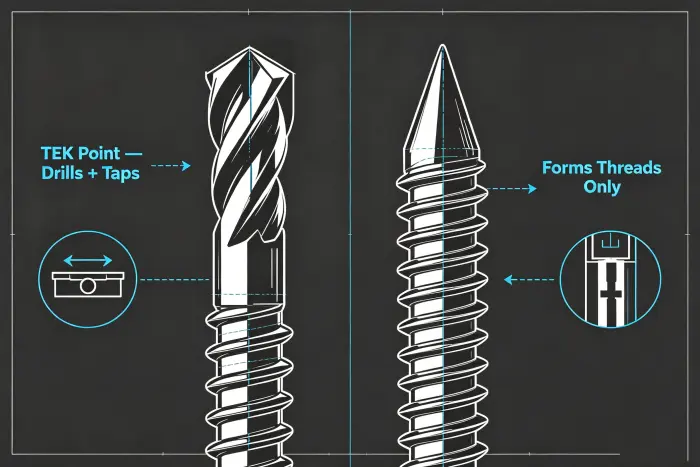
Self-drilling screws, also commonly called TEK screws or drill screws, have a drill-shaped point that allows drilling, tapping, and fastening in one operation. They are widely used for metal sheets, steel purlins, steel framing, and applications where pre-drilling is not preferred.
By comparison, self-tapping screws form or cut threads during installation, although some types require a pre-drilled hole. For thin metal sheets and pre-punched applications, sheet metal screws, thread-forming screws, and thread-cutting screws remain important fastening options.
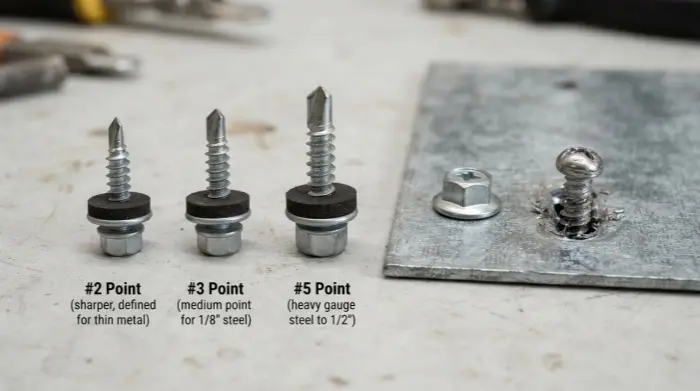
Key components to consider include:
- Drill point: determines the screw's ability to penetrate steel.
- Drill flutes: help remove material during drilling.
- Grip length: determines whether the connected materials can be clamped effectively.
- Hex washer head, flange head, pan head, or countersunk head: affect torque transfer, bearing area, and appearance.
- EPDM bonded washer: provides long-term sealing around roof penetrations.
The steel-thickness capability of Tek 3, Tek 4, and Tek 5 self-drilling screws varies by manufacturer and specification. Final selection should be based on substrate thickness, product data, and on-site testing rather than the TEK designation alone.
Metal-to-Metal Roofing Screws: Fastening Metal Panels to Steel Structures
Metal-to-metal self-drilling screws are designed for fastening metal roofing sheets to steel purlins, light steel framing, steel beams, and metal support members. They are widely used in industrial buildings, warehouses, steel workshops, and metal cladding systems.
The first step is to confirm the thickness of the steel substrate. Thin steel purlins require fast drilling and dependable thread engagement, while thicker steel members require careful evaluation of self-drilling screws for thick steel, structural steel self-drilling screws, and Tek 5 self-drilling screws.
ScrewTrade's hexagon head self-drilling screws are suitable for direct fastening into thin steel sheets, light-gauge steel framing, and metal fittings. When selecting a screw, confirm that:
- The drill point is suitable for the target steel thickness.
- The thread design provides sufficient engagement.
- The screw length covers the roofing panel, washer, and substrate without being unnecessarily long.
- The selected metal-to-metal roofing screws include suitable sealing components where waterproofing is required.
- Pull-out, shear, and wind-load requirements are verified for critical projects.
For light gauge steel screws, preventing panel deformation from over-tightening is especially important. For thicker steel structures, drilling performance and installation efficiency should be verified before bulk installation.
Metal-to-Wood Roofing Screws: Fastening Metal Panels to Timber Purlins
Metal-to-wood screws are used to fasten metal roofing sheets, wall panels, flashing, and trim components to timber purlins, wood framing, and wooden substrates. Their selection logic differs from steel fastening because wood density, moisture content, grain direction, and splitting risk all affect connection performance.
Metal-to-wood roofing screws require a thread design suitable for timber engagement and enough penetration depth into the wooden substrate. In applications where a screw must pass through metal first and then engage wood, winged self-drilling screws can help prevent early thread engagement between the metal sheet and wood.
When selecting these screws, consider the metal panel thickness, actual timber thickness, required thread engagement in wood, and whether EPDM sealing is required. Standard sheet metal screws should not automatically be used for metal-to-wood fastening, as an unsuitable thread or length can result in loose panels under wind loads, thermal movement, and vibration.
Sandwich Panel Screws: Fastening Insulated Roof and Wall Panels
Sandwich panel screws are used to install insulated roof and wall panels. Because sandwich panels commonly include an outer metal facing, insulation core, inner metal facing, and structural substrate, their screw length and sealing requirements are more demanding than those of standard roof panels.
When selecting self-drilling screws for sandwich panels, screw length must account for the total panel thickness, installation clearance, washer thickness, and required thread engagement in the substrate. Selecting a screw based only on the outer panel thickness can result in insufficient substrate engagement. A screw that is too long may affect the interior appearance or create unnecessary thermal-bridge concerns.
For sandwich panel projects, confirm:
- Whether the substrate is steel, timber, or another material;
- Whether the screw length matches total panel thickness;
- Whether long-length sandwich panel screws are required;
- Whether the EPDM washer can seal the penetration effectively;
- Whether installation torque may deform the panel facing or damage the insulation core.
Waterproof Sealing: Matching EPDM Washers with Roofing Screws
For roofing systems, EPDM roofing screws do more than hold panels in place. Their EPDM bonded washer seals the penetration point and helps prevent water from entering the roof system.
A quality EPDM washer should offer resistance to weathering, ozone, temperature changes, and long-term loss of elasticity. Under-tightening can leave a water path around the screw, while over-tightening can deform, split, or prematurely age the washer. The correct installation condition is a uniformly compressed washer that contacts the panel surface without visible gaps or excessive distortion.
For a detailed explanation of the sealing function, see ScrewTrade's article: EPDM Washer in Roofing Screws: Why It Matters More Than You Think.
Corrosion Resistance: Coatings, Stainless Steel, and Bi-Metal Screws
Corrosion risk depends heavily on the installation environment. Standard outdoor sites, coastal regions, humid locations, chemical facilities, and agricultural buildings can require very different fastener materials and surface treatments.
Common options include zinc plating, Ruspert roofing screws, Dacromet coatings, stainless steel, and bi-metal self-drilling screws. A bi-metal construction commonly combines a stainless steel body with a hardened carbon steel drill point, balancing corrosion resistance with direct drilling performance in steel.
For outdoor roofs, wall cladding, ventilation ducts, and light steel structures, buyers can review ScrewTrade's 304 stainless steel hex washer head self-drilling screws. When selecting corrosion-resistant roofing screws, consider environmental exposure, expected roof service life, panel material, and maintenance cost rather than initial purchase price alone.
Special Roof Connections: Side Laps, Overlaps, and Metal Trim
In addition to primary fastening points, metal roofing systems often include side laps, flashing, trim, edge details, and panel overlaps. These areas commonly use side lap screws, metal deck sidelap screws, or stitching screws.
Side lap screws are mainly used to connect adjacent metal sheets laterally. Stitching screws are commonly used for lap joints, flashing, trim, and thinner metal-to-metal connections. Their length, head style, drill point, and spacing may differ, so they should not be treated as interchangeable.
Although these fasteners are often smaller than main roofing screws, they significantly influence panel alignment, wind resistance, and weather-tightness at roof edges and overlaps. For broader installation and performance guidance, see Metal Roofing Fasteners: Selection, Installation, and Performance.
How to Select Metal Roofing Self-Drilling Screws by Project Conditions
When selecting products related to self-drilling screws steel thickness, use the following process:
- Confirm the connection type: metal-to-metal, metal-to-wood, or sandwich panel.
- Confirm substrate material and actual thickness.
- Select the appropriate drill point and TEK screws type.
- Select head style, diameter, and length based on panel profile and load requirements.
- Choose suitable EPDM washer products for waterproofing.
- Select plating, stainless steel, or bi-metal self-drilling screws according to the environment.
- Conduct pull-out, torque, drilling, and sealing tests for high-wind, thick-steel, or critical applications.
The complete ScrewTrade product range can be reviewed before matching products to drawings, specifications, and target applications.
Installation Practices to Improve Waterproofing and Pull-Out Performance
Even correctly selected metal-to-metal screws or metal-to-wood screws can fail if they are installed improperly. Screws should enter the panel at the correct angle, with suitable speed and torque. Avoid continuing to tighten the screw after it has already reached the correct seating position.
After installation, check that:
- Screws are perpendicular to the panel surface;
- EPDM washers are evenly compressed;
- Screws are not stripped, tilted, or installed in oversized holes;
- Roofing sheets are not dented by over-tightening;
- Side lap screws follow the specified installation spacing;
- Color-matched screw heads remain consistent with the roofing panel.
For additional guidance on how roofing fasteners influence building safety, durability, and installation efficiency, read How Modern Roofing Screws Improve Building Safety, Durability and Installation Efficiency.
Common Causes of Metal Roofing Screw Failure
Common problems include drill points that cannot penetrate the steel substrate, stripped threads, insufficient engagement, incomplete washer sealing, and surface corrosion. To solve these issues, first confirm that self-drilling screws for thick steel are suitable for the actual substrate thickness. Then review screw length, drill point type, installation tools, and torque settings.
If local roof leakage occurs, inspect the condition of EPDM roofing screws, washer compression, screw angle, panel deformation, and fastening at overlap areas. If corrosion is found, reassess whether the selected corrosion-resistant roofing screws are suitable for the project's exposure conditions.
Frequently Asked Questions
Can metal-to-metal and metal-to-wood screws be used interchangeably?
No. Metal-to-metal screws and metal-to-wood screws have different drill-point, thread, and length requirements. They should be selected according to the actual substrate.
How do I choose between Tek 3 and Tek 5?
Selection should be based on substrate steel thickness, product technical data, and site testing. Tek 5 self-drilling screws are generally selected where greater drilling capacity is required, but the exact application range should follow the manufacturer's specification.
How should sandwich panel screw length be calculated?
Sandwich panel screws should pass through the complete panel thickness and achieve sufficient engagement in the substrate while allowing for the EPDM washer and installation clearance.
Which roofing screws are suitable for coastal projects?
Consider stainless steel, bi-metal self-drilling screws, or Ruspert roofing screws with an appropriate corrosion-resistance level. The final selection should also account for the roofing panel material and local environmental conditions.
Conclusion: Select Roofing Fasteners by Application Conditions
A reliable metal roofing connection is not achieved by selecting a screw alone. It requires self-drilling screws, drill points, threads, EPDM washers, protective coatings, and substrate conditions to work as one matched fastening system.
Whether a project requires metal-to-metal roofing screws, metal-to-wood roofing screws, sandwich panel screws, stitching screws, or highly corrosion-resistant bi-metal self-drilling screws, selection should be based on real installation conditions.
For product matching based on drawings, steel thickness, roof panel type, coating requirements, and packaging needs, submit project requirements through ScrewTrade Contact.
Related News
Other news you might be interested in

The 2027 Fastener Demand Map: Data Centers, Energy and Industrial Projects
The 2027 fastener outlook is not a broad recovery. It is a map of project pockets—and the strongest pockets are data centers, energy and selected industrial work.The direction is already visible in late-2026 company results. Hilti reported local-currency sales growth of 5.9% in the first eight months of 2026, with double-digit growth in the Americas and Asia Pacific, while describing traditional construction as soft. LISI’s aerospace sales rose 14.3% in the first nine months, but its automotive sales fell 5.2%. Bossard’s third-quarter sales grew 12%, helped by data-center demand in the Americas and semiconductor and electronics expansion in Asia.

What Is a Bi-Metal Screw and Why Does Aluminum Roofing Need One?
a bi-metal screw is one fastener made from two metals with different jobs. In roofing, the common construction is a stainless steel head and body with a hardened carbon steel drill point and lead thread. The stainless section resists corrosion on the exposed roof; the hardened point drills the steel purlin, girt or frame. Aluminum roofing often calls for this combination when an aluminum panel is fixed directly to a steel substructure, because the panel is soft and corrosion-resistant, but the screw still has to drill steel and survive the weather. Bi-metal is not a guarantee: the stainless grade, point capacity, coating, washer and aluminum-to-steel detail still have to be specified.
Want to know more?
Get in touch with us for more information about our services and products.