
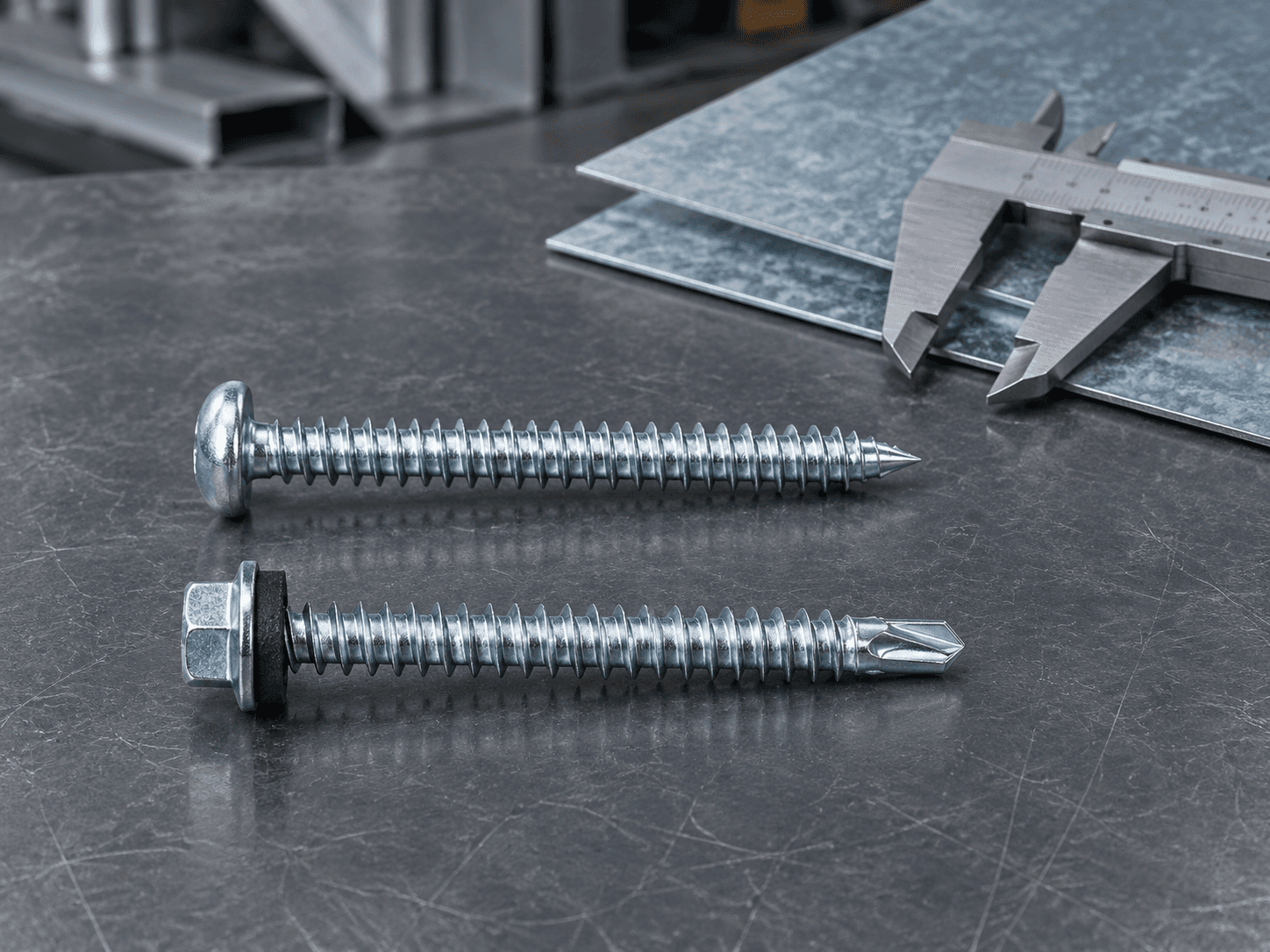
What Are Sheet Metal Screws — and Why Do 40% of Field Failures Trace Back to the Wrong Thread Type?

Han Congming
AuthorWith experience in screw and fastener manufacturing and sales, we operate our own production facility with stable large-scale capacity. We are specialists in self-drilling screws, drywall screws, chipboard screws, machine screws, bolts, and customized fasteners for construction and industrial applications.
A sheet metal screw is usually the cheapest line on a bill of materials and the last item anyone reviews. It arrives in a box, gets driven by a tool, and is judged only when something goes wrong: a screw spins in the hole, a head snaps off, a panel leaks, a callback lands on the installer's desk.
By then the purchase order has usually been closed for months. And in most of those reviews, the screw itself is not defective. It is dimensionally correct, properly heat-treated and coated as ordered. It is simply the wrong thread for the joint — a thread designed to displace material in a substrate that needed one to cut, a pitch chosen for thick steel and used in 0.5 mm panel, a drill point sized for a thickness that was never measured.
This guide is written for the people who have to prevent that: importers, distributors, roofing and façade subcontractors, and procurement teams at metal fabricators. It explains what "sheet metal screw" actually covers, which thread families sit inside that name, and how to turn a field failure into a specification change instead of another argument about quality.
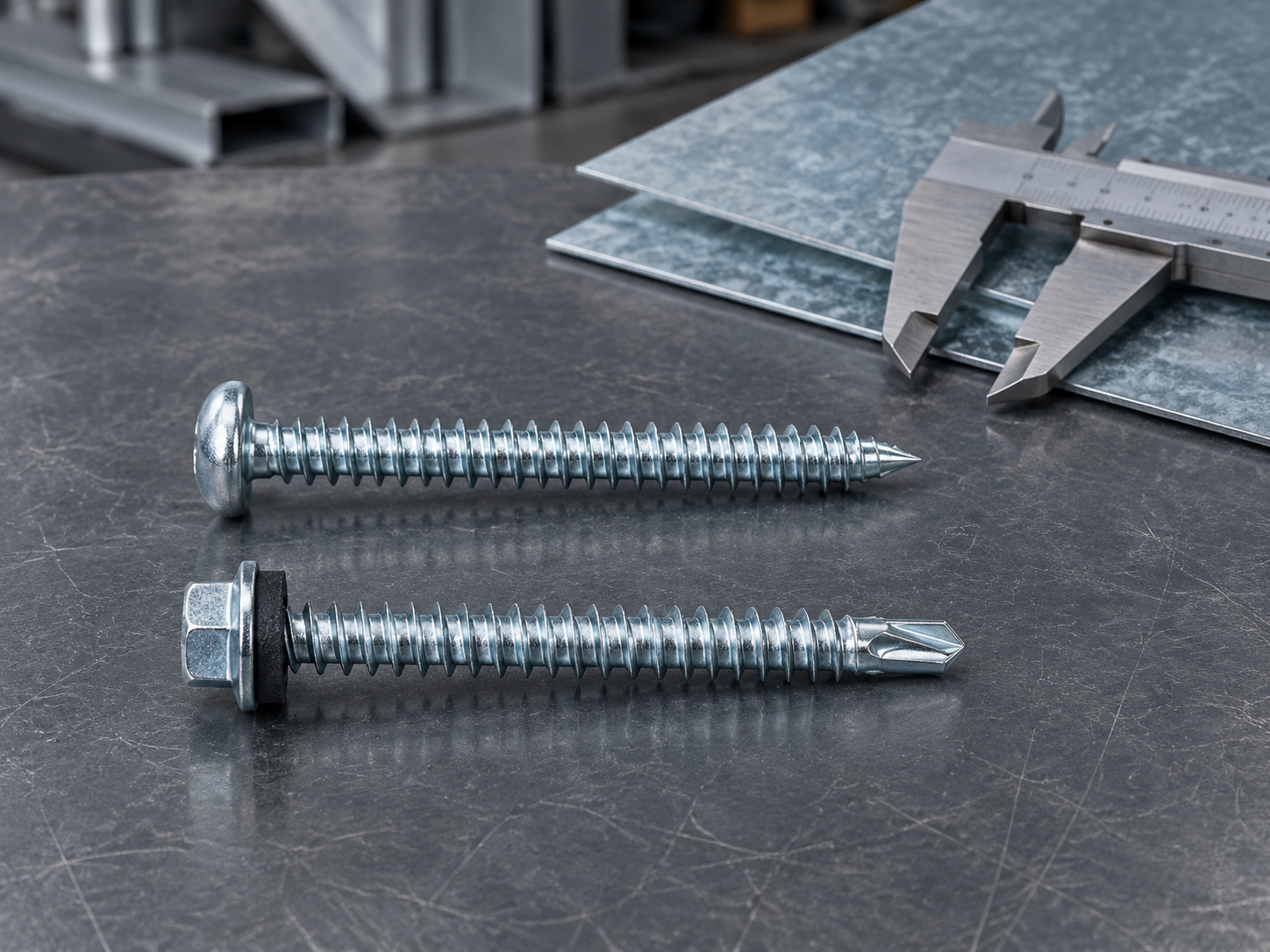
The short answer: the joint decides, not the catalog name
Before a screw can be quoted correctly, three questions have to be answered.
- Who makes the hole? The screw itself (self-drilling), the punch or drill (thread-forming or thread-cutting into a prepared hole), or the screw piercing thin sheet (self-piercing).
- What happens to the material around the thread? It is displaced and compressed (thread-forming), removed as chips (thread-cutting), or both in sequence (self-drilling).
- Does the thread have enough material to grip? Pitch, diameter and length have to match the thickness of every layer in the stack, not just the top sheet.
A 12 mm self-drilling screw with a #3 point, a fine thread and a bonded washer, a Type AB screw with a sharp point, and a Type 17 screw with a cutting point can all be sold as "sheet metal screws." They are not interchangeable. One drills its own hole in 2 mm steel; one needs a punched hole in 0.8 mm sheet; one cuts a thread in stainless or brittle plastic. Put the wrong one in the joint and the screw will still go in — which is exactly why the mistake survives inspection and fails in service.
A note on the 40% figure
The 40% in the title is a diagnostic benchmark, not a published industry statistic.
No ASTM, SAE or ISO standard publishes a global breakdown of field failures by root cause, and no public dataset supports a fixed "40% of all sheet metal screw failures" claim. What the number represents is a pattern seen repeatedly in failure reviews — warranty returns, installation audits, pull-out and strip tests, and callback logs. When a team sorts preventable fastener failures by cause, thread and point mismatch is consistently one of the largest single categories, and in many reviews it lands near 40%.
That share is not universal. It moves with the substrate mix, the product mix, the tools used, installer training and how "failure" is defined. A roofing distributor with one panel profile and one installer crew will see a different split from a fabricator running six substrates across three shifts.
What transfers between projects is the mechanism, not the percentage. If you have your own callback data, replace our number with yours. The diagnostic sequence below still applies — and if thread mismatch turns out to be 15% of your failures instead of 40%, it is still the cheapest category to fix, because it is decided on the purchase order rather than on the roof.
What "sheet metal screw" actually means
In North American trade usage, "sheet metal screw" is a category, not a specification. It describes a family of small screws that form or cut their own mating thread in thin metal. Inside that family sit at least four different mechanisms.
| Trade term | How the thread is made | Hole required | Typical joint | Often confused with |
|---|---|---|---|---|
| Thread-forming tapping screw (Type A, AB, B) | Material is displaced and compressed around the thread | Punched or pilot hole | Thin sheet, plastic, plywood, hardwood | "Self-tapping" in general |
| Thread-cutting tapping screw (Type 17, 23, 25) | Material is cut and cleared as chips | Pilot hole | Heavier sheet, stainless, non-ferrous metal, brittle plastic | Thread-forming screws |
| Self-drilling tapping screw (Tek, DIN 7504) | A drill point cuts its own hole, then the thread forms | None | Steel to steel, panel to purlin, metal to wood | Self-tapping screws |
| Self-piercing tapping screw | A pointed, unfluted point pierces thin sheet, then forms a thread | None | Thin cold-formed steel framing | Self-drilling screws |
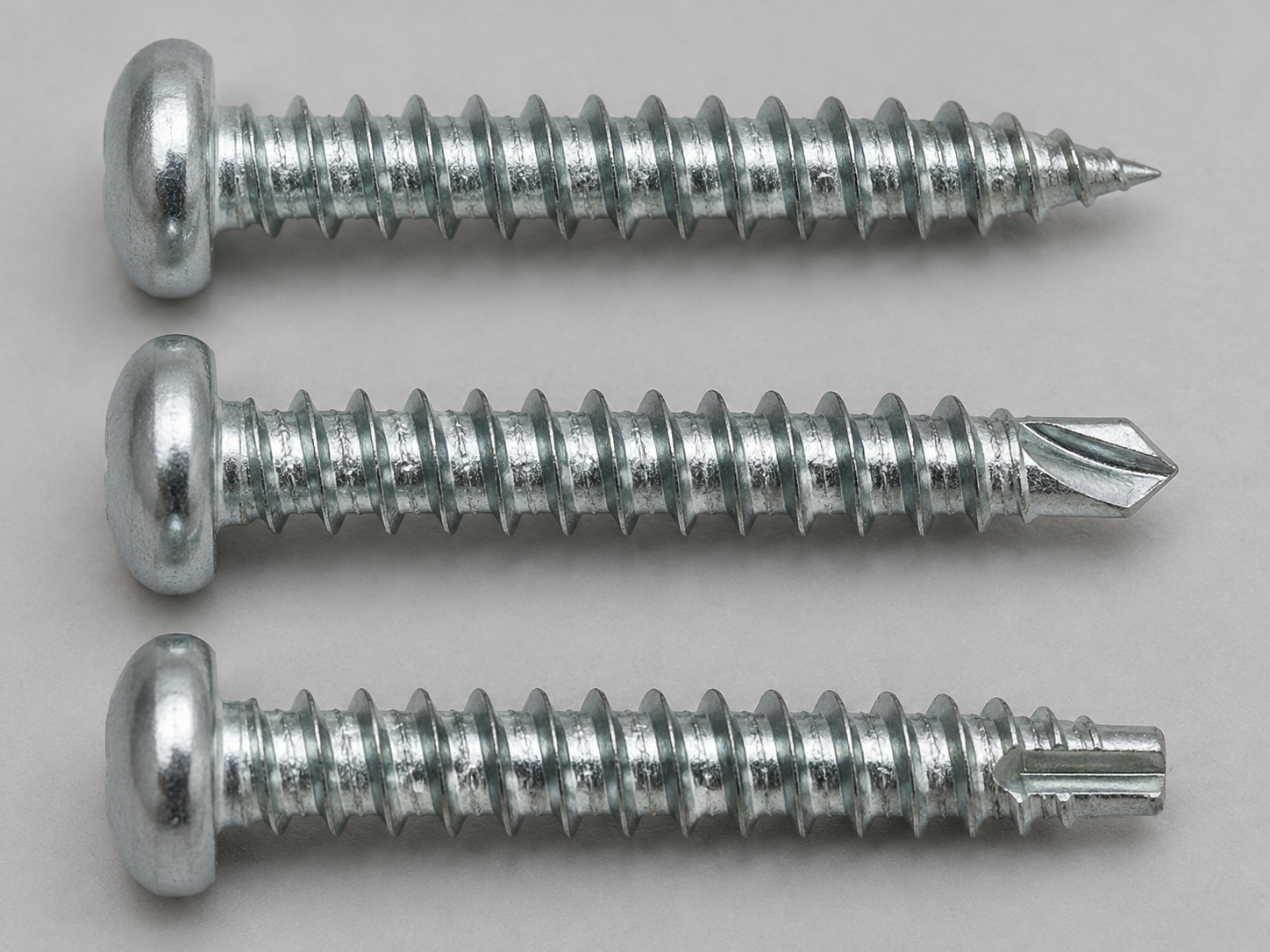
The distinctions inside each row matter as much as the rows themselves.
- Type A has a coarse thread, wide spacing and a sharp gimlet point. It is used in thin sheet (roughly up to 18 gauge), wood and plastic, and forms its thread by displacement.
- Type AB sits between A and B: intermediate thread spacing and a sharp point, used in light-gauge sheet, plastics and plywood. It is the general-purpose forming screw in many catalogs.
- Type B has a finer thread, closer spacing and a blunt point. It is intended for heavier sheet (roughly 18–24 gauge), plastics and hardwoods, and normally requires a pilot hole.
- Type 17 uses a machine-screw thread with cutting edges at the point and is used in stainless steel, non-ferrous metal and plastics, where displacing material risks cracking or high driving torque.
- Type 23 extends the cutting point for thick sheet and castings; Type 25 uses three cutting edges for plastics and brittle materials.
Self-drilling screws are a separate mechanism again. SAE J78, the standard for steel self-drilling tapping screws, covers point Styles 2, 3, 4 and 5, and defines the job as drilling the hole and forming or cutting the mating thread without deforming the screw's own thread or breaking during assembly. ASTM C1513 covers steel self-drilling and self-piercing tapping screws used to connect cold-formed steel framing members. Those are the two standards most often referenced when a US buyer asks whether a screw is "standard."
None of these names is a specification on its own. A DIN 7981 pan head self-tapping screw and a DIN 7504 self-drilling screw can look almost identical in a catalog photo and behave completely differently on the same panel. "Tek" tells you the screw has a drill point; it does not tell you the point size, thread pitch, length or coating.
And a sheet metal screw is not:
- a machine screw, which needs a nut or a pre-tapped hole;
- a wood screw, which has a coarse, tapered thread and a different engagement mechanism;
- a drywall screw, which is a specific bugle-head, coarse-thread screw for gypsum board;
- a concrete screw, which cuts a thread in masonry, not sheet metal.
Using any of those in place of the correct sheet metal screw is the same error in a different costume: the thread was chosen by name instead of by joint. Our guide to sheet metal screw types, specifications and materials covers the catalog side of that choice in more detail.
The four variables that decide whether the screw works
"Thread type" is shorthand for four separate decisions. Each one can be specified, quoted and inspected.
| Variable | What it controls | What goes wrong when it is wrong |
|---|---|---|
| Thread form (forming, cutting, drilling-forming) | Whether material is displaced or removed | Cracking or high torque in brittle/hard material; low strip torque and chips in thin ductile sheet |
| Point geometry (gimlet, blunt, drill point number, cutting point) | Whether the screw can start, drill and seat | Walking, no penetration, over-drilling, damage to the second layer |
| Thread pitch and thread length | How many threads engage and how load is distributed | Stripping, pull-out, incomplete seating, head snap |
| Diameter and length | Bearing area, clamp force, engagement depth | Insufficient engagement, bottoming out, crushed panel, exposed point |
Behind those four variables sit the joint conditions that actually govern them: substrate material and grade, thickness of each layer, total stack thickness, number of layers and gaps between them, how the hole is made and how clean it is, whether the connection is load-bearing, whether it will vibrate or be disassembled, and what environment the fastener will see.
Two screws can share a diameter, a length and a head style and still be wrong for each other's jobs, because the joint — not the catalog page — is the specification.
The five mismatch patterns behind field failures
Most thread-related failures fall into five patterns. They are worth learning because each one produces a different symptom, and the symptom is usually what the buyer actually reports.
1. A thread-forming screw in a brittle or hard substrate
Thread-forming screws work by pushing material aside. In ductile sheet that is an advantage: the compressed material grips the thread and the joint feels tight. In brittle plastic, cast material or hard, thick steel, the same displacement creates hoop stress. The result is a cracked boss, a starred panel, a thread that never fully forms, or a driving torque so high that the head twists off before the screw seats.
The fix is usually a thread-cutting screw — Type 17 or Type 25 — which removes a small amount of material instead of forcing it outward. It costs more per thousand and produces chips, which is why it is often skipped until the callbacks start. The mechanism is compared in detail in our thread-forming versus thread-cutting guide.
2. A thread-cutting screw in thin ductile sheet
The reverse mistake is less obvious. A cutting screw in 0.6 mm galvanized sheet removes the material that a forming screw would have compressed around the thread. With so little thickness to begin with, the result is shallow engagement, low strip torque and a screw that holds on the bench but loosens on the wall.
Cutting screws also leave chips. In a roofing or façade assembly, chips can sit under the washer, interfere with sealing and migrate into the joint. Thin ductile sheet usually wants a forming thread with the right pitch, not a cutting thread.
3. Fine thread in thin sheet, or coarse thread in thick hard sheet
Pitch is where "more threads must be stronger" fails. A fine thread puts more threads per inch, but each one is shallower. In thin sheet there may be only one or two full threads in the loaded material, and the joint strips before the screw reaches its rated strength. A coarse thread engages fewer, deeper threads and is often the better match for thin sheet and softer material.
In thick or hard steel the logic reverses. A coarse thread has to displace or cut a large volume of material per turn, driving torque climbs, and the screw may fail to seat or snap at the head. A finer thread cuts or forms more easily in hard material and distributes load over more turns.
There is no universal "correct" pitch. There is a pitch that matches the thickness and hardness of the material the thread has to hold.
4. Point type or length mismatched to total thickness
The point has one job: get through the stack and stop in the right place. A drill point that is too small for the total thickness will not penetrate, or will burn and dull before it breaks through. One that is too long relative to the stack will drill past the intended member, enlarge the hole, damage a second layer, or leave the thread engaging almost nothing.
Point numbering is covered in our self-drilling drill point chart, and the common reasons a point fails to start are set out in why self-drilling screws fail to drill.
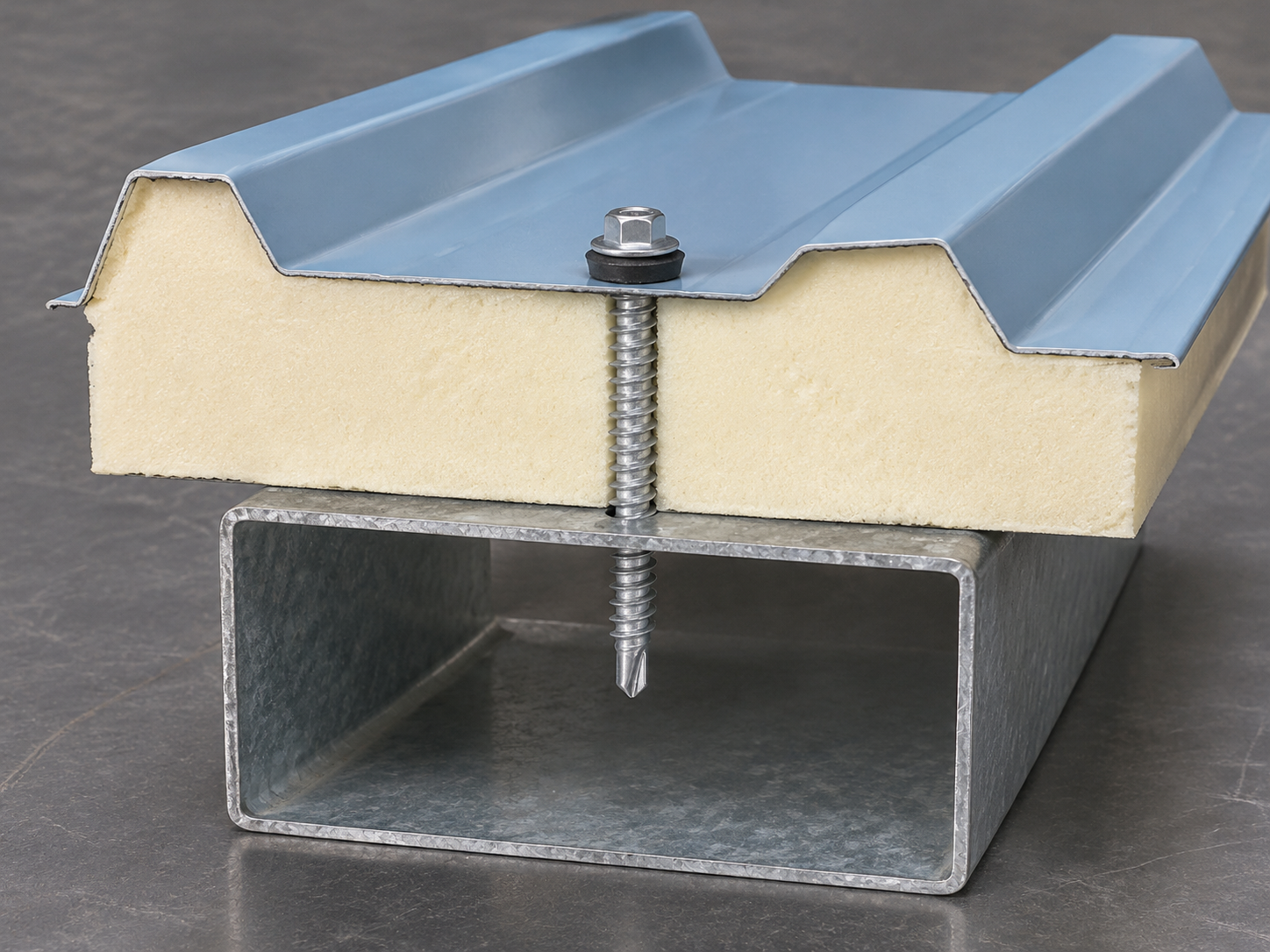
Length has the same failure mode in the other direction. A screw that is too short engages too few threads and pulls out under load; one that is too long bottoms out, leaves the point exposed, crushes insulation or deforms the panel. In multi-layer assemblies — panel, insulation, purlin — the number that matters is the total thickness, not the thickness of the sheet the installer can see.
5. A machine screw used where a tapping screw was required
This one is common in repair and retrofit work. A machine screw needs a nut or a pre-tapped hole. Driven into plain sheet, it will usually start, cut a rough path and then spin. If it does hold, it holds on deformed material rather than an engaged thread, and it will not survive vibration.
The same failure appears when a replacement screw has the wrong pitch for an existing threaded hole: it cross-threads, binds or strips the original thread. In both cases the fastener "fits" the hole and still cannot carry the load.
Thread is not the only variable in a joint — head bearing area, washer compression and coating all matter — but it is the one most often missing from the purchase order, and therefore the one most often left to chance.
A field symptom table: what the failure is telling you
Use this table when a complaint arrives. Start from the symptom, then check the joint, not the screw alone.

| What you see | Most likely mismatch | What to check | What to specify next time |
|---|---|---|---|
| Screw strips before it seats | Fine pitch in thin sheet; cutting thread in ductile sheet; hole too large | Sheet thickness, hole size and method, thread form, pitch | Forming thread with coarser pitch; correct hole diameter; longer engagement |
| Screw spins after seating | Thread stripped; point drilled through the engaged member; screw too long | Total stack thickness, point length, engagement depth | Point sized to stack; shorter or longer screw; confirm engagement in the loaded layer |
| Screw pulls out under load | Too few threads engaged; diameter too small; thin sheet | Number of full threads in the loaded member, sheet thickness, load direction | Larger diameter or coarser thread; longer screw; bearing washer where the design allows |
| Head snaps during driving | Driving torque too high; hard or thick substrate; wrong tool setting | Substrate hardness, thread form, pilot hole, clutch setting | Cutting thread or larger pilot; reduce clutch setting; confirm screw strength class |
| Screw goes in at an angle or cross-threads | No pilot in hard material; wrong pitch for an existing hole; poor access | Hole alignment, hole diameter, thread match | Pilot hole or jig; correct pitch; different drive or head for access |
| Joint loosens under vibration | Low clamp force; stripped thread; no locking feature | Engagement, clamp load, washer compression, vibration source | Correct thread and length; locking washer or adhesive per design; re-check torque |
| Sheet cracks or deforms around the hole | Forming thread in brittle or hard material; hole too close to edge; overdriving | Material ductility, edge distance, thread form, clutch setting | Cutting thread; revise edge distance with the engineer; control seating |
| Water leaks at the fastener | Washer under- or over-compressed; wrong head for the profile; elongated hole | Washer condition, head type, panel profile, installation torque | Correct washer and head; trial on the actual profile; sealing detail per panel maker |
| Point will not start or walks on the surface | Blunt or gimlet point on unprepared sheet; drill point too large; angled surface | Point type, surface flatness, whether a pilot is needed | Self-drilling point for unpierced steel; pilot hole; punch mark or jig |
Two rows in that table are not strictly thread problems — leaks and cracking — but they are where thread mismatch usually surfaces, because the installer compensates by overdriving, and overdriving damages the seal or the panel. The relationship between torque, stripping and seal failure is covered in our installation torque guide.
Why buyers keep specifying the wrong thread type
The errors are systematic, not personal. The same six causes appear in almost every review.
- The catalog is organized by head style and size. Buyers see pan, truss, hex washer and flat head, plus a diameter and length grid. The thread is a filter, not a headline, so it drops out of the comparison.
- "Self-tapping" is used as a synonym for "self-drilling." They are different mechanisms. A self-tapping screw needs a hole; a self-drilling screw makes one. Quoting one against the other produces a screw that either cannot start or cannot hold.
- An old SKU is copied after the substrate changes. A screw that worked in 1.2 mm galvanized steel is re-ordered for 2.5 mm, or for stainless, without re-checking point and thread.
- More threads is assumed to mean more grip. In thin sheet, finer pitch usually means less engagement, not more.
- Quotes are compared per thousand pieces without a thread callout. Two suppliers can quote the same diameter and length with different thread forms, and the lower price may simply be the wrong mechanism.
- The trial is run on the wrong scrap. A test on 1 mm offcut says nothing about 2 mm production steel, and a test by hand says nothing about a clutch-controlled tool at production speed.
Each of these is fixed by one change: make the thread, point and engagement part of the RFQ, not an assumption behind it.
A buyer's selection sequence
The order matters. Buyers who start with the screw family usually end up fitting the joint to the catalog; buyers who start with the joint usually get a screw that works.
- Define the stack. Material and grade for every layer, thickness of each layer, total thickness, gaps, and which layer carries the load.
- Define the hole. No hole, punched, drilled, or an existing thread. Record diameter, burr and alignment.
- Choose the mechanism. Self-drilling if the screw must make its own hole; thread-forming if there is a clean pilot and the material is ductile; thread-cutting if the material is hard, brittle or non-ferrous.
- Choose the point. Drill point number for self-drilling, matched to total thickness; gimlet or blunt for forming screws; cutting point for Type 17, 23 or 25.
- Choose pitch, diameter and length. Enough full threads in the loaded member, enough length for the full stack, and a diameter that gives the required bearing and pull-out resistance without exceeding the panel's edge capacity.
- Choose head and washer. Bearing area, drive type, clearance, sealing and appearance. A large truss head spreads load on thin sheet; a hex washer head with a bonded washer is a roofing detail, not a cosmetic one. The trade-offs are compared in pan head versus truss head.
- Run a trial on production-intent material with production tooling. Then inspect for strips, cracks, washer compression, seating and point exposure. Adjust before the bulk order, not after.
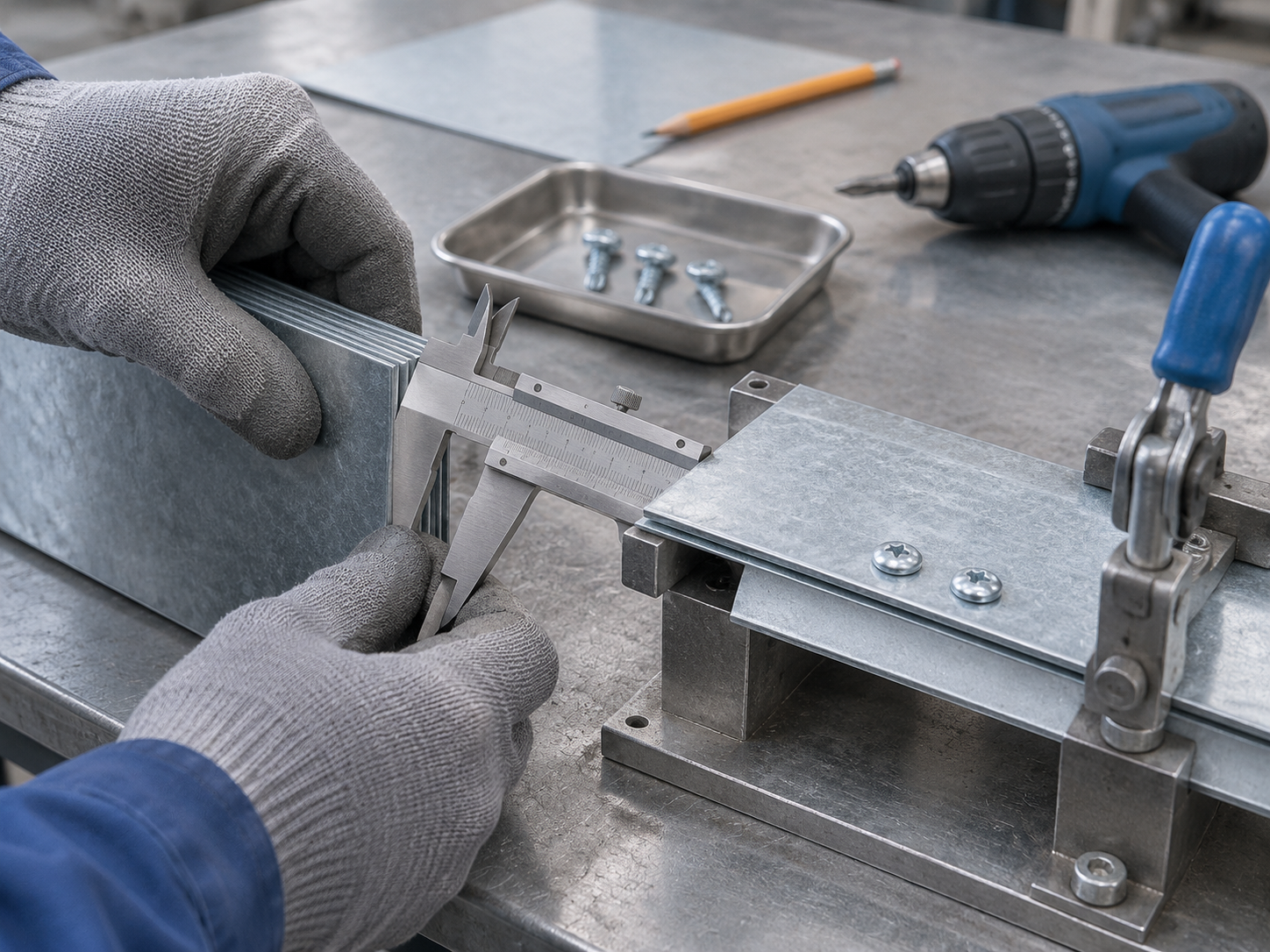
Steps 5 and 6 are where buyers most often want a number from the supplier. Be careful: engagement, spacing, torque and pull-out requirements belong to the connection design, the panel manufacturer or the project engineer. A screw supplier can tell you what a screw is capable of and what it was tested to; it cannot approve someone else's connection.
RFQ checklist: what to send before you compare prices
A complete RFQ shortens quoting, sampling and approval. It also protects the buyer, because a supplier who quotes against a defined joint cannot later hide behind "standard product."
| Field | What to state | Why it matters |
|---|---|---|
| Substrate | Material and grade of each layer | Determines forming vs cutting vs drilling |
| Thickness | Each layer plus total stack | Determines point, length and engagement |
| Hole condition | None, punched or drilled; diameter and burr | Determines whether the screw drills or forms |
| Joint type | Panel to purlin, sheet to sheet, sheet to wood, framing | Determines head, washer and thread |
| Load and service | Static, vibrating, load-bearing, disassembled | Determines diameter, engagement and locking |
| Environment | Interior, exterior, coastal, washdown, chemicals | Determines material and coating |
| Head and drive | Head style, drive type, washer | Determines bearing, sealing and installation |
| Thread and point | Type if known, or the joint data to select it | The core of the specification |
| Standard and sample | SAE J78, ASTM C1513, DIN, or an approved sample | Defines acceptance criteria |
| Volume and packaging | Annual or quarterly quantity, carton, label, pallet | Defines MOQ and price basis |
| Destination and documents | Port, market, certificate or test requirements | Defines compliance and logistics |
| Trial requirement | Sample quantity and trial substrate | Prevents approval by photo |
If you can only send five things, send substrate and grade, thickness per layer and total, hole condition, application and environment, and target quantity. Those five decide most of the thread specification before any price is discussed.
Where ScrewTrade fits
ScrewTrade supplies self-drilling screws and self-tapping screws for metal roofing, steel framing, sandwich panels, HVAC and general sheet metal assemblies. The range includes pan head, truss head and hex washer head self-drilling screws, bi-metal and 304 stainless self-drilling screws, galvanized Class 4 roofing screws, DIN 7981 pan head and hex flange self-tapping screws, plus side lap, stitching and sandwich panel screws for metal roofing.
That range matters because most thread problems are system problems. A roofing screw is not just a thread: it is a drill point, a thread, a length, a head, a washer and a coating chosen together for one panel profile and one purlin thickness. A self-tapping screw for a bracket is the same story at a smaller scale.
We can review a joint as a system — substrate, thickness, hole condition, point, thread, length, head, washer and coating — and quote against a drawing, a sample or a described assembly. Where the joint data is incomplete, we will say which fields are missing rather than guess a specification. Final dimensions, thread, point and coating are confirmed on the quotation and the approved sample, because catalog ranges describe what a range can cover, not what every individual SKU is certified to do.
If you are working on a project with repeated fastening failures, send the substrate stack, the thickness of each layer, how the hole is made, the application, the target quantity and the destination market. We will come back with the screw family, point and length that fit the joint — and a short list of items that need your engineer's or panel supplier's confirmation.
Conclusion: specify the joint, not just the screw
A sheet metal screw is not a commodity defined by diameter and length. It is a thread mechanism selected for a substrate, a thickness and a hole condition. When those are written down, most of the failures in this article never reach the field.
The 40% figure is a prompt, not a law. It says that thread and point mismatch is one of the largest preventable categories in fastener callbacks — large enough to review before the next price negotiation. The mechanism behind it is not mysterious: displacement versus cutting, coarse versus fine, drill point versus prepared hole, total thickness versus screw length.
Three things are worth doing this week:
- Pull the last ten fastener complaints and sort them by symptom, not by supplier.
- Pick the three highest-volume joints and write down substrate, thickness, hole condition and total stack.
- Re-quote those three with a thread and point callout, and run one trial on production material.
That is usually enough to find the mismatch — and to stop paying for it twice.
Related News
Other news you might be interested in
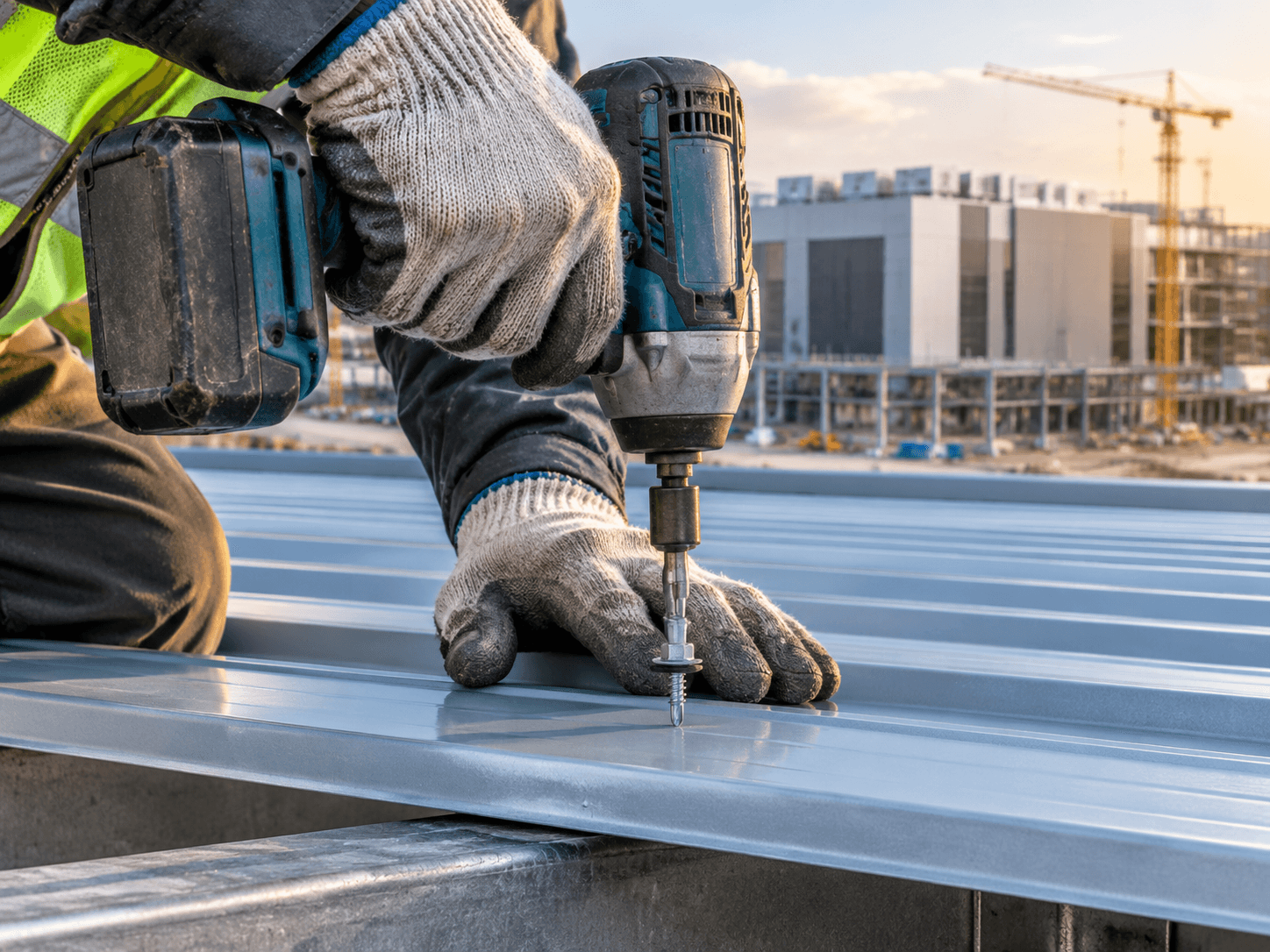
The 2027 Fastener Demand Map: Data Centers, Energy and Industrial Projects
The 2027 fastener outlook is not a broad recovery. It is a map of project pockets—and the strongest pockets are data centers, energy and selected industrial work.The direction is already visible in late-2026 company results. Hilti reported local-currency sales growth of 5.9% in the first eight months of 2026, with double-digit growth in the Americas and Asia Pacific, while describing traditional construction as soft. LISI’s aerospace sales rose 14.3% in the first nine months, but its automotive sales fell 5.2%. Bossard’s third-quarter sales grew 12%, helped by data-center demand in the Americas and semiconductor and electronics expansion in Asia.
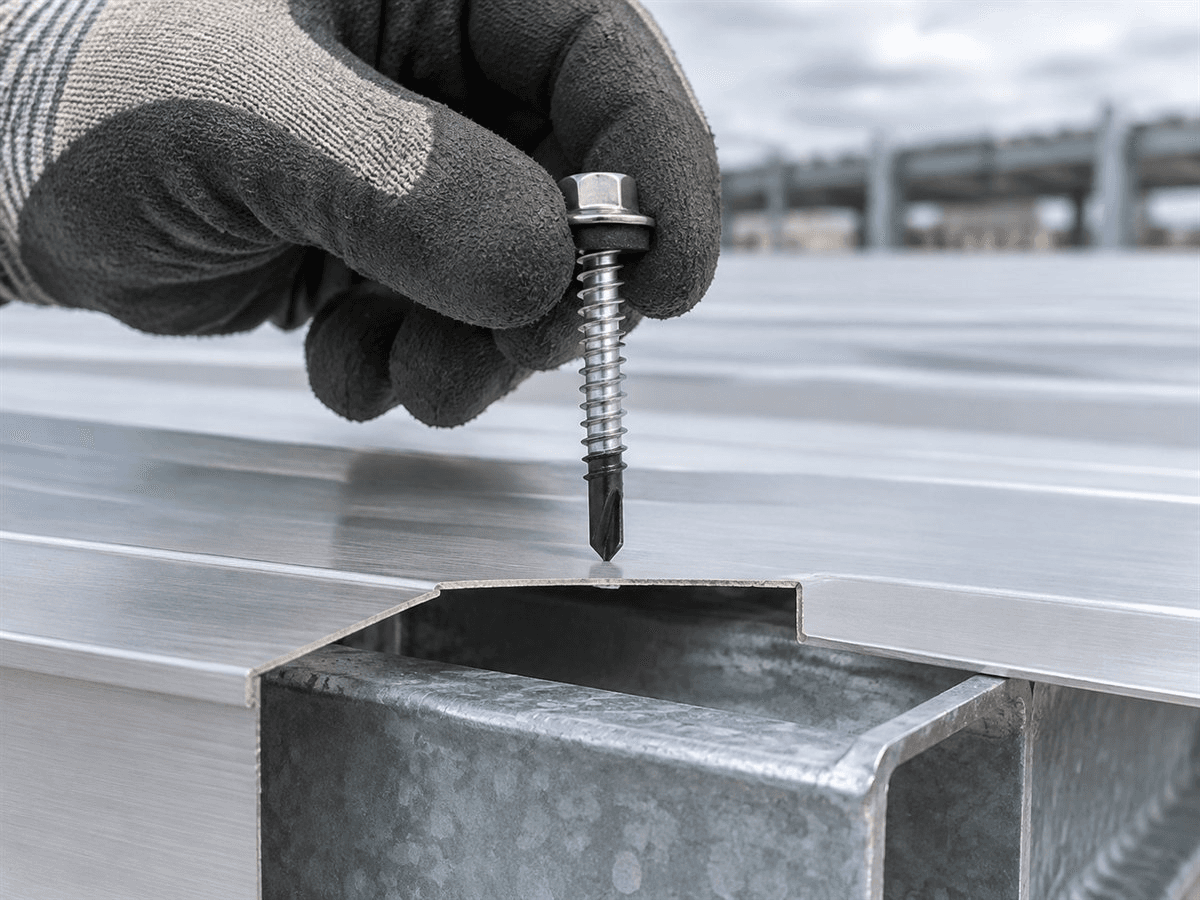
What Is a Bi-Metal Screw and Why Does Aluminum Roofing Need One?
a bi-metal screw is one fastener made from two metals with different jobs. In roofing, the common construction is a stainless steel head and body with a hardened carbon steel drill point and lead thread. The stainless section resists corrosion on the exposed roof; the hardened point drills the steel purlin, girt or frame. Aluminum roofing often calls for this combination when an aluminum panel is fixed directly to a steel substructure, because the panel is soft and corrosion-resistant, but the screw still has to drill steel and survive the weather. Bi-metal is not a guarantee: the stainless grade, point capacity, coating, washer and aluminum-to-steel detail still have to be specified.
Want to know more?
Get in touch with us for more information about our services and products.